Go try it and let us know what you think! 𝚙𝚗𝚙𝚖 𝚒 @𝚕𝚊𝚗𝚐𝚌𝚑𝚊𝚒𝚗/𝚖𝚌𝚙-𝚊𝚍𝚊𝚙𝚝𝚎𝚛𝚜
New to MCP in LangChain? Start here: https://t.co/DQhj0fig3Y
Coming from 1.x? Migration guide: https://t.co/hXkYdcdc02
See the release notes: https://t.co/IvQqMeoRDh
@𝚕𝚊𝚗𝚐𝚌𝚑𝚊𝚒𝚗/𝚖𝚌𝚙-𝚊𝚍𝚊𝚙𝚝𝚎𝚛𝚜 2.0 is out! 🧵
Using MCP with your TypeScript agents up to MCP servers just got a lot simpler: support for the latest stateless version of MCP, tools that can check in with your users when they need something, much easier auth integrations, and a ton of QoL updates.
Here's what's new 👇
Plus a bunch of QOL cleanup to make the adapter easier to build with:
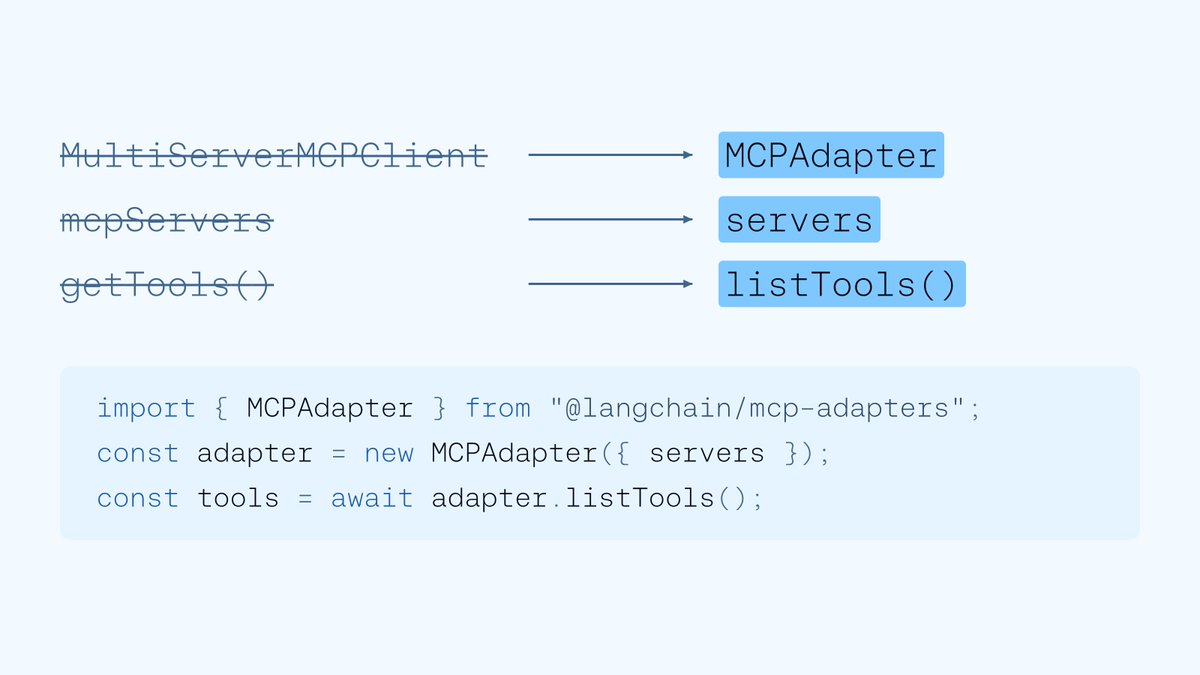
— MultiServerMCPClient → MCPAdapter, mcpServers → servers, getTools() → listTools() (old names still work)
— Tool names carry the server name, so two servers can both expose search
— Tool errors from the server reach the model as error ToolMessages
Starting today, @LangChain’s Managed Deep Agents can bake your agent’s environment at deploy time. 🧑💻
No clone. No install. No repeated setup.
Drop in https://t.co/nRjv44yzSl or a Dockerfile. Bake once. Every new thread starts ready. 👇
Starting today, a @LangChain's Managed Deep Agent deploy provisions your Slack app for you 🤯
No manifest. No OAuth redirects. No bot tokens to copy around.
One command, and your agent says 👋 in Slack.
An agent is 3️⃣ layers.
👉 Business logic you write.
👉 A harness that runs the loop.
👉 Infrastructure that survives production.
@hwchase17 breaks the whole stack in one video.
https://t.co/dGgwa5YsR6
Managed Deep Agents is just getting started 🚀
@hwchase17 just published a set for banger videos that get you up to speed how shipping production agents today looks like.
In Managed Deep Agents skills load in two steps, which is why a lean SKILL.md works.
The prompt keeps the name and description. The body opens when the task matches.
https://t.co/qMMcS0MhnB
Mention the agent in Slack. It runs. It replies in the thread.
Managed Deep Agents treats Slack as a channel file: channels/slack.py. Mentions, DMs, and follow-ups start a run as the caller and post the answer back. No bot server to stand up either.
https://t.co/NIzSDwvUlT
You don't stand up an agent. You upload a folder.
Claude Code is a harness for your laptop. Managed Deep Agents is a harness for production.
Want Slack? Add a file. Want a daily run? Add a file. Want memory? Add a file.
LangSmith runs the harness.
https://t.co/xEUE3mg0v9
We’re launching Managed Deep Agents today 🎉👀
https://t.co/juC4QZVdKG @LangChain
The goal posts for building agents have moved.
Giving an agent tools, deploying it somewhere, and putting a UI in front of it isn’t the hard part anymore.
The next challenge is everything around the agent: identity, memory, credentials, permissions, and securely connecting it to the services your users already use.
This beta release is just the beginning and our foundation what is about to come next 🚀
this blog covers 6 common workflow patterns we see with dynamic subagents (fanout and synthesize, adversarial verification, etc)
if you'd prefer to learn w/ a video, check out this excellent guide from @colifran_ with examples and trace walk throughs!
Plugged the new @shadcn chat components into @LangChain_JS Deep Agents and one-shotted a full code review agent.
One reviewer per file, local sandbox, streaming live. Wild how fast this was 😍
🧑💻 full demo: https://t.co/8LwjdGkpXZ
Alex recently joined the @LangChain_OSS team, and he published his first article on how Deep Agents uses prompt caching to cut API costs.
Give it a read, and give @its_ao a follow!