📌 MMAT | MMTLP | TRCH
Meta Materials Inc. Bankruptcy
Case No. 24-50792-gs (Chapter 7)
Document No. 2870
Filed: June 12, 2026
⚖️ Summary:
Judge Gary Spraker granted the Trustee’s request for shortened time, allowing an expedited hearing regarding DTCC subpoena compliance and protective order administration. The order does not decide the DTCC dispute itself—it simply puts the matter before the Court on an accelerated schedule.
🚨 HEARING SCHEDULED:
📅 June 16, 2026 💥
🕤 9:30 AM PT
💻 Remote Zoom Hearing
⚠️ Not Legal Advice. For informational and entertainment purposes only.
💥💥May 27, 2026 marked a
LANDMARK PROCEDURAL VICTORY!
🦋⚖️ $MMAT / TRCH / MMTLP
In re Meta Materials Inc. Chapter 7 Bankruptcy — Case No. 24-50792
On March 6, 2025, the Trustee served nine subpoenas seeking trading and market data from:
📌 Charles Schwab
📌 TD Ameritrade
📌 TradeStation
📌 DTCC
📌 Nasdaq
📌 FINRA
📌 Citadel Securities
📌 Virtu Financial
📌 Anson Funds
⚡ All parties are now complying or moving toward EXPEDITED compliance under individualized protective orders governing sensitive trading data and confidential information.
📆 Upcoming calendar of events shown in the graphic below.
📚 This case is becoming a significant example of a Chapter 7 Trustee strategically leveraging the Bankruptcy Code’s powerful discovery and investigatory tools to pursue potential estate claims and maximize value for creditors.
⚠️ Not Legal Advice
Detailed infographic below and song attached.
https://t.co/HE77dAvkwO
📣📣JUDGE IN MMAT MMTLP TRUSTEE HAS A RIGHT TO INVESTIGATE 🚨🚨
The MMAT MMTLP Bankruptcy case is settling a very important Precedent for bankrupting Companies for profit.
Bankruptcy is no longer no question asked protection for criminals.
IMPORTANT DATE
"📅 JUNE 25, 2026
The Judge ordered Citadel, Virtu, and Anson to PRODUCE:
📊 Market-wide trading data
📈 For the 161-day schedule identified by the trustee
📂 Under the Rule 45 subpoenas
unless modified by the protective order."
@kimkep4796 you are doing an amazing job 👏
This Is Big
Major Court Ruling Against
“🏢 Citadel Securities
🏢 Virtu Financial
🏢 Anson Funds
These firms tried to QUASH (block) the bankruptcy trustee’s subpoenas seeking trading data tied to:
📈 $MMAT
📈 $TRCH
📈 $MMTLP 📅 JUNE 25, 2026…
The Judge ordered Citadel, Virtu, and Anson to PRODUCE:
📊 Market-wide trading data
📈 For the 161-day schedule identified by the trustee
📂 Under the Rule 45 subpoenas
unless modified by the protective order….”
- @kimkep4796
🦋⚖️ $MMAT / $MMTLP — Meta Materials Inc.
⚖️ U.S. Bankruptcy Court, District of Nevada
📄 ORDER ON MOTION TO QUASH
📅 Filed: May 27, 2026
⚠️NLA
🚨 BIG PICTURE — WHAT JUST HAPPENED?
Judge Gary Spraker just issued a MAJOR ruling against:
🏢 Citadel Securities
🏢 Virtu Financial
🏢 Anson Funds
These firms tried to QUASH (block) the bankruptcy trustee’s subpoenas seeking trading data tied to:
📈 $MMAT
📈 $TRCH
📈 $MMTLP
The Judge said:
❌ The subpoenas are NOT being fully thrown out.
✅ The trustee CAN obtain important trading records.
⚠️ BUT there will be strict protective-order limitations.
⸻
🧠 LAYMAN’S TERMS
The trustee believes there MAY have been market manipulation or wrongful conduct connected to Meta Materials trading activity.
The trustee is trying to determine:
🔍 Was trading activity harming the company?
🔍 Did it impact fundraising?
🔍 Did it damage the bankruptcy estate?
🔍 Are there potential legal claims worth pursuing before statutes expire?
The Judge basically said:
“The trustee has the right to investigate.” ⚖️
⸻
📌 THE COURT EMPHASIZED RULE 2004 IS VERY BROAD
The Court repeated that Rule 2004 examinations are basically:
🎣 “Fishing expeditions”
📂 Broad investigative tools
🔎 Used to uncover wrongdoing or estate assets
The Judge cited multiple cases saying trustees can investigate third parties to determine whether wrongdoing occurred.
⸻
🚨 HUGE PART — THE COURT ACCEPTED THE TRUSTEE’S THEORY ENOUGH TO ALLOW DISCOVERY
The trustee identified:
📊 11 separate “events”
where Meta or Torchlight allegedly:
💰 Sold treasury shares
📉 Issued dilution
📈 Raised capital
📄 Issued warrants/acquisition stock
during periods where the trustee claims trading manipulation may have affected pricing.
The Non-Parties argued:
❌ “Meta wasn’t actually selling into the manipulated market.”
❌ “The trustee lacks standing.”
❌ “This is too speculative.”
Judge Spraker was NOT persuaded enough to stop discovery. 👀
⸻
⚠️ VERY IMPORTANT — THE JUDGE DREW A LINE
The Court said:
🛑 This is NOT the stage where the Court decides whether Citadel/Virtu/Anson actually committed wrongdoing.
Instead:
✅ The trustee only needs enough justification to INVESTIGATE whether viable claims might exist.
That distinction matters A LOT.
⸻
👀 THE JUDGE ALSO SHOWED SOME CONCERN
This part is important.
The Court acknowledged concerns that:
⚠️ The trustee’s special counsel is involved in OTHER securities litigation against Citadel and Virtu.
⚠️ Rule 2004 discovery cannot simply become a shortcut for outside litigation.
⚠️ Discovery should benefit the bankruptcy estate — not unrelated lawsuits.
So the Judge imposed guardrails.
⸻
🔒 PROTECTIVE ORDER INCOMING
The Court ordered the parties to negotiate a STRICT protective order.
That order must:
🔒 Limit use of produced data -THIS bankruptcy
🔒 Limit use to trustee-related litigation
🔒 Restrict dissemination of data
🔒 Restrict access to trustee + approved professionals only
🚨 RESPONSE DEADLINE:
📅 June 18, 2026 — Protective order must be submitted to the Court.
⸻
🚨 BIGGEST DEADLINE OF ALL
📅 JUNE 25, 2026
The Judge ordered Citadel, Virtu, and Anson to PRODUCE:
📊 Market-wide trading data
📈 For the 161-day schedule identified by the trustee
📂 Under the Rule 45 subpoenas
unless modified by the protective order.
That is the MAJOR headline here. 🚨🚨
⚖️ WHAT THIS MEANS PRACTICALLY
The trustee now gains access to a significant amount of trading data that the Court believes may help determine:
🧩 Whether viable claims exist
🧩 Whether wrongdoing occurred
🧩 Whether the estate suffered damages
🧩 Whether litigation should be filed before limitation deadlines
This does NOT mean:
❌ Anyone has been found liable
❌ Manipulation has been proven
❌ The trustee automatically wins anything
BUT…
✅ The investigation survived.
✅ Discovery survived.
✅ The Court largely sided with allowing investigation over shutting it down.
SIGNIFICANT legal victory for the trustee!
Strategic meaning
This is significant because the trustee now gets access to:
✅ short interest reporting
✅ TRF trading data
✅ Reg SHO short sale data
Those are core market-structure datasets.
If the trustee finds actionable evidence:
Possible paths could include:
adversary litigation
settlement leverage
additional subpoenas
expanded discovery
claims against third parties
⸻
What this does NOT mean
This order does NOT mean:
❌ FINRA committed wrongdoing
❌ Citadel/Virtu/Anson are guilty
❌ manipulation has been proven
❌ shareholders receive money directly
It means:
The trustee gets meaningful discovery tools to investigate.
⸻
Bottom line
In plain English:
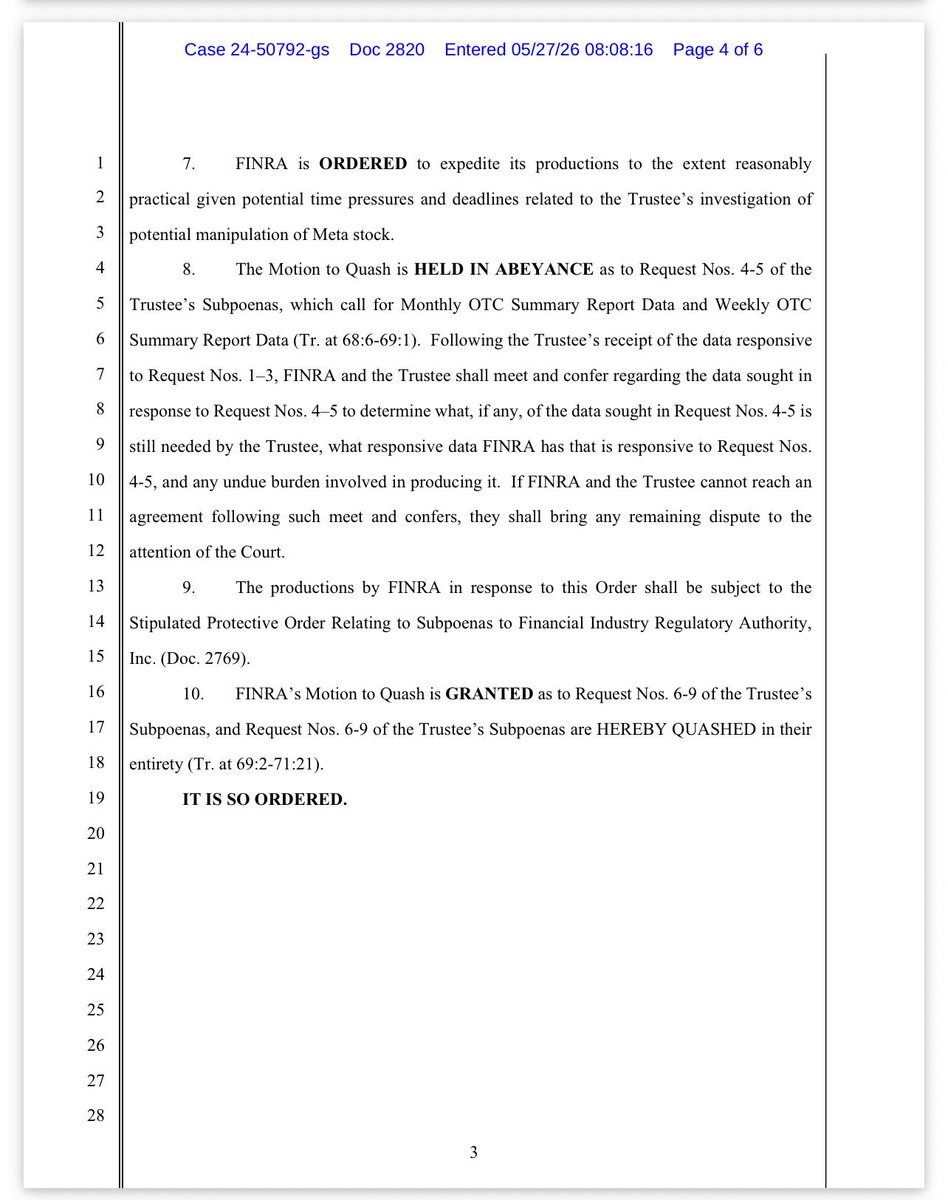
🧨 Judge Spraker told FINRA:
“You can’t fully hide behind burden arguments. Produce the important manipulation-related trading data, move fast, and the trustee will pay reasonable costs.”
For the trustee?
Meaningful win.
For anyone watching the market-manipulation theory?
This is one of the most consequential discovery orders in the case.
MMAT | In re Meta Materials Inc. | Case No. 24-50792-gs | Doc 2820 | Filed May 27, 2026
Order Granting in Part and Denying in Part FINRA’s Motion to Quash Trustee Subpoenas
⚠️ Not Legal Advice
The big picture
This is a major discovery win for the Chapter 7 Trustee.
Judge Spraker basically said:
“FINRA, you do have to turn over important trading/manipulation-related data. But there are limits, and the trustee has to pay certain production costs.”
This order is directly tied to the trustee’s investigation into potential manipulation of Meta stock (MMAT / TRCH / MMTLP).
⸻
What happened in plain English
FINRA tried to block the subpoenas
FINRA asked the court to either:
Kill the subpoenas entirely (motion to quash) OR
Narrow them significantly via protective order.
The judge said:
Not entirely. Some yes. Some no.
Hence:
“Granted in part, denied in part.”
⸻
What the Trustee WON 🥇
1) Short Interest Data — PRODUCE IT
FINRA must turn over reported short interest data.
That includes:
TRCH + MMAT
Sept. 21, 2020 → Aug. 21, 2024
MMTLP
June 28, 2021 → Dec. 14, 2022
Layman’s meaning:
This shows what broker-dealers were reporting as short positions.
This helps answer:
Was short interest unusually elevated?
Did reported short positions match actual market behavior?
Were there anomalies around key events?
⸻
2) TRF Data — HUGE 🧨
FINRA must produce Trade Reporting Facility (TRF) data.
Same date ranges.
This is likely one of the most important parts of the order.
Why?
TRF captures off-exchange / OTC reported trades, often associated with internalized trading / market maker activity.
Layman’s translation:
If the trustee is investigating alleged manipulation, this is where some of the most meaningful footprints could live.
Judge even ordered:
FINRA must expedite production due to time pressure.
That’s important.
⸻
3) Reg SHO Daily Short Sale Volume Data
FINRA must produce this too.
Same date ranges.
This helps show:
Daily short sale activity
Short-sale patterns
Whether activity spiked during sensitive periods
Not proof of wrongdoing by itself.
But valuable puzzle pieces.
⸻
Timing priority (important) 👀
📆FINRA agreed to prioritize production in this order:
MMAT 2023
MMAT 2024
MMAT 2022
MMAT 2021
Then TRCH
Then MMTLP
Why that matters:
The trustee likely wants the most actionable data first given statute/time pressure.
⸻
Judge explicitly referenced manipulation investigation
This is a key line.
Judge ordered FINRA to move quickly because of:
“potential manipulation of Meta stock.”
That’s notable.
This is not a finding that manipulation occurred.
But it confirms the court recognizes the trustee’s investigation as legitimate and time-sensitive.
⸻
Requests put on HOLD (not denied yet)
Requests 4–5:
Monthly OTC Summary Report Data
Weekly OTC Summary Report Data
Judge said:
Let’s wait.
Reason:
The trustee may get enough from Requests 1–3 first.
If more is still needed, the parties must meet and confer.
If they still fight, they can come back to court.
Translation:
This door is still open.
⸻
What FINRA WON
Requests 6–9 were QUASHED entirely.
Meaning:
FINRA does NOT have to produce whatever those categories were seeking.
So this was not a total trustee sweep.
⸻
Costs — trustee pays
Because FINRA is a nonparty, Rule 45 cost protections apply.
Meaning:
If producing the data is expensive or burdensome:
the trustee pays the production costs.
This matters because FINRA had argued massive burden.
The judge basically said:
“Produce it—but the estate can shoulder the cost.”
⸻
Protective order remains in place
Anything produced stays under the existing protective order.
Meaning:
This data is not automatically public.
It’s controlled discovery material.
So no—this does not mean shareholders get to immediately see raw trading records.
I know that @Maximus711474 actually reads documents.
For those who do not, their dangerous and misleading commentary about the order is another signal of their ignorance and/or desperation to protect their patrons, while running their influencer/faked-shareholders-for-hire little business they are running for professional ambulance chasers.
For the record:
1. The Court did NOT say MMTLP is “irrelevant”. In fact, the order references MMTLP multiple times.
2. The Court DID authorize BROAD production of #MMAT/TRCH trading data, including:
-all orders
-executions
-cancellations
-replaces
-order attributes
-RASH/CORE data
across nearly FOUR YEARS which is extraordinary…
Did you know?
NASDAQ did NOT trade #MMTLP (which traded on the OTC), hence they do NOT have ANY MMTLP data to produce… you weird geniuses you! 🤣
3. The Court explicitly REJECTED Nasdaq’s “undue burden” argument and reaffirmed the Trustee’s broad Rule 2004 investigatory powers regarding potential wrongdoing.😎
4. Saying “everything else was quashed” is simply false. Nasdaq LOST the motion to quash in all MATERIAL respects related to the CORE trading data they control! 🦋
And finally, the Trustee is an independent fiduciary appointed by the Court. If the investigation had no merit, the subpoenas would NOT keep surviving judicial scrutiny.
🧐 speculation and opinions have exactly ZERO evidentiary value in court.
Actual court orders do.
$MMAT / $TRCH / $MMTLP 🦋
Case: In re Meta Materials Inc., Bankruptcy Court, District of Nevada
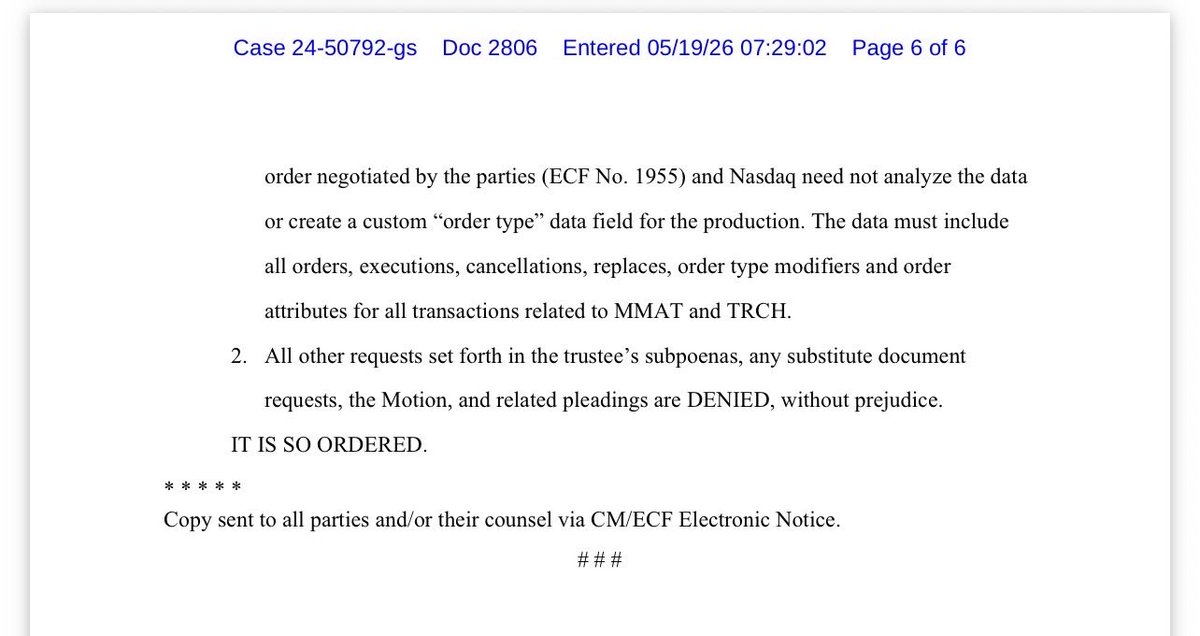
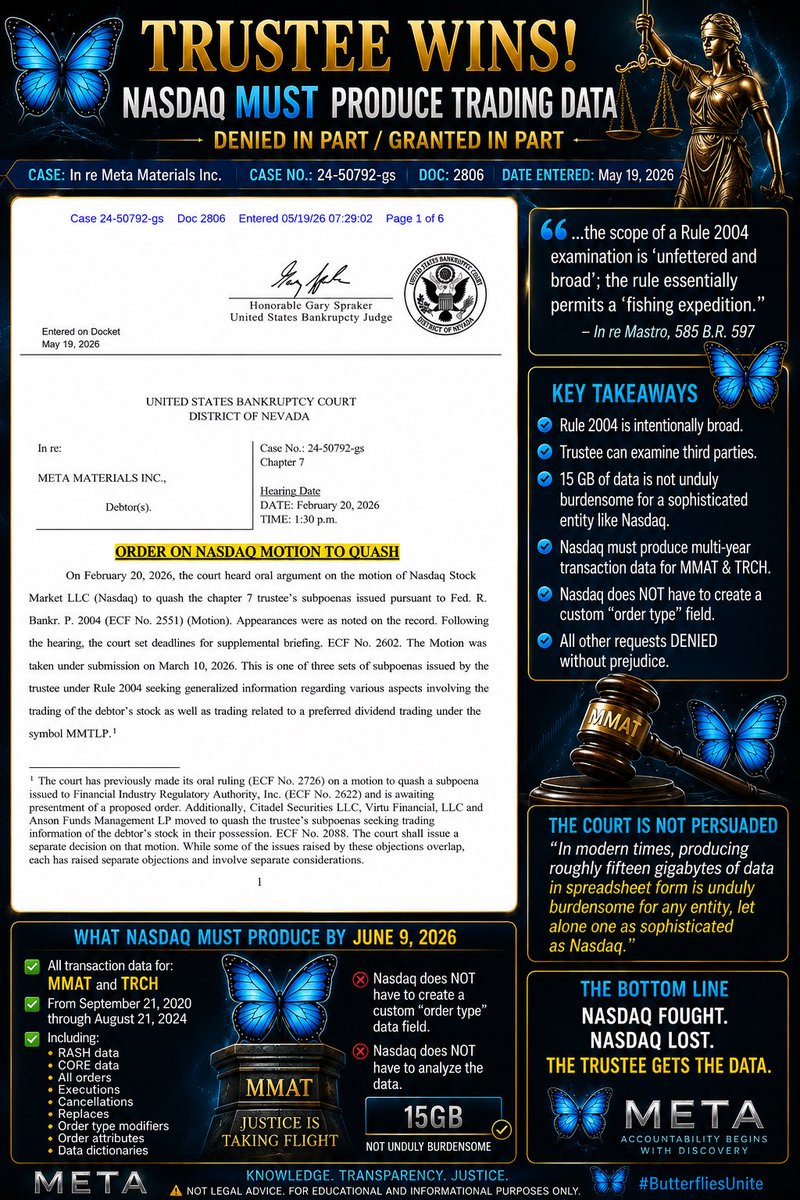
DOC: 2806
Date Entered: May 19, 2026
⚠️ Not Legal Advice
What happened in plain English:
🎣 Rule 2004 = Bankruptcy’s “fishing expedition” (yes, the judge basically says that)
The judge reiterated what he’s hinted at before: Rule 2004 discovery is VERY broad.
Translation:
A bankruptcy trustee gets wide latitude to investigate:
✅ what happened to the debtor
✅ possible wrongdoing
✅ transactions involving third parties
✅ whether there are claims worth bringing for the estate
This is not normal narrow civil discovery. It’s intentionally broad.
⸻
📉 Nasdaq’s argument: “This is too burdensome”
Nasdaq argued:
🛑 The trustee wants too much data
🛑 It would require custom/expert work
🛑 About 4 years of data is too much
🛑 Producing “order type” information would require creating special work product
🛑 Rule 2004 is being used as a pre-lawsuit litigation weapon
⸻
👨⚖️ Judge’s response: Not buying most of it
The judge was blunt.
Big takeaway quote:
“The court is not persuaded that in modern times, producing roughly fifteen gigabytes of data in spreadsheet form is unduly burdensome for any entity, let alone one as sophisticated as Nasdaq.”
That’s a pretty direct rejection. 💥
Translation:
“Nasdaq, you’re a major market operator. Don’t tell me 15GB is impossible.”
⸻
📂 Trustee’s clarification mattered
Judge noted trustee said:
❌ She is NOT asking Nasdaq to create a brand new custom “order type” field
✅ She IS asking Nasdaq to produce existing trade data and identify how order type can be determined from existing fields
That distinction appears to have helped.
⸻
🧱 Nasdaq’s Rule 45 procedural argument failed
Nasdaq argued the subpoena process was improper.
Judge said essentially:
❌ Nope.
Nevada bankruptcy local rules explicitly allow Rule 45 subpoenas in this context.
So that argument went nowhere.
⸻
🎯 Standing / scope argument also failed
Nasdaq argued:
“Third-party stock trades aren’t Meta’s property.”
Judge’s answer:
The trustee presented evidence Meta was issuing stock during the relevant time.
AND…
The trustee identified possible estate claims like:
💰 breach of fiduciary duty
💰 unjust enrichment
💰 professional malpractice
Meaning:
This isn’t just curiosity—it could directly affect the estate.
That makes Rule 2004 discovery appropriate.
⸻
🧠 Pre-litigation concern (Nasdaq had one valid point)
The judge acknowledged Nasdaq’s concern:
Rule 2004 cannot be abused just to get a free head start in litigation.
BUT…
He ultimately deferred to the trustee’s business judgment.
That’s important.
Translation:
“Yes, I see the concern—but I’m not stepping in here.”
⸻
👀 Prior production hurt Nasdaq’s credibility
This is a sneaky but important line.
Judge notes Nasdaq already produced 6 months of data previously.
Translation:
“If you already produced similar data, it’s harder to argue further production is impossible.” 💥
That undercuts Nasdaq’s burden argument significantly.
⸻
THE ACTUAL ORDER 📜
NASDAQ MUST PRODUCE BY JUNE 9, 2026 ⏰
Nasdaq must produce transaction data for:
✅ MMAT
✅ TRCH
Date range:
📅 September 21, 2020 → August 21, 2024
Including:
📊 RASH data /CORE data
📊 data dictionaries / all orders
📊 executions / cancellations
📊 replacements / order type modifiers
📊 order attributes
BUT:
❌ Nasdaq does NOT have to create a custom new “order type” field
⸻
Denied? “All other requests” in the subpoena package were denied w/out prejudice.
That means:
🚪 not necessarily dead forever
🚪 trustee may potentially narrow/repackage later
⸻
Practical takeaway 🦋
This is a meaningful trustee win.
Nasdaq fought production. Nasdaq lost the core fight.
The trustee gets a multi-year transactional dataset—exactly the kind of raw market data that can be used for forensic analysis.
The judge imposed guardrails, but the headline is clear:
Nasdaq must produce. 📈⚖️🦋
🚨Breaking news: 🦋
@Nasdaq just LOST its Motion to Quash.
Read that again s l o w l y . . .
The Bankruptcy Court in Nevada has now ordered Nasdaq to produce extensive $MMAT/TRCH trading data under Rule 2004, including RASH and CORE data, order attributes, cancellations, replaces, executions, and related transaction records covering nearly FOUR YEARS.
The Court was NOT persuaded by the ‘undue burden’ argument, noting that producing ~15GB of spreadsheet data is not exactly impossible for… Nasdaq. (One $10 usb stick)
Even more important, the Court explicitly recognized the Trustee’s AUTHORITY to investigate whether wrongdoing occurred on behalf of the estate, including potential claims tied to stock trading activity.
Translation:
This investigation is very much ALIVE.
For months, some people mocked and undermined the Trustee’s efforts, claimed discovery would never happen, and acted like every subpoena didn’t get served initially and that it would be crushed before daylight. Instead, the wall keeps cracking.
FINRA discovery.
Now Nasdaq discovery.
And the Court explicitly referenced separate pending motions involving Citadel, Virtu, and Anson.
Interesting times ahead.
Turns out Rule 2004 is not just a decorative suggestion.
To the Trustee and legal teams, incredible respect.
It takes courage to walk into rooms filled with institutions that have virtually unlimited resources and say:
‘Produce the data’
And to the echo chambers already warming up their spin machines tonight…
You may want to read the actual order first. 🤝
Blessings to all.
@JKash000@JtB_easy Homes lost, marriages ruined and nothing but obstacles and indifference from the very agencies set up to protect investors from Wall Street predators.
@JKash000@JtB_easy Cynthia was one of those affected just like tens of thousands of other Mmtlp investors whose wealth and retirements disappeared on December 9, 2022. Included many veterans, many elderly. Some who committed suicide.