His Excellency, President for Life, Field Marshal Al Hadji Doctor Idi Amin Dada, VC, DSO, MC, Lord of All the Beasts of the Earth and Fishes of the Seas...
The Tungwarara-Matinyarare and Mliswa-Chivhayo controversies over the weekend were loud, emotional, and messy. They were also, beneath all of that, among the most useful intelligence exercises the Zimbabwean social media space has produced in years - entirely by accident.
What has emerged from the wreckage is a clear categorisation map.
The episodes stripped away the usual ambiguities and forced every actor to reveal themselves. We can now identify the Information Mercenaries with precision - their synchronised messaging, their payroll footprints, the external interests they mask as conviction. We can see clearly those who hold their ground on principle, who remain disciplined and unambiguous in their alignment with the President and ZANUPF. We can trace the real opposition actors who have been celebrating every moment of the friction and discord. And we can now read, in high resolution, the deeper layer - who hates whom, and why - grievances and allegiances older than these particular episodes.
What unfolded was an inadvertent surfacing of information that subjects would not ordinarily disclose and in some cases actively conceal. The blunt mechanics of human nature under emotive pressure revealed it all.
The terrain is now well-mapped.
Interestingly, there are the politically confident and astute who chose to ignore the drama entirely, relegating it to a mere sideshow. Those are probably the true movers and shakers in the grand scheme of Zimbabwe's politics.
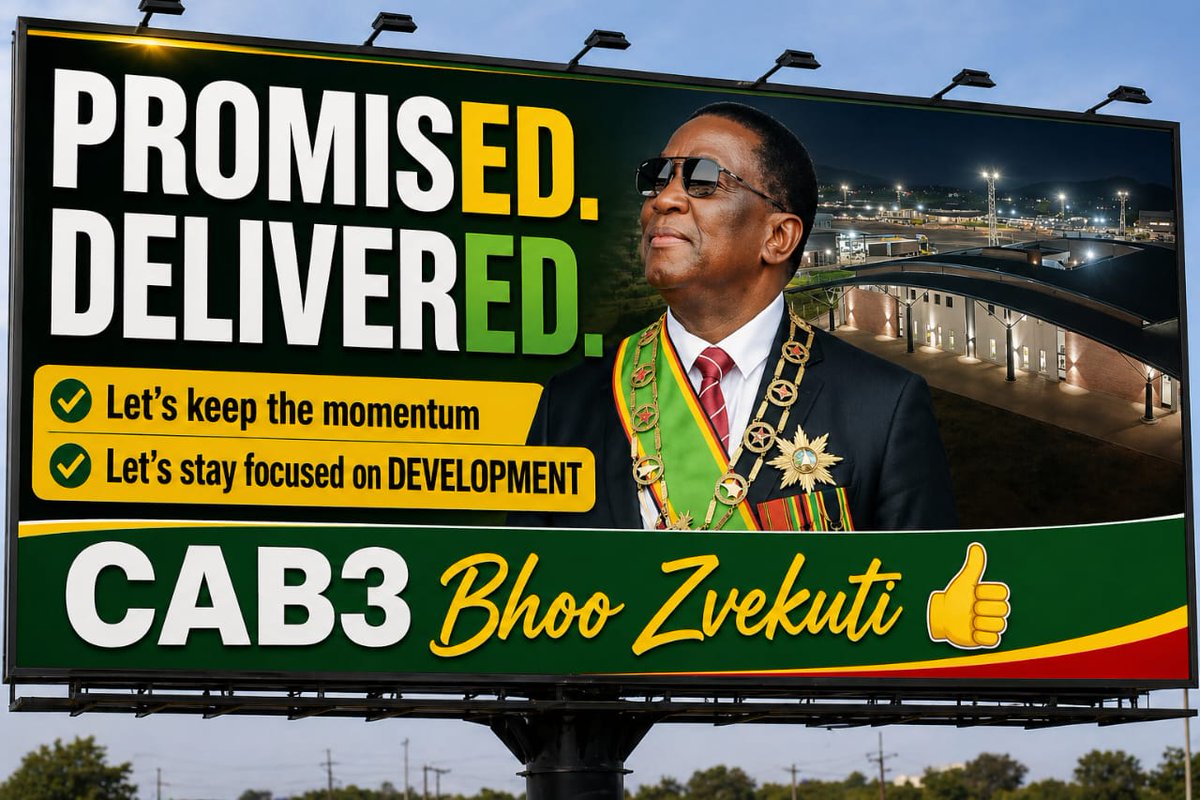
CAB3 arrived in the National Assembly on a mandate built submission by submission, constituency by constituency, across a country that understands the difference between noise and numbers. Minister Ziyambi Ziyambi tabled the Bill before Parliament on Tuesday following Cabinet approval, gazettement in February, and a nationwide public consultation programme that generated over 500 000 submissions - one of the most participated-in legislative processes in the country's history. Critics who confused Twitter trending topics with genuine civic participation missed the entire exercise.
The Bill's proposals are substantive. Presidential, Parliamentary and local authority terms extending from five to seven years. A parliamentary model for Presidential election. Reforms to electoral administration and constitutional institutions designed to strengthen governance architecture and support policy continuity through to Vision 2030. These are not cosmetic adjustments - they are structural interventions in how Zimbabwe governs itself across generations.
ZANUPF holds the majority in both Houses. Arithmetic. Constitutional amendment requires legislative muscle, and the muscle exists. What opponents are really objecting to is not the process but the outcome they cannot stop.
Democratic legitimacy has never been the property of the loudest voice in the room. It belongs to the verified, the counted, the constitutionally consequential. Half a million submissions clear that bar by a distance.
The Bill has had its First Reading. The debate will follow. The votes are there. The people already spoke.
Everything else is commentary.
Zimbabwe has quietly crossed a major healthcare threshold, and the significance of this moment deserves more than a passing mention in a government bulletin.
The final batch of multi-energy radiotherapy machines has arrived in the country, meaning that the kind of advanced cancer treatment which once forced ordinary families to drain their life savings on flights, accommodation and foreign hospital bills is now accessible on home soil - at Parirenyatwa, at Mpilo, and soon at Gweru Provincial Hospital.
What makes this particularly noteworthy is the funding mechanism. The Government drew from revenue generated by the Sugar Tax introduced in the 2024 National Budget, which is precisely what progressive fiscal policy should look like - taxing a demonstrable health risk to directly fund a health solution.
For thousands of patients who either languished on waiting lists or quietly gave up because treatment was financially beyond reach, the calculus has fundamentally changed.
Zimbabwe keeps the foreign currency, keeps the patients, and keeps the dignity of treating its own people.
That is governance with intent.
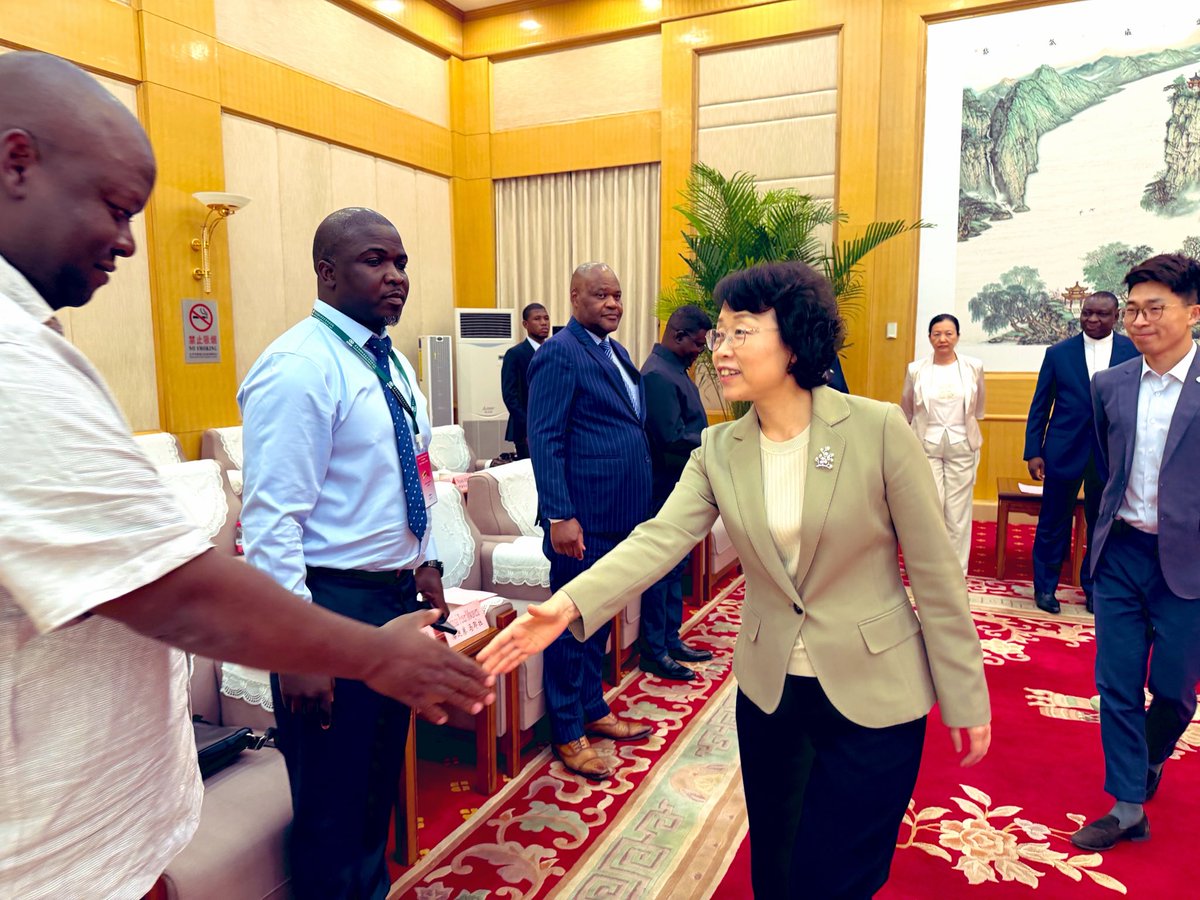
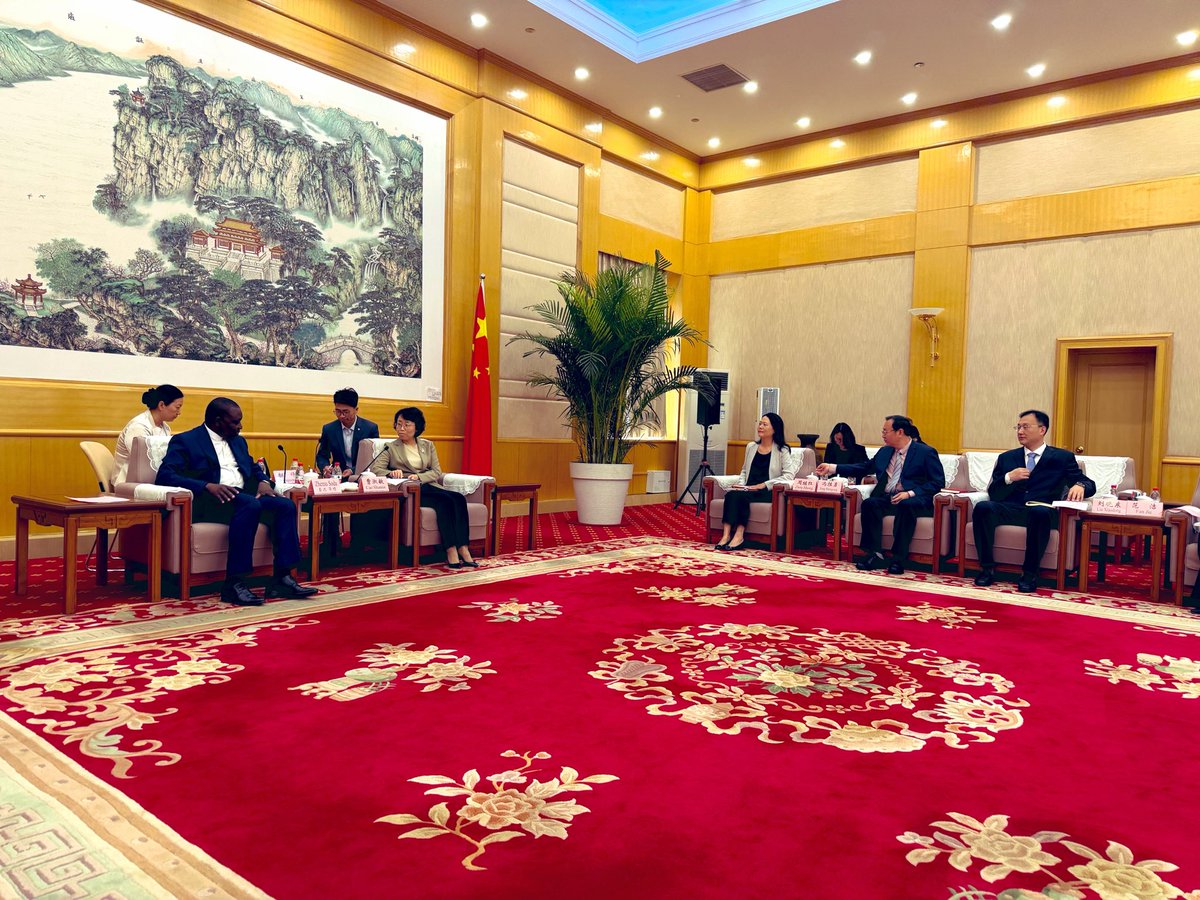
Today, I had the distinct honour of participating in a highly productive engagement led by Zimbabwe’s Hon. Minister of Information, Publicity and Broadcasting Services, Hon. Soda Zhemu, with the Minister of the National Radio and Television Administration of the People’s Republic of China, H.E. Cao Shumin.
The discussions focused on strengthening Zimbabwe-China cooperation in the areas of broadcasting, television production, content sharing, digital media development, and technical and professional skills exchange within the media sector.
The Chinese delegation included senior officials from the National Radio and Television Administration, among them Director-General of the Television Drama Department, Mr. Feng Shengyong; Director-General of the International Cooperation Department, Ms. Zhou Jihong; Deputy Director-General of the Publicity Department, Mr. Liu Xiaodong; Deputy Director-General in the Department of Management of Online Audio-Video Contents, Ms. Fan Jie; and Director of the External Relations Division, Ms. Qi Xiaochao.
Accompanying Hon. Soda Zhemu on the Zimbabwean side were Zimbabwe’s Ambassador to China, Her Excellency Ambassador Abigail Shoniwa; Minister Counsellor at the Embassy of Zimbabwe in China, Mr. Pedzisai Peter Mwayera; the Chief Director in the Ministry of Information, Publicity and Broadcasting Services, Mr. Jonathan Gandari; ZBC News and Current Affairs Director, Mr. Effort Magoso; and myself.
The engagement reflected the deepening strategic partnership between Zimbabwe and China, particularly in the fields of media cooperation, communication infrastructure, content development, and the exchange of professional expertise between the two nations.
Here is a free lesson in Political Science 101.
If you want to discredit someone, do not - under any circumstances - write report after report declaring them unstoppable.
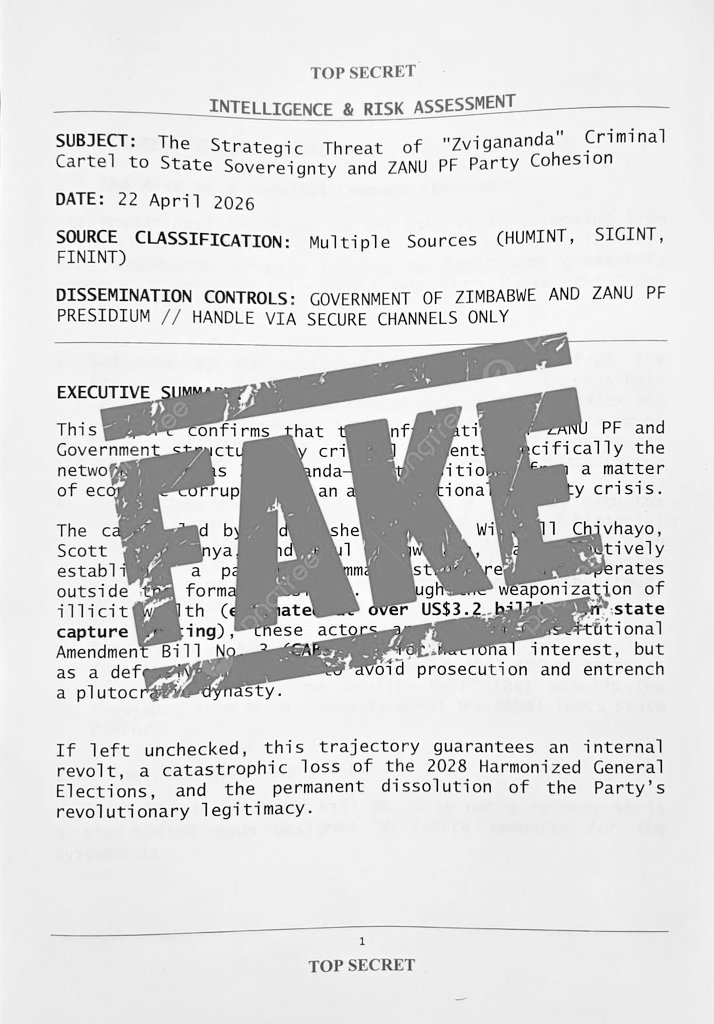
Yet that is precisely what these so-called intelligence documents shared by @LynneStactia on her X (Twitter) handle have accomplished. In one report, the "Zviganandas" have captured the military. In the next, they own the intelligence services. Then ZANU-PF itself, the Central Committee, the Presidency, the whole Government. And now - USD 3.2 billion at their disposal.
Congratulations. You have just made them invincible legends.
No rational Zimbabwean reads that pile of claims and thinks "someone must stop these people." The only logical conclusion available is: NOBODY CAN.
This is the law of unintended consequences in its most embarrassing form. You aimed for discreditation. You delivered mythology.
Effective psychological operations require discipline and strategic intelligence. What this operation reveals instead is poor coordination, zero editorial oversight, and a complete absence of strategic thinking.
You do not defeat an enemy by making them invincible on paper.
You have not exposed the Zviganandas.
YOU HAVE CROWNED THEM.
Ndangoti tionesane.
Ndatenda.
Cde Chinamasa Said 'Prove Me Wrong' on Liberation History and CAB3 - No One Has
There is a peculiar intellectual dishonesty at work among the loudest critics of Constitutional Amendment Bill 3. Faced with a substantive constitutional debate, they have chosen to fight a phantom - brandishing historical documents as weapons while fundamentally misreading what those documents actually say. Worse, in their rush to weaponise the liberation struggle, they have inadvertently exposed their own shallow grasp of the history they claim to defend.
Cde Chinamasa's central claim deserves to be stated clearly and evaluated fairly: that the precise mechanism by which a President is selected - whether by direct popular vote or by parliamentary mandate - was never a settled ideological commitment of the liberation struggle. His critics, armed with photocopied pages of the 1973 Mwenje No. 2 ZANU Political Programme and the 1963 ZANU Policy Statement, believe they have demolished this argument. They have not. They have, in fact, confirmed it.
Reading What the Documents Actually Say
Examine the Mwenje No. 2 document that critics thrust forward so triumphantly. It states that every citizen of Zimbabwe shall have the right to exercise a free vote to elect members of the National Assembly and all other state institutions. This is a guarantee of universal franchise - the foundational democratic right that colonialism denied to black Zimbabweans. It is a statement about who gets to vote, not a constitutional blueprint for how an executive is structured.
Similarly, page 65 of the 1963 ZANU Policy Statement - the other favourite exhibit - declares that the only franchise the ZANU republic would recognise is one based on one man, one vote. Read that sentence carefully. It speaks to the basis of franchise, not the architecture of executive selection. "One man, one vote" was the battle cry against a racist weighted voting system that reduced black Zimbabweans to political nonentities. It was a demand for equal citizenship - a rejection of the colonial order in which black skin meant zero representation. It was never, in any of its iterations, a technical prescription for how an executive president should be chosen.
To argue that these passages mandate a direct presidential ballot is to commit a category error of breathtaking proportions. A document demanding that all citizens have the right to vote does not, by logical necessity, specify that those citizens must vote directly for a president rather than for representatives who then form a government. Such an interpretation would disqualify virtually every parliamentary democracy on earth - including South Africa, Botswana, Germany, India and the United Kingdom - from claiming fidelity to the principle of popular sovereignty. Are we prepared to argue that Botswana, which has never held a direct presidential election and remains one of Africa's most stable democracies, has betrayed its people? The suggestion is absurd.
The 1987 Precedent Cuts Both Ways
Critics lean heavily on the 1987 constitutional amendment, arguing that ZANU-PF's own move to introduce direct presidential elections proves the party was always ideologically committed to this model. But this argument backfires with considerable force. If a democratically elected Parliament could legitimately introduce direct presidential elections in 1987 - based on evolving national priorities and the imperative of post-Gukurahundi national unity - then the same constitutional logic permits Parliament to reconfigure that arrangement in 2026 based on equally pressing developmental imperatives. The critics cannot simultaneously celebrate 1987 as a democratic triumph and declare 2026's parliamentary process illegitimate. The constitutional mechanism is identical. The principle is the same. Only the political convenience has changed.
Moreover, the 1987 shift was itself a pragmatic response to specific historical conditions - principally the need to transcend the regional and tribal fractures that had nearly torn the young nation apart. Edison Zvobgo, one of the sharpest legal minds ZANU ever produced, argued persuasively that a nationally elected executive would be accountable to the whole country rather than to sectional interests. That was a valid argument for its time and context. But arguments are not eternal laws. Circumstances evolve. Constitutions, by their very nature, are designed to accommodate that evolution. The 1987 Parliament understood this. So does the 2026 Parliament.
The Cde Chinamasa Challenge Stands
Cde Chinamasa challenged his critics to produce, from pre-independence archives, any evidence that the liberation movement debated and resolved the specific question of whether the president should be elected directly or by parliament. The response has been to produce documents that speak to universal suffrage and majority rule - principles which nobody disputes and which CAB3 does not touch. Not a single document produced shows the liberation movement convening to debate parliamentary versus direct presidential selection as a distinct and deliberate constitutional question.
Because it was not debated. Cde Chinamasa is correct. The liberation struggle was fought for the right of the majority to govern - full stop. The form that governance would take was always understood to be a matter for free Zimbabweans to determine through their own sovereign constitutional processes, generation by generation. To retroactively inscribe a specific electoral mechanism into that struggle - to claim that the fighters in the bush were dying for a particular ballot format - is not history. It is fabrication dressed in revolutionary clothing.
The Practical Stakes: Development, Stability and the Cost of Division
Beyond the historical argument lies a more urgent question that Cde Chinamasa's critics conspicuously avoid: what are the real-world consequences of the constitutional arrangement we choose?
Zimbabwe's 2023 harmonised elections cost the government in excess of USD 165 million to administer - resources that could have built hospitals, funded irrigation schemes, expanded the national road network or equipped rural schools. That is not a trivial sum for a developing economy still clawing its way out of decades of sanctions and economic turbulence. Elections, by their nature, are also divisive events - they inflame factional tensions, suspend developmental focus and redirect national energy toward political contest rather than productive enterprise. The more frequently a country holds high-stakes national elections, the more it pays - not only in direct financial cost but in the incalculable cost of social fragmentation.
Zimbabwe is, by every honest developmental measure, still catching up. The country ranks among the top ten fastest-growing economies in Sub-Saharan Africa, with projected growth of five percent in 2026 and inflation reduced to single digits - achievements that reflect genuine policy discipline and should not be squandered on premature political disruption. The stability that has made this trajectory possible is not accidental. It is the product of deliberate, consistent leadership. Continuity is not an abuse of democracy. In a developing economy, it is often its most important enabler.
Parliamentary systems are not merely a different electoral format - they are architecturally designed for governmental stability. Cabinet is drawn from and remains accountable to the legislature. Policy continuity is structurally protected. The kind of executive paralysis that afflicts directly elected presidencies - where a president and a hostile parliament deadlock over national priorities - is substantially reduced. For a country at Zimbabwe's stage of development, these are not abstract constitutional preferences. They are practical necessities.
On the Question of Democracy
The most intellectually serious objection to CAB3 is not the historical one - which, as shown, collapses under scrutiny - but the democratic one: does a parliamentary selection model dilute popular sovereignty? This is a legitimate question and it deserves a serious answer. Under CAB3, Zimbabwean citizens still vote. They vote for Members of Parliament and councillors. Their elected representatives then exercise a mandate on their behalf - including the formation of government. This is not the abolition of democracy. It is one of democracy's oldest, most stable and most widely practised forms. The franchise is not diminished. It is channelled through representative institutions - precisely the model the liberation struggle's own documents described when they spoke of citizens electing members to all state institutions.
What CAB3 does remove is the spectacle of a fractious, expensive, destabilising direct presidential contest every five years - a contest that, in Zimbabwe's specific political ecology, has historically generated more heat than democratic light.
Conclusion
Those who call Cde Chinamasa a "sellout" for making this argument have substituted insult for analysis. They have waved documents they have not read carefully, invoked history they have not understood fully, and dressed narrow political opposition in the borrowed costume of constitutional scholarship. The liberation struggle deserves better than to be reduced to a factional talking point.
The historical record, read honestly and in full, vindicates Cde Chinamasa's core position. The liberation struggle gave Zimbabwe the right to govern itself. How it structures that self-governance - in ways that best serve its people's development, stability and prosperity - is, and always was, a question for each generation of free Zimbabweans to answer for themselves.
This generation's answer is CAB3. And it is a defensible one.
I spent my early years in Sanyati, Kadoma. I learned at Chiguvare Primary School and later did my secondary education at Sanyati Baptist High School. That’s why I’m still active in several local whatsapp groups from the area.
One of those groups has recently uncovered the truth: Knox is not a war veteran. He was nowhere near our liberation war. His real surname is Mutimusakwa. He only became friends with Geza when he worked as an ARDA manager in Sanyati.
Right now, he’s hiding in South Africa. Let there be no doubt - the man is an outright phony.
These are the voices that matter - not the hollow, self-serving noise manufactured by social media elites who have turned narratives into a revenue stream.
In the end, it is the quiet, unfiltered verdict from the people on the ground that decides outcomes. It is this enduring disconnect that explains the ritual shock of urban social media circles after every decisive electoral defeat at the hands of ZANUPF.
Nyaya yese iri paground. Pano, it is all performance and echo chambers. Confuse the two, and you will continue to misread the country's politics.
Once you grasp this distinction, you begin to understand ZANUPF politics in its true form.
Uyu ari kutoti tinoda 20 years chaidzo nekuti 2 years ishoma.
Ndatenda.
The Rise of Digital Mercenaries and the Threat to Party Discipline
There is a dangerous illusion taking root on Zimbabwean social media - the illusion that noise is authority, that proximity can be manufactured, and that a following is a substitute for ideological grounding. It is an illusion sustained by noise, but beneath that noise lies something far more serious: an erosion of institutional discipline masquerading as participation.
What we are witnessing is counter-revolutionary digital opportunism - an infiltration eating away at the ideological integrity of ZANU PF from within. The tragedy is that many have mistaken this for harmless activism. It is not. It is a distortion that, left unchecked, fragments authority and replaces institutional clarity with performative chaos.
The modern political communication landscape has been flattened by technology. Today, the cost of entry into public discourse is effectively zero. Anyone with a smartphone can construct an identity, project influence, and claim alignment with power. But what has been lowered is access - not legitimacy. That distinction is where many have failed, deliberately or otherwise.
What has emerged is a class of political mercenaries - individuals who trade in perception rather than principle. They manufacture proximity, curate credibility, and weaponise association. To the untrained eye, they appear embedded. In reality, they are external actors operating without ideological anchor, institutional accountability, or discipline.
Visibility is not, and cannot be, authority. A following built on sensation is a house of sand. Those who brand themselves as ZANU PF without the baptism of ideological rigour will always expose their true nature. They lack the one quality that has defined the movement’s success against colonialism, sanctions, and every other onslaught: discipline.
ZANU PF, by contrast, has never been a creature of noise. It is a product of structure. Its endurance was not forged in digital ecosystems, but in the crucible of struggle, where cohesion was not optional and discipline was not negotiable. That tradition did not disappear with independence - it evolved into a political culture anchored on institutions. Debate is not suppressed; it is structured. It occurs within defined platforms - the Conference, the Congress, and Party organs. Once a position is adopted, it ceases to be personal opinion and becomes collective doctrine.
This is the central misunderstanding of the mercenary class. They interpret discipline as weakness and uniformity as suppression. In truth, discipline is what transforms a collection of voices into a movement. Without it, there is no coherence. Without coherence, there is no direction. Without direction, there is no power.
What we are witnessing now is not dissent. It is distortion. The tactics employed are neither organic nor benign. There is a clear pattern - extortion disguised as influence, ghost accounts deployed to simulate consensus, algorithmic manipulation designed to mislead leadership, and calculated double-dealing where individuals play multiple sides for personal gain. This is not engagement. It is infiltration driven by opportunism.
Left unchecked, such behaviour does not democratise communication - it fragments authority. It creates the false impression that the Party is defined by its loudest voices rather than its legitimate structures. That cannot be allowed to stand.
ZANU PF is not a platform for self-appointment. It is an institution governed by rules, hierarchy, and doctrine. Representation is not seized - it is conferred. Credibility is not declared - it is earned and recognised within the system.
This is precisely why the Party’s Social Media Policy exists - not as a symbolic document, but as a regulatory instrument designed to align digital engagement with institutional discipline. The current moment demands not revision, but enforcement.
Clarity must be restored. Only authorised structures speak for the Party. Any individual operating outside those structures does so in a personal capacity, not as a representative voice. This must be stated plainly, and that distinction must be enforced decisively.
The objective is not to silence participation, but to protect integrity. A movement cannot afford ambiguity about who it is, what it stands for, and who speaks on its behalf. Once that ambiguity sets in, the space is quickly captured by those with the least loyalty and the strongest incentives.
The movement has faced greater challenges than digital opportunism and prevailed because of one principle - unity anchored in discipline. That principle must now be reasserted in the digital arena with the same firmness that defined it in the past.
The era of mercenary communication is not sustainable in a system built on ideological clarity.
The choice is simple. Either the Party defines its voice, or it is defined by noise.
The ideological fortress is not for rent. And history has already shown which path ZANU PF takes.
The controversy surrounding ZANUPF’s grassroots-driven proposal to extend the President’s term to 2030 becomes far less dramatic when examined through the principles of constitutional democracy.
A constitution exists to serve the people, not the other way around. Societies evolve, and with them the priorities, expectations, and strategic needs of citizens. Constitutions therefore include amendment provisions precisely so the supreme law can adapt to the democratic will of the people when circumstances change. Amendment is not a violation of constitutionalism; it is one of its essential features.
Zimbabwe’s Constitution clearly sets out how amendments may be made. Certain provisions require a referendum, while others may be lawfully amended through Parliament. Where the Constitution assigns that authority to Parliament, there is no legal requirement for a national vote. The Constitution also prescribes the necessary parliamentary threshold, ensuring that any amendment reflects a decisive legislative mandate. When Parliament follows this procedure, it is acting squarely within the rule of law.
Zimbabwe is a constitutional democracy founded on legal process and institutional authority. President Emmerson D. Mnangagwa has repeatedly affirmed his respect for the Constitution. Respecting the Constitution includes respecting the mechanisms it provides for lawful amendment. When constitutional procedures are followed, the process is not only legal but democratically legitimate.
It is equally important to recognise where the proposal originated. The discussion did not emerge from political elites. It grew from conversations and sentiments within ZANUPF’s grassroots structures across the country. In representative democracies, grassroots political expression often shapes national political direction.
In this context, we as ZANUPF supporters have no reason to be defensive. A political party that commands a parliamentary majority has the democratic right to pursue the agenda supported by its constituents through lawful constitutional processes. Exercising that majority responsibly is not an abuse of democracy; it is a normal function of representative governance.
Ultimately, the debate about 2030 is not simply about personalities. It is about constitutional procedure, political stability, and policy continuity. Advocating a constitutional amendment through the lawful mechanisms provided by the Constitution is therefore not bending the rules. It is using them exactly as they were designed to be used.
Ndatenda.
The Horse Has Bolted and the Referendum Cry Is a Confession of Defeat
Let us name the strategy plainly, because subtlety is wasted on the willfully obtuse. The opposition’s fixation on a referendum is not a matter of constitutional principle – it is a tactical retreat. They know they cannot stand in the arena of ideas and debate the actual contents of Constitutional Amendment Bill No. 3 with the people of Zimbabwe and win. They know that before the bar of public opinion, their objections dissolve into irrelevance. So they have fled to the procedural trenches, hurling the word “referendum” like a grenade, hoping to blow up the process because they have already lost the argument. Not that they would win a referendum anyway – the overwhelming majority of Zimbabweans have witnessed the brilliant delivery of the Second Republic under President Mnangagwa, and the horse has long since bolted. Nothing now stands in its way.
A constitution is not a corpse to be embalmed by sentimentalists. It is the supreme law precisely because it provides for its own evolution. To argue that amendment is improper is to argue against the very document one pretends to defend. The Constitution of Zimbabwe can be changed, and it will be changed – not as a matter of whim, but as a sovereign act of governance. Every republic that endures understands this: a rigid constitution is a brittle one. We do not seek permission to refine our legal architecture; we assert the right of the state to remain responsive to the shifting demands of development, stability and national will. Those who wail against amendment are not conservators of the Constitution; they are undertakers hoping to bury its utility.
Let us be surgical about the law, because the law is unforgiving. Section 328 of our Constitution draws a clear distinction: certain entrenched provisions require a referendum; all other amendments lie within the exclusive competence of Parliament, provided the prescribed majorities are met. CAB3 falls squarely in the latter category. To demand a referendum where none is legally mandated is not an act of democratic vigilance – it is an act of constitutional subversion. It is an attempt to graft an extra-legal condition onto a lawful process. The irony is scathing: those who shriek loudest about “protecting the Constitution” are demanding that we ignore its explicit provisions on amendment. That is not constitutionalism; it is constitutional vandalism dressed in populist costume.
Why the frantic retreat to procedure? Because the substance of CAB3 reflects the incontestable successes of the Second Republic. Under President Mnangagwa, Zimbabwe has witnessed infrastructural transformation, economic re-engagement and a clarity of governance that renders the old opposition playbook obsolete. The people have seen delivery. They have felt the ground shift beneath their feet. And the opposition knows that in a genuine national debate on the merits of the Bill – on how it consolidates institutional efficiency and aligns our legal framework with the pace of development – they would be routed. So they hide behind the procedural smokescreen, hoping to delay what they cannot defeat.
Let this be recorded: the amendment will pass. The Constitution will be refined, as it has been before and as it will be again. The manufactured noise from the usual quarters will amount to nothing more than a footnote in our march towards sovereign efficiency. The people of Zimbabwe have already chosen momentum over stagnation. The horse has bolted. The law is clear. And no amount of procedural histrionics will turn back what has already been set in motion.
The white man is basically saying Nelson Chamisa has shown up on the dance floor doing his old kwasa-kwasa moves, while the rest of the world has already moved on to amapiano.
In short: the DJ changed, the beat evolved… but the guy is still dancing like it’s 2003. 😂🕺🏾😂
Manje pakadaro ZANUPF inokusiya uchitamba kusvika makumbo adambuka.