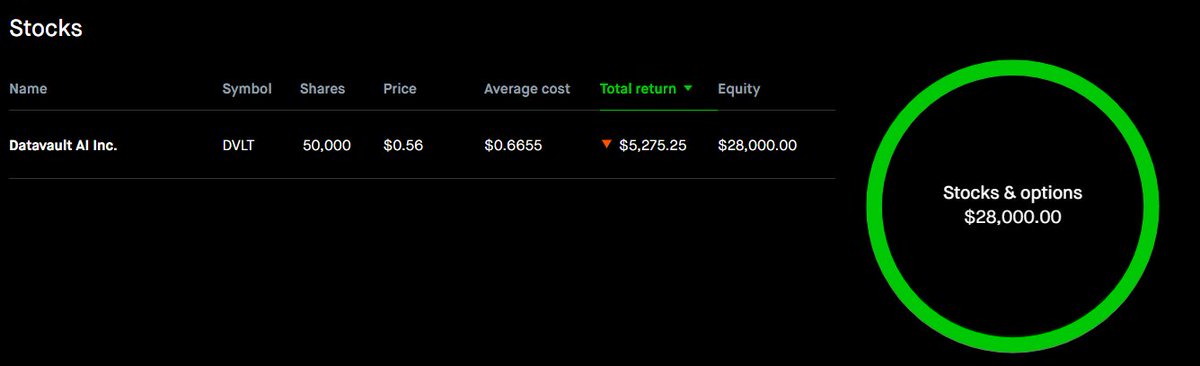
@__jwc16 If they don't hit 200M end of year guidance, so Q1 2027, ill rethink my position in the company. But I am going to wait until then to even consider selling/trimming.
Cutting Through the Noise on the $DVLT 8-K
Let’s look at the actual structural facts of the Helmex deal to clear up the confusion floating around the comment sections/social platforms.
The "Shell Company" Misconception: People are panicking because Helmex was recently registered and lists "no persons of significant control." In international corporate finance, this is standard procedure. Major institutions don't route multi-billion-dollar deals through their main parent companies; they set up a brand-new SPV (Special Purpose Vehicle) specifically tailored to hold that single transaction. The partners listed are other corporate entities, not individuals, which is why individual names don't show up on initial registration lookups.
The Reality of a Reverse Split: If this deal were toxic or designed to screw retail, the fund would be demanding heavily discounted shares to dump on the open market. The official May 30th 8-K shows the exact opposite: the term sheet sets the capital stock purchase price between $1.55 and $2.00 per share. With the stock currently sitting in the $0.40's, an international financier is committing to a structure that values this equity at a 300%+ premium. This premium pricing anchors the underlying value well above the NASDAQ minimums, which fundamentally acts as a shield against a reverse split.
The Control/Board Seat Structure: Yes, as the funding tranches close, the partner can earn majority board representation. This isn't a hostile takeover; it’s a standard requirement for a group bringing an exclusive global tokenization mandate to the table. They want operational oversight because they are legally committing to route their massive digital asset and blockchain pipeline directly through DVLT’s ecosystem.
I am looking at the macro picture, not short-term retail panic. My conviction remains tied to the long-term tokenization thesis and the massive revenue benchmarks ahead. I fully believe this company will execute and be successful. I track this data meticulously—if the fundamentals ever break or if my thesis changes, then I will revisit my position. Until then I will continue to hold.
It's totally fair to be frustrated by the dilution, especially when the messaging six months ago was 'no more funding.' I hear you on that.
The nuance here is that the operational scope changed massively. The cash required to run standard day-to-day operations is completely different from the liquidity required to onboard a $2B tokenization pipeline. They didn't need money for the old model; they absolutely need it for this new one.
Edward Barger from IR confirmed exactly this in your picture 'Can't tokenize without cash on the balance sheet.' To properly tokenize at this scale, they need serious compliance and infrastructure capital upfront. It’s painful in the short term, but it's a necessary bridge to hit those macro revenue benchmarks.
If they don't hit $200M EOY 2026, and $2B revenue in EOY 2027, then you right, but for me, ill keep waiting on that, as long as its true and they do it; I got nothing to worry about, the revenue will follow.
I keep seeing people say DVLT is receiving $25m today, that is not true. Datavault AI $DVLT is paying the $25 million today.
According to the terms of the $2.0 billion structured financing term sheet they executed on May 30, 2026, DVLT has a binding obligation to pay a $25.0 million non-refundable upfront payment by wire transfer by today, June 4, 2026.
What it's for: This payment covers the administrative, operational, and structuring costs for the first tranche of the deal. The total $2.0 billion financing is broken into four successive tranches of up to $500 million each.DVLT will be obligated to fund a similar $25 million expense fee for each subsequent tranche as they move forward.
Making this payment secures their pathway to the massive asset-backed funding, which they intend to use to support their digital asset exchanges, real-world asset (RWA) tokenization programs, and SanQtum GPU network expansion.
This is my pitch for $DVLT in a simple way for retail investors.
What does DVLT do?
Why is it going to be successful?
You know how brokerages lets you buy a tiny $5 fraction of an expensive stock?DVLT is building the secure, global Visa network that lets the financial world do that with anything. Like buying digital of pieces of gold/minerals, real estate, sports, pharama, energy, government and IP data. Because they secure, tokenize, and monetize this data on every single trade, they act like a toll booth on a multi-trillion-dollar highway. As global asset trading shifts onto tokenization tech, that massive transaction volume is what could launch this stock into a infrastructure giant.
@uk3578 Yes they do, currently getting the exchanges going is #1 priority, so the amount of contracts with certain companies are not a lot, but they will be getting ton of contracts after exchanges are all up , volume should explode.
Last week, Datavault announced a massive 5-program RWA deal with Perpetuals to bring tokenized Gold, Copper, & Minerals to global 24/7 trading.
Yesterday, $PDC dropped their 2-week metrics. It changes everything.
Here is why this is huge for $DVLT :
1/ Massive Validated LiquidityPerpetuals' UpsideOnly platform didn't just launch; it went beast mode. In 2 weeks, it pulled 30k users and $4.5B in volume. DVLT's tokens are getting dropped right into a raging torrent of liquidity.
2/ The Perfect AudienceOut of that $4.5B volume, Gold led with $1.4B . Precious metals made up 35% of all activity. Perpetuals' users are actively hungry for commodity trading. Enter DVLT's GoldVault (Q3) and Coppercoin (End of Q2).
3/ Clear Path to RevenueThis isn't a vague "tech partnership." • Targets $328M + in asset issuances across 3 programs. • Generates an expected $38M in direct fees for DVLT. • For a micro-cap with ~$42M in trailing 12-month revenue, this single deal is an absolute game-changer.
4/ Multi-Layered UpsideRemember, DVLT isn't just a tech provider. Under programs like GoldVault, they hold direct equity/warrants in mining ops, collect production royalties, and hold exclusive bullion acquisition rights (projecting ~$40M in profit potential alone).
High Exchange Volume ➔ Surging Commodity Demand ➔ Accelerated Token Issuance ➔ Maximum Royalty/Fee Capture for Datavault.
This bridges DVLT from a patent-rich micro-cap straight into a highly profitable, cash-flowing infrastructure giant for the RWA tokenization boom. Strong piece of the puzzle for their $200M FY2026 revenue target. 🚀
Technically it was 75m that they got from a partnership with $DVLT, so actually they sold 20M last month. So this was already done via the partnership; not really new shares that they just bought; since they got them because of a deal with dvlt.
Vivasor, Inc., identified as a ten percent owner of Datavault AI Inc., executed four open-market sales of common stock between May 4 and May 7, 2026. In total, it sold 20,000,000 shares at weighted average prices around $0.50–$0.58 per share.
These are straightforward open-market sales (code S) of non-derivative common stock, with no options or other derivatives reported. Following the final transaction, Vivasor’s direct holdings stood at 55,942,666 shares, indicating it remains a significant shareholder after the sales.
The footnotes state that prices are weighted averages for trades within defined ranges, and that detailed trade-by-trade data is available on request. The filing does not reference any Rule 10b5-1 trading plan, so the timing appears discretionary based on the information provided.
🚨 $DVLT $2B Financing: Speculation & Connecting the Dots
Hey everyone, now that the dust is settling on this massive $2.0B news, I wanted to share some thoughts on who the mystery counterparty might be.
Since it’s a non-binding term sheet, they haven't named the firm yet, but the press release left some very specific breadcrumbs. The PR states the buyer is a: "UK-based regulated structured institutional investment platform that operates across technology, mining, and real assets."
When you look at the $2 billion scale and those specific sectors (mining and real-world assets), here are the three most logical theories on who is on the other side of this deal:
1. The UK Tokenization Pioneers (e.g., Archax or Zodia)
Because the PR explicitly mentions a UK-regulated platform, the smart money is on firms already fully approved by the UK’s Financial Conduct Authority (FCA) to handle digital assets.
•The Logic: A firm like Archax (the UK's first regulated digital asset exchange and broker) fits the exact profile. They specialize in tokenizing RWAs (Real World Assets) like fixed-income funds. Giving DVLT an exclusive global tokenization mandate lines up perfectly with a major platform trying to scale its infrastructure.
2. Legacy UK Asset Managers (e.g., Abrdn or Schroders)
We need to look at who actually holds massive portfolios in "mining and real assets."
•The Logic: Major UK traditional asset powerhouses like Abrdn or Schroders have been aggressively moving into blockchain and tokenization over the last couple of years. They already own the physical commodities and infrastructure; they need Datavault’s patented platform to wrap those multi-billion-dollar real assets into tokens.
3. UK-Regulated Structures Backed by Sovereign Wealth (GCC/Middle East)
A $2 billion check size is massive for a micro-cap space, which usually points to mega-funds.
•The Logic: It is incredibly common for Middle Eastern Sovereign Wealth Funds (like Saudi Arabia's PIF or Abu Dhabi's ADIA) to route massive tech and infrastructure investments through UK-regulated investment vehicles or Special Purpose Vehicles (SPVs). These funds are currently deploying billions globally to lock down AI and blockchain infrastructure.
🗓️ What to Watch For Next
The real validation comes by June 4, 2026. The term sheet requires a $25 million non-refundable upfront payment by this Thursday. If that cash lands, we know whoever this UK powerhouse is, they mean business.
Let me know what you guys think or if you're diggin' into any other names that fit the UK tech/mining profile!
Honestly, a lull after May 20th isn't too shocking for a stock like $DVLT. Micro-cap volume comes in massive waves and then completely dries up for weeks at a time. It’s just testing everyone’s patience while we wait for the next major catalyst or PR.
One day.. this will change. When we start hitting $1b revenue mid 2027, this will be the opposite imo
News for $DVLT today in easy to understand wording.
A massive investor wants to back Datavault AI with up to $2 billion, and in exchange, Datavault gets a monopoly on all of that investor's crypto/token projects.
Here is the breakdown of the key details:
•The Money: It's a potential $2 billion deal, split into four smaller parts ($500 million each).
•The Catch: It is "dilutive," meaning Datavault will issue new stock to the investor at around $1.55 to $2.00 a share. This creates more total shares, which usually lowers the value of existing shares.
•The Power Shift: If the investor goes through with all four parts of the deal, they might get control of the company's board of directors.
•Is it official? Not yet. It's "non-binding" (like a serious mutual interest letter), but the investor has to prove they are serious by paying a $25 million non-refundable deposit by June 4, 2026.
•Why now? Datavault is growing fast, but need to get to $1 to ease investors, they are aiming to make at least $200 million in revenue for 2026.
100% right on the structure—they aren't walking away with cash, they are getting a bond portfolio to borrow against.
But looking at this as just a way to 'pay bills' misses the scale. You don't pay a $25M upfront fee just to cover operational overhead.
The real strategy here is liquidity leverage. By using that $500M tranche as a collateral base, they can secure massive commercial credit lines to fund the liquidity pools for their upcoming RWA and digital asset exchanges. The $25M is the price of admission to unlock institutional-grade borrowing power that a micro-cap could never get on its own.