I am addressing the question to you, as it concerns what St. Symeon is saying and your ability to comprehend the text.
In case it is not yet clear to yourself, your sensibilities are far closer to Nestorius (cf. 'Letter to Cosmas') than to the fathers of the early church, and in slandering St. Symeon you in particular slander the Syriac fathers and theologians, even those post-Chalcedon. Compare the very passage that offends you to Severus of Antioch (to Anastasia), describing souls as wombs that must be impregnated with the semen of the faith to give birth to their salvation, for but one example.
St. Symeon is heavily indebted to the Syrian fathers, and if we read but only a few pages more of Hymn 15, he wears it on his sleeve by invoking St. Symeon the Stylite and ending in phrasing so *very* near to that of Severus mentioned above that it suggests he'd either read him positively or they shared a common source (see below).
And perhaps you should consider his warning of the danger of hearing these things like a worm that thinks and understands only disgusting things.
@10Kidus@ApostolicOrtho You aren't reading St. Symeon attentively, then, or else you have developed a peculiar eucharistic theology. Do you believe that the whole Adam is deified? Or do you believe the redemption of the whole man is in fact selective?
When you're done putting words in my mouth, you may want to read some more early Greek and Syriac patristic texts and familiarize yourself with their comfort with sexual or sexual-adjacent allusions, be it Jacob of Serugh or St. Romanos the Melodist (particularly relevant as the standard-bearer for Constantinopolitan hymnography, with his fusion of the Syriac tradition into the Hellenic style, which ultimately informed St. Symeon's compositions). Interpreting Jacob or Romanos as pervert-brained says more about the reader than they.
But that is neither here nor there, my point about the source of St. Symeon's account stands.
@KARIMAXXING The 'Dispute Between a Man and his Ba' dates from circa 1900 BC, and is a fairly complex text musing on evil - the author even considers suicide as an escape. "[I] grieve for [the] children who were crushed in the egg, who saw the face of Khenty [death] before they had lived."
@geeg_mp4 Yes, the leavened use is older than unleavened, and is rooted in a different interpretation of the Last Supper (seder vs non-seder where leaven is still eaten before Pesach). Cf. Joseph Jungmann SJ's Mass of the Roman Rite for a brief history of the change in the 7th C.
@oanagnostes@dash_eats Her secretary John of Ephesus corroborates that she came from a brothel as public knowledge. And while Procopius alleged her to be a nymphomaniac (doubtful), in his typical snobbery he also recounts her being trafficked to sodomites at age 8, which would leave a mark on anyone.
@desertcynic And that's not even scratching the surface of the Syrian/Jerusalemite tradition of venerating Samson (his monastery at Beth Shemesh was once a major center - cf John Moschus). Cf also Jacob of Serugh's panegyric on Samson
@desertcynic 2/2killed his daughter, because she met him when he had vowed that he would sacrifice to God whatever first met him as he returned...Samson...is justified only on this ground, that the Spirit who wrought wonders by him had given him secret instructions to do this. -St. Augustine
@byzantinetx Very true, and glory to God! Though it is also a matter of some historical irony that the first book published in the New World was St. John Climacus' Ladder, albeit in Spanish, via the printing press installed in the recently conquered Tenochtitlan/Mexico City.
@Ishodas_Thomman This isn't unique to Indian Christians; the Greek form "Hormisdas" was born by even a 5th-6th C pope. Cf other saints with other pagan-derived theophoric names like Dionysus, Demetrius, Bacchus, Serapion, et al
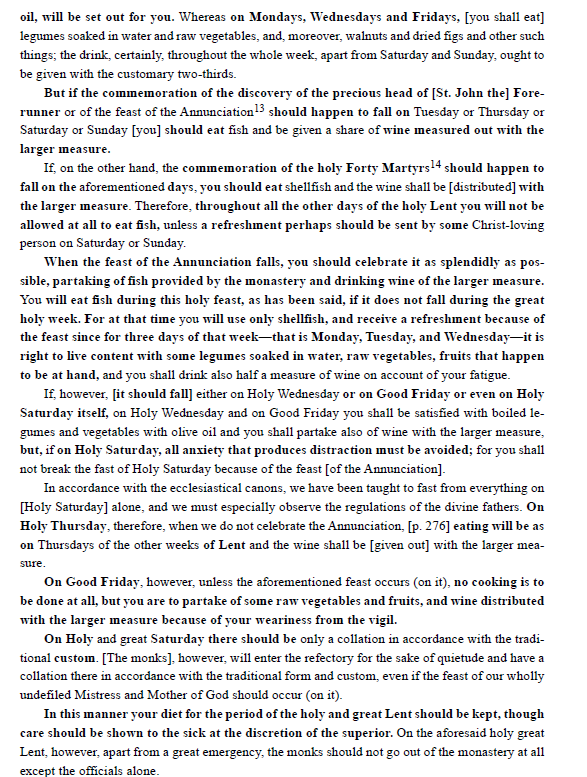
@YoungPenitent@HaiducRomos I should add that it is historical malpractice to take the (highly) abbreviated selections from the various typika at face value when they are quoted in the *liturgical* typika. They are not the same type of document despite the name. For but one example:
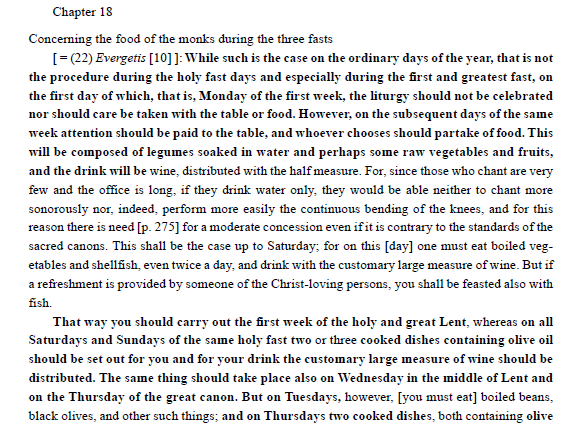
@YoungPenitent@HaiducRomos This is simply not true; monastic typika routinely provided quite detailed (and familiar) dietary instructions, especially of the Sabbaite/Studite line. See Thomas and Hero's "Byzantine Monastic Foundation Documents: A Complete Translation," 2000.
@scottmannion There are ~115 works by St. Mark (under the name Mark Eugenikos) with Ms. sources listed in "La théologie byzantine et sa tradition. Tome II (XIIIe-XIXe s.)" C. G. Conticello; V. Conticello (eds), starting on page 423. Titles are given in Greek and English in that book as well.