Step 1: Launch a coin with a mint address ending in ‘hoLd’. 🔒
On LaunchSafe, built-in safeguards are there from the first second—not added later.
Built to reward holding. Currently in devnet testing. #Solana
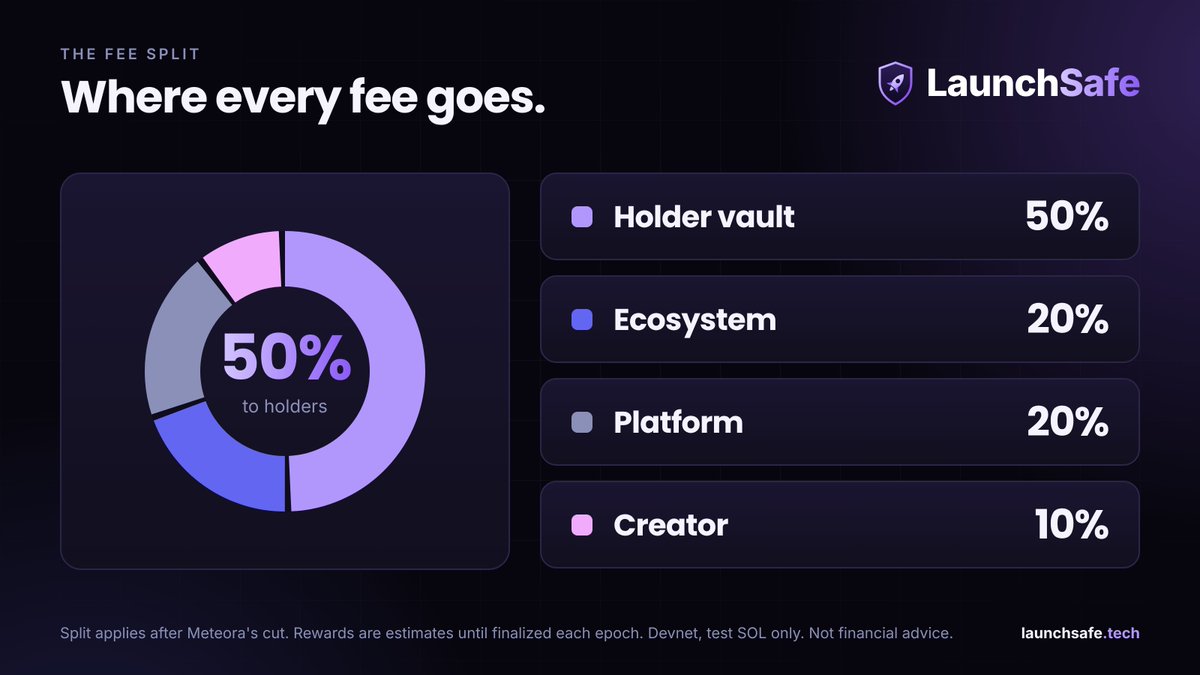
Here's the whole fee split on LaunchSafe, because it's easier to trust a number you can see.
Every fee on a coin is divided four ways, after Meteora takes its cut. Half goes to the holder vault. Twenty percent goes to the ecosystem. Twenty percent goes to the platform. The last ten percent goes to the creator.
The first number is the one I'd look at. The biggest share is set aside for the people holding the coin. How much of that vault you get depends on your holder score, which rises the longer you hold. Someone who has been in a coin for days earns more of it than someone who bought ten minutes ago.
Rewards are published in seven-day rounds, and funded rounds have a separate seven-day wait before you can claim. If you sell, you give up the rewards that apply to what you sold. The amounts you see on the site are estimates until each epoch is finalized, so they aren't a promise.
The creator still earns, with 10% of fees.
None of this changes the risk. A coin can still lose all its value, and a share of fees won't fix that. But you should know exactly where the money goes before you put anything in.
Still on devnet with test SOL.
https://t.co/fNPT0WSMeY
One coin has graduated on LaunchSafe. As I write this, nothing else is bonding.
That's an open board on a launchpad built around holders. The leaderboard ranks coins by average holder score over the last 24 hours, and right now it has exactly one name on it. Diamond.
If you've never launched here, this is how the climb works. Your coin starts on a bonding curve. Anyone who sells in the first 10 minutes after buying pays 20%. That falls to 15%, then 10%, then 5%, and after 24 hours it's the normal 1% curve fee until the coin graduates. Half of every fee goes to the holder vault. When the curve fills, the liquidity moves to Meteora and gets locked for 12 months.
So the thing that gets a coin across the line is holders who don't fold. We even put it on the mascot. HOLDEN's line is "Diamond hands. No folding."
Here's my question. If you could launch one coin on devnet tonight, what would it be called? Name and ticker. Reply with it, then go and launch it, because the second graduate is still up for grabs.
It's test SOL, so it costs nothing to try. Worst case you find out how the curve feels. Best case you're number two.
https://t.co/fNPT0WSMeY
Devnet is where we test, learn, and tighten the bolts. 🛠️
LaunchSafe is building in public: a Solana memecoin launchpad designed to reward holding. Still testing, still refining—come follow the work, not just the hype.
#Solana#BuildInPublic
Something we don't talk about enough on LaunchSafe is that every coin launches under a profile, and the profile sets the rules before anyone buys.
The ones worth knowing: a 1% wallet cap, so no single wallet can scoop up the supply early. An anti-whale sell limit on how much one wallet can sell. And launch fees and locks that are set per profile, so you can see up front what the creator has committed to.
I keep coming back to why this matters. Most memecoin launches are decided in the first few minutes, usually by whoever showed up with the biggest wallet. Caps are a blunt tool, but they make that first stretch more even, and they make it harder for one person to move the chart.
They don't make a coin good. A coin with a 1% cap can still go to zero, and nothing here predicts which ones won't. What the rules do is narrow the ways it can go wrong and put them where you can read them before you buy.
If you launch on devnet this weekend, pay attention to the profile you pick and try to run into the limits. Buy until the cap stops you. Try to sell a big chunk and see what the sell limit does. That's the fastest way to find out whether the numbers feel right, and we'd like to hear if they don't.
https://t.co/fNPT0WSMeY
Discord: https://t.co/6ICG83M4pW
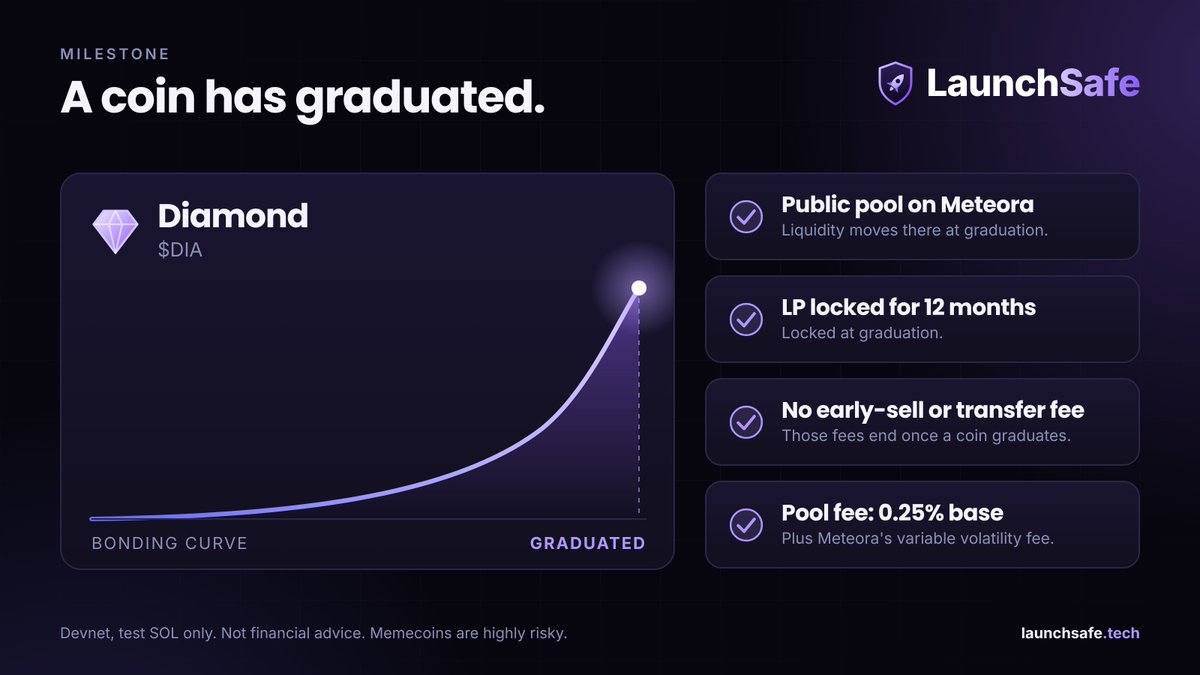
A coin has graduated on LaunchSafe.
It's on devnet with test SOL, so there's no real money involved, but the mechanics are real. Diamond, $DIA, filled its bonding curve and moved into its own pool on
Meteora. It's sitting at number one on the leaderboard, which ranks coins by average holder score over the last 24 hours.
For anyone who hasn't seen what graduation does here, a few things change at once. The liquidity moves to a public pool and gets locked for 12 months. The early sell fee and the transfer fee go away, so after graduation nobody pays 20% or 15% to leave early. The pool charges a 0.25% base fee plus Meteora's variable fee, which moves with volatility.
What I'd like to see next is a second coin. Right now nothing is bonding, so the whole curve is open to anyone who wants to launch and find out how it feels to get one across the line. Launch one, get a few friends to buy in separate lots, and see whether it makes it.
The numbers on the site change by the hour, so check the coin page for where $DIA stands today.
https://t.co/fNPT0WSMeY
Devnet is where we put LaunchSafe to the test. 🛠️
Building a Solana memecoin launchpad that rewards holding means testing, learning, and sharing the process—not just the highlights.
Still testing. Still building. In public.
#Solana#BuildInPublic
Most of how LaunchSafe works comes down to one idea. Time held is what counts.
Every time you buy, that lot starts aging. A buy from last week and a buy from ten minutes ago age separately, and the older one counts for more. Longer holds score higher, and your holder score decides your share of the holder vault. The vault gets half of every fee, which is the biggest share by a good margin.
Rewards open in 24 hour or 7 day windows. Funded rounds have a 7 day wait before you can claim, and if you sell, you lose the rewards that apply to what you sold. Sales take your oldest purchases first, and transfers keep the original purchase time, so moving coins between wallets doesn't reset the clock.
I want to be careful about what the numbers mean. The rewards you see are estimates until they're finalized each epoch. They aren't guaranteed, and prices can fall. Holding earns you a share of fees. It doesn't protect the coin's price.
The leaderboard ranks coins by average holder score over the last 24 hours, so it's a quick way to see where holders are sticking around.
Everything runs on devnet with test SOL for now. If you want to see how a score builds, launch a coin, buy it in a few separate lots and watch what happens over a day. Tell us what's confusing. That's the feedback we need most.
https://t.co/fNPT0WSMeY
Telegram: https://t.co/2uVeVnnJvl
Before you buy anything on LaunchSafe, the coin page shows you a few things you'd otherwise have to dig for. I want to go through them, and also be clear about what they don't do.
Mint authority is checked at launch. If it's revoked, nobody can create new supply later. There's no freeze authority either, so a creator can't lock the coins in your wallet.
Every coin shows the creator's allocation, along with how it's locked and vested. We also flag top-holder concentration when insiders hold 10%, 20% or 30% and above, so a coin where a handful of wallets own a big slice looks different from one that's spread out.
When a coin graduates, its liquidity moves to a public pool and the LP is locked for 12 months. Each coin also runs on a launch profile with its own buy caps, launch fees and locks, so the rules are visible before you put anything in.
I'll say the next part plainly. None of this makes a memecoin safe. These checks reduce some specific risks, like a creator minting more or freezing wallets. They don't stop a price from falling and they don't guarantee returns. A coin can pass every check and still go to zero.
What they do is make sure you're deciding with the facts in front of you. If something on the page is unclear, or you think a check is missing, we'd like to hear it. We're on devnet with test SOL, which is a good time to find the gaps.
https://t.co/fNPT0WSMeY
Discord: https://t.co/6ICG83M4pW
A lot of people see the early sell fee on LaunchSafe and read it as a penalty. I'd rather explain why it's there, because it works a bit differently from what you'd expect.
If you sell in the first 10 minutes after you buy, the fee is 20%. Between 10 and 30 minutes it's 15%. Between 30 and 60 minutes it's 10%. From one hour to 24 hours it's 5%. After 24 hours, and until the coin graduates, you just pay the normal curve fee, which is 1%.
The part people miss is that the clock is yours. It runs from each buyer's own purchase, not from the moment the coin launched. If you find a coin three hours in and buy it, your 10 minutes starts when you buy, so nobody gets punished for the timing of someone else's trade. A buy placed before trading opens starts aging when trading opens.
Two more details. When you sell, your oldest purchases go first. And if you move coins to another wallet, they keep the original purchase time, so transferring doesn't reset anything.
Where the fees go matters too. After Meteora's cut, half goes to the holder vault, 20% to the ecosystem, 20% to the platform and 10% to the creator. People who sell quickly also forfeit the rewards that apply to what they sold.
This is how the Standard launch profile works. Other profiles can have different buy caps, launch fees and locks, so check the coin page before you buy. We're on devnet with test SOL right now, so it costs nothing to try. If any of the numbers look wrong to you, tell us in the Discord.
https://t.co/fNPT0WSMeY
How LaunchSafe works, step 3: Graduation 🔒
At graduation, liquidity is locked permanently—no unlock date, no pulling it later.
Built for a culture of holding. Currently in devnet testing. #Solana
I launch & hold on @LaunchSafesol 💎 — the Solana launchpad that rewards holders, not flippers. Every coin ends in "hoLd".
Verifying my account: LS-AJ4B-EALZ
How LaunchSafe works, step 2: HOLD 🔒
In devnet testing, holding earns test SOL rewards. Sell, and you forfeit your rewards—they’re redistributed to the holders who stay.
That’s the mechanic: patience gets the spotlight. 🛠️
Every coin. One signature. 🔎
On LaunchSafe, every coin’s mint address ends in “safe”—easy to spot, not a guarantee of safety.
We’re testing on Solana devnet. Small details, strong identity. 🛠️ #LaunchSafe
Quick question for anyone who’s ever sold a memecoin too early.
On LaunchSafe, selling in the first 10 minutes costs 20%. Between 10 and 30 minutes it’s 15%. From 30 to 60 minutes, it’s 10%. After a day it drops to the normal curve fee of 1%.
The clock runs from your own purchase, not from the launch, so nobody gets punished for the timing of someone else’s buy.
Is that fair? Would you change it?
We’re on devnet, so this is the time to tell us.
Hold energy > flip energy. ⚡ LaunchSafe is building SOL rewards for holders—not flippers. We're testing on Solana devnet, putting the hold-first mechanics through their paces. No mainnet hype. Just progress. #LaunchSafe#Solana
Big wallets shouldn’t run the show. Early buyers shouldn’t be an afterthought. 🛡️
LaunchSafe is testing anti-whale and early-buyer protections on Solana devnet—building a memecoin launchpad that rewards holding, not just showing up first.
#LaunchSafe
Step 1: Make it hoLd. 🔥
Launch a coin whose mint address ends in 'hoLd', with built-in safeguards from the first second—not added as an afterthought.
LaunchSafe is in devnet testing. Built for hold culture. #Solana
LaunchSafe is live on devnet. Here’s what it is and why it works the way it does.
If you’ve traded memecoins on Solana, you know how most launches go. Someone launches, early buyers dump into the first real volume, and everyone who held on watches the chart go the wrong way. Nothing in the system rewards you for staying. If anything, it rewards whoever leaves first.
We wanted to try the opposite.
On LaunchSafe, every buy you make starts aging the moment you make it. The longer you hold, the higher your holder score. Your score sets your share of the holder vault, and rewards open in 24 hour or 7 day windows. If you sell, you give up the rewards that apply to what you sold.
The vault gets half of every fee. The rest goes 20% to the ecosystem, 20% to the platform and 10% to the creator. Selling in the first 10 minutes costs 20%, and that drops the longer you wait. After 24 hours, until the coin graduates, you just pay the normal curve fee of 1%.
We also didn’t want to wave away safety. Mint authority is revoked at launch, so no new supply can be created. There’s no freeze authority, so a creator can’t lock your coins. Every coin shows its dev allocation, lock and vesting, and we flag top holder concentration at 10%, 20% and 30%. When a coin graduates, its liquidity moves to a public pool and stays locked for 12 months.
None of that makes a memecoin safe. Prices can still go to zero, and rewards are only estimates until each round is finalized. Treat it like the high risk game it is.
Since we’re on devnet with test SOL, nothing here costs you real money, which makes it the best time to poke at it. Launch a coin, buy some, hold it, try to claim, and tell us what felt off.
https://t.co/fNPT0WSMeY
Discord: https://t.co/6ICG83M4pW