Youngest lecturer in the U.K. 🤓 Making Neuroscience fun! 📚 Passionate about healthcare and neuro 🧠 Lecturer @LSBU Brain research at Queen Square IoN, @UCL
Missed my talk on the radio? Now you can catch it anytime on the podcast! I spoke about social media and brain changes! We broke down the latest insights and why they matter. Tune in and let me know your thoughts!
Catch up here:
https://t.co/UPscrf49dh
“I love watching people grow into loving a topic they once found difficult.” Meet Dr. @LauraElinPigott, Senior Lecturer, Researcher, and Science Communicator in Neuroscience & Allied Health (part 1).
#careersinstem#womeninSTEM
“I love watching people grow into loving a topic they once found difficult.” Meet @LauraElinPigott Senior Lecturer, Researcher, and Science Communicator in Neuroscience & Allied Health (part 2).
#careersinstem#womeninSTEM
Forever grateful for people like Matt Beard for caring about women’s football before anyone else. Without people like this we wouldn’t be getting paid to work our dream job everyday 🤍
🌐 Networks that Nurture
📅 18 Sept | ⏰ 6–7 PM CET / 5–6 PM BST
How do mentorship & inclusion shape careers in neuroscience?
Join our panel + live Q&A for insights, stories & tips on building strong mentor relationships.
While absolute risk is still low, the population-level impact is significant considering the number of women worldwide that use a combined hormonal contraceptive. @lauraelinpigott
https://t.co/Q5HMxE4GuL
Missed my talk on the radio? Now you can catch it anytime on the podcast! I spoke about social media and brain changes! We broke down the latest insights and why they matter. Tune in and let me know your thoughts!
Catch up here:
https://t.co/UPscrf49dh
It’s crucial to better understand these shifts to support healthier online habits. Looking forward to sharing more as we explore this evolving issue.
A huge thanks to Neve Tinch and Nyona Reehal for their contributions to this project and also to @amyloulord and Brooke Beard
Exciting findings from our latest research on the impact of social media on young minds! As we continue to study how constant digital engagement affects attention, cognition, and behavior, our article in @ConversationUK highlights some key insights.
https://t.co/CQQNrY2Fkk
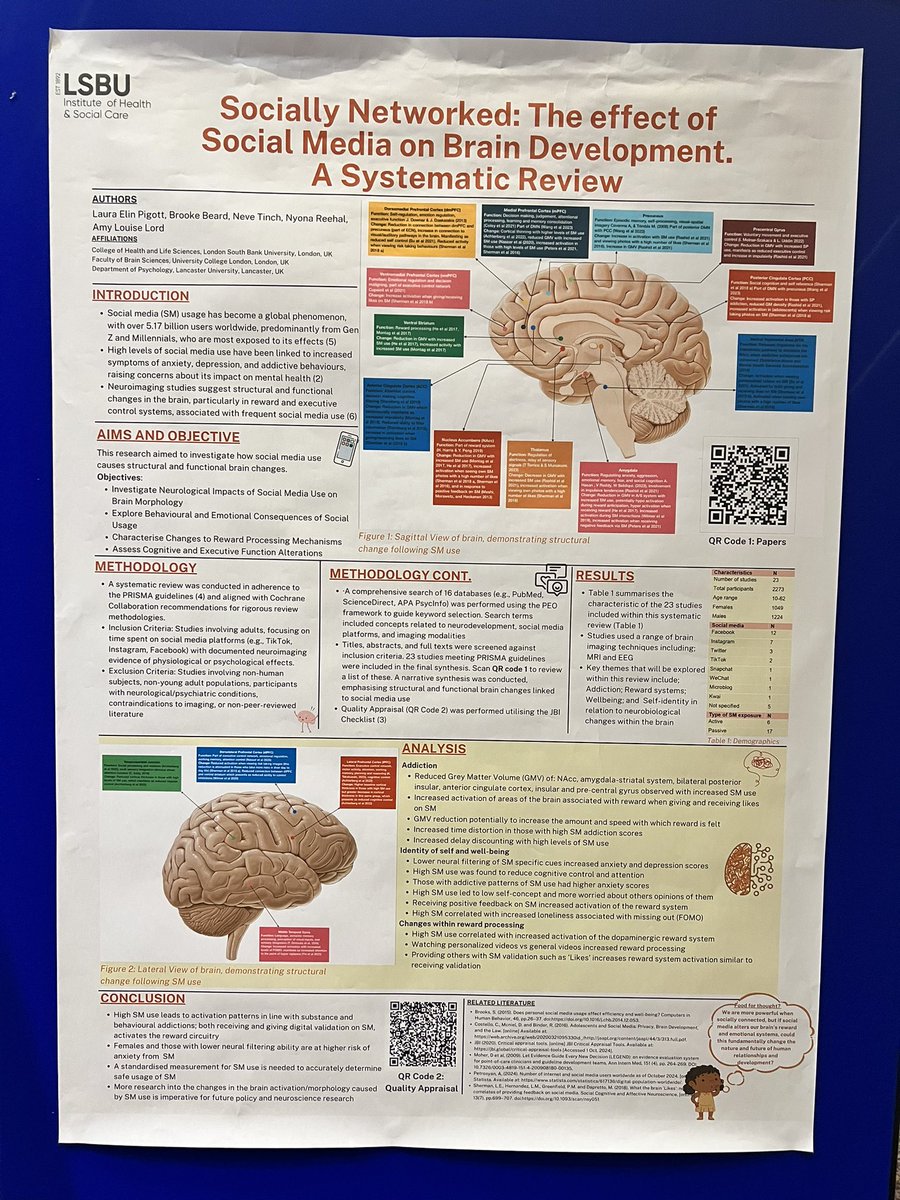
Excited to share our latest conference poster, titled Socially Networked: The Effect of Social Media on Brain Development, presented at the British Neuroscience Association (BNA) Festive Symposium!
#Neuroscience#BrainDevelopment#research#SocialMedia#neurology
An announcement 👀
Today I’ve been presented the @DianaAward#2024DianaAwards for creating & leading @womeninneurouk! ⭐️
Princess Diana recognised ‘young people have the power to change the world’. What a joy to be acknowledged as a young change-maker today 🧠💗
Thrilled to see this article published with @FrontiersIn and published in the Applied Neuroimaging Frontiers Journal and the Women in Radiology: Neuroimaging and Neurotechnology special edition.
#neuro#cancer#machine_learning#ArtificialInteligence
https://t.co/TnmbhOb0ga
Such a privilege to present on elbow ultrasound, focusing on anatomical variants and differential diagnoses at #SonoCon2024 in #Vancouver. Huge thanks to Audrey, Jody and the organising committee for the invite!
Key points from my lecture are in the thread below 👇
Home-Based Brain Stimulation Shows Promise for Treating Depression
A new study reveals that home-based transcranial direct current stimulation (tDCS) is a safe and effective treatment for moderate to severe depression.
The research shows that patients using active tDCS at home experienced significant improvements in their depressive symptoms compared to those in a control group.
The noninvasive treatment involves applying a mild electrical current to the scalp, which has been used in clinical settings for other mental health conditions.
In this study, participants underwent 10 weeks of treatment, with tDCS sessions initially five times a week and then reduced to three.
Results showed that the active tDCS group had three times higher rates of remission compared to the placebo group.
This innovative approach could make depression treatment more accessible for millions of people who struggle with traditional therapies.