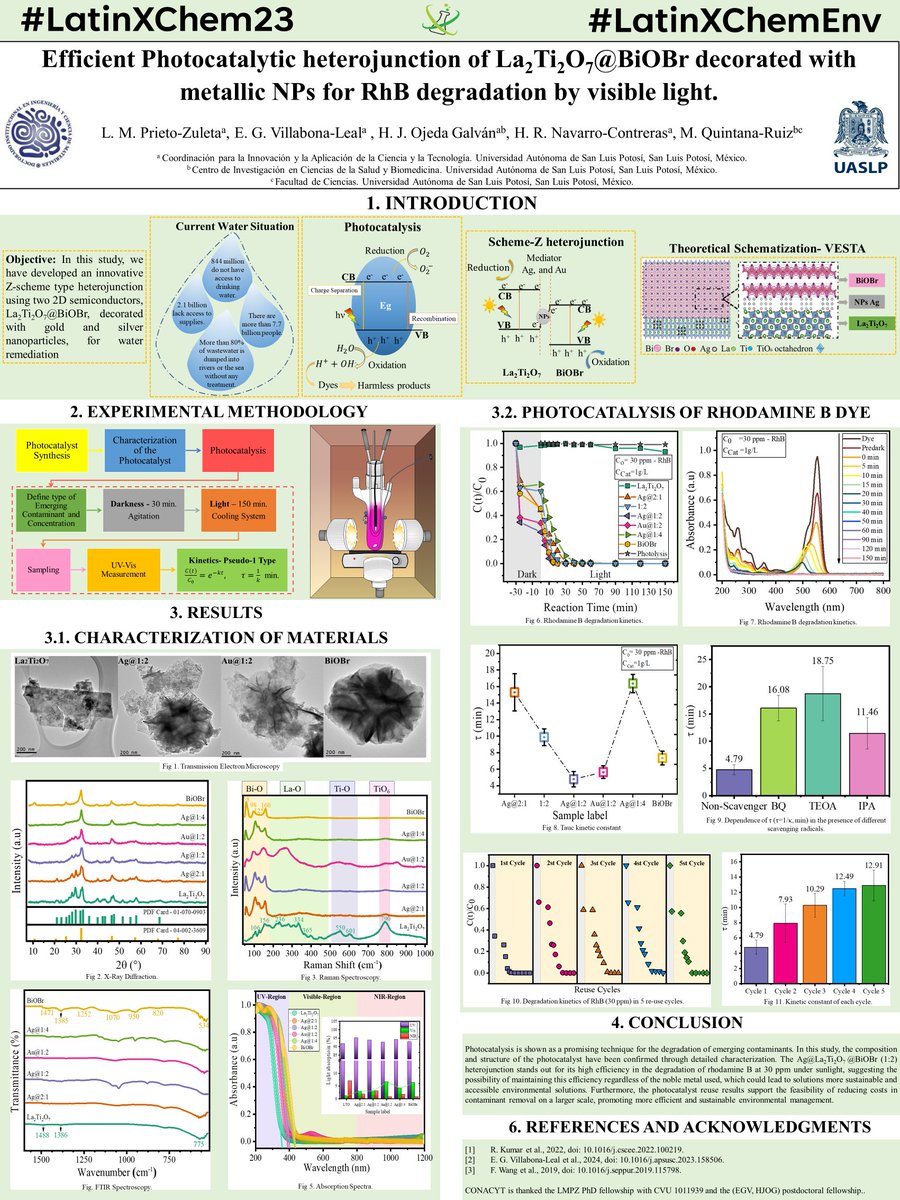
Hi to the entire @LatinXChem community, it's a pleasure to present to you the study developed on ‘Efficient Photocatalytic heterojunction of La2Ti2O7@BiOBr
decorated with metallic NPs for RhB degradation by visible light’ at #LatinXChem23#LatinXChemEnv#Env064@EnvSciRSC
Hi to the entire @LatinXChem community, it's a pleasure to present to you the study developed on ‘Efficient Photocatalytic heterojunction of La2Ti2O7@BiOBr
decorated with metallic NPs for RhB degradation by visible light’ at #LatinXChem23#LatinXChemEnv#Env064@EnvSciRSC
@LauraM0204@LatinXChem@EnvSciRSC Hola Laura, muy buen trabajo. ¿Cómo realizaste la síntesis de tu material heteroestructurado?. ¿Cómo crees que es el mecanismo de degradación de la Rhodamina, e términos de la generación de especies reactivas?
@JCDuran_Alvarez@LatinXChem@EnvSciRSC 2. Se realizó un estudio de "scavengers" para identificar las especies activas que participan en el proceso de degradación de la rodamina. Los resultados demostraron la generación de radicales hidroxilo y superóxidos, además de la importancia de los huecos (h+) en dicho proceso.
@JCDuran_Alvarez@LatinXChem@EnvSciRSC Gracias por tu pregunta
1. Las heterouniones se realizan mediante síntesis hidrotermal a bajas temperaturas, específicamente a 130°C durante 12 horas.
@th_dany@LatinXChem@EnvSciRSC Thank you for your comment. From the absorption spectrum, the absorption edges for each material can be determined by extrapolating the linear region to the wavelength axis, allowing us to understand the wavelengths absorbed by each material.