When God wanted to make David a king, He didn’t give him a crown; He sent him Goliath.
When God wanted to raise Joseph up to the palace, He didn’t give him a shortcut; He gave him prison.
When God wanted to make Moses a leader, He didn’t give him a stage; He gave him a wilderness.
When God wanted to make Esther a queen, He didn’t give her comfort; He gave her a crisis.
A lot of times, when you feel like God is breaking you, He’s actually building you.
📣ESTA LEY NO QUERIAN APROBAR LOS TERRORISTAS @iber_maravi@bancadaJP@RuthLuqueIbarra etc de criminales 🤬pero gracias a verdaderos Peruanos se aprobó! @RicardoBelmontC gracias totales y a su senador conciente que el 🇵🇪es primero 💪🇵🇪
Cuando sientas un caos por dentro, sal a caminar. Los monstruos de la mente detestan el aire fresco, los colores de la naturaleza, el murmullo del mar, la lluvia, el sol y la luna.
🔵🇨🇱 La estudiante venezolana de 11 años, María Andreína Lárez, ganó el primer lugar en el prestigioso certamen escolar de lectura en voz alta "El Placer de Oír Leer" 2026 en Chile, representando a Atacama 📚. #Chile#TalentoVenezolano#Internacional
📹 @elvenezolanohou
I asked my readers one question this month. What are you fighting?
I told them I would pray over every answer, and I did.
Most of the answers were about marriage. The same fight, over and over. Old hurts that come back up the second anyone says a word.
One spouse carrying the whole house alone. Grown sons who haven't called in years. Family who treat you like a stranger since you came to faith.
Christie read every one of them with me. We've been married 24 years and raised five kids. When she finished, she said, we need to make something for these people.
Solomon wrote about this exact fight three thousand years ago.
"He that covereth a transgression seeketh love; but he that repeateth a matter separateth very friends." Proverbs 17:9
Repeateth. That's the word that kills a house. The hurt is old, but it gets dragged back out and replayed until two people who love each other end up strangers under one roof.
To cover a matter is to leave it buried. You quit digging it up every time something new stings.
Find the real fight under the one you keep having. Own your half of it out loud. Then say the hard thing once, plainly, and stop bringing it back to the table.
Stop repeating the matter.
Nothing Changes
If you feel stuck and unable to make progress, here's the truth I have discovered after decades of studying brain science, and surviving multiple traumas in my own life, including the loss of my son:
Nothing changes until you change something.
I lost a lot of time waiting to feel better, thinking I could only change after my emotions did. But what I discovered was that you never feel better enough to change your actions, but as soon as you change your actions, you start to feel better. Change doesn't require perfection, it requires interruption.
And that type of change, that type of initiative, doesn't calm until you begin to change things that you think about and the ways that you think about the situation you've been in.
That's why Romans 12:2 tells us not to be conformed to the pattern of the world, which is a constant focus on our circumstances and feelings, but to be transformed by of our minds.
Once you understand that your mind is in charge of your brain and know what you think about can change how your brain works, you can be truly set free the partner with God in going after the life he's calling you to.
And if you feel like you can't hold it all together, I have good news: you were never supposed to. Colossians -20 says that in him everything is held together.
Nothing changes until you change something. As soon as you're ready to change your mind, you can change your life.
Your creator is ready to help you, your brain is designed to heal, grow, and change, and we're counting on you.
Save this for the next time you feel stock, and share it with a friend who needs to know that nothing changes until we change something.
Click the link in my bio to learn more about my New York Times best seller, The Life-Changing Art of Self-Brain Surgery, and to find my weekly newsletter, podcast, and more.
#neuroscience #anxiety #mentalhealth #selfbrainsurgery
¿Sabes qué significa ser amable y cortés con todo el mundo, pero ser grosero con tu familia? Esto se basa en una situación muy rara que pocos conocen. Te lo explico:
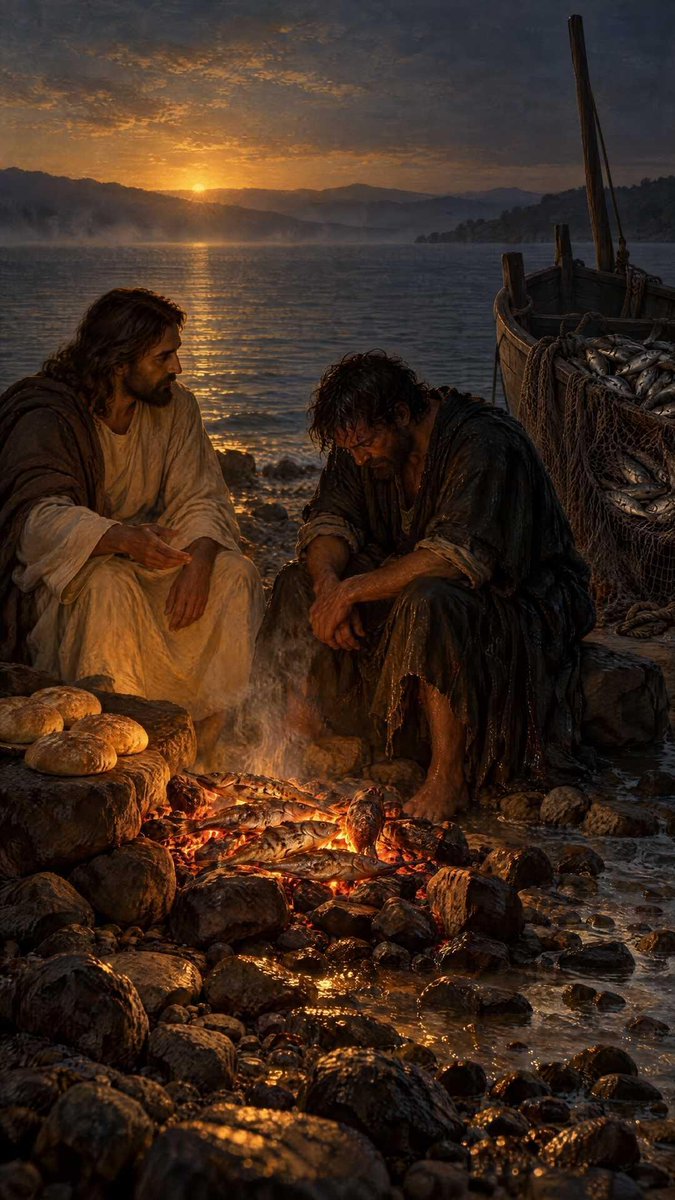
There is a Greek word that appears exactly twice in the entire New Testament. The word is anthrakia, and it means a charcoal fire. John uses it once on the worst night of Peter's life, and once on the morning that gave his life back. The two scenes are separated by a few weeks and about seventy miles, but John connects them with this one rare word. Once you notice it, you can see that Jesus deliberately rebuilt the scene of Peter's greatest failure in order to heal it.
The first fire burned in the courtyard of the high priest. Jesus had just been arrested in Gethsemane and taken to the house where Annas and Caiaphas questioned Him through the night. Most of the disciples had scattered. Peter followed at a distance and got into the courtyard. John tells us it was cold, so the servants and officers had made a charcoal fire, and Peter stood with them, warming himself. That detail matters. Hours earlier, Peter had sworn to Jesus that even if everyone else fell away, he never would, that he was ready to go to prison and to death. Now he stood warming his hands at a fire among the men who had just arrested his Lord.
The questions came one after another. First, a servant girl at the door asked him, "You are not also one of this man's disciples, are you?" He said, "I am not." Then someone at the fire asked him the same thing, and again he denied it. The third question was the most dangerous. It came from a relative of Malchus, the servant whose ear Peter had cut off with a sword in the garden that same night. He said, "Did I not see you in the garden with him?" Matthew and Mark record that Peter began to call down curses on himself and swore, "I do not know the man." Three denials. Then the rooster crowed.
Luke adds the most painful detail in all the Gospels: "And the Lord turned and looked at Peter." Somewhere across that courtyard, bound and beaten, Jesus turned, and their eyes met. Peter remembered the words Jesus had spoken only hours before: before the rooster crows, you will deny me three times. And Peter went out and wept bitterly. The last time Peter saw Jesus before the cross, he was standing at a charcoal fire, having just sworn that he never knew Him.
Then Jesus died. Peter never got to take it back. For three days he lived with the knowledge that the last thing he had done for his Lord was abandon Him.
Even after the resurrection, the wound was still open. The angel at the tomb told the women, "Go, tell his disciples and Peter." And Peter, by name. Heaven knew exactly who needed to hear it. Jesus appeared to Peter privately, which Luke and Paul both mention, but Scripture never tells us what was said. The public restoration was still to come.
That happens in John 21. Peter has gone back to Galilee, back to the lake, back to his boats. "I am going fishing," he says, and six other disciples go with him. They fish all night and catch nothing. At dawn, a figure on the shore calls out, telling them to cast the net on the right side of the boat. They do, and the net fills with so many fish that they cannot haul it in. John counts them: a hundred and fifty-three large fish, and the net did not tear. Any fisherman in that boat would have recognized this, because it had happened before. Three years earlier, on this same lake, after a night of catching nothing, Jesus had filled Peter's nets in the same way. That was the day Peter fell at His feet and said, "Depart from me, for I am a sinful man, O Lord," and Jesus called him to follow. Now the miracle that began Peter's calling was happening again.
John says, "It is the Lord!" Peter doesn't wait for the boat. He throws on his outer garment and jumps into the sea, swimming a hundred yards to shore to get to Jesus. And when he climbs out of the water, dripping, the first thing he sees is a charcoal fire, anthrakia, with fish laid on it and bread.
Think about what Peter felt. The same kind of fire, the same smell of burning charcoal that had filled the courtyard on the night he denied his Lord. Smell is one of the strongest triggers of memory, and Jesus had set the scene exactly. He was not doing this to shame Peter. He was taking him back to the place where he broke so He could put him back together there.
After breakfast, Jesus turns to him. "Simon, son of John, do you love me more than these?" Notice the name. Not Peter, the Rock, the name Jesus had given him. Simon, son of John, the name of the fisherman before he was ever called. Peter answers, "Yes, Lord; you know that I love you." Jesus says, "Feed my lambs." He asks a second time. Peter answers again. "Tend my sheep." Then a third time, and John writes that Peter was grieved because Jesus asked him the third time. Of course he was. Three questions, at a charcoal fire, for three denials at a charcoal fire. Peter understood exactly what was happening. His answer the third time holds everything that is left of his old confidence: "Lord, you know everything; you know that I love you." He no longer boasted about what he would do. He could only say, "You know what is in me."
Each denial was answered by a confession, and each confession by a commission. Jesus did not merely forgive Peter; He put him back to work. The man who could not stand up to a servant girl was entrusted with the care of Christ's entire flock.
Then Jesus tells him how it will end. "When you were young, you dressed yourself and walked wherever you wanted, but when you are old, you will stretch out your hands, and another will dress you and carry you where you do not want to go," John explains that Jesus said this to show by what kind of death Peter would glorify God. The man who once swore he would die for Jesus and then ran would, in the end, actually do it. And Jesus closed with two words, the same two words He had spoken on that lakeshore three years before: "Follow me."
Watch what happens next. A few weeks later, at Pentecost, Peter stood in Jerusalem, the city where he had denied Jesus, and preached to thousands. Three thousand were baptized that day. Soon after, in Acts 4, Peter was arrested and brought before the council. Luke lists who was sitting there: Annas the high priest and Caiaphas. The same men whose courtyard fire he had warmed himself at. This time there was no denial. Peter looked at them and said there is salvation in no one else, for there is no other name under heaven by which we must be saved. The council was astonished at the boldness of these uneducated men, and they recognized that they had been with Jesus.
To the world, failure is final. Your worst moment defines you. Deny what you believe when it counts, and you are finished. But the Gospel has a charcoal fire on a beach. The denial was real, and the tears were real, but the restoration was more real. Jesus did not ignore Peter's failure. He brought him back to face it, and then He answered it with love, three times over.
Maybe you have your own charcoal fire. A night you would give anything to take back, a moment you denied Him with your words or your silence or your life. You may still be able to smell the smoke. Jesus knows where that fire burned. He is not waiting to shame you there. He is waiting to cook breakfast, ask you one question, and send you back out.
"Do you love me?" You know the answer. So does He.
Jesus is the Good Shepherd who restores the ones who ran. Thank You, Jesus.
🚨‼️Walking in the Spirit is not proven by how much noise a man can make in a church service. Galatians 5:16 says, “Walk in the Spirit, and ye shall not fulfil the lust of the flesh.” That is where God puts the measuring stick. Not on the volume of the meeting, not on the emotional temperature of the room, not on whether somebody shook, shouted, fell, cried, or claimed a private message from heaven. God looks at the walk. What happens when lust knocks? What happens when anger rises? What happens when pride gets wounded? What happens when nobody is watching? Religious theater can be staged for an hour. A walk has to survive the week.
The flesh loves public spirituality because public spirituality can feed the flesh while pretending to kill it. A man can enjoy being seen as spiritual almost as much as another man enjoys being seen as rich. Pride does not care whether it wears a gold chain or carries a black Bible as long as somebody notices. That is why the Holy Ghost keeps dragging the Christian away from display and back to obedience. “The fruit of the Spirit is love, joy, peace, longsuffering, gentleness, goodness, faith, Meekness, temperance” (Galatians 5:22–23). None of those requires a spotlight. Most of them get tested where there is no audience.
Here is the part the flesh hates: the Spirit-filled life is often very ordinary to look at. It is a man keeping his mouth shut when one sentence could start a war. It is a woman refusing bitterness after being wronged. It is a believer turning away from temptation before anybody knows the temptation was there. It is somebody telling the truth when a lie would be cheaper, forgiving when revenge would feel better, serving when nobody says thank you, and opening the Bible when the world is offering a thousand easier distractions. Heaven calls that spiritual. The flesh calls it boring because the flesh only enjoys religion when self gets to stay in the picture.
You want to know whether you are walking in the Spirit? Do not start by asking what happened to you in a meeting. Ask what happened to your flesh when God’s word crossed it. Did pride sit down? Did lust get refused? Did anger lose the microphone? Did bitterness get evicted? Did self-will surrender the keys? That is where spiritual power shows itself. The Holy Ghost did not come to make the Christian impressive. He came to make Jesus Christ visible in a life where self used to occupy the throne.
The Third Commandment of Self-Brain Surgery:
"I must believe that not all of my thoughts are true."
Being curious about your thoughts instead of reactive to them is a superpower if you want to flourish in your life.
II Corinthians 10:5 isn't just a good idea, it is 1st-century neuroscience.
#selfbrainsurgery
Your brain doesn’t know what time it is. Every time you replay that conversation from last year, that mistake from last month, that moment you wish you could take back from yesterday, your brain treats it like it’s happening right now. Same stress chemicals. Same alarm bells. You’re not remembering it. You’re reliving it, on a loop you built yourself.
That's because of two things: your brain doesn't know the difference between what's really happening and what you're just imagining, and neuroplasticity means that your brain automates things that you think about and turns them into programs that it runs without you having to think about them next time.
So, the more you rehearse something from the past or something you're just imagining, the more your brain builds out a reality as if that thing is still here right now.
The ninth Commandment of self brain surgery is, "I must believe that what I'm doing I'm getting better at." That means if you're doing things with your mind that are making your brain better at living in the past or worrying about imaginary outcomes, you're getting better at feeling worse. So knock it off.
Here’s the shift: you can’t edit the past, but you can stop rehearsing it. Every replay is a rehearsal, and your brain gets better at whatever you rehearse. Let's make neuroplasticity work for us and not against us.
We call that self-brain surgery. It's not easy at first, it's hard and holy work. But remember, you get better at whatever you repeatedly do
Philippians 3:13 says it like this: forget what lies behind and strain towards what lies ahead. Not denying it happened, but refusing to keep performing it. There's better stuff in the future, but not if you keep building a brain that lives in the past.
Follow me to connect neuroscience and scripture every day. Save this for the next time your mind hits replay. Share it with someone stuck on a loop.
Click the link in my bio to learn more about Self-Brain Surgery.
#SelfBrainSurgery #Neurosurgery #FaithAndScience #BrainHealth
Eclesiastés 11:4 dice que el que mira demasiado el viento nunca siembra, y el que mira las nubes nunca cosecha. No habla de imprudencia, habla de una forma de miedo disfrazada de prudencia. La verdad incómoda es que el momento perfecto no existe, es una excusa con buena reputación. Mientras lo esperás, la vida sigue pasando sin vos, y el tiempo que creías estar cuidando en realidad se te está escapando de las manos. La fe no es actuar sin pensar, es animarse a sembrar aunque el cielo siga nublado.