Check out @LauraTebcharani's zero-order release formulation.
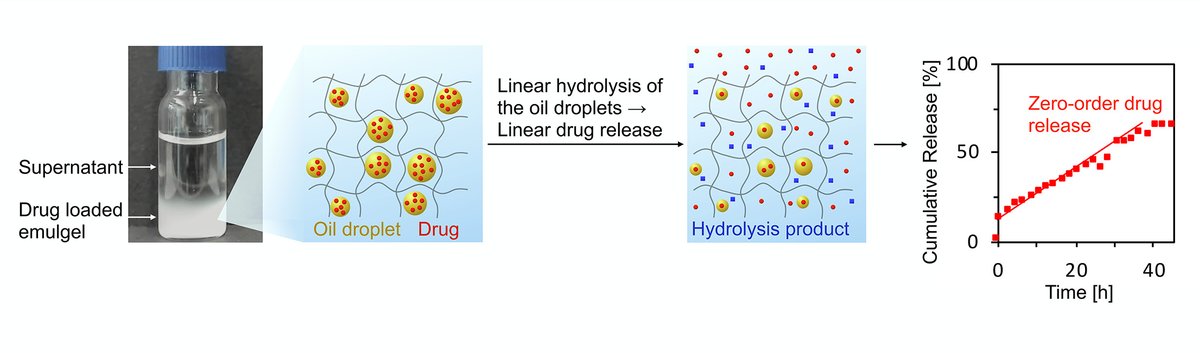
A gelly emulsion of a hydrolyzable oil. BUT... the oil hydrolyzes with rare, zero-order kinetics, which we use to release a drug with linear kinetics, too. For days, we get a constant rate!
https://t.co/w1CzYkYylq
@VdovchenkoAlena @TPolymerist @BoekhovenLab Thank you Alena! The plan is that we do not use any fuel at all. So far we use the fuel only to get the oil droplets, but if we directly start with the oil droplets we don't need fuel. This will also mean no toxic waste.
@paul_hurst@BoekhovenLab Thank you! That's also a very good question. The droplets are immobilised in a hydrogel, so the emulsion is stable over the entire release period. Without a hydrogel we can observe phase separation after some time.
@icetritium2@BoekhovenLab thanks, that's a good question. So here we used 10mM of the acid precursor and 10-30mM EDC. The EDC is only necessary to form the anhydride which forms the droplets. Since the EDC is toxic for cells, we will leave out this step and directly use the anhydride.
@Sandeep_1966@BoekhovenLab The droplets with the incorporated drug will be immobilised in a hydrogel. Then the idea is to coat medical devices with this formulation to achieve a constant drug release.
@PalliThordarson@BoekhovenLab Thanks for the question, here the drugs are released with the C10 anhydride because it has a longer lifetime. But it is also possible to release the drugs with the C8 anhydride.
Hi all,
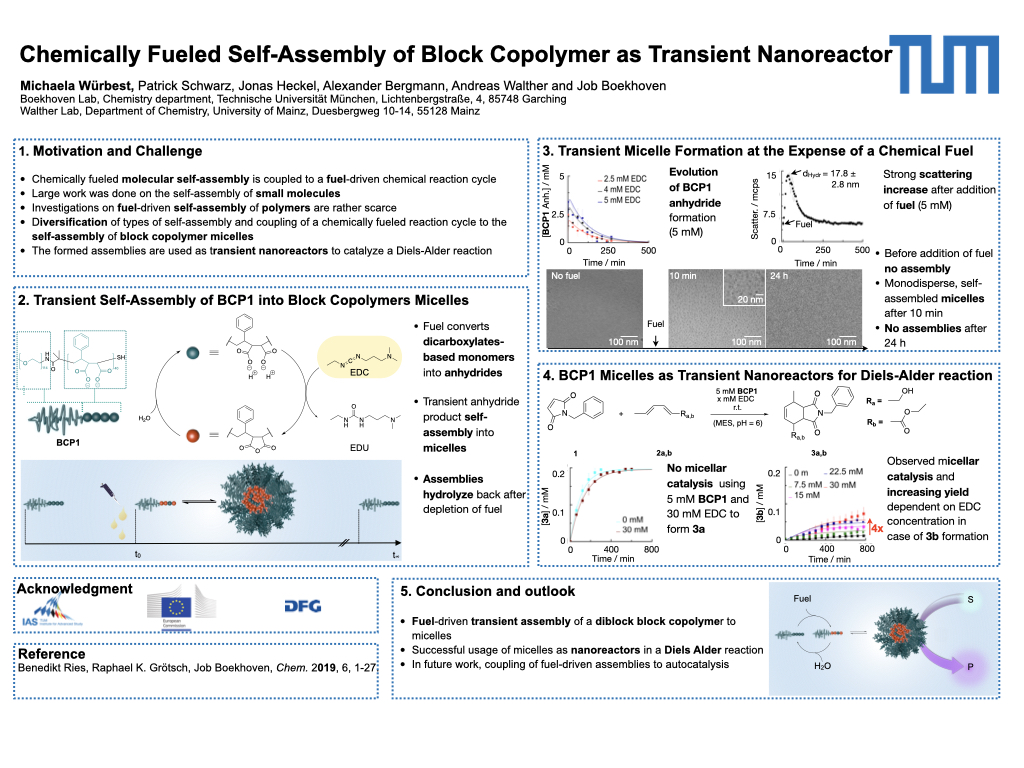
I am excited to present our recent study from the @BoekhovenLab on chemically fueled self-assembly of block copolymer micelles working as transient nanoreactors as a #RSCPoster, #RSCOrg, #RSCCat.
Hi,
I am delighted to present our recent work from the @BoekhovenLab on self-immolative active emulsions as a #RSCPoster. We developed some materials which destroy themselves after a certain time and decay within several minutes. #RSCMat
@ArdoyMendez @ismsc2020 @BoekhovenLab Thanks! the drug is added when most of the droplets are formed, after the EDC is fully consumed. We measured the drug concentration that remained in solution shortly after the drug was added to the droplets. We observed a burst release of 10-20%. So the uptake is 80-90%.
Hi supramolecular chemists. Check out my poster of the @ISMSC2020 conference #ISMSCPoster#selfassembly25. We developed a cool drug delivery platform @BoekhovenLab
@CatyMarsden @ismsc2020 @BoekhovenLab Thank you! Preliminary cell viability experiments showed that concentrations <1mM of the anhydride (oil droplets) as well as of the acid (hydrolysis product) are not toxic for cells.
@TesselBouwens @ismsc2020 @BoekhovenLab Thank you! The release period and rate is only determined by the oil droplet and drug concentration, not the chemical properties of the drug. However, the drug has to be hydrophobic so that it partitions into the oil droplets. It does not work with hydrophilic drugs.