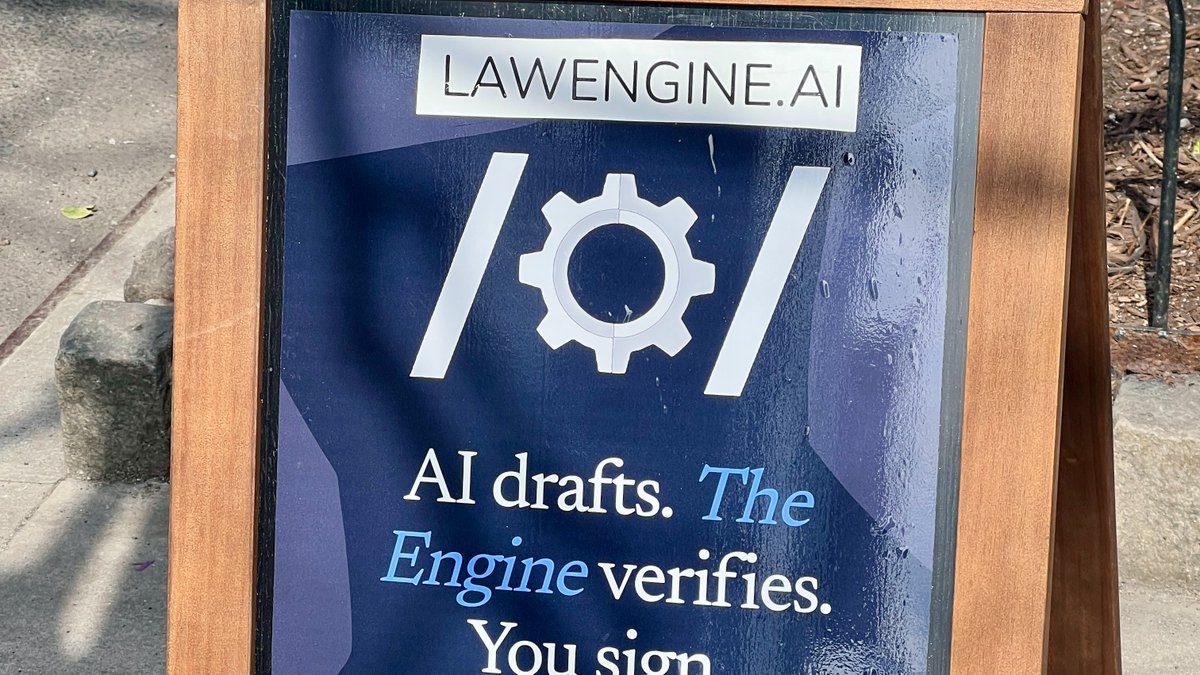
Wrapped #Legalweek26.
Connected with some of the best in legal AI — @harvey , @WeAreLegora , @SmokeballNews , and more.
@LawEngineAI had two presences at the show: inside the Javits, and a sandwich board doing unsupervised guerrilla marketing down the street.
The sandwich board may have outperformed.
Built in a courtroom — not a conference room.
🔗 https://t.co/gCHwGnMu9o
@LegalweekShow #LegalAI #LegalTech
#legalweek
We talk a lot about AI 'hallucinating' completely fake case law, but there is a much more subtle risk in legal AI that is far harder to catch: the 'confidently wrong' citation.
Here is a great example of how this happens: Imagine an AI is generating a prior-restraint analysis and cites Nebraska Press Assn. v. Stuart at 423 U.S. 1027. At first glance, it passes the eye test. It's a real case name, a real reporter, and a real page number.
But if you actually pull the case, you'll find that 423 U.S. 1027 is just a procedural order granting certiorari. The actual landmark merits decision that provides the substantive prior-restraint analysis is 427 U.S. 539. Four volumes. One year. Completely different document.
These 'near-miss' errors are arguably more dangerous than obvious hallucinations because their formatting and fluency bypass our initial skepticism. It's a great reminder for those of us building and using legal tech: AI is incredibly powerful for surfacing information, but verifying the actual context and legal weight of a citation still requires a trained human eye.
Always read the case.
This is the exact problem we're building against at LawEngine — deterministic citation verification that checks whether a citation maps to a real, verified provision in a structured corpus, not just whether it looks right.
https://t.co/gCHwGnMu9o
#Legal #legaltech
@SellersCounsel@writeclimbrun I’m building a better legal tech system than the big guys have, my market is small law firms. Would love to connect and show you what I have.
📄 Source: Magesh et al., Hallucination-Free? Assessing the Reliability of Leading AI Legal Research Tools, 22 J. Empirical Legal Stud. 216 (2025) — Stanford RegLab & HAI.
This was the first preregistered empirical evaluation of proprietary legal AI tools. Testing was conducted in May 2024 on Lexis+ AI (LexisNexis) and Westlaw AI-Assisted Research + Ask Practical Law AI (Thomson Reuters) — the two dominant platforms in legal research — across 200+ open-ended legal queries.
Results: hallucination rates of 17% for Lexis+ AI and 33% for Westlaw AI-Assisted Research, despite both using retrieval-augmented generation (RAG) — a method both providers had publicly claimed would eliminate or avoid hallucinations.
These tools have continued to evolve, and improvements have been made. But the structural challenge of probabilistic AI outputs in high-stakes legal contexts remains an open problem — and one worth solving differently.
Full paper: https://t.co/DFiMbAyavO
The legal industry has a hallucination problem.
Back in 2024, a peer-reviewed Stanford study tested the two biggest names in legal AI — Lexis+ AI and Westlaw — and found they hallucinated between 17–33% of the time. Even with purpose-built retrieval systems.
These tools have improved since. But the underlying architecture hasn't fundamentally changed.
Probabilistic confidence is still not the same as verified truth.
We're building something different — where citation verification isn't probabilistic. It's deterministic.
No confidence scores. No "likely accurate." Just: verified or not verified.
The math is different here. The architecture is different here.
More soon. 🔒
(source in comments ↓)
#LegalAI #LegalTech #IllinoisLaw #LawEngine #DeterministicAI
@SMB_Attorney@SMB_Attorney - Not an endorsement, but it's working for me.
Only took a couple thousand hours, but hey - I did find an error in the IL Supreme Court Rules that no other lawyer or association spotted. Successfully petitioned per Rule 3.
An attorney emailed me with a Linked stating "battle tested." It actually broke my heart right then (is this what it's about?!)
84% of low-income veterans' civil legal problems get inadequate or no legal help. Seven of the top ten unmet needs of homeless vets are legal needs.
I'm fighting to change this narrative.