Super excited about this paper led by the incomparable Henry Robbins!
You no longer need heuristics to check that your LLM correctly reformulated a MILP problem (or passes a benchmark), we can prove it in Lean for any instance!
An LLM can rewrite your optimization problem to improve solve time, pass every test, and still silently change the underlying problem.
Our new paper introduces FLARE, an LLM agent that uses Lean to prove that a given MILP reformulation is valid across all possible problem instances, not just those used for testing.
On 54 reformulation pairs of NP-hard problems, FLARE correctly classified all (best baseline: 83%) and provided a machine-checkable proof for every accepted reformulation.
AI-generated optimization needs proofs; passing tests isn’t enough.
It's very easy to arm-chair quarterback healthcare transformation from an office in San Francisco. Much harder to actually assemble the avengers in Akron Ohio and try to fix it.
Very proud of the role @percepta plays in this work. Reach out if you want to get on the ground in Akron with our team
@LawlessOpt and I are excited to present our #AAAI2026 tutorial on “LLMs for Optimization: Modeling, Solving, and Validating with Generative AI.”
When: Tuesday, Jan 20, 2026, 8:30am–12:30pm (Singapore time)
Where: Garnet 216 (Singapore EXPO)
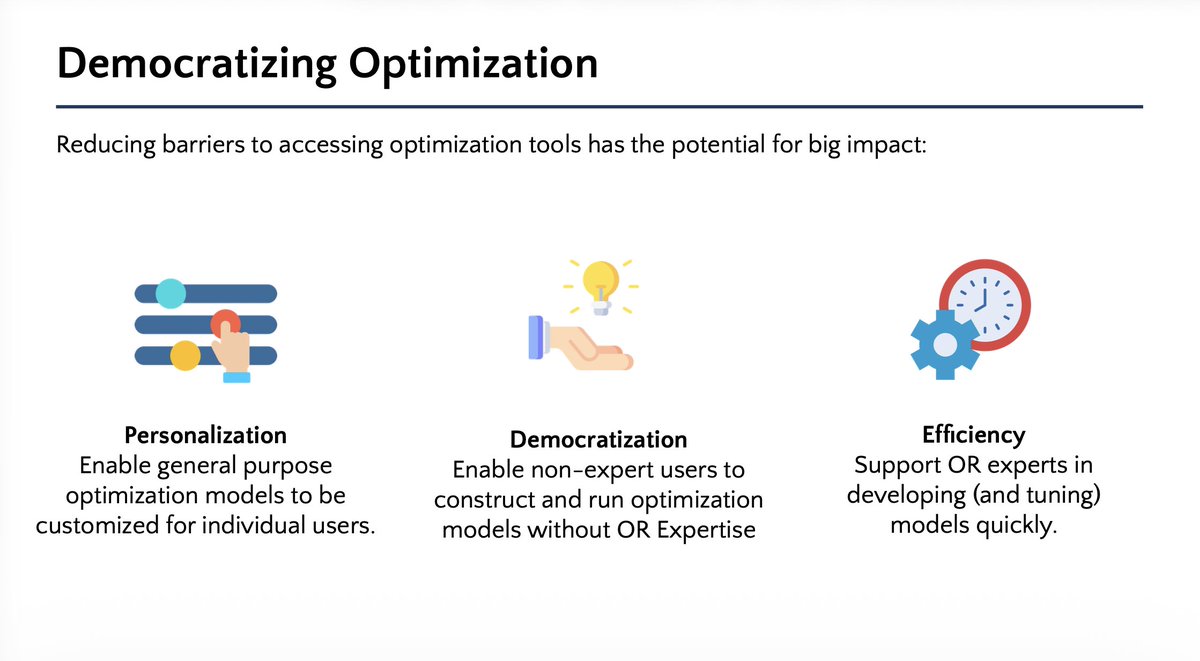
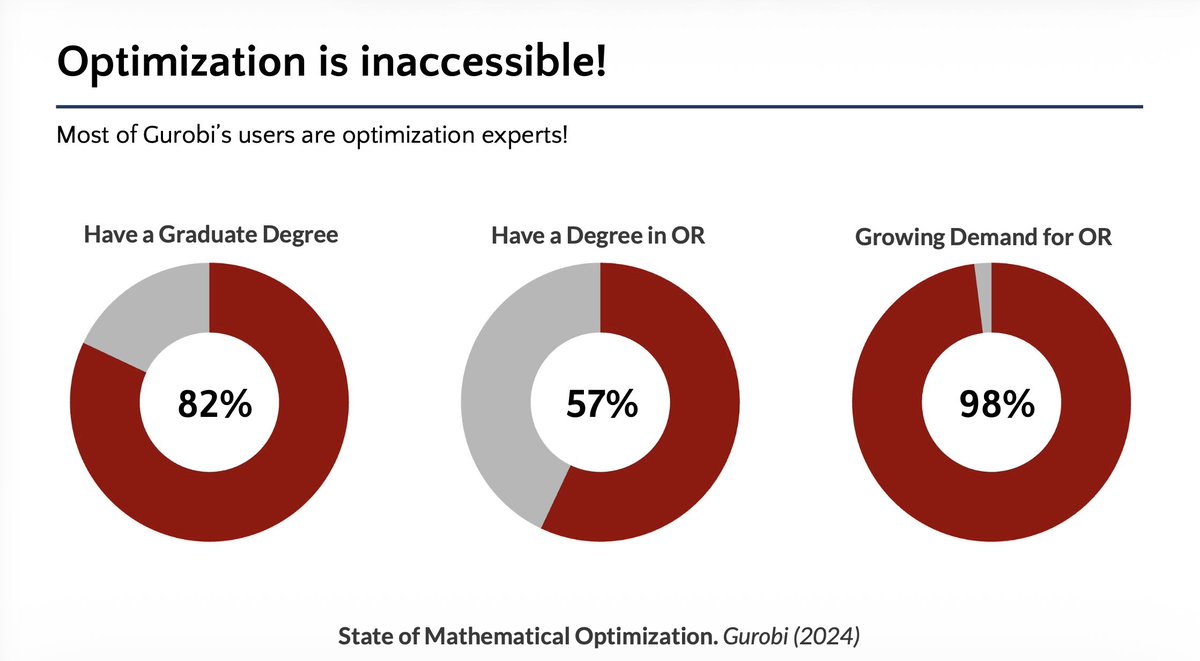
Optimization is central to planning, scheduling, and decision-making, but deploying solvers requires deep expertise. Our tutorial covers how LLMs can support the end-to-end optimization pipeline (model formulation, solver configuration, and model validation) and highlights open research directions.
Tutorial page (agenda + reading list): https://t.co/Nb3v4qRub3
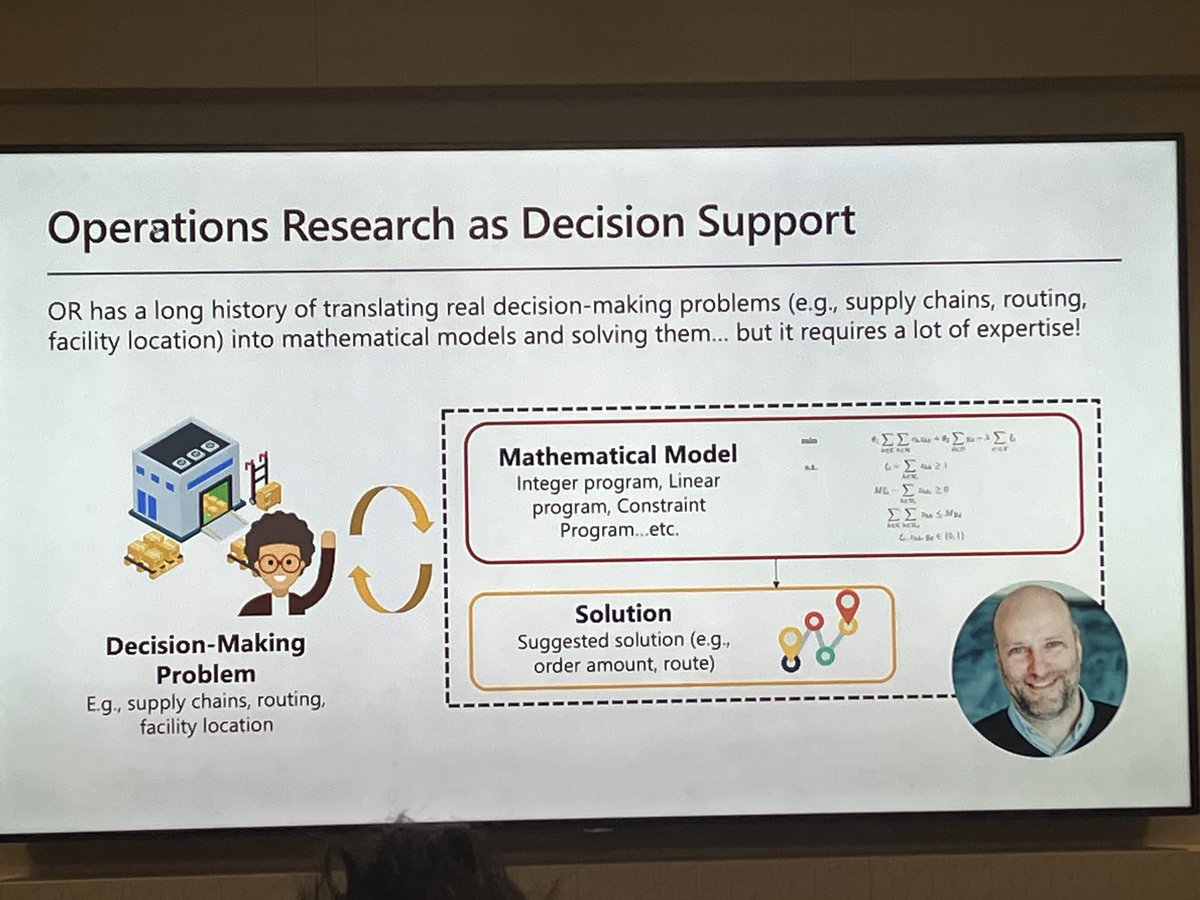
(Connor’s intro slides are shown here.)
Thanks to @leo_bix and @madeleineudell for helping put the proposal together.
CC @RealAAAI
Excited to be talking about this project at INFORMS today (ME31 - 4:00 @ Summit 422)! In this paper we build and do the first user study with a system that combines LLMs with Constraint Programming for personalized optimization modelling (accepted in ACM TiiS, an HCI journal!)
Super excited about this project from my time at @MSFTResearch! We explore how to combine LLMs and Constraint Programming to allow non-expert users to design optimization models in the context of meeting scheduling.
Connor Lawless (@LawlessOpt) talks at #cpaior2024 about a new notion of fairness in clustering to ensure minimum majority representation of groups across clusters, which helps shaping more representative electoral districts, & which may shown to be impossible by an exact approach
In my presentation at the AI / OR workshop, I talked about incentives for collaboration across disciplines, touching a bit on journal and conference publishing cultures.
From later conversations, this seems to be less of an issue in IE departments than it is in business schools.
Continuing the second session of the AI / OR workshop, @LawlessOpt talks about using large language models to replace the #orms expert when formulating optimization models, such as for building a constraint programming model for scheduling meetings
Sharing some papers I enjoyed at the OPT workshop at #NeurIPS2023! sorry I couldn't interact with everyone (had a tight flight schedule).
@BaharloueiSina 's paper on f-ERM.
@LawlessOpt's paper on Fair Clustering.
Todo: Another post on DP, fairness, game theory, bandits papers.
Super excited about this project from my time at @MSFTResearch! We explore how to combine LLMs and Constraint Programming to allow non-expert users to design optimization models in the context of meeting scheduling.
"I Want It That Way": Enabling Interactive Decision Support Using Large Language Models and Constraint Programming
paper page: https://t.co/LJiRsfRxDz
A critical factor in the success of decision support systems is the accurate modeling of user preferences. Psychology research has demonstrated that users often develop their preferences during the elicitation process, highlighting the pivotal role of system-user interaction in developing personalized systems. This paper introduces a novel approach, combining Large Language Models (LLMs) with Constraint Programming to facilitate interactive decision support. We study this hybrid framework through the lens of meeting scheduling, a time-consuming daily activity faced by a multitude of information workers. We conduct three studies to evaluate the novel framework, including a diary study (n=64) to characterize contextual scheduling preferences, a quantitative evaluation of the system's performance, and a user study (n=10) with a prototype system. Our work highlights the potential for a hybrid LLM and optimization approach for iterative preference elicitation and design considerations for building systems that support human-system collaborative decision-making processes.
We are launching our Graduate School Application Financial Aid Program (https://t.co/i4k36GMIZq) for 2023-2024. We’ll give up to $750 per person to queer STEM scholars applying to graduate programs. Apply at https://t.co/HjaIfHrjKS. Donate to support at https://t.co/h9F3Nkj1yQ 1/
📢 The Online Seminar Series #MachineLearning NeEDS #MathematicalOptimization, https://t.co/MtHTw37yA5, is back on October 2, 16.30 CET!
ℹ️ Join mailinglist https://t.co/luW7w7j13W
@needs_project activity, branding the role of #orms in #AI with the support of @EUROonline_News
Urgent!!!
PhD studentship contract for project "MATHEMATICAL OPTIMIZATION AND STATISTICS FOR EXPLAINABLE
AND FAIR MACHINE LEARNING" at @unisevilla
(Ref INV-PRE-2023-I-040 in https://t.co/iRtOKe0qdA)
Interested? Contact us asap!
Know an undergrad looking to apply to OR PhD programs? @Cornell_ORIE is launching our application support program for prospective URM PhD students! Deadline is December 1st. Help spread the word!
https://t.co/pBTyVrFPuy
Awesome feature on some of the cool stuff @chamsihssaine has been up to since she a̵b̵a̵n̵d̵o̵n̵n̵e̵d̵ ̵u̵s̵ ̵a̵t̵ graduated Cornell!
https://t.co/lbAUgGXo9S
@LawlessOpt Thank you for your presentation at our Online Seminar Series Machine Learning NeEDS Mathematical Optimization, https://t.co/MtHTw37yA5!
Indeed, your pic is here
👇
https://t.co/sGEnMmFd2o
Well done with the pub!
It also has a whole new empirical section validating new computational heuristics! It's been a (long) labor of love... if you don't believe me - here's a presentation I gave on this paper almost 3 years ago: https://t.co/0hTLDqMMnJ
The paper has been through quite a few iterations (I started working on it during the first year of my PhD!), and this final version has new theoretical results on the use of hamming loss as a proxy for 0-1 classification loss and computational hardness of the pricing problem.