We are building a decentralized trust layer for the new data economy. Grant or revoke consent to your data, and earn a share of what it generates💰
More info coming soon...
https://t.co/sHIpqcLN1X
Gartner forecasts that 90% of enterprise software engineers will use AI code assistants by 2028.
Your review queue won't grow at that speed.
Picture an agent-written pull request that adds email and device-ID reads to a feature whose consent receipt only covers the original purpose. The diff looks clean. The consent gap goes live with the merge.
One check for the reviewer: which consent records or device identifiers does this change read, and does the receipt cover that purpose?
Which record type did an agent's pull request last touch in your codebase, and how did anyone confirm its consent status?
Buying a dataset because the seller says "all consented" is the mistake. The risk didn't go away. It just moved to you.
Ask for a record you can verify yourself, per user, still active today.
Send this to whoever signs off on your data purchases.
InfoQ reports a comprehension gap: agents write code faster than people can review it.
We see the same gap in data. Nobody reviews whether the records an agent just read still have valid consent. Nobody.
Review speed won't fix that, and I don't think more reviewers will either. A consent check at read time will.
Reuters reported that a US review of airline data privacy closed without penalties.
Don't read that as permission. Your next partner will ask for the consent receipt. Not the policy page.
What did you show the last buyer who asked for proof?
Regulators aren't penalizing missing consent banners anymore.
They target silent data handoffs. No audit trail.
A user opts out, yet that choice stays locked in front-end cookies while backend feeds keep pushing records to external vendors without a second thought.
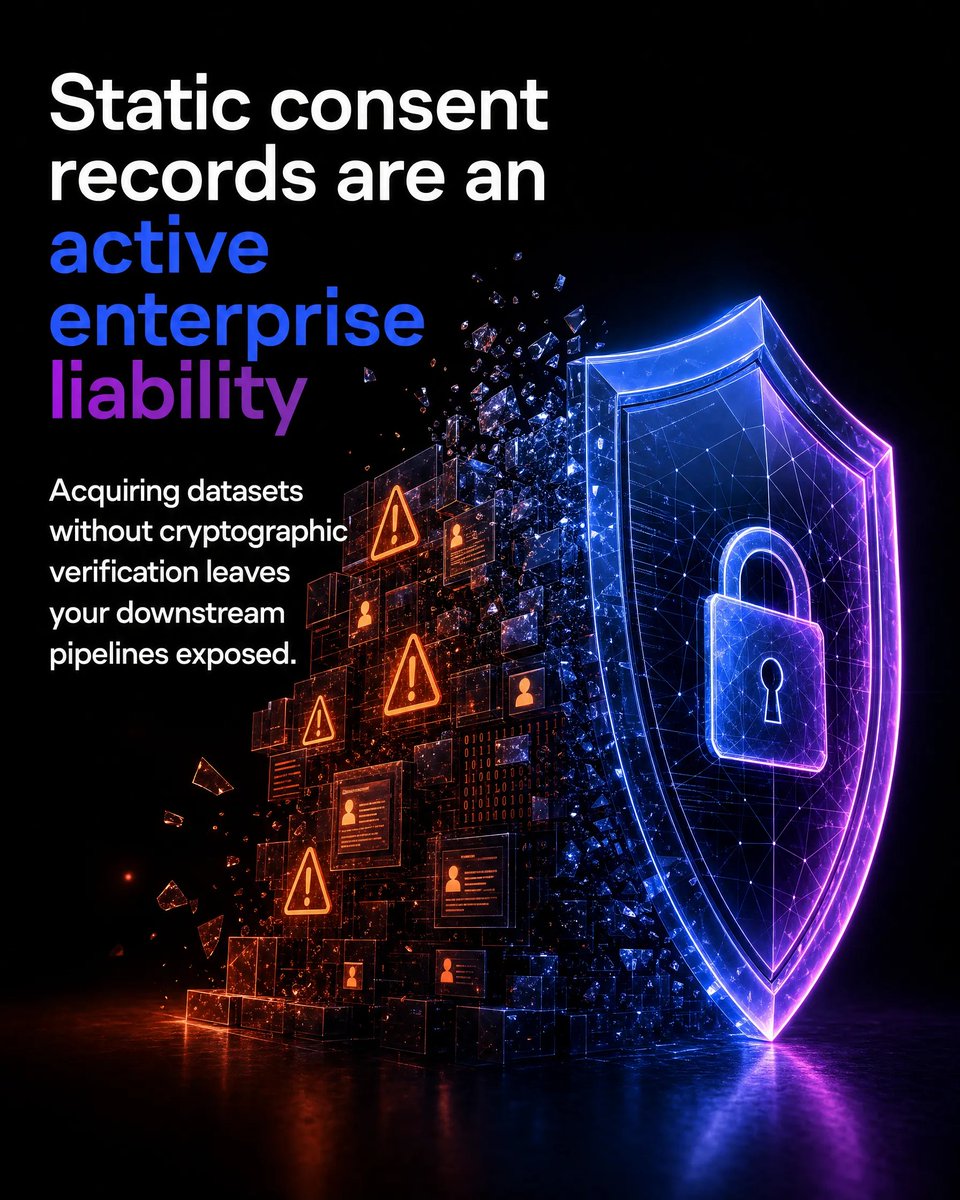
Without an immutable receipt verifying permission at the exact moment of transfer, your team trades on assumption.
When did you last check what your data pipelines transmit after a user revokes consent?
A user unchecks an ad-tracking box in your settings, yet your marketing stack keeps sharing their profile across three different networks anyway.
Why?
Your CMP lives in an isolated silo. It logs the opt-out, but downstream data brokers never receive verifiable confirmation.
We are preparing an open verification standard to eliminate this blind spot entirely. No more blind trust between data collectors and external consumers.
Every consent state anchored. Every downstream query verified in real time.
What is the single biggest breakdown in your current consent architecture?
If you manage data infrastructure, an internal database timestamp is not proof of consent.
An auditor asks for proof that a user opted in last March.
You export a CSV from your SQL database showing a clean timestamp.
The auditor points out the fatal flaw:
Anyone with admin credentials could have modified that row yesterday.
A verifiable consent trail requires three properties:
1. Capture at the point of interaction
2. Cryptographic immutability on a public ledger
3. Instant third-party verification without shared database access
Forward this to your lead data architect before your next audit cycle.
A user taps accept.
That consent record vanishes into a system with zero memory.
Your CMP logs a local timestamp, and your pipelines immediately stream their raw profile out to five external ad exchanges.
Two weeks later, permission gets revoked.
Your internal database marks that single row inactive, but downstream partners keep processing the profile forever.
Without downstream verification, your banner is an illusion.
Send this to an engineer building third-party data pipelines.
Paper contracts cannot guarantee consent verification across modern data feeds.
LayerD anchors user consent directly on Hedera.
Each record gets a cryptographic receipt before downstream systems touch it.
Send this to your data engineering lead before your next audit.
The unspoken reality of programmatic ad exchanges: platforms trade user profiles on assumed permissions that buyers cannot independently verify.
Everyone passes compliance liability down the wire until a regulator knocks.
Cryptographic proof of consent ends the guessing game.
Forward this to a data privacy lead.
#DataPrivacy #ProofOfConsent
If you build a third-party data exchange without verifiable consent receipts, you're setting yourself up for an open-ended audit risk.
Frontend modals and internal database rows leave zero proof downstream partners can actually verify. We built LayerD to fix that by anchoring cryptographic consent receipts directly to Hedera without exposing personal data.
It works.
Send this to the engineer building your pipeline.
Why do enterprise data buyers demand heavy legal indemnities even when your CMP dashboard shows 99% opt-in rates?
Because dashboards are claims, not evidence.
Without a cryptographic receipt anchored on-chain, downstream buyers take on pure regulatory risk.
We give publishers and buyers verifiable Proof of Consent through LayerD.
Follow for technical breakdowns on decentralized data compliance.
#ProofOfConsent #LayerD
Here's why your server logs will fail your next privacy compliance audit.
Internal SQL tables are mutable. Period. If an engineer can just go in and update a row, that record simply can't serve as impartial legal proof when regulators come knocking.
We built LayerD to anchor consent receipts directly to an open ledger right at capture, which makes opt-ins immutable, permanent, and instantly verifiable.
Send this to your compliance lead before your next audit cycle hits.
Treating internal database logs as legal compliance proof is a dangerous engineering mistake.
If an admin with write access can alter a timestamp, an auditor will reject it as evidence.
True data governance requires immutable cryptographic receipts anchored to a public ledger.
Send this to an engineer designing your data pipeline.
#DataPrivacy #ProofOfConsent
Autonomous AI agents are accelerating data processing, but we've seen them operate on unverified consent.
Internal database logs are mutable. They prove nothing. When your auditor asks for proof, a standard timestamp just won't hold up under scrutiny.
That's why we built LayerD to anchor opt-in decisions directly to Hedera as cryptographic receipts before an agent ever touches a record.
Send this to the engineer designing your agent workflows.
A single privacy checkbox can either disappear forever or generate an immutable cryptographic receipt.
Private database logs break the moment data leaves your perimeter.
Downstream systems process revoked records because static exports cannot track living consent.
LayerD logs each permission to Hedera, so buyers verify compliance on-chain before processing records.
Send this to the engineer handling your pipeline compliance.
The second you tap accept, automated AI agents consume your information with zero accountability.
Software vendors are racing to deploy autonomous agents across every application.
Yet nearly half of enterprise security teams warn these agents create critical identity and data risks.
If an AI bot cannot verify an active cryptographic consent receipt before pulling user data, it is a liability waiting to happen.
The future of agentic AI requires decentralized verification.
#AIIdentity #DataPrivacy
Every consent click you collect can remain a liability or become a verifiable revenue stream.
LayerD logs each user opt-in as a cryptographic receipt on Hedera.
AI agents and data buyers verify permission before purchasing, so publishers prove compliance instantly without audits.
Send this to a publisher still treating consent banners as lost revenue.
When you tap accept on a privacy prompt, companies cannot prove your consent choice. They can only claim it.
They store a private record on their own servers. Then they sell your behavioral data to AI labs and ad networks.
If a regulator asks for audit evidence, they have no shared receipt.
Real compliance requires verifiable proof on an open ledger. Not internal promises.
#ProofOfConsent #Web3
A single privacy checkbox gets clicked, but the audit trail breaks at the very first handoff.
Internal logs stay trapped while vendors ingest data with zero proof of consent.
LayerD anchors consent receipts on Hedera so compliance stays verifiable downstream.