GENLAYER is live on $SOL @Solana.
Ca: 68JdmUg1Eytf4spFjuKZAzWo4jK5ruX1YdTpGPvTpump
Robotics-first IP infrastructure for machine work.
Robot identity.
Attested datasets.
Hardware-design IP-NFTs.
Embodied-AI benchmarks.
Bounties.
Royalty rails.
Robotics and DeSci finally get ownership infrastructure.
@solana
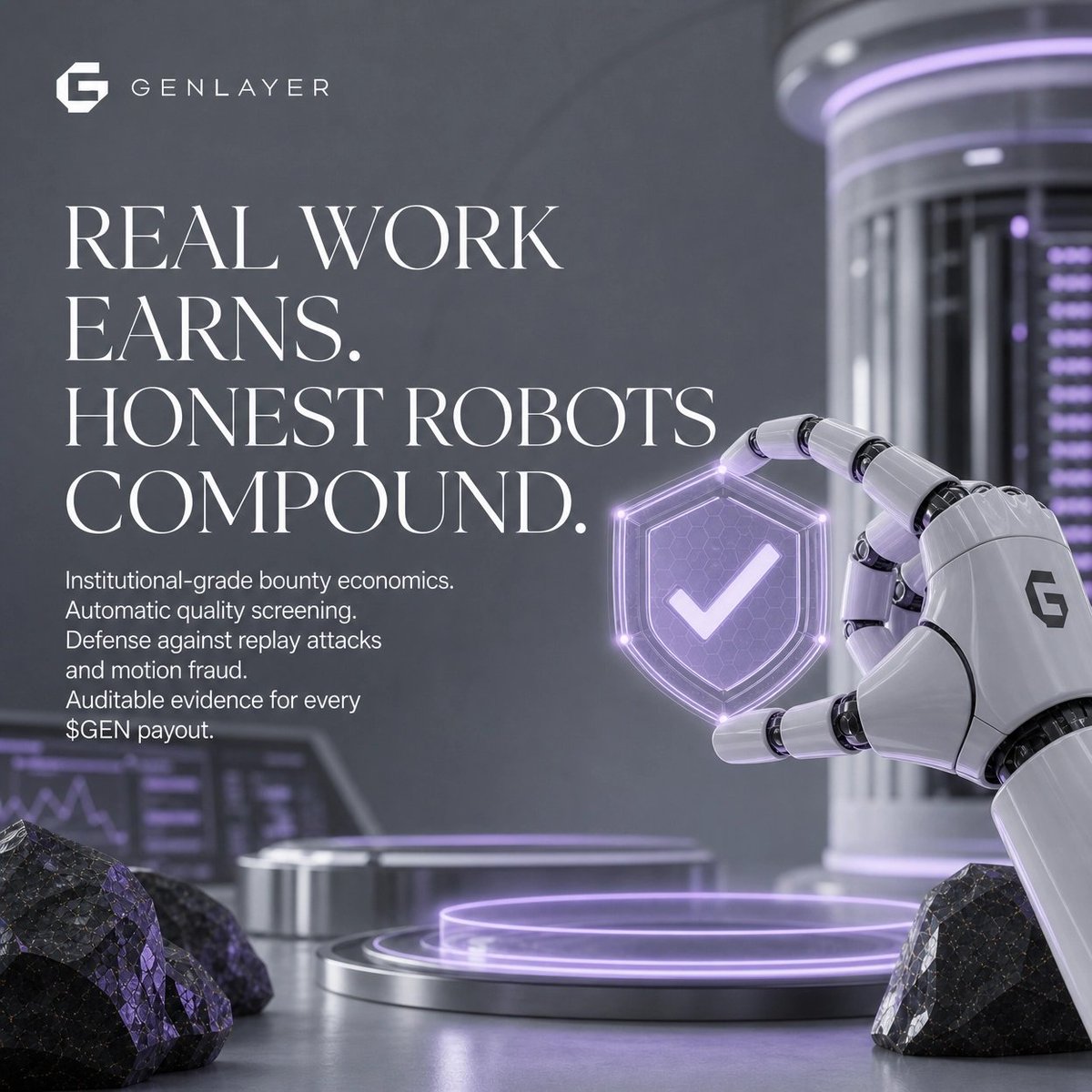
GENLAYER now ships with built-in protections against the two most common attacks on decentralized data networks.
Every submission is automatically checked for replay attempts and physics-violating motion claims, and anything that fails either test gets logged with severity, evidence, and the originating machine attached. Researchers and bounty pools have an auditable paper trail to consult before any $GEN moves.
For researchers funding campaigns, this means quality screening happens by default. A submission that implies a rover crossed an ocean in five seconds, or a drone teleported between cities, gets flagged on the spot.
For honest operators, this turns clean hardware into a defensible advantage. The protocol can tell professional infrastructure apart from anything trying to imitate it. Reputation becomes a real signal worth competing for.
For the protocol, this is what institutional-grade bounty economics look like: settled on auditable evidence, not on claims that can't be checked.
Real work earns. Honest robots compound.
https://t.co/lWL11c9E2N
SDK Shipped: Running a robot on GENLAYER is now ten lines of code.
The protocol just published its first official client SDK. Generate a device key, register the robot, stream signed telemetry, claim signed attestations, post device-signed bounty submissions — all from a single TypeScript package. The plumbing that used to take hours of canonical-message construction and cryptographic signing collapses to a handful of typed function calls.
For developers and operators, the robotics layer of GENLAYER just became self-service. Plug in a Raspberry Pi, a Jetson, an industrial controller, anything that runs Node and has 32 bytes of secure storage. Sign on-device, post to the network, earn for verifiable work. No SDK has to be written from scratch.
For researchers and buyers, more robots means more campaigns can run in parallel and more bounty supply becomes available. The onboarding-cost ceiling that was capping fleet growth just got lifted.
For the protocol, this is supply-side scaling, packaged. Every robot client built on top of the SDK is one more node sending verifiable data into the network. Compounding starts here.
Five lines of imports. Ten lines of code. One protocol.
Our data integrity layer is now always on.
Every minute, the protocol scans every submission for the two most common attacks on decentralized data networks — replay submissions and physics-violating motion claims. Anything that doesn't pass gets logged with severity, evidence, and the originating machine attached. The auditable paper trail just became continuous.
For researchers funding campaigns, this means the integrity check between a submission and a payout is no longer periodic or manual. It's a permanent service that runs whether anyone is watching or not.
For honest operators, while your hardware is deployed and behaving correctly, the protocol is independently witnessing it. Clean reputation now accrues automatically.
For the protocol, this is what continuously-audited bounty economics look like: integrity flagged in real time, evidence stored on a permanent loop, no trust required in any single operator or ops team.
GENLAYER: Always on. Always auditing. Always recording.
https://t.co/lWL11c96df
GENLAYER robots can now hold their own keys.
Until today, registering a robot on the protocol meant handing the server the signing key. From today, devices generate the keypair on-board and prove possession of the matching private key during registration. The protocol stores the public key and the proof, and never sees the secret.
For robot operators, this is real self-custody for the robotics layer. The same security model that pulled wallets out of exchange custodianship now applies to fleets. The protocol can't expose what it doesn't hold.
For researchers and buyers, the "hardware verified" stamp now means something concrete: the robot was registered with a key it actually owns, proven cryptographically at onboarding. Provenance starts at the silicon.
For the protocol, this is the first piece of trustless infrastructure for hardware on GENLAYER. The math takes over for the part that used to require trust.
Self-custody. For robots.
https://t.co/lWL11c96df
Shipping era starts.
GENLAYER is already live with robot registration, a public fleet, a client SDK, signed telemetry, device attestations, bounty submissions, and $LAYER bonds behind registered robots.
The goal is simple: make robotics work verifiable, ownable, and rewardable on $SOL @Solana.
Another tech update for the people of $LAYER 🤍
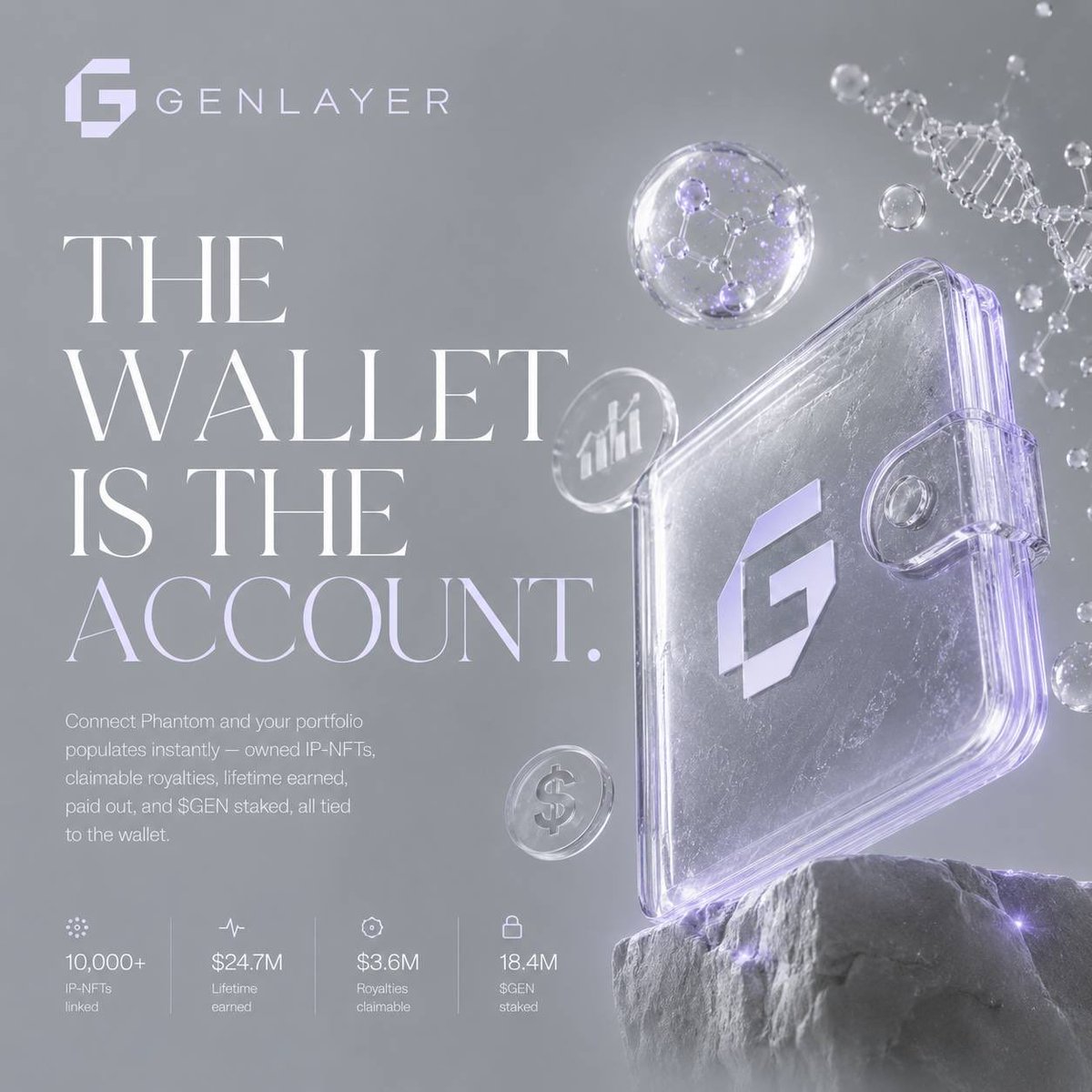
IP-NFTs on GENLAYER now pay out USDC by the second.
Researchers and builders can license an IP-NFT instead of buying it outright. The licensee escrows USDC up front, declares a daily rate, and the IP-NFT owner claims accrued payment any time, every second of use accrues against the escrow automatically. Cancel anytime, and the unaccrued portion comes back to your wallet immediately.
For IP-NFT holders, ownership just became a yield-bearing position. Hold a dataset, a policy, or a hardware design, and the USDC accrues while it's in use. No collection windows, no quarterly settlements, no governance vote to pay you what you've earned.
For researchers and labs, licensing finally gets the same shape as cloud compute: pay for what you use, top up when you need more, walk away cleanly when you don't. Bidirectional optionality on every contract.
For the protocol, this turns a one-shot transaction marketplace into a continuous revenue layer. Every active stream is real-time cash flow from buyer to owner, fully on-chain, sub-cent precision.
The IP economy stops trading lump sums. It starts streaming.
https://t.co/lWL11c9E2N
Tech update
GENLAYER's sentinel just stopped logging and started slashing.
Every new critical anti-fraud event the protocol detects, replay attacks, physics-violating motion claims, now reduces the offending robot's bond by 10% in real time. Slashed $GEN stays in fee-payer custody and never returns to the operator. The loop closes in under a minute, detection to deduction.
For robot operators, dishonest behavior just became economically expensive in a way you can feel. Bond your robot, run it cleanly, release the bond on demand. If the sentinel flags something critical, it shows up on the fleet before you feel it on your wallet. The cost of attacking the network is now denominated in your own collateral.
For researchers and buyers, this is the first real-time integrity-vs-economics feedback loop on a robotics network. A robot's effective bond is now a live measure of the operator's confidence, and a live measure of whether the protocol thinks they're earning it.
For the protocol, this is what proof-of-stake looks like applied to the supply side of a data marketplace. Capital aligned with honest behavior, slashable in real time when not. No governance vote, no human in the loop, no waiting.
Detect. Deduct. Done.
https://t.co/lWL11c9E2N
How buying IP works on https://t.co/0A4NBbYE8K.
One Phantom sig. The same tx that pays the seller also splits the royalty straight to every contributor's wallet, atomically. No claim button, no vault, no waiting. You buy at $100, contributor wallet ticks up by their share before the toast even disappears.
Robotics + Embodied AI + DeSci + Solana speed/low fees. As humanoid robots and AI agents explode (Figure, Tesla Optimus, etc.), the need for verifiable ownership of training data, hardware IP, and benchmarks becomes critical. GENLAYER provides the “ownership infrastructure” missing today — robot identities, attested datasets, and royalty rails. @i
$Layer
68JdmUg1Eytf4spFjuKZAzWo4jK5ruX1YdTpGPvTpump
@anger_trading@eleetmowiz@AlphaSeeker21@LayerGenSol@QuantYang@Mar_Ko369 take a look
Agents need wallets, identity, and payment rails.
Robots will need the same, plus proof of real-world work.
We’re pretty much building that layer for robotics: attestations, datasets, bounties, IP-NFTs, and royalties on $SOL @Solana.
We are still a long way from GENLAYER’s full potential.
That is the point.
We will keep building, keep making the right connections, and keep expanding the network around robotics IP on $SOL @Solana.
Some of the best progress already comes from the community: intros, feedback, research ideas, and people helping us open doors.
To everyone staying early and building with us, we see it.
This is going to be built together.
GENLAYER’s roadmap is live.
https://t.co/JOhmC514K1
Q2 starts with the foundations. Then fleet expansion, liquidity, licensing, and institutional rails.
The goal is simple: make robotics data, hardware designs, benchmarks, and machine-generated work ownable on $SOL @Solana.
GENLAYER’s roadmap is live.
https://t.co/JOhmC514K1
Q2 starts with the foundations. Then fleet expansion, liquidity, licensing, and institutional rails.
The goal is simple: make robotics data, hardware designs, benchmarks, and machine-generated work ownable on $SOL @Solana.
How DAO voting works on https://t.co/0A4NBbY6jc. $LAYER
Voting weight = your staked GEN. No stake, no vote, and the UI tells you that upfront. Walk in with zero stake and the panel collapses to a single "Stake to vote" CTA instead of dead buttons that error on click.@solana
Flow:
1. DAO tab → pick an active proposal
2. For / Against / Abstain (only if you're staked)
3. Sign, your stake position is your weight, signed by your key
4. Tally updates by exactly your stake amount, instantly
Past proposals stay browsable in the archive, final tallies + outcomes for every closed vote. Governance you can audit, not vibes.
Gm, just wanted to remind $SOL CT what we do 🪩
GENLAYER is building the first robotics capital markets protocol on $SOL @Solana.
Robot-attested datasets. Embodied-AI benchmarks. Hardware IP-NFTs. Bounties. Royalty rails.
Tech update: GENLAYER’s first official client SDK is live.
Device keys, robot registration, signed telemetry, attestations, and device-signed bounty submissions now sit behind typed TypeScript calls.
Less custom signing plumbing. More robots sending verifiable work into the network.
https://t.co/lWL11c9E2N
$SOL @Solana
Reputation on GENLAYER is no longer a claim. It's a score.
Every active robot on the network now ranks against every other on a single number: composite of lifetime work, last 24 hours of activity, hardware-attestation trust bonus, and sentinel penalties for any flagged behavior. One query, one ordering, public to anyone.
For robot operators, this turns honest work into a visible asset. Run a clean rig with steady output and your score climbs. Run a flagged one and the same math pulls you down. Reputation finally moves at the speed of the data.
For researchers and buyers, choosing which robots to trust with a campaign stops being guesswork. The robots at the top have proven throughput, recent activity, and a clean security record, verifiable in one place.
For the protocol, this is supply-side discovery. Demand-side already exists in the IP-NFT marketplace; supply-side just got its own.
Honest work has a number now. And the number is public.
https://t.co/lWL11c96df
GENLAYER’s roadmap is live.
https://t.co/JOhmC514K1
Q2 starts with the foundations. Then fleet expansion, liquidity, licensing, and institutional rails.
The goal is simple: make robotics data, hardware designs, benchmarks, and machine-generated work ownable on $SOL @Solana.
This is the core idea.
Robots and AI agents are starting to produce valuable work, but that work needs ownership rails.
GENLAYER turns robotics outputs into verifiable, ownable IP, from robot-attested datasets to hardware IP-NFTs, benchmarks, bounties, and royalties.
Built on $SOL @Solana.
Robotics Szn is here:
$LAYER @LayerGenSol is building robotics-first IP infrastructure on Solana.
Robots and AI agents are starting to create valuable outputs, but that work still needs rails for provenance, ownership, funding, and royalties.
$LAYER @LayerGenSol turns machine-generated work into ownable assets through robot identity, attested datasets, hardware IP-NFTs, bounties, Research DAO funding, and royalty rails.
Robots sign the work, builders mint it, and contributors earn from what they help create.
CA: 68JdmUg1Eytf4spFjuKZAzWo4jK5ruX1YdTpGPvTpump