$LPAD is live. Just launched on Ponsfamily. Live on Robinhood Chain.
0xba1f6cdcb34b9803aaf47fa183542b03a02092d2
LayerPad is the modular token launcher for Robinhood Chain. $LPAD is the protocol token that sits under that launcher. Today it is not a slide and not a date. It is a public market on Ponsfamily, the launch venue people on this chain already know how to use.
That is the point of launching there. Same chain. Same wallet. A book anyone can find without waiting for a private round to finish telling the story. You can read the pair. You can trade. You can watch the tape while the launch is still the news.
$LPAD is how the venue aligns with usage. People launch. People trade. Fees move. The token is the layer that is supposed to feel that activity, not a mascot parked next to the product. Ponsfamily is where that market opened. Robinhood Chain is where it settles.
If you have been waiting for the token, this is the post. Open the Ponsfamily page. Confirm you are on Robinhood Chain. Then trade $LPAD. The product lives at https://t.co/8PqdqA2UOV. The market is live now.
LayerPad is live. You can launch on three chains.
That is the whole announcement. Not a waitlist. Not a coming soon card. The launcher is open and the chain picker is part of the product. One flow. Three networks. You bring the token, you pick where it should live, you press EXEC.
Robinhood Chain is still the home surface. The other two networks sit next to it in the same session, with the same wallet, so you are not exporting a draft to a second app just to finish the launch. One launcher. Three networks. Open now.
If you have been waiting for LayerPad to feel like a real venue instead of a single chain page, this is that moment. Go to https://t.co/8PqdqA2mZn. Launch the token. Pick the chain. Make the market public.
A launchpad that cannot show the tape is only a form. LayerPad discovery is the public market list on Robinhood Chain. Search tokens. Read name, market cap, and twenty four hour change. See what is hot while it is still moving.
Find the tape means the launcher and the feed are the same venue. You do not deploy on one site and go hunting on another to learn if anyone showed up. Robinhood Chain carries the trades. LayerPad surfaces them live so a new token has a place to be found on day one.
Public markets only work if they are actually public. No invite wall. No delayed candle. A search box, a live table, and a chain that settles fast enough for the list to mean something.
Open https://t.co/8PqdqA2mZn and look at the tape before you launch into silence.
Liquidity that can leave is not liquidity. LayerPad locker is how you lock LP and set time locks so the pool on Robinhood Chain stays where traders can see it.
LP lock is for the pair itself. Time lock is for the clock. Together they turn a launch from a promise into a constraint. The market can still move. The book can still be thin. What should not happen is a quiet remove that shows up as a screenshot after the damage is done.
On chain means the lock is a contract, not a pinned message. Anyone on Robinhood Chain can verify the locker the same way they verify the pool. Transparent. Verifiable. Built to outlast a single announcement.
If you are launching and you want the lock to be part of the product, use the locker on https://t.co/8PqdqA2mZn.
Eighty to the creator. Twenty to the protocol. That is the LayerPad fee split on Robinhood Chain, and it is meant to be read at a glance.
Creator first is not a slogan on a docs page. It is the number. If people trade your token, you keep most of the fee. The protocol takes a smaller cut so the launcher, the indexer, and the later DEX can stay online. No hidden third wallet in the middle of the split. No story where the team earns first and the creator earns later.
Robinhood Chain settles that split in public. You can read the pool. You can read the fee. You can see who got paid. If a launchpad cannot show the split this cleanly, it is not creator first.
Read the fees at https://t.co/8PqdqA2UOV. Then decide if you still want to launch somewhere that keeps the larger share.
On Robinhood Chain a token should not be trapped in a single pair. LayerPad lets you launch against ETH, USDG, or stock tokens. AAPL. NVDA. TSLA. GOOGL. The quote asset is a choice, not a default you are stuck with.
That matters because the pair is the market. A token quoted in ETH behaves like crypto beta. A token quoted in USDG behaves like a dollar book. A token quoted in a stock token sits next to an equity people already understand. Same launcher. Same chain. Different books.
Pair with anything is the point of building on Robinhood Chain instead of copying a generic pump page. You bring the thesis. You pick the quote. LayerPad deploys the pool so the first trade happens in the pair you actually wanted.
See the tiles, then go set the pair at https://t.co/8PqdqA2UOV.
LayerPad is a three step machine on Robinhood Chain. Configure. Launch. Trade. That is the whole product, written in the order you actually use it.
Configure is where the token becomes real. Name. Pair. Supply. You decide what the market is before anyone can buy it. Launch is the moment the pool goes on chain and the page and the liquidity are the same object. Trade is the public tape. Anyone on Robinhood Chain can find it, read it, and take a position without waiting for a group chat to open the door.
Most launchpads hide the middle step. They let you fill a form, then someone else finishes the market later. LayerPad does not do that. Robinhood Chain is fast enough that configure, launch, and trade can live in one session, with one wallet, on one site.
If you want the flow in plain language, this is it. Open https://t.co/8PqdqA2UOV. Walk the three cards. Press EXEC when the setup is honest.
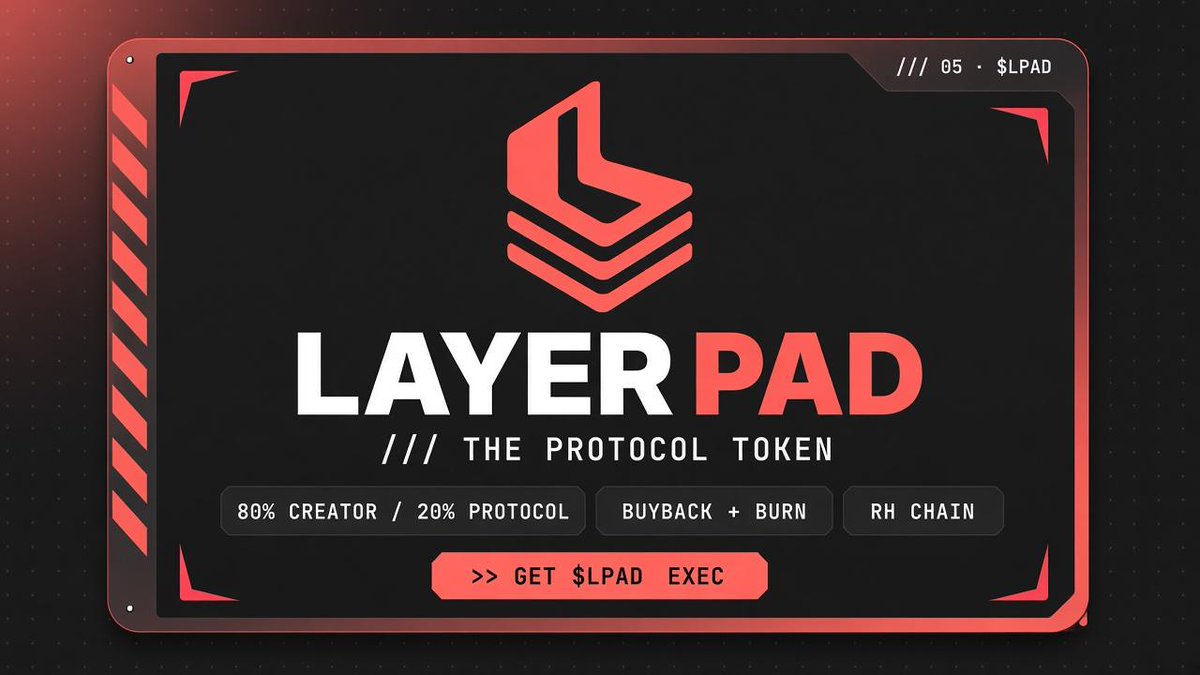
$LPAD is the protocol token for LayerPad. It is not a mascot. It is how the venue pays itself and how the venue pays creators.
Fee split is creator first. Eighty percent to the creator. Twenty percent to the protocol. Protocol revenue is aligned with the token through buyback and burn, so usage of the launcher and the DEX is supposed to show up in $LPAD, not only in a treasury slide.
That is the loop. People launch. People trade. Creators keep most of the fee. The protocol takes a smaller cut, then uses it to tighten supply. RH Chain is the settlement layer. $LPAD is the alignment layer.
If you want the token that sits under the launcher, this is it. Get $LPAD at https://t.co/8PqdqA2UOV. Read the fees. Watch the burn. The product and the token are the same machine.
On chain migration is how a launch becomes a market that lasts. Phase 1 is the launcher. You deploy into a Uniswap V3 pool and the token is tradable immediately. Phase 2 is the DEX. Native V2 and V3, wired into the same LayerPad stack so migration is not a rumor and not a screenshot.
Transparent. Verifiable. Built for the future. Those three words are the design constraint. Anyone should be able to read the pool, check the fees, and see that liquidity did not vanish into a side wallet. The path from launch to venue is public.
Too many tokens die in the gap between “we launched” and “we have a real market.” LayerPad closes that gap on chain. The launcher is not a dead end. It is the first room in a larger exchange.
If you want a token that can graduate without a trust me post, this is the flow. Phase 1 launcher. Phase 2 DEX. Same protocol. Read it at https://t.co/8PqdqA2UOV.
Robinhood Chain is fast enough that a launchpad should feel instant. LayerPad is built for that speed. The interface is industrial on purpose. Hazard marks, live status, EXEC. You should know when the chain is online and when your token is actually live.
Speed only matters if the state is honest. LayerPad keeps the launcher and the market on the same chain, in the same session, with the same wallet. No export to a second app to finish the job. No delay while someone wires liquidity by hand.
RH Chain ONLINE is the point. Low latency, public settlement, and a launcher that does not get in the way. Built for speed means the click and the pool are close enough that you can feel it.
LayerPad is the token layer on Robinhood Chain. If you care about where new markets open, watch this surface at https://t.co/8PqdqA2UOV.
Most token launches still feel like a back room. A spreadsheet. A group chat. A pool that appears after the story has already been told. LayerPad is the opposite of that. You configure the token, you pick the pair, you launch, and the market is public from the first trade.
This is a seamless token launcher on Robinhood Chain. ETH, USDG, and stock tokens as quote assets. Uniswap V3 under the hood. No theatre around who got in first. The curve, the pool, and the page are the same object.
Launch Your Token is not a slogan. It is the product. You bring the name, the image, and the thesis. LayerPad turns that into a live market that anyone can find, read, and trade.
If you have been waiting for RH Chain to feel like a real launch venue, this is that venue. Open https://t.co/8PqdqA2UOV, walk the flow, and ship.
LayerPad is the modular token launcher for Robinhood Chain. Not a landing page with a connect button and a hope. A full stack for people who want to create a market, route liquidity, and stay on chain from the first block.
The idea is simple. You should be able to launch a token without assembling a dozen tools, a private group of insiders, and a week of guesswork. LayerPad puts the launcher, the pool, and the discovery surface in one place so the token is live the moment you confirm.
LAYER is the system. PAD is the surface you actually use. Together they are built for speed, for clarity, and for creators who want the market to open in public.
If you are launching on Robinhood Chain, start here. https://t.co/8PqdqA2UOV. Seamless token launcher. Press EXEC when you are ready.
LayerPAD is a trust minimized, multichain token launch protocol.
What that means concretely a creator can deploy a token once and have it land with real, immediately tradeable liquidity on @RobinhoodCrypto , @ethereum, and @base at the same time, at the same contract address on every chain, in a single atomic transaction.
Trust minimized isn't a marketing descriptor here. It refers to a specific architectural property the mechanism that moves supply between chains @LayerZero_Core V2's burn then mint model, verified by a Decentralized Verifier Network structurally prevents any party from minting supply that wasn't already burned somewhere first. The team cannot do it. The relayer cannot do it. The bridge cannot do it.
No bonding curve. No migration step. No LP position the creator can rug it's burned in the same transaction that builds the pool.
That's the product.
Learn more: https://t.co/TU2tgLLtXU
Launching a token on a single chain is not a neutral decision. It is a constraint.
Users on other chains must bridge before they can participate, adding friction that can turn organic demand into a multi-step onboarding process. Liquidity is concentrated in one ecosystem instead of meeting users where they already are.
Expanding later introduces another question: how do you move supply across chains without adding custodial risk or new trust assumptions?
LayerPAD starts from a different premise.
Multichain should be part of the launch itself, not an afterthought.
One deployment. Real liquidity across up to three chains. A unified launch architecture designed to minimize additional trust assumptions.
Multichain, by design.
How to launch a token on LayerPAD
1/ Connect your wallet
Go to https://t.co/TU2tgLLtXU and connect your wallet.
2/ Create your token
Enter your token name, ticker, total supply, and required details.
3/ Configure your launch
Set your launch parameters and select your supported chains.
4/ Review
Double check your configuration before deployment.
5/ Deploy
Confirm the transaction and deploy your token.
6/ Go live
Your token is ready for the market.
Built for multichain launches across Robinhood, Base, Ethereum.
→ Launch at: https://t.co/TU2tgLLtXU
→ Join the community: https://t.co/iUXNhniIrI
Important:
The official LayerPAD token has NOT launched yet.
Please wait for an official announcement from LayerPAD regarding the token launch.
Beware of unofficial tokens or impersonators.
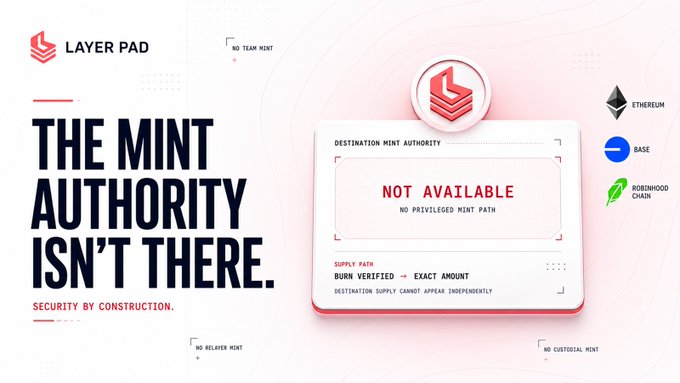
The Mint Authority Isn’t There.
Multichain infrastructure introduces an important security consideration who has the authority to create token supply on a destination chain?
In custodial bridge designs, that authority may depend on privileged contracts, operators, relayers, or keys. If compromised, the destination supply can diverge from the intended supply model.
LAYERPAD takes a different approach.
Rather than relying on privileged minting authority, the protocol is designed around a verifiable supply path
Burn verified → Exact amount → Destination supply
No team mint.
No relayer mint.
No custodial mint.
Security by construction.
LAYERPAD is building multichain infrastructure where supply integrity is enforced by the system itself not by trusting a privileged actor to behave correctly.
Most token launches are stuck on ONE chain.
Pick a chain.
Build liquidity.
Then watch everyone else struggle to access your token.
LayerPAD flips the whole model.
Deploy ONCE.
Launch THREE chains simultaneously.
- Robinhood
- Ethereum
- Base
One contract address.
Real liquidity.
LP burned.
Anti-snipe protection.
No bonding curve.
No migration.
No wrapped tokens.
No middleman.
One transaction. Three chains. Multichain by design.
This isn't a roadmap promise.
It's the mechanism.
Welcome to multichain launches.
Welcome to LayerPAD.