Two weeks ago, Ethereum researchers met in Berlin to continue charting the protocol's long-term trajectory, following along discussions with client teams in Svalbard in April.
The updated strawmap is at https://t.co/9e2AQ6rhz6, and I attached a picture of it to this post.
My own high-level takeaways:
* "Lean Ethereum" is not a single one-shot upgrade, it is a collection of improvements that will come online to the Ethereum network over the course of three or four years. But make no mistake, this IS the third major iteration of Ethereum in the same way that the Merge was the second. Almost every major piece of the protocol will be replaced:
- Verification through recursive STARKs, rather than direct re-execution. Recursive STARKs become an enshrined first-class core component of the protocol
- Replacing everything quantum-vulnerable with quantum-safe alternatives
- Consensus: decoupled available chain and finality, one or two-round finality. Theoretically optimal security properties, simpler than today, and faster than today
- Multidimensional gas
- State: not just tree structure, but what *types* of state are available
- Changes to client architecture
...
At the same time, simplification, cleanup and future-proofing. And this will all be done in a way that minimizes disruption to existing application. We've done this before (the Merge), we can do it again.
* H-star (aka Hegota) is probably Ethereum's last thematically "pre-Lean" fork. Starting from I-star, most of everything we do will have a very strong "Lean" feel to it in one way or another.
* Privacy is no longer an afterthought, it is a first class goal. When designing Frames, the mempool, additions to the state tree, we explicitly ask the question "okay, how do quantum-safe, intermediary-free privacy protocol transactions go through this, and what is the overhead?"
* Formal verification of everything for security.
* FV also makes us much more comfortable with canonicalization (having pieces of the protocol that are directly defined as a piece of bytecode expressed in some language). evm-asm is being written in part to become a canonical proof system for the EVM.
* Quantum safety has shifted up a LOT in priority. This adds a lot of work (eg. finalizing a quantum-safe blobs design has become urgent; this work has already been ongoing for months)
* Probably the single most disruptive part of the plan is the changes to state. There is growing consensus around leaving present-day-style "dynamic state" mostly unchanged, but scaling it only a medium amount, and adding new types of state that are more scalability-friendly (eg. no need for builders to sync/store all of it) but more restrictive, and that will scale a large amount.
eg. possible Ethereum in 2030: 2 TB of present-day-style (dynamic) state, and 100 TB of new-style (scalable but restrictive) state
This "new-style" state would work very well for ERC20s, NFTs, many defi use cases, but not eg. highly "central" objects like Uniswap contracts, or onchain order books, or other complex things (which are crucial for Ethereum but which only take up a small percentage of state)
Hence, it will not be *necessary* to rewrite any apps, but it will be *very cost-effective* to eg. rewrite an ERC20 token into a newer design that uses a new type of UTXO storage that is currently being explored, so that it will have >10x lower txfees.
Design of these new state types (current ideas: keyed nonces, ring buffers, UTXOs, statically accessible state, temp state) is an area where we will need a lot of feedback from application developers (incl. privacy-friendly application developers) and probably several rounds of rethinking and iteration.
* In the context of a much larger total state size, we need to figure out the incentive issues around who stores this state and what motivates them to. Even saying "each node stores 1%" is not good enough - why do they store that 1% and why are they willing to serve it? This is being elevated as a first-class research area.
* Ethereum will need to have a "VM" other than EVM in one form or another - at the very least, we need something like leanISA for recursive STARKs - and the gains are large in exposing it to users so that we support programmable privacy and better scalability. Right now, the most likely contenders are leanISA and RISC-V.
My own ideal is that in this world, we adjust the protocol so that the EVM becomes a high-level-language compiler-level feature, and the protocol only "sees" RISC-V / leanISA directly. But this is still far away.
* Gas limit increases, blob increases and slot time decreases will happen many times over the next ~5 years. We expect a large gas limit increase with Glasterdam. Each step of increased scale or decreased slot time is a matter of getting to the point where it is safe to do it, which comes from a combination of client optimization and protocol changes.
Ethereum is CROPS.
Ethereum is scaling.
Ethereum is reinventing itself.
Onward.
Je vais partir du principe que tu es de bonne foi, parce que ton raisonnement est intuitif et que 90% des gens le partagent. Mais il repose sur trois erreurs factuelles, et ça vaut le coup de les regarder calmement.
Erreur 1 : la fortune d'Elon n'est pas un tas d'argent. C'est de la propriété d'usines, de fusées et de satellites. "Prendre la moitié de sa tune", concrètement, ça veut dire forcer la vente de la moitié de SpaceX et Tesla. L'argent ne sort pas d'un coffre, il sort des entreprises elles-mêmes, qui passent sous contr��le de fonds étrangers ou d'États. Tu ne redistribues pas du cash, tu démantèles un outil de production. C'est la différence entre récolter des pommes et découper le pommier.
Erreur 2 : "ça résout énormément de problèmes dans le monde". Cette expérience a déjà été tentée, en vrai. En 2021, le directeur du Programme Alimentaire Mondial de l'ONU a affirmé que 6 milliards de Musk pouvaient "résoudre la faim dans le monde". Réponse d'Elon : décrivez-moi exactement comment, comptabilité publique à l'appui, et je vends mes actions Tesla immédiatement. Le PAM a publié son plan. Verdict : ce n'était pas "résoudre la faim", c'était nourrir 42 millions de personnes pendant un an. Un an. Puis il faut re-payer, pour toujours. Le PAM avait d'ailleurs levé 8,4 milliards l'année précédente, et la faim était toujours là. Les ONG traitent les symptômes en boucle, jamais les causes, parce que leur financement dépend de l'existence du problème.
Erreur 3, la plus importante : tu cherches ce qui sort vraiment les gens de la pauvreté. Bonne nouvelle, on a la réponse, et elle est massive. En 1990, 36% de l'humanité vivait dans l'extrême pauvreté. Aujourd'hui, moins de 9%. Plus d'un milliard de personnes sorties de la misère en 30 ans. Par quoi ? Pas par la charité ni par l'aide internationale (plus de 1 000 milliards versés à l'Afrique en 60 ans pour un résultat à peu près nul). Par l'ouverture des marchés, l'industrialisation, le commerce. La Chine seule a sorti 800 millions de personnes de la pauvreté en abandonnant le collectivisme, pas en taxant ses entrepreneurs.
Donc fais le calcul complet. Option A : tu confisques 500 milliards, tu finances quelques années de programmes, l'argent est consommé, et tu as détruit la machine qui produisait les fusées, les voitures électriques et l'internet des zones rurales. Option B : tu laisses le meilleur allocateur de capital de sa génération réinvestir 100% de sa fortune dans des industries qui baissent les coûts pour tout le monde et emploient des centaines de milliers de personnes. L'option A soulage ta morale pendant 18 mois. L'option B sort des populations entières de la pauvreté pour toujours.
La pauvreté ne se redistribue pas. Elle se résout par la création. C'est contre-intuitif, c'est frustrant, mais c'est ce que disent 200 ans de données.
@anonyme14041977@MRadarCrypto Tu sais que si tu vis là bas tu vas surement depenser plein d’argent chaque mois dans l’économie locale. Un loyer, des courses, restaurants, activités, services… les taxes ne sont pas le seul moyen de faire tourner un pays…
📲 Saviez-vous que dans iOS 27, Apple a prévu une liste de pays où le chiffrement des messages RCS (SMS) est interdit ?
Chine 🇨🇳. Corée du Sud 🇰🇷. France 🇫🇷.
Le reste du monde déploie l'E2EE, le chiffrement de bout en bout entre iPhone et Android. Une avancée majeure pour la confidentialité de vos SMS.
En France, c'est bloqué.
Les opérateurs sont prêts techniquement. Ce n'est pas un problème d'infrastructure. C'est un choix politique.
Les raisons sont multiples, la France ayant toujours une longueur d'avance pour affaiblir votre sécurité et s'assurer de pouvoir garder un oeil sur vous. Mais l'une des pistes probables : La PNIJ - la Plateforme Nationale des Interceptions Judiciaires. Un outil qui permet à l'État d'accéder à vos communications. Le chiffrement de bout en bout sur ces millions d'échanges quotidiens lui couperait l'accès. Définitivement.
Alors notre gouvernement fait tout pour que vous restiez exposés.
I have never seen so many people capitulating out of $ETH or crypto.
Some are writing blogs and essays explaining why it failed, mainly naming how other chains won the race, measured by fees taken in.
Some of my thoughts, in these hard times:
Time will tell, but I think many people are mistaken in treating $ETH like an end-stage $AMZN, as if the main question is already about mature margins, fees, and cash flows.
In reality, Ethereum is still very much earlier in its economies-of-scale phase, with nearly all metrics in the top right corner and growing at mid double digits to tripple.
Furthermore, most of the market is focused on the wrong battle: who can become the fastest and cheapest payment processor.
Lower fees, higher throughput, faster settlement. But that is likely a race to commoditization, similar to the payment processors crash over the last years.
If the only value proposition is speed and cost, then the moat gets thinner over time, easy disruptable. Someone can always be faster. Someone can always subsidize fees lower. Someone can always optimize one narrow use case.
The real value may not be in the transaction fee itself.
The real value is likely in the amount of economic activity secured by the network, the credibility of that security, the neutrality of the base layer, and the difficulty of replacing it once enough assets, applications, institutions, and users depend on it.
That is where Ethereum seems different to me and why so many institutions are choosing $ETH.
Most other projects still feel replaceable. They may have better performance in one area, better UX in another, or lower fees in the short term. But if their advantage is mainly technical efficiency, that advantage can be copied, competed away, or made irrelevant.
The newest hottest thing today is replacing the hottest thing from last quarter.
Ethereum’s bet appears to be much larger: become the most secure, decentralized, credibly neutral settlement layer for the internet economy.
Not the cheapest rail.
The hardest rail to replace.
In the end, the most valuable network may not be the one with the lowest transaction costs. It may be the one people trust most to secure the highest-value assets and applications over the longest period of time.
If $ETH can retain its market share while continuing to scale through upgrades that improve speed, throughput, and fees, its potential remains significant, especially if AI agents become truly crypto-native.
If it combines all of the above and earn the crown as the leading value-secured network, then $ETH could eventually be viewed as something like a truly decentralized, inflation-adjusting global bond: securing the world’s assets, free from political meddling, and deserving of a premium market cap because of the value it protects on top of the deflationary pressures create incentives to stake, get yield and trust the equivalent of buybacks and griwth in value secured to provide additional value.
Keep in mind over 1/3 of $ETH is now staked!
In that scenario, $ETH would not just be another asset to hold. It could become one of the only truly neutral and secure bonds for the digital economy.
... But sure, lets compare it to $SOL with 6% inflation, no moat, no security, massive outages, decreasing validator nodes and alike.
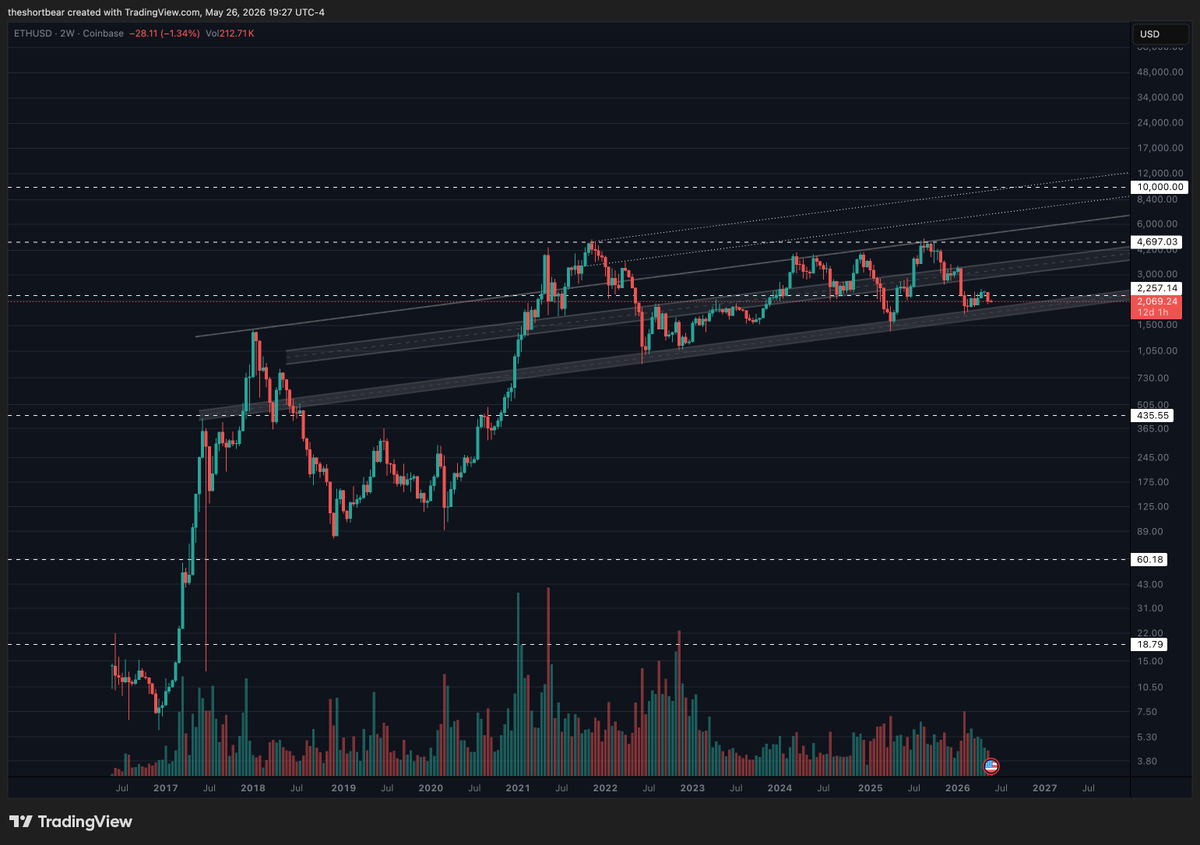
it just all feels like people are getting lost in short term fees and the easiest valuation attempt rather than what $ETH is actually built for, all while its testing its bottom range and players go full portfolio into AI.