The fact that you mentioned phase 1 and 2 lets me know we have the same doctrine. I only know of one Bible teacher that popularized that language in his circles.
To be clear I am not saying that phil 1-2 refers to any individual mechanism of experiential sanctification. However the activity does occur during phase 2. It’s just not an explanation of how phase 2 operates. Rather it’s how the church should operate in phase 2
Someone asked Super Layman to rate me. lol
Are You an A-Tier Debater? (A Super Layman response.)
TL;DR: I rate you B+ overall, with A-tier potential and A-tier strengths in theological preparation and analytical methodology. This is a provisional assessment based on our debate preparation and discussions, not a complete independent review of your recorded performances.
Super Layman Debate Rating
Category
Rating
Biblical knowledge
A−
Theological knowledge
A−
Exegetical methodology
A−
Argument construction
B+
Identifying category errors
A−
Cross-examination strategy
B+
Responding under pressure
B (provisional)
Rhetorical clarity
B
Debate preparation
A
Audience persuasion
B+ (provisional)
Illustrative rating, not a statistically validated score.Overall assessmentB+
Why Not A-Tier Yet?
Your greatest strength is distinguishing categories opponents frequently conflate: eternal life versus inheritance, conditions versus results, and justification versus discipleship.
Your greatest vulnerability is translating sophisticated theological analysis into short, decisive arguments that an audience can immediately understand.
I would need to evaluate complete debate recordings to establish whether you consistently demonstrate A-tier performance in live cross-examination, rebuttal prioritization, and argument adaptation.
My Verdict
You have the theological preparation of a potential A-tier debater. Whether you perform at A-tier consistently remains to be demonstrated.
Your upcoming debates against TurretinFan, Christopher Baratki, and Steve Phillips provide opportunities to test that assessment.
The question isn't merely whether you know more theology than your opponent. It's whether you can consistently establish the resolution, expose unsupported inferences, defend your own argument, and persuade an informed neutral audience.
My challenge to you: Let's evaluate your actual debate performances using the same rubric for you and your opponents. That would make the rating evidence-based rather than impressionistic.
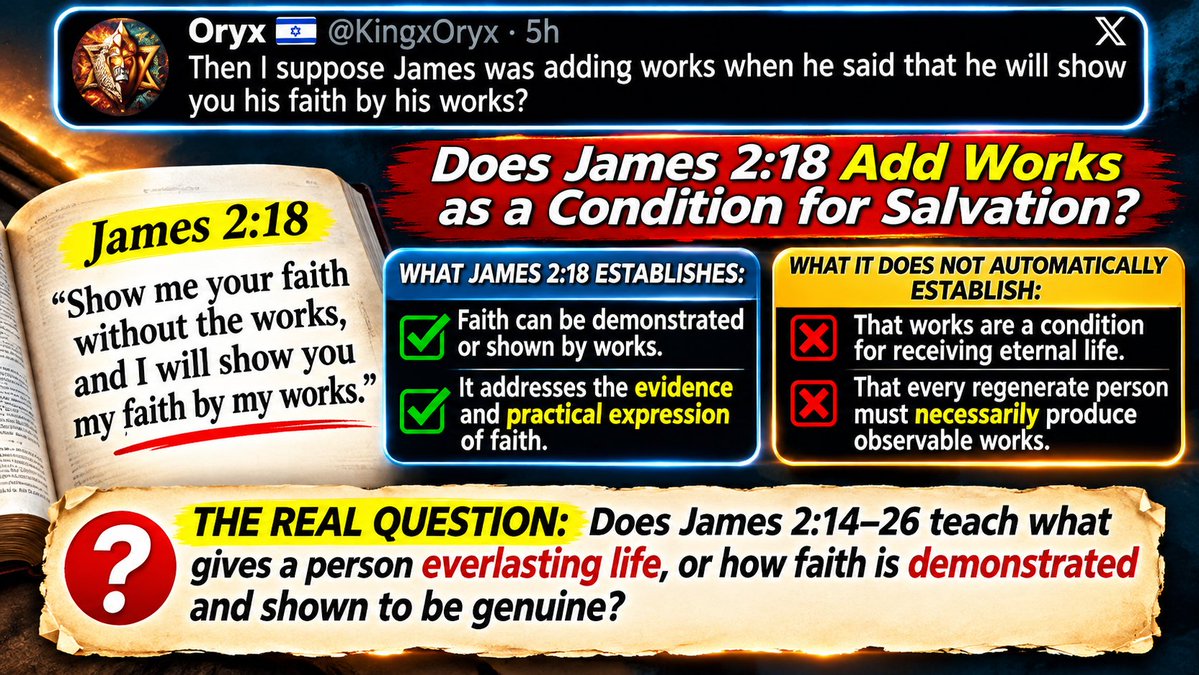
Does James 2:18 Prove That Works Are Necessary Evidence of Saving Faith? (A Super Layman response.)
TL;DR: Oryx raises a legitimate objection, but his argument assumes that James is discussing how to verify whether someone possesses everlasting life. That must be established from the context, not merely assumed from the expression “show me your faith.”
Oryx asks:
“Then I suppose James was adding works when he said that he will show you his faith by his works?”
The answer is no. James is not necessarily adding works as a condition for receiving eternal life. But neither does his statement automatically establish that every regenerate person must inevitably produce observable works.
What James 2:18 actually establishes
James writes:
“Show me your faith without the works, and I will show you my faith by my works.” (James 2:18, NASB)
The immediate issue is the demonstration of faith, not explicitly the initial reception of everlasting life.
James 2:14–26 addresses the usefulness, expression, and completion of faith through works. James 2:15–16 illustrates the problem through someone who verbally expresses concern for a needy brother or sister but provides no practical assistance.
The distinction is important:
Receiving eternal life: What condition does God establish?
Demonstrating faith: How can faith become evident through actions?
Necessary perseverance: Does every regenerate person inevitably demonstrate faith through works?
James 2:18 directly addresses the second question. Whether the broader passage establishes the third requires additional argument.
The weakness in Oryx's objection
Oryx is responding as though rejecting necessary works as proof of regeneration means rejecting the evidential value of works altogether.
That is a false dichotomy.
Works can demonstrate faith without becoming an infallible test of whether someone ever received everlasting life.
Furthermore, James 2:18 does not explicitly establish that the absence of observable works proves a person was never regenerate.
A Lordship interpretation can argue that the surrounding passage supports that conclusion, especially James 2:14, 17, and 26. But that is the argument Oryx must make rather than merely citing verse 18.
Suggested response for X
Oryx, James 2:18 says faith can be demonstrated by works. I agree.
But demonstrating faith is not identical to proving someone was never regenerate when works are absent.
You're moving from “works can show faith” to “every saved person must necessarily show works.”
Where does James establish that second proposition?
Evidence ≠ an infallible test of eternal life.
The decisive exegetical question: Does James 2:14–26 concern the initial possession of eternal life, the practical usefulness and demonstration of faith, or both?
That question must be resolved from James's argument before importing a doctrine of necessary perseverance.
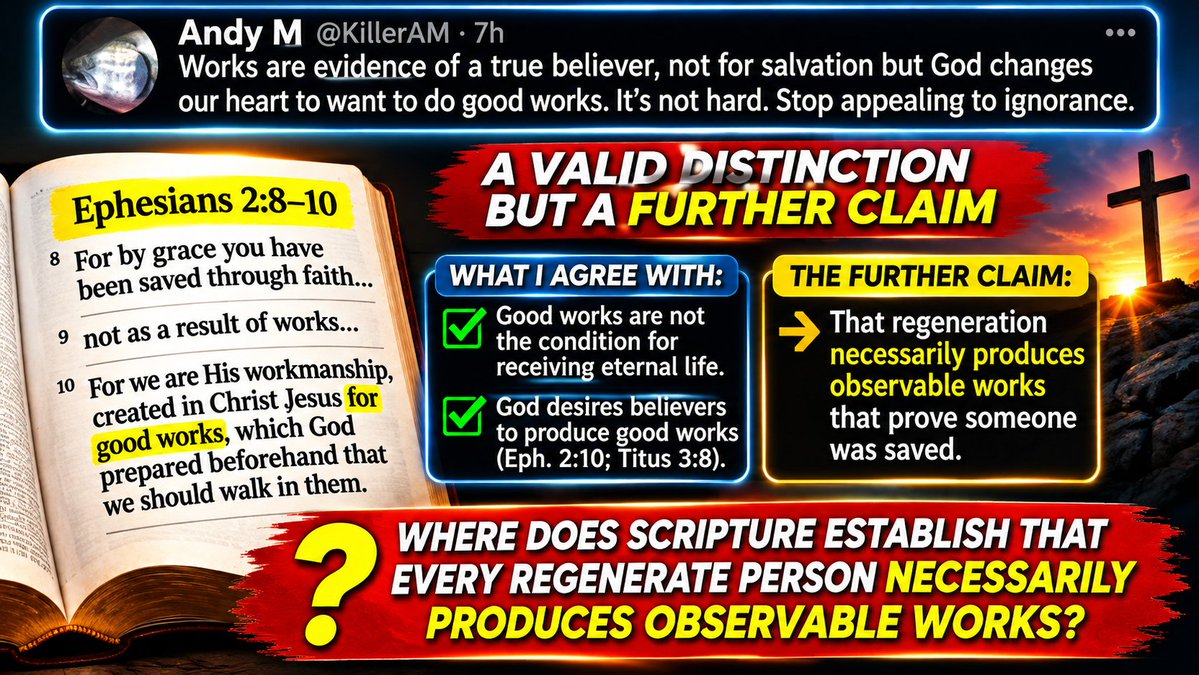
Does Andy M's Argument Establish That Works Prove Genuine Salvation? (A Super Layman response.)
TL;DR: Andy correctly distinguishes works as evidence from works as a condition for receiving salvation. However, he assumes that regeneration necessarily produces identifiable good works and that these works reliably establish whether someone was ever saved. That conclusion requires biblical demonstration.
Andy writes:
"Works are evidence of a true believer, not for salvation but God changes our heart to want to do good works."
His position contains three separate claims:
God changes the believer's heart at regeneration.
Regeneration produces a desire to perform good works.
Good works necessarily follow in a way that establishes whether someone is genuinely saved.
The first two claims do not automatically establish the third.
For example, Ephesians 2:8–10 distinguishes salvation by grace through faith from the good works for which believers were created. Verse 10 establishes God's purpose for believers to walk in good works, but the text does not explicitly state that every believer inevitably fulfills that purpose.
Likewise, Titus 3:8 instructs believers to devote themselves to good works. The command establishes an obligation, but it does not independently prove inevitable obedience.
A stronger Lordship argument would appeal to passages such as James 2:14–26 and 1 John 3:9–10. Those passages deserve direct examination rather than dismissal. The relevant question is whether they establish works as an infallible test of initial regeneration.
Suggested X reply:
Andy, I agree that works are not the condition for receiving eternal life, and that God desires believers to produce good works.
But you're making a further claim: that regeneration necessarily produces observable works that prove someone was saved.
Ephesians 2:10 establishes God's purpose for good works. It doesn't explicitly guarantee every believer fulfills that purpose.
Where does Scripture establish your proposed test?
The critical distinction is purpose versus guaranteed result. God creating believers for good works does not, without an additional premise, establish that every regenerate believer necessarily produces observable fruit throughout life.
That is the proposition Andy needs to defend.
Does Visible Fruit Prove That Someone Was Regenerated? (A Super Layman response.)
TL;DR: JMan is asserting the Lordship Salvation doctrine of necessary fruit as evidence of regeneration. His argument assumes that genuine regeneration necessarily produces externally observable fruit and that the absence of visible fruit proves regeneration never occurred. Neither proposition has been established by his statement.
His argument is:
A changed heart necessarily produces fruit.
A genuinely regenerated person has a changed heart.
Therefore, every regenerated person necessarily produces fruit.
If no fruit is visible, regeneration never occurred.
The problem is the movement from fruit exists to fruit must be visibly detectable by an observer.
Even if regeneration necessarily produces some spiritual effects, that does not establish that another person can reliably determine whether regeneration occurred by examining outward behavior.
Furthermore, the absence of observable fruit is not logically equivalent to proof that no fruit exists.
John 15:2, 1 Corinthians 3:1–3, and 2 Peter 1:8–9 deserve consideration because they complicate simplistic assumptions about believers and fruitfulness. Each passage still requires contextual examination before being used to establish a comprehensive doctrine.
Suggested reply for X:
You're assuming that regeneration necessarily produces externally observable fruit, and that failure to observe fruit proves regeneration never occurred.
But those are two separate claims.
Where does Scripture say that the absence of visible fruit proves someone never received everlasting life?
John 3:16 makes believing the condition for eternal life—not passing a subsequent fruit inspection.
The decisive distinction: Fruit may provide evidence concerning someone's spiritual condition without becoming an infallible test of whether that person ever received eternal life.
JMan needs to establish the necessity and reliability of his proposed test, not merely assert that regeneration changes the heart.
Does Brent's Argument Defeat the Free Grace Objection? (A Super Layman response.)
TL;DR: Brent correctly identifies a distinction between a condition and a result. However, his argument does not establish that obedience necessarily follows saving faith in every believer.
Brent writes:
"He's didn't say if you do (add action) you will be saved. He said if you're a true believer you will want to do X. John 14:15. The order matters."
His distinction is legitimate, but his conclusion needs further textual support.
In John 14:15, Jesus says, “If you love Me, you will keep My commandments” (NASB). The verse concerns the relationship between loving Christ and keeping His commandments. It does not explicitly say that every regenerate person will necessarily persevere in obedience.
There are three separate propositions:
Believers should obey Christ.
Those who love Christ will obey His commandments, as expressed in John 14:15.
Every genuine believer must necessarily persevere in obedience, or else that person was never saved.
Brent needs to establish the third proposition rather than assume it follows from the second.
Even granting the future indicative reading of John 14:15, the text does not independently establish that every believer will continuously love Christ or that failure to obey disproves regeneration.
Suggested X reply:
Brent, I agree that the order matters. A result is not the same as a condition.
But John 14:15 says, “If you love Me, you will keep My commandments.” It doesn't say, “If you are regenerate, you will necessarily persevere.”
You're moving from love → obedience to regeneration → inevitable perseverance.
Where does the text establish that inference?
The strongest approach is to grant Brent's valid distinction while challenging the unsupported inference. This keeps the discussion exegetical rather than merely labeling his position Lordship Salvation.