Imagine a man so brilliant that 2,200 years later, we still speak his name with awe.
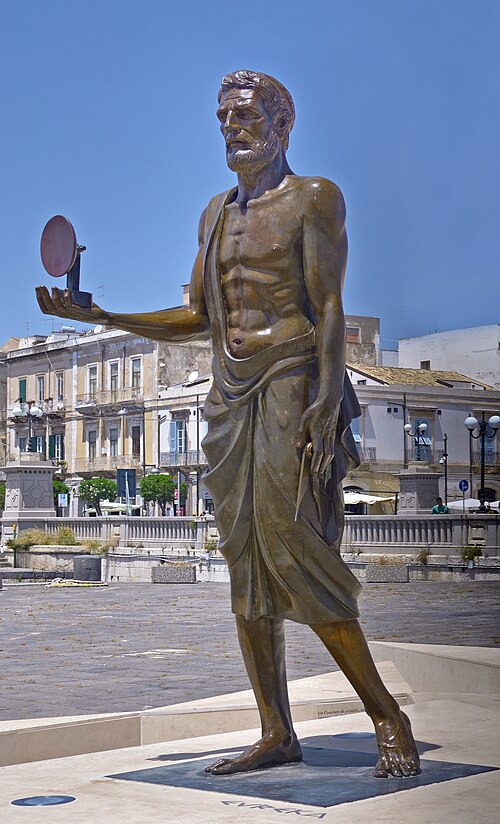
A man so ingenious to build pumps for irrigation still used today, mirrors that could burn ships at a distance and much more.
His name was Archimedes of Syracuse (c. 287–212 BC).
Born in the ancient Greek city-state of Syracuse in Sicily, this legendary mathematician, physicist, and inventor didn’t just study the world, he bent it to his will.
He calculated π with astonishing precision using the “method of exhaustion,” proved that a sphere’s volume is exactly two-thirds of its surrounding cylinder (a discovery he cherished above all others), and laid the earliest foundations of calculus centuries before Newton.
He also wrote The Sand Reckoner, where he devised a system for expressing extremely large numbers and estimated how many grains of sand would fill the universe.
One day, while stepping into his bath, he discovered the principle of buoyancy, now known as Archimedes’ Principle, and famously ran naked through the streets shouting “EUREKA!” (“I have found it!”). He gave us the law of the lever, boldly declaring: “Give me a place to stand and a lever long enough, and I shall move the Earth.”
But Archimedes wasn’t just a thinker. He was a genius inventor.
He created the Archimedes Screw, a revolutionary water pump still used around the world today. He designed powerful compound pulleys and cranes. And when the Roman army besieged Syracuse during the Second Punic War, he became a one-man defense force, engineering devastating catapults and the fearsome “Claw of Archimedes,” a massive crane that lifted enemy ships out of the water and smashed them against the rocks.
Ancient writings even credit him with inventing burning mirrors, giant arrays of polished bronze that focused the sun’s rays to set Roman warships ablaze from afar. While historians still debate the exact details, modern experiments have proven the idea is scientifically possible under the right conditions.
In 212 BC, when Roman forces finally breached the city, General Marcellus gave strict orders: spare Archimedes. Yet as the great thinker sat drawing mathematical diagrams in the sand, a Roman soldier killed him.
His last words? “Do not disturb my circles!”
His surviving works shaped Galileo, Leibniz, Newton, and the entire Scientific Revolution. He remains one of the greatest minds humanity has ever produced — a bridge between ancient genius and modern science.