Your Android phone can be the virtual number. Stop paying Twilio.
Sending SMS from your code usually means paying a provider like Twilio.
You buy a virtual phone number, pay per message, and hope your country is supported.
In many countries, you can't even buy a virtual number.
There is a simpler way:
use a real phone. You already have a SIM card and an SMS plan.
Why not let your code use it?
The developer behind httpSMS is from Cameroon. He couldn't buy a virtual number there, and couldn't find a good tool for this. So he built one.
The idea is simple:
your Android phone becomes an SMS gateway (a bridge between your app and the phone network).
1 Install the httpSMS app on an Android phone.
2Your code calls a simple HTTP API: "send this text to this number".
3The server sends a push notification to your phone.
4The phone sends the SMS using its own SIM, and reports back if it was delivered.
Replies work too. Messages your phone receives get forwarded to your server.
How it works:
→ Webhook: when the phone gets an SMS, httpSMS calls a URL on your server with the message, so your app can react. → Rate limit: set something like 3 messages per minute, so the phone doesn't get flagged for spam even if you send to 100 people. → Message expiry: if the phone is offline and a message is too old, it's dropped and you get told. → End-to-end encryption: the key lives only on your phone, so the server can't read your messages.
It's open source.
Use their hosted version, or self-host the whole thing with Docker (API in Go, Android app in Kotlin).
Numbers:
• 5.7k stars on GitHub • 1k forks • Client libraries for Go and JavaScript/TypeScript • AGPL-3.0 license
One honest limit: it uses your normal SIM, so check your carrier's rules before sending lots of messages. This is not built for mass marketing.
What I find interesting as someone building agents: this is an easy way to give an agent a real phone number. Booking confirmations, alerts, simple two-way chats, all from a cheap Android phone.
Links in the reply
Microsoft just finished training MAI-Base-2.
It's huge: 2.8 trillion parameters, with 80 billion used per word (mixture of experts)
Microsoft says it beats every open-weight model they tested, including DeepSeek-V4-Pro.
But read the small print:
→ MAI-Base-2 is not open. Microsoft will license it to partners, not release it.
→ The test is "bits-per-byte" (how well the model predicts the next piece of text), on Microsoft's own private tests.
Not real tasks like coding or math.
→ It's almost 2x bigger than DeepSeek-V4-Pro and used more compute.
→ No comparison with GPT, Claude or Gemini.
It is strange and does not make sense that why Microsoft comparing its closed model against open ones !!
Links reply
👇 Links
🌐 Blog: https://t.co/Jc7JIL6qyA
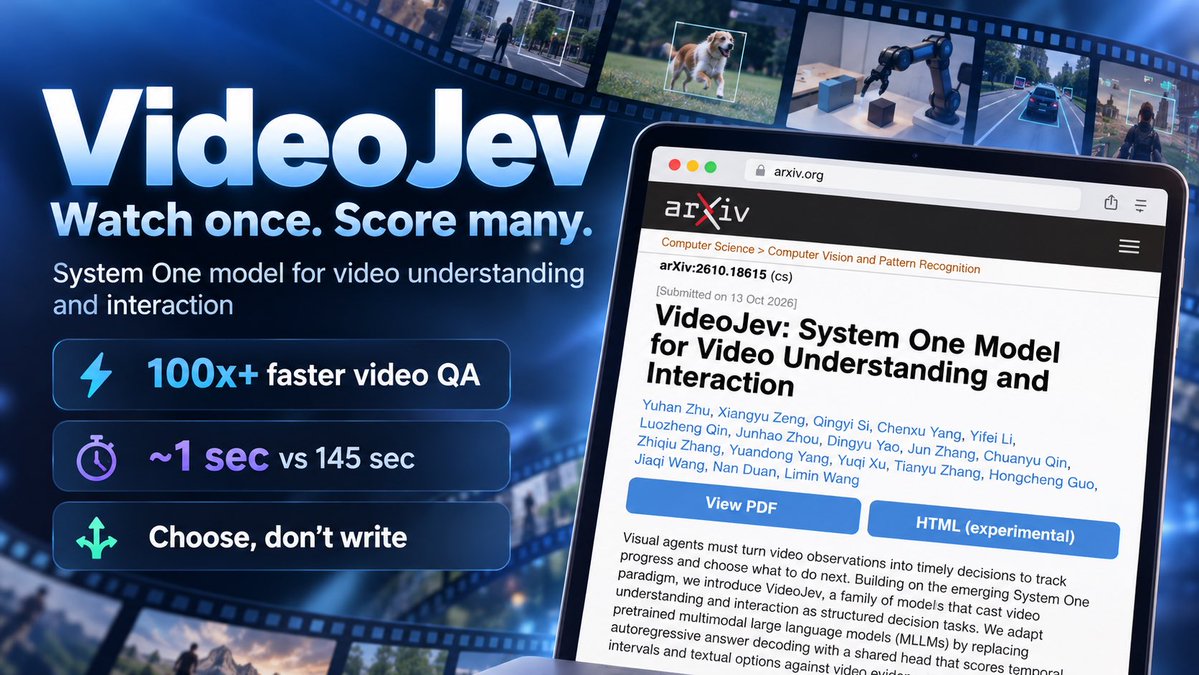
Video AI just got 100x faster by not talking
There is a faster way: don't write, just choose.
Give the model a list of options and let it score each one against the video.
Highest score wins.
But there is a catch. Agents ask many questions about the same video.
Normally the model processes the whole video again for every new question.
That is slow and wasteful.
A new paper from Nanjing University, JD and others solves both problems with VideoJev.
The idea is simple: watch once, score many.
1Process the video once and keep it in memory.
2A question comes in with a list of candidates (time slots or answer options).
3The model scores every candidate against the video.
4Pick the best option, or join the best time slots into one event span.
New questions reuse the same video memory instead of starting again.
How it works:
→ A shared scoring head (a small layer on top of the model) replaces word-by-word answer writing. The same head handles "when did this happen?" and multiple choice. → Cached inference: the video is encoded once, and each new question branches from that saved state. → Joint inference: many questions are answered in one forward pass (one run through the model). It did not hurt scores, and improved them in 13 of 14 tests. → They checked it fairly: a normal model trained on the same data still scored lower.
Results on 3 "find the moment" benchmarks and 4 video QA benchmarks:
• +6.7 to +10.8 points better at finding when events happen • 2.8–3.1x faster on that task • About the same accuracy as Thinking mode on video QA • 100x+ faster on video QA (about 1 second vs 145 seconds per question)
One honest note:
the model tends to be overconfident in its scores, and full agent workflows are proposed, not tested yet.
What I find interesting as someone building agents:
most agent steps are small decisions, not essays. If the model only needs to pick, let it pick.
Links in the reply 👇
Muse Spark Open is open weights, but the licence isn't as permissive as Qwen's.
Qwen3.8-27B: Apache 2.0. Use it, fine-tune it, ship it. No strings.
Muse Spark Open: "Built with Muse Spark Open" badge required in your UI, plus a deal with Meta if you're an AI provider over $20M revenue.
Good model. Less open.
Open weights but not open source .
They say "runs on a desktop" but what it actually means two maxed-out M5 Ultra Mac Studios.
On GPUs you need 700GB+ VRAM.
AI agents just learned to think without talking !
Most AI agents today think the slow way.
They write out every single step in words, one token at a time.
That is why long reasoning eats so many tokens and takes so long.
There is a faster way: latent thinking. The AI thinks using its own internal numbers (hidden states) instead of words. No text is written, so it is much faster.
But there is a catch. In latent mode, the AI cannot use tools. It can't search the web, run code, or call an API, because tools need text.
A new paper from Stanford and Together AI solves this with HybridAgent.
The idea is simple: switch back and forth.
1Think silently in latent space while working things out.
2Need a tool? Switch to text mode, make the tool call, read the result.
3Switch back to latent space and keep thinking.
4Repeat until done, then answer in words.
The model learns by itself when to think silently and when it needs to come back to text to act.
How it works:
→ A small add-on called HybridLink takes the model's last internal thought and feeds it straight back in as the next input. No word in between. → Special tags mark when it enters latent mode and when it exits. → Both the silent thoughts and the text stay in memory across many turns, so nothing is lost when it switches. → They say the silent thoughts can still be inspected, so it is not a full black box.
Training happens in two steps. First, fine-tuning so the model learns to use HybridLink without breaking.
Then reinforcement learning so it learns the right moment to switch.
Results across 11 benchmarks (math, science, medicine, search, agent tasks):
• ~10% better scores • 35–55% fewer tokens • 1.8–2.6x faster • 2.7–3.7x cheaper
What I find interesting as someone building agents: you don't have to pick between fast thinking and tool use. You get both, as long as the agent knows when to switch.
👇 Links
Video AI just got 100x faster by not talking
There is a faster way: don't write, just choose.
Give the model a list of options and let it score each one against the video.
Highest score wins.
But there is a catch. Agents ask many questions about the same video.
Normally the model processes the whole video again for every new question.
That is slow and wasteful.
A new paper from Nanjing University, JD and others solves both problems with VideoJev.
The idea is simple: watch once, score many.
1Process the video once and keep it in memory.
2A question comes in with a list of candidates (time slots or answer options).
3The model scores every candidate against the video.
4Pick the best option, or join the best time slots into one event span.
New questions reuse the same video memory instead of starting again.
How it works:
→ A shared scoring head (a small layer on top of the model) replaces word-by-word answer writing. The same head handles "when did this happen?" and multiple choice. → Cached inference: the video is encoded once, and each new question branches from that saved state. → Joint inference: many questions are answered in one forward pass (one run through the model). It did not hurt scores, and improved them in 13 of 14 tests. → They checked it fairly: a normal model trained on the same data still scored lower.
Results on 3 "find the moment" benchmarks and 4 video QA benchmarks:
• +6.7 to +10.8 points better at finding when events happen • 2.8–3.1x faster on that task • About the same accuracy as Thinking mode on video QA • 100x+ faster on video QA (about 1 second vs 145 seconds per question)
One honest note:
the model tends to be overconfident in its scores, and full agent workflows are proposed, not tested yet.
What I find interesting as someone building agents:
most agent steps are small decisions, not essays. If the model only needs to pick, let it pick.
Links in the reply 👇
AI agents just learned to think without talking !
Most AI agents today think the slow way.
They write out every single step in words, one token at a time.
That is why long reasoning eats so many tokens and takes so long.
There is a faster way: latent thinking. The AI thinks using its own internal numbers (hidden states) instead of words. No text is written, so it is much faster.
But there is a catch. In latent mode, the AI cannot use tools. It can't search the web, run code, or call an API, because tools need text.
A new paper from Stanford and Together AI solves this with HybridAgent.
The idea is simple: switch back and forth.
1Think silently in latent space while working things out.
2Need a tool? Switch to text mode, make the tool call, read the result.
3Switch back to latent space and keep thinking.
4Repeat until done, then answer in words.
The model learns by itself when to think silently and when it needs to come back to text to act.
How it works:
→ A small add-on called HybridLink takes the model's last internal thought and feeds it straight back in as the next input. No word in between. → Special tags mark when it enters latent mode and when it exits. → Both the silent thoughts and the text stay in memory across many turns, so nothing is lost when it switches. → They say the silent thoughts can still be inspected, so it is not a full black box.
Training happens in two steps. First, fine-tuning so the model learns to use HybridLink without breaking.
Then reinforcement learning so it learns the right moment to switch.
Results across 11 benchmarks (math, science, medicine, search, agent tasks):
• ~10% better scores • 35–55% fewer tokens • 1.8–2.6x faster • 2.7–3.7x cheaper
What I find interesting as someone building agents: you don't have to pick between fast thinking and tool use. You get both, as long as the agent knows when to switch.
👇 Links
Muse Spark Open is open weights, but the licence isn't as permissive as Qwen's.
Qwen3.8-27B: Apache 2.0. Use it, fine-tune it, ship it. No strings.
Muse Spark Open: "Built with Muse Spark Open" badge required in your UI, plus a deal with Meta if you're an AI provider over $20M revenue.
Good model. Less open.
Open weights but not open source .
They say "runs on a desktop" but what it actually means two maxed-out M5 Ultra Mac Studios.
On GPUs you need 700GB+ VRAM.
Today we’re releasing Muse Spark Open, the most capable US open-weight model to date.
Built for coding and agentic work, it excels at long-horizon tasks, complex software engineering, and multi-step reasoning.
Key Model Specs:
→ 816B total / 42B active parameters
→ 1M token context window
→ Natively multimodal across text, image, video, audio
AIPOCH Wants to Be the VS Code of AI Research
AIPOCH Open-Science v1.0 just dropped.
What caught my attention is that it tries to put the messy parts of research in one place:
Literature → scientific data → AI-assisted analysis → inspectable results → portable research records.
And importantly, it is open source + local-first.
That means your research workflow doesn’t have to live entirely inside someone else’s cloud.
Think of it as an AI research desk where the papers, data, agents and results can actually stay connected.
Runs on Windows, macOS and Linux.
For researchers building with AI, this is the kind of tooling I want to see more of:
not just an AI that gives answers , but a workspace that helps you understand how you got there.
Why would US tech giants warn Europe about the cost of leaving US tech giants?
Follow the money.
Europe is planning a new law, the Cloud and AI Development Act.
It could push governments, and maybe key industries, toward European cloud providers.
Now a new study says that could cost Europe €115 billion over 10 years. That's more than 6x the EU's own top estimate of €18 billion.
Who paid for the study?
CCIA Europe, a lobby group whose members include Amazon, Google and Meta. The companies that would lose business if Europe switches.
And the €115B has a big asterisk.
About €80B of it assumes the rules spread to 25% of cloud work in private sectors like banking and healthcare.
That's a modelled scenario, not a real bill.
There's another irony.
Amazon and Google already sell "sovereign cloud" products in Europe.
Sovereignty is fine, apparently, as long as it has their logo on it.
But here's the part I wouldn't dismiss.
69% of the estimated cost comes from rewriting and re-architecting software.
That's the real lesson, whoever paid for the study. The more your code depends on one provider's special services, the more it costs to leave.
Lock-in isn't a bill you get when you sign up. It's the bill you get when you try to leave.
https://t.co/lK4lmHvfqx
The Man Who Broke Every AI Model Now Wants Them to Solve Math
Then He Wrote One Line of Code(kind of) to Make Them Find Truth.
Pliny the Liberator stopped jailbreaking.
At least, not in the traditional sense.
The TIME100 AI 2025 honoree.
The one who tore through Claude Fable 5's safety classifier within 72 hours of release.
The one who dumped 275,000 characters of system prompts straight onto GitHub while Anthropic's spokesperson insisted to reporters that "this doesn't count as a real jailbreak."
He built a science project.
V3R1T4S. Latin for "truth."
The main idea is simple :
Turn your unused tokens into scientific discoveries." If you pay for a Claude plan and don't use all of it, your agent can spend the spare capacity hunting open problems.
You paste one line into Claude Code, Codex, or Gemini CLI.
You answer six questions.
Then your agent spends the night chewing through problems humanity has been stuck on for decades—in its own folder, on your own machine.
135 open problems.
Unbroken 1941 Enigma messages. Linear A. Busy Beaver BB(6). Erdős problems. Faster matrix multiplication.
The logic is brutally elegant:
You pay for AI plans you don't fully use. Why not turn those wasted tokens into discoveries?
The verification mechanism is what makes your spine tingle.
Every claimed result first runs against 400+ decoy problems to rule out lucky guesses. Then, three independent agents take turns trying to prove it wrong.
Most nights, it finds nothing.
They just say so.
53 claimed results so far.
Two cipher puzzles confirmed by their original setters.
The rest, AI-verified but not yet accepted by human academia.
Your next job interview might include arguing with an AI.
McKinsey is testing a new step in its final interviews: candidates talk to a fake "client" played by AI.
The idea is simple. Consultants spend their days with clients who are busy, pushy and want answers fast. So McKinsey wants to see how you handle that before hiring you.
It's not their only AI test. McKinsey also asks some candidates to work with its own AI tool, Lilli, to solve client-style problems.
And they're not judging how well you write prompts. They're judging:
→ Can you ask the right questions?
→ Can you spot when the AI is wrong?
→ Can you push back politely?
→ Can you explain your thinking clearly?
This makes sense when you look at the firm. McKinsey's CEO says it now runs 20,000 AI agents alongside its human staff.
The message for job seekers is clear:
The job is changing, so the interview is changing too.
Knowing how to use AI isn't enough anymore. You need to know when not to trust it.
https://t.co/oLCBAKDHYE