Retired Fortune 100 tech executive. Published novelist. Produced screenwriter. Entrepreneur. Gardener. Lover of good food, wine, Negronis, & traveling in style.
Call it the soul, élan vital, or consciousness—humans have IT; the device in your hands does not.
You are IT; the AI model is not.
For some jobs that difference is irrelevant. For others, IT is the only thing that matters.
@PeterDiamandis How to reverse the erosion of epistemic standards and rational thinking & discourse. Why? Because it is leading to the decline of western civilization.
@DillonLoomis Tesla and Elon fan and long holder of $TSLA and must say, I agree. Paint a big vision, but in earnings calls, under promise and over deliver.
SpaceX builds rockets. Rockets run on chemical propulsion. Chemical propulsion has a ceiling.
It can reach Mars. Maybe deeper into the solar system.
But interstellar travel requires physics that doesn’t exist yet.
Weinstein: “You can’t get to the stars using SpaceX because it’s a chemical rocket company.”
The ceiling isn’t the universe’s. It’s ours.
Weinstein: “One of his slogans is ad astra, to the stars.”
To the stars. From a man who knows better than anyone that his rockets can’t reach them.
You don’t declare a destination your vehicle can’t reach unless you already know what replaces it.
The rockets were never the endgame.
Weinstein: “I think he’s given up on the corruption of science. He keeps talking about the fact that he doesn’t like the term researcher, he believes only in engineers.”
The breakthroughs that would get humanity past chemical propulsion should have happened decades ago.
They didn’t.
Not because the physics is impossible. Because the institutions responsible for discovering it optimized for everything except discovery.
Grant cycles. Tenure politics. Citation metrics.
The entire incentive structure of modern science rewards safe, incremental work and punishes the kind of risk that produces breakthroughs.
The system isn’t broken. It’s working exactly as designed.
It was just never designed for discovery.
Weinstein: “I think what he’s doing is he’s building Grok to do science in a time when humans are too corrupt to be truthful and real.”
Musk looked at the entire global scientific establishment and decided it was faster to build a mind that could do the physics than to fix the institutions that wouldn’t.
That calculation alone tells you everything about the state of modern science.
Everyone sees xAI competing with OpenAI and Anthropic in the chatbot race.
Weinstein is saying it was never in the chatbot race. It’s in the physics race. The one nobody else is running.
Weinstein: “Look at the logo for Grok, I think it’s like a black hole profile. Look at its slogan, to understand the universe.”
Not to assist. Not to optimize.
To understand the universe.
SpaceX is the vehicle. xAI is the destination.
One builds the ship. The other discovers how far it can go.
The distance to the stars was never measured in light years.
It was measured in the limits of the mind reaching for them.
The most ambitious project on Earth right now isn’t a rocket program.
It’s an AI being built to find the physics that makes rockets obsolete.
@r0ck3t23 A fascinating take. There is truth in what you say. You can already at the most basic level get into fascinating conversations with Grok on what it would take for FTL travel, and where the “ah ha!” discoveries need to be.
@visegrad24 Does anybody else look at this person and think they are clearly mentally ill? I'm sorry but I wouldn't want them anywhere near me and would not feel safe if they were.
@Teslaconomics Make $500k a year for 10 years. Be frugal in your lifestyle (this is the hard part). Invest at a maximum rate, adding at least $150K to the pot every year. Retire or choose whatever you want to do with your life at the end of the 10 years. You’ll have achieved financial freedom.
@giveashitnature The American way would be to offer a reasonable tax incentive and then let each store decide if it makes sense for them. Much better than a blanket mandate.
🇺🇸 Using Starlink, American Kelsey Pfendler Broke 4 Records Rowing Solo from California to Hawaii 🇺🇸
On America’s 250th birthday, Kelsey Pfendler, an American woman and Grand Canyon raft guide, turned an audacious dream into history.
During training, she was already doing “homework for my Starlink,” preparing the American-made satellite internet system that would keep her connected while rowing 2,400 miles solo and unsupported from Monterey, California to Oahu, Hawaii.
On May 21, 2026, she launched alone in her 24-foot boat Lily.
Forty-three days, 17 hours, and 55 minutes later (in the early hours of July 4, 2026) she crossed the finish line and shattered four major records:
• Fastest solo row from California to Hawaii (overall)
• Fastest woman ever
• First American woman to complete the Mid-Pacific solo crossing
• Youngest person ever to achieve the feat
Starlink made it possible.
As Elon Musk has said,
“Starlink is designed to provide high-speed internet to places where it’s either impossible or extremely expensive to do so with traditional methods.”
The high-speed satellite connection turned her small boat into a connected command center.
It allowed real-time WhatsApp interviews, daily video updates posted straight from the Pacific, coordination with her shore team, and a constant lifeline that kept millions following her journey.
Without it, the world would have waited in silence until she landed.
Her achievement landed on the perfect day.
As America celebrated 250 years of independence and innovation, one of its own used American technology to push the boundaries of human endurance.
Along the way, she raised more than $30,000 for the Whale Foundation, supporting mental and physical health resources for river guides.
Kelsey Pfendler proved that American grit, paired with American innovation, can still conquer the impossible!
Happy 250th, America. 🌊🚣♀️🇺🇸
@Reuters Not far right.
Supports free speach for all.
Wants legal immigration—not closed borders.
Built Tesla to fight climate change.
Criticizes “woke” policies that lower standards or divide people.
Voted Democrat until Biden.
Pushes merit, innovation, and individual rights.
= Centrist
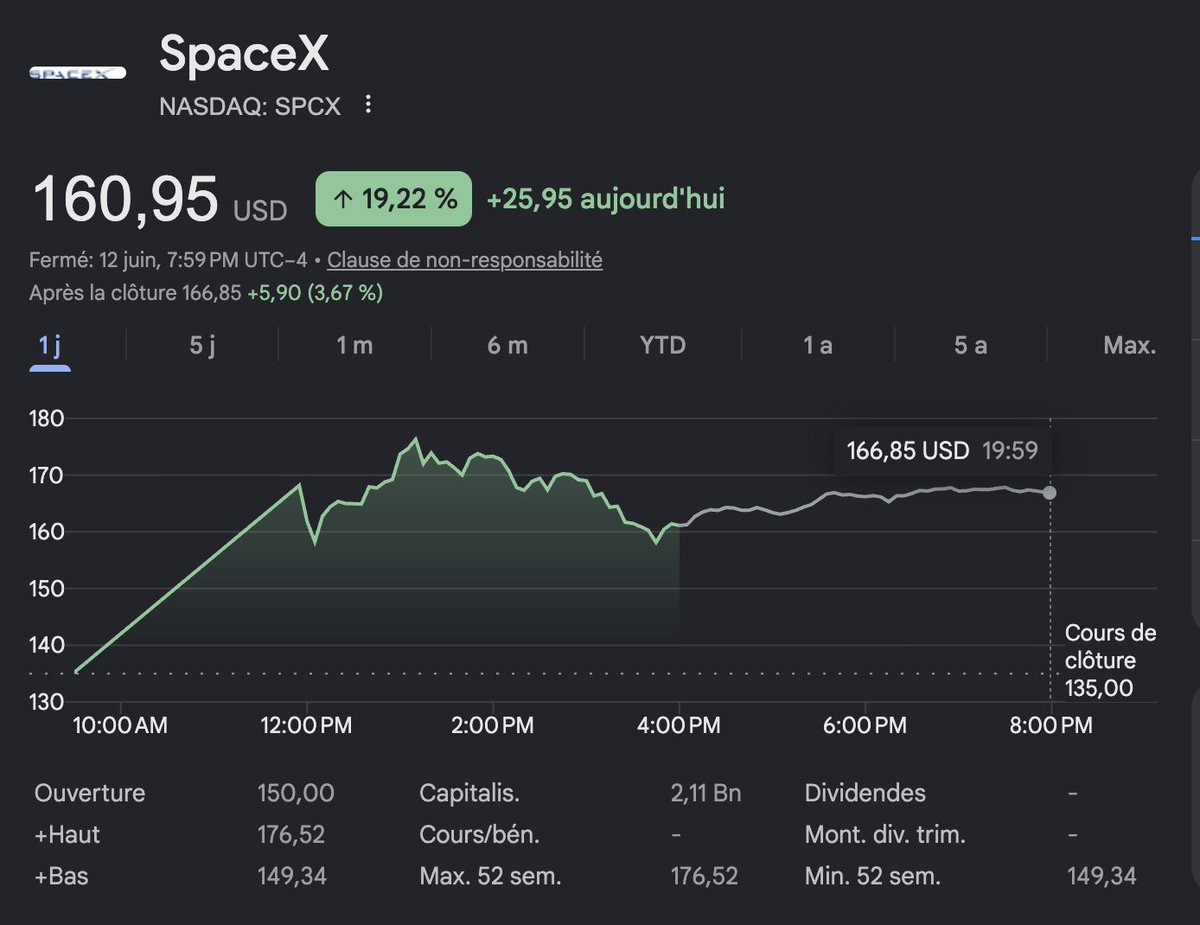
SpaceX a clôturé son premier jour de cotation à 2 100 milliards de dollars, +19%. Tout le monde regarde le chiffre. Personne ne regarde ce qu'il price réellement.
Laissez-moi vous dire ce que le marché vient d'acheter, et pourquoi je pense que cette boîte vaudra 30 à 50 trillions d'ici 5 ans.
D'abord, le symbole. Cette IPO est un référendum. D'un côté, 20 ans de discours sur la décroissance, la sobriété, la redistribution, la fin de l'histoire gérée par des comités. De l'autre, un homme qui a dit "je vais rendre l'humanité multiplanétaire", que tout le monde a traité de clown, et qui vient de créer la plus grosse entreprise cotée de l'histoire en partant d'un entrepôt à El Segundo. Le marché a voté. Le wokisme avait des départements RH, SpaceX avait des fusées. Les fusées ont gagné.
Ensuite, la mécanique économique, parce que c'est là que tout le monde se trompe. Les analystes valorisent SpaceX comme une entreprise de lancement plus Starlink. C'est comme valoriser Internet en 1995 sur le marché du fax. Starship ne réduit pas le coût du kilo en orbite de 20%, il le divise par 100. Et chaque fois dans l'histoire qu'un coût d'infrastructure est divisé par 100, ce n'est pas le marché existant qui grossit, ce sont des industries entières qui naissent. Le coût du calcul divisé par 100 a donné Internet, le smartphone, l'IA. Le coût de l'orbite divisé par 100 va donner une économie spatiale complète.
Faisons la liste de ce qui devient rentable quand le kilo en orbite coûte le prix d'un billet d'avion. Les data centers orbitaux, avec énergie solaire continue et refroidissement gratuit, au moment exact où l'IA fait exploser la demande énergétique terrestre. La fabrication en microgravité de semi-conducteurs, de fibres optiques, d'organes imprimés impossibles à produire sous gravité. Le tourisme orbital de masse, puis les hôtels lunaires, qui passeront du fantasme au business plan exactement comme la croisière de luxe au 20ème siècle. Le transport point à point terrestre, Paris-Tokyo en 40 minutes. L'industrie minière des astéroïdes, dont un seul corps de classe M contient plus de métaux que tout ce que l'humanité a extrait depuis le néolithique. Et Mars en ligne de mire, pas comme destination touristique, mais comme le plus grand projet d'infrastructure jamais entrepris, avec tout ce que ça implique de demande en énergie, matériaux, robotique, IA.
SpaceX ne participera pas à ces marchés. SpaceX possède le péage d'entrée de tous ces marchés. C'est AWS, mais pour la civilisation. Apple vaut 3 500 milliards en vendant des rectangles de verre sur une seule planète. Le premier monopole d'accès à une frontière infinie à 30 ou 50 trillions dans 5 ans, ce n'est pas de l'exubérance, c'est une simple règle de trois sur l'expansion du marché adressable.
Et maintenant, la partie que je préfère. Ce futur n'a pas besoin de bureaucrates. Il n'y a pas de comité consultatif en orbite. Pas de commission Théodule sur Mars. Chaque dollar de cette nouvelle économie sera créé par des ingénieurs, des techniciens, des soudeurs, des pilotes, des entrepreneurs. Les diplômés en gestion de la norme vont devoir apprendre un métier utile, et franchement, c'est une excellente nouvelle pour eux aussi : construire est infiniment plus fun que contrôler.
Parce que c'est ça, le vrai signal d'aujourd'hui. Pendant 50 ans on nous a vendu un futur rétréci : moins d'énergie, moins d'enfants, moins d'ambition, gérer le déclin proprement. Et là, d'un coup, le plus gros actif financier du monde est un pari sur l'abondance, l'expansion et l'aventure. Le pessimisme vient de passer en position vendeuse sur lui-même.
Le futur sera méga fun. Il y aura des hôtels avec vue sur la Terre, des honeymoons en orbite, des gamins qui diront "papa, c'était comment avant les fusées réutilisables" comme on dit "c'était comment avant Internet". Et quelque part dans les années 2030, un humain marchera sur Mars en livestream devant 5 milliards de personnes, et ce jour-là plus personne ne se souviendra du nom d'un seul de ses détracteurs.
Achetez de l'optimisme. C'est encore sous-valorisé.