“I lived so carefully, thinking someone was watching. But the stage was empty, the audience never came.”
- Osamu Dazai
Osamu Dazai (1909–1948) was a celebrated Japanese novelist known for exploring loneliness, identity, guilt, and the darker sides of human existence. His most famous works, No Longer Human and The Setting Sun, continue to resonate with readers through their emotional honesty and powerful portrayal of human struggles.
The quote, “I lived so carefully, thinking someone was watching. But the stage was empty, the audience never came,” reflects the regret of living in fear of other people’s judgment. It compares life to a performance, where someone constantly seeks approval from an audience that may not even be paying attention.
The deeper message is that people often sacrifice their happiness and freedom worrying about what others think, only to realize that most people were never watching as closely as they imagined. Life is too short to spend it performing for an audience that may never exist.
“The life you seek is hidden inside the discipline you avoid.”
- Epictetus
Despite being born into slavery, Epictetus rose to become one of history’s most influential Stoic philosophers. He believed that genuine freedom does not come from having an easier life, but from developing the ability to master yourself.
His teachings emphasized a challenging yet powerful principle: while you cannot determine everything that happens around you, you can choose your reactions, guide your decisions, and remain persistent when confronted with adversity.
“The life you seek is hidden inside the discipline you avoid.”
Although this quotation has no verified connection to Epictetus, its message reflects a central theme of Stoic philosophy. The future you desire may depend on confronting the responsibilities you repeatedly put off, whether that means exercising when you lack motivation, completing difficult tasks, or finally making the uncomfortable choices you have been avoiding.
On March 11, 889, a 22-year-old Japanese emperor wrote in his diary about a new black cat he had recently acquired…
“On the 6th Day of the 2nd Month of the First Year of the Kampo era. Taking a moment of my free time, I wish to express my joy of the cat. It arrived by boat as a gift to the late Emperor, received from the hands of Minamoto no Kuwashi.
The color of the fur is peerless. None could find the words to describe it, although one said it was reminiscent of the deepest ink. It has an air about it, similar to Kanno. Its length is 5 sun, and its height is 6 sun. I affixed a bow about its neck, but it did not remain for long.
In rebellion, it narrows its eyes and extends its needles. It shows its back.
When it lies down, it curls in a circle like a coin. You cannot see its feet. It's as if it were circular Bi disk. When it stands, its cry expresses profound loneliness, like a black dragon floating above the clouds.
By nature, it likes to stalk birds. It lowers its head and works its tail. It can extend its spine to raise its height by at least 2 sun. Its color allows it to disappear at night.
I am convinced it is superior to all other cats.”
“The highest form of peace is having no desire to be seen, validated or understood by anyone.”
- Epictetus
Epictetus (c. 50–135 CE) was a Greek Stoic philosopher born into slavery in the Roman Empire. After gaining his freedom, he became one of Stoicism’s most influential teachers, arguing that true freedom comes from mastering your own mind rather than controlling your circumstances.
Although Epictetus wrote nothing himself, his teachings were recorded by his student Arrian in the Discourses and Enchiridion. He taught that we should focus on what lies within our control—our thoughts, choices, and character—and meet everything else with acceptance and resilience. His ideas influenced generations of thinkers, from Roman emperor Marcus Aurelius to modern psychology, particularly cognitive behavioral therapy.
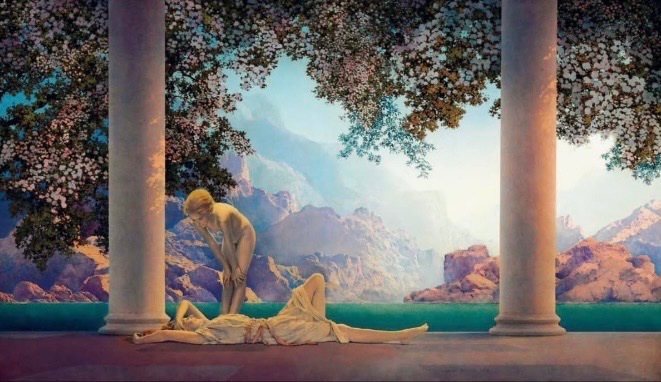
Painting: Daybreak, 1922, by Maxfield Parrish (1870–1966)
A medieval dog tending to a bedridden cat suffering from “melancholy,” possibly treating it with milk thistle, an ancient herbal remedy traditionally associated with liver ailments.
In medieval medicine, “melancholy” meant far more than simply feeling sad. Physicians followed the ancient theory of the four humors and believed it resulted from an excess of black bile, which was traditionally linked to the liver and associated with both physical and emotional symptoms.
Herbal remedies were widely used, and milk thistle had been recognized since antiquity for its traditional connection to liver ailments. Medieval manuscripts are filled with scenes of animals taking on human roles as doctors, musicians, teachers, and tradesmen. Some were intended as satire or allegory, while others suggest medieval artists had a surprisingly familiar sense of humor.
“A crooked tree lives its own life, but a straight tree is turned into wood.”
- Chinese Proverb
The idea behind this proverb comes most clearly from the writings of Zhuangzi, one of the central thinkers of Daoism in the 4th century BCE.
In the Zhuangzi, a famous story tells of a large, twisted tree that carpenters ignore because its wood is unsuitable for construction. Precisely because it is considered “useless,” the tree is never cut down and survives to live out its natural life.
Zhuangzi uses the tree as a metaphor for human life. In Daoist thought, being “useful” by conventional standards can make a person vulnerable to exploitation, control, and exhaustion. Those who are unconventional, overlooked, or unwilling to fit society’s expectations may instead preserve their freedom and live on their own terms.