Banquier contre le monopole bancaire. Redonner aux gens le pouvoir sur leur argent. Si vous n'aimez pas le système vous allez m'adorer ! Delubac, @delupay FTW
People often ask what makes Silicon Valley culture so special and hard to replicate.
It's not the talent or the capital. There are many places with both.
The secret sauce of Silicon Valley is that it doesn't punish failure. This is rare to the point of being basically unique.
Failure is already its own punishment. Spending years of your life trying to build something that goes nowhere is a deep and unforgiving grief. The time, the energy, the money, the opportunity cost, it's impossible to erase that.
But what SV startup culture strips away is that second layer of punishment: the shame that society stacks on top. The whispers at the next party, that you've embarrassed yourself, that you should have known better. In SV, there's no shame in winding down a startup, it's the mark of having entered the arena and taken a swing.
But then there's stuff like this. This is how it works almost everywhere else in the world. This founder failed, therefore the salary he paid himself is a disgrace (if he did OK, no one would ever bring it up).
Silicon Valley VCs would never post anything like this about a wound down startup. No mention of the founder's background either: Was $200K a paycut for them? Do they live in NYC/SF where $200K is ~$100K take-home? Do they have kids, a mortgage? And come on, no seed-stage company is running out of money because the founder is paying themselves $200K~, seed rounds are in the millions. $200K/yr is like a single engineer's salary. Yeah $200K is on the high side, but really? If you think this founder embezzled from the company, then sue them. If you thought $200K was unconscionable, did you mention that when you invested? Otherwise what is the point of this?
This is why in Silicon Valley (and China and Israel too), startup culture is a gem that's almost impossible to replicate anywhere else in the world. People can't help themselves to rub salt in the wounds of failure, and they don't think about the wider culture reverberations of that attitude.
Not depending too much on politics.
You always do to a degree, look how bad government players have affected BTCUSD.
But at least no one can just debase your bitcoin overnight because they just decided to do so.
Everyone should have a significant bit of their assets on bitcoin.
Very very basic. Played with very similar things before LLMs even existed.
RAG and fine-tuning both have their advantages and drawbacks, which anyone who played a bit with training neural networks, let alone LLMs, will "feel".
RAG doesn't require to invest in retraining, but each request will take more time. It will allow very dynamic behavior but if your context is too big it will devolve fast. Lots of littérature on that. Also provides way more auditability, if you train on sources the model will have better instincts based on those but if you put them on RAG it will have way better ability to say where which idea comes from exactly.
Fine-tuning is an investment, it's actually a small retraining. But after, you've changed the identity of the model itself, and it will be fast and efficient. It will have acquired new reflexes. Now if your dataset is dynamic, you're not gonna retrain everytime it changes, are you? And when fine-tuning fails it's way harder to see why because a neural network is a black box.
To be very simple RAG affects the model's knowledge whereas fine-tuning affects its identity.
Also if you asked me whether to use fine-tuning or RAG to solve a specific problem I'd probably tell you a bit of both. Like RAG to always bring up to date data and fine tuning so it takes the lessons that new data teaches into account in the future. Think of any specific issue and you'll see why. It's just like a human expert in training, he needs both implicit and explicit knowledge, learned through both experience and solid external sources.
That's it mostly.
The European Parliament has just approved the creation of a digital euro - while yesterday, the U.S. Senate voted to ban the creation of a digital dollar for at least four years.
That contrast speaks volumes about Europe’s strategic blind spots.
We need to say it plainly, and keep repeating it: money is no longer just a financial or political issue - it has become a TECHNOLOGY issue.
New financial communication rails now exist: blockchains. They allow value to move faster, more easily, and with far less friction across borders.
The U.S. has understood this. It is betting heavily on it, with major players like @circle. Dollar stablecoins now represent 99% of stablecoins in circulation (i.e., online). The market already weighs in at $350B. In ten years, it could be ten times larger.
Europe needs to be on this field. Crypto-native actors and European banks like @SG_Forge already have their stablecoins - but without the support of the ECB or the European Parliament. What Parliament has just approved, with the enthusiastic backing of some politicians like @AuroreLalucq (whose fight for European sovereignty I share), is a digital euro that will run on legacy rails - not on these new infrastructures.
As @paddi_hansen writes in an op-ed published in @TheBigWhale_, setting the digital euro against private stablecoins is a false debate.
https://t.co/INz7TdVyX4
The ECB’s digital euro will not respond to the dominance of dollar stablecoins. These are fundamentally different things.
I’m not against a digital euro (the design choices still need to be debated). But pretending we’re defending Europe’s monetary sovereignty with a "Minitel money" is a huge joke.
The Americans are building the Internet of money. We’re congratulating ourselves for launching the Minitel of money…
It will be painfully expensive. And many of us will have said so.
Je suis chef d'entreprise.
Il y a plein de raisons valables pour refuser d'embaucher quelqu'un qui a apporté une contribution significative dans son domaine.
Un certain niveau de talent va rarement sans une psychologie très particulière, et il faut un cadre approprié pour pouvoir accueillir ce type de profils. C'est en soi une compétence collective qu'une entreprise n'acquiert pas d'emblée.
Mais quand même, il y a des choses qu'on ne peut pas lire sans sursauter.
Se moquer du créateur de l'outil qui est ou a été utilisé par un pan significatif de l'industrie où on travaille, c'est quand même sacrément méconnaître sa propre place dans l'ordre des choses.
Il a créé un outil dont tout le monde connait les défauts… parce que tout le monde connait cet outil.
Tu as créé quoi, toi ?
remember that time the guy who invented homebrew was furious he got turned down for an eng job so he posted about how this company turned down the guy who invented homebrew, then everyone was like dude homebrew sucks
La @banquedelubac est connue pour avoir été la première à s'ntéresser aux cryptos mais cela procède plus généralement d'une culture technique.
Le faux sentiment de sécurité lié aux versions officielles des systèmes d'exploitation aboutit à ce que beaucoup d'apps refusent de s'exécuter ailleurs que sur ces versions officielles.
Pourtant GrapheneOS est plus sûr que la version officielle d'Android s'il est bien utilisé.
Mais la "détection de root" et de toute variation de l'installation officielle est une pratique standard et ne pas la respecter expose à la censure des auditeurs et des régulateurs.
On croirait se retrouver des années en arrière, quand Linux était assimilé à la cybercriminalité.
Sans même changer d'OS, le simple fait de reprendre le contrôle de son propre téléphone empêche l'usage des applications bancaires.
Le problème est administratif et ne pourra se régler que par l'évolution des recommandations officielles de l'@ANSSI_FR.
La question est fondamentalement la même :
- votre banque doit-elle être une prison ?
- votre smartphone/votre ordinateur doit-il être une prison ?
- notre société doit-elle devenir une prison ?
Les débats récents sur la "vérification d'âge" (c'est-à-dire un contrôle d'identité) pour l'accès aux réseaux sociaux sont du même ordre.
‼️ BREAKING: Volkswagen has banned GrapheneOS users from using their app. Users are reporting they can't log in or control their car anymore. Users are confused, saying Volkswagen allows their app to be used on End-of-Life Android versions, but not on fully patched GrapheneOS.
Rappel utile : même une IA plus intelligente qu'un être humain ne peut pas deviner ce que vous êtes seul à savoir sur votre besoin.
Si vous utilisez une IA pour le développement il lui faut tout de meme des spécifications.
Si vous utilisez une IA pour spécifier il lui faut tout de même des entretiens avec vos métiers.
L'IA n'est pas une baguette magique.
It's bizarre to me that people are so convinced that agents can one-shot solutions to problems based on vague underspecified descriptions.
The best human programmers in the world still need to understand what they need to build. You could put Donald Knuth, Fabrice Bellard, and John Carmack in a room, but if you only give them a vague description of what you want them to do, you'll end up with a brilliant solution to a different problem than the one you actually have.
Engineering involves building something that matches a set of requirements and fits within a set of constraints. Yes, agents can translate from English to code, but the English still needs to be precise enough to specify these things.
SpaceX rachète 60 milliards de dollars (!!) Cursor qui est principalement un fork de vscode orienté vibe-coding, et qui a son propre LLM (Composer) basé sur Kimi K2.5, lequel sera sûrement très vite dégagé au profit de Grok.
$175 million. The largest fundraise in DeFi history. And it's French - European!
@Morpho - founded in Paris, built by a French team 🇫🇷 - just closed the biggest round DeFi has ever seen. Led by @paradigm, @a16zcrypto, and @RibbitCapital.
The protocol is now valued at around $2 billion.
At @TheBigWhale_, we've been following @PaulFrambot, @MerlinEgalite and the Morpho team from the very beginning.
What they've built is genuinely impressive - +$10B in deposits, integrations with @SG_Forge, @coinbase, and many other companies. A protocol that serious institutions actually use.
The vision is clear: move global credit onchain. The market they're targeting? $200 trillion.
One detail worth noting: Morpho has no shares. Only governance tokens. US funds just bet $175M on that model. That says something.
And yes - the irony isn't lost on me. Europe's biggest DeFi success story is being funded mostly by American capital. Bpifrance is there, which matters. But the weight of the round tells a story about where risk appetite lives right now.
Still - this is a win. For the team, for Paris, for the European ecosystem.
We'll be with them in NYC on June 22. Come if you're around: https://t.co/suwEbnwoc7
👉 Full interview with Paul Frambot: https://t.co/HiK8arhT7v
The EU age verification app is presented as “completely anonymous”. But the risk is that member states (the countries are supposed to create their own versions of the open-source EU app) use it to introduce identity verification that makes it impossible to post anonymously on social media.
The idea behind “completely anonymous” is to use Zero-Knowledge Proof (ZKP) cryptography to break the link between the age credential issuer (EU governments) and the regulated services/sites. Currently, the EU app does not have ZKP functionality, contrasting Ursula von der Leyen’s claim that the app ”is technically ready to be used”. But more importantly, the app is designed to always function without ZKP technology; if ZKP is unavailable, the app falls back to a non-ZKP model. Even if fully developed ZKP technology could be implemented in the future, it would remain an optional extra feature that countries may choose to disable and that the EU could remove at any time.
This means that the EU could decide at any time that ZKP may no longer be used, and in one stroke the app would fall back to its default mode, meaning that every post on social media carries an ID tag. By that point, an infrastructure will already have been rolled out; people will have gotten used to it, and it will be harder to roll it back.
More details on https://t.co/wTVKHMS1zg
If you cannot evaluate director performance based on factual metrics you have no business being a CEO.
If you don't know where to begin read this book.
If you're in a company where politics counts for more than performance, MOVE.
https://t.co/R6cDm5aqVy
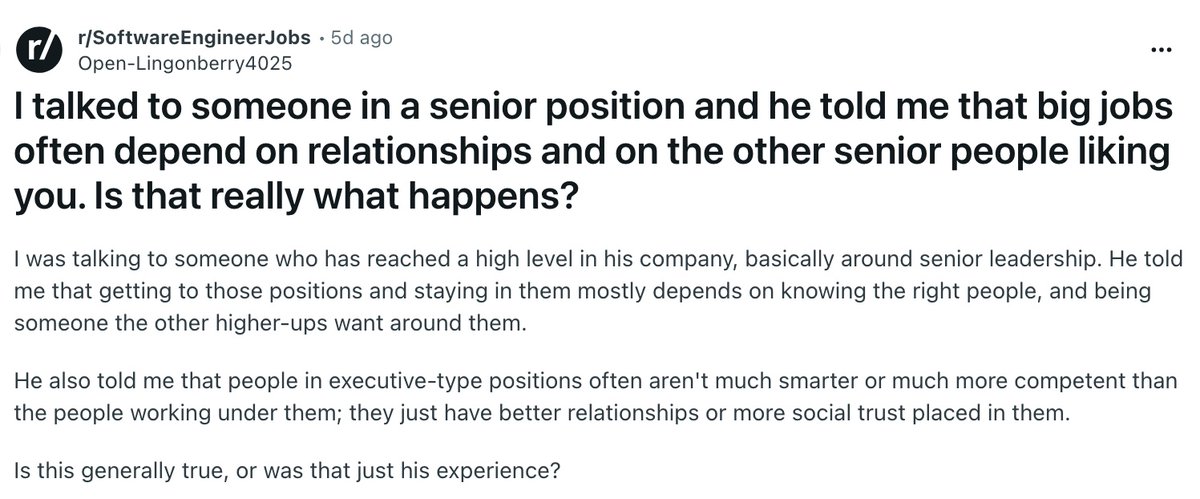
The higher you climb the corporate ladder, the more relationships matter.
At entry level, your output is visible. You do the work, it shows up. It gets seen and you get a raise and promotion.
At director and above, almost none of your work is visible. You're not doing the hands on dirty work, or at least in large amounts. You're making decisions in a room with a few people and the results show up 6 months later. Nobody can trace them back to you.
So how do they decide who belongs in those rooms?
They pick people they already know.
Not "know of." Know.
People they worked with and have seen operate under pressure. That person gets the call more times than not over the stranger with the better resume.
The stakes are higher, so the trust threshold is higher. A bad hire at $70K is annoying. A bad hire at $300K who controls a $50M budget is catastrophic.
And yeah, it's political. Not in the "office politics is a game" way. In the "if you make a mistake at this level, it doesn't just hit you, it hits your boss, your boss's boss, and so forth.
So people protect themselves by surrounding themselves with people whose body of work they've seen firsthand.
This is why "networking" advice misses the point. The goal isn't to collect contacts.
The goal is to do good work with good people so that when a seat opens at their next company, your name is the first one they think of.
N'importe qui peut créer une SCOP. Mais son collègue comme patron, c'est le pire.
Le capitalisme est beaucoup plus libre que la démocratie.
N'importe qui peut démissionner dès qu'il a trouvé un travail ailleurs.
Imaginez si on pouvait choisir la loi Suisse sans déménager !
La démocratie ne peut pas s'arrêter aux portes de l'entreprise.
Dans notre République, les citoyens votent pour gouverner le pays. Mais au travail ? Les salariés n'élisent pas leurs dirigeants. Les décisions stratégiques appartiennent à quelques actionnaires. Le rapport de subordination reste la règle.
Des chercheurs parlent même d'« îlots autoritaires » au cœur de nos sociétés démocratiques.
Et pourtant, les Français ont déjà tranché : 56 % estiment que les entreprises devraient être détenues prioritairement par leurs salariés, 63 % seraient prêts à en acquérir des parts, et plus de 60 % des jeunes de 18-34 ans veulent s'engager dans des modèles coopératifs.
Pourquoi ? Parce que chacun comprend désormais le lien direct entre participation des salariés, bien-être au travail et productivité durable, comme le démontrent les données ETUI 2024, qui placent la France parmi les nations où forte participation et forte productivité vont de pair.
Mais la réalité d'aujourd'hui est cruelle : 4 salariés sur 10 estiment que leur santé est menacée par leur travail. La France est le pays européen le plus touché par les dépressions liées au travail.
Burn-out, perte de sens et suicides au travail sont devenus des phénomènes de masse. Comme l'analyse la sociologue Danièle Linhart : le taylorisme n'a pas disparu, il a simplement changé de visage.
Pendant ce temps, le modèle coopératif prouve silencieusement son efficacité : les SCOP représentaient déjà 9,4 milliards d'euros de chiffre d'affaires en 2023. Les coopératives pèsent 40 % de l'agroalimentaire, 30 % du commerce de détail, 60 % de la banque de dépôt. Dans une SCOP, les salariés détiennent au moins 51 % du capital, 65 % des droits de vote, et les bénéfices sont partagés équitablement. Ce n'est pas de l'utopie, c'est déjà là.
Ce qui est à portée de main, c'est une véritable démocratie économique française : participation des salariés aux décisions stratégiques, présence obligatoire dans les conseils d'administration, développement massif des coopératives, intéressement et actionnariat salarié, sans oublier des rémunérations rehaussées, une formation continue tout au long de la carrière et de vraies perspectives d'évolution.
Les Français ne veulent pas travailler moins. Ils veulent travailler mieux, avec plus de sens, plus de responsabilité, plus de pouvoir d'agir.
Parce qu'une nation forte ne peut pas être fondée sur des travailleurs invisibles. La démocratie politique sans démocratie économique finit toujours par s'épuiser.
Jaurès disait que "la Révolution a fait du Français un roi dans la cité et l'a laissé serf dans l'entreprise".
Je ne suis pas sûre que le Français soit encore un roi dans la cité, avec tous les renoncements à la souveraineté des derniers dirigeants ; ce que je sais, c'est que le combat pour reconquérir le pouvoir d'agir en politique n'a de sens que s'il s'accompagne d'un combat pour que l'entreprise soit aussi un lieu d'accomplissement pour chacun.
Jesus Huerta de Soto a parfaitement raison ici : tant que le prix de la monnaie sera décidé par l'État, nous ne serons pas dans un système capitaliste.
Le taux d'intérêt, donc le prix du capital monétaire, n'est pas un prix parmi d'autres, c'est le prix le plus important du marché. Le taux d'intérêt, c'est le prix du temps, c'est-à-dire le signal que le marché envoie aux entrepreneurs sur la quantité de capital disponible, on consommé immédiatement, pour des projets longs, risqués, productifs et non directement en lien avec la consommation finale.
Ce prix est essentiel, car il permet de connaître l'état réel du marché, la préférence temporelle des consommateurs, ainsi que les endroits où déployer le capital, l'attention, le temps et l'énergie des producteurs.
Quand une banque centrale fixe arbitrairement le taux d'intérêt, ce n'est pas seulement un simple prix qu'elle fausse, c'est le temps lui-même qu'elle manipule, et avec lui toutes les incitations individuelles de la société.
Huerta de Soto a également raison quand il dit que l'action des banques centrales s'apparente à du socialisme. C'est du socialisme pur et dur. Elles agissent comme des agences de planification centrale du marché de la monnaie et du crédit. Et, comme pour les autres biens et services, toute gestion centralisée de la monnaie ne peut pas fonctionner.
Il faut laisser, comme il le dit lui même en citant Mises et Hayek, le marché décider lui même du prix de la monnaie. C'est uniquement de cette façon que le marché peut fonctionner, dans ses mots à lui :
"La banque centrale essaie d'ajuster finement l'économie, en injectant ce qu'elle pense être la quantité monétaire optimale nécessaire à chaque instant. Et pire encore, ils fixent le taux d'intérêt, qui est un prix très important qui devrait être le plus libre possible sur le marché, parce qu'il s'agit du prix des biens présents en termes de biens futurs. Donc, il n'y a pas de marché.
C'est du socialisme pur dirigé par une agence de planification centrale. Tous les arguments et théories sur l'impossibilité [du socialisme], qui ont été découvertes par l'économiste autrichien Friedrich Hayek, s'appliquent pleinement à la banque centrale.
Il est théoriquement impossible qu'elles réussissent dans leurs tentatives d'ajuster finement l'économie, pour une raison fondamentale : il leur est impossible d'obtenir l'information spécifique dont elles ont besoin pour coordonner la nature des ordres et des réglementations. C'est au cœur de l'argumentaire et de la théorie de l'impossibilité du socialisme découverte par Mises et Hayek."
I can't believe they're doing that.
If it were us, I would have sued this former employee to hell and beyond, and then sought vengeance for decades even after he would not longer be able to find a job in banking ever.
Pay blackmail once, pay blackmail forever.
If you're going to spend one million on a blackmailer, spend it on hurting them badly enough that the next one will chose another mark.
Breaking: JPMorgan offered a former banker $1 million to settle his lurid sex claims weeks before he filed a lawsuit that has captivated Wall Street https://t.co/Q89wY4Il86
Un club, ce n’est pas seulement une équipe sur le terrain. C’est aussi une ville, des tribunes, une énergie qui se construit.
Merci à tous ceux qui font grandir le @ParisFC match après match.
On se retrouve dimanche 3 mai à 17h15 dans notre stade Jean Bouin pour le match contre Brest
https://t.co/qwskWASALi
Sci-Hub is an evil website that pirated 85M+ research papers and made them freely available
And now they've added AI to their database to make Sci-Bot.
It answers your questions using latest, full-text articles.
But DO NOT use it. We should all try to make billion-dollar academic publishers richer.
I'm putting the link below so you know how to avoid it.