Mary E. Hoskins Walbank, and Michael B. Walbank. "A Roman Corinthian Family Tomb and Its Afterlife." Hesperia: The Journal of the American School of Classical Studies at Athens 84, no. 1 (2015): 149-206. Accessed May 14, 2021. doi:10.2972/hesperia.84.1.0149.
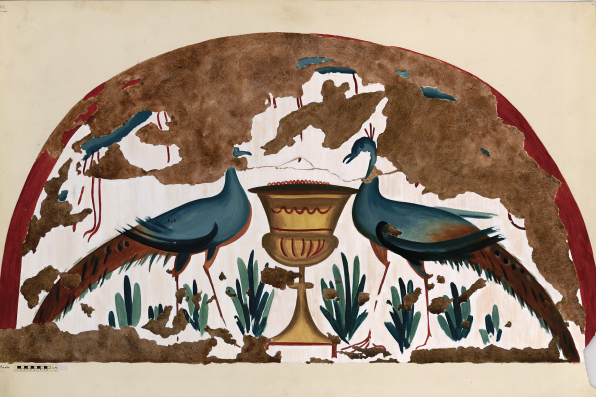
The symbols and iconography have certain meanings, in funerary art, birds represent souls of the dead, peacocks specifically represent immortality. The two men are Dioskouroi, the heavenly twin Pollux, the son of Zeus, was immortal, and the other, Castor, was originally mortal.
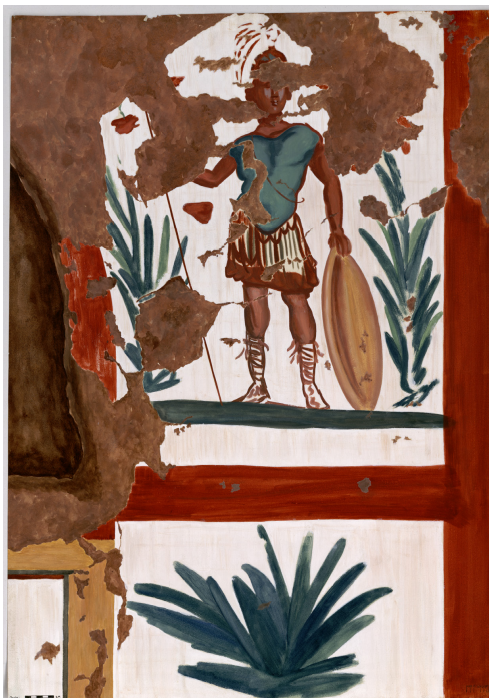
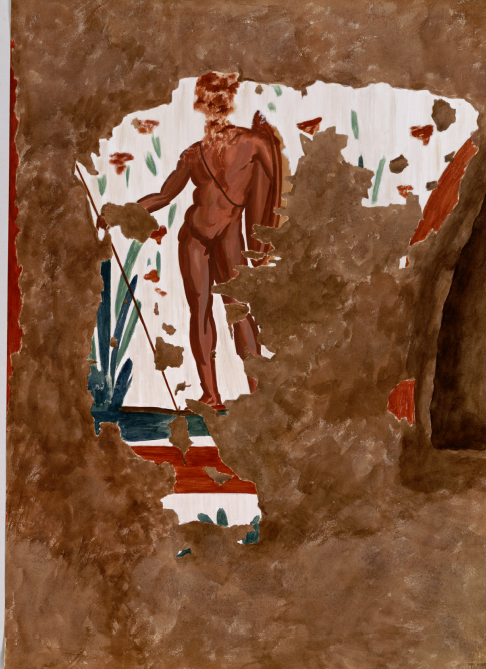
A question we might be able to ask is why are there soldiers on the inside of the tomb? What are some hypotheses we can make about them, and the relationship to the tomb?
On the east wall of this shear painted tomb also had a figure in a military dress carrying a long spear and a shield, another figure on the west wall was a nude figure also holding a sphere and a shield.
KONTORLI-PAPADOPOULOU, LITSA. “MYCENAEAN THOLOS TOMBS: SOME THOUGHTS ON BURIAL CUSTOMS AND RITES.” Bulletin of the Institute of Classical Studies. Supplement, no. 63, 1995, pp. 111–122. JSTOR, https://t.co/oefhRZYfzR. Accessed 14 May 2021.
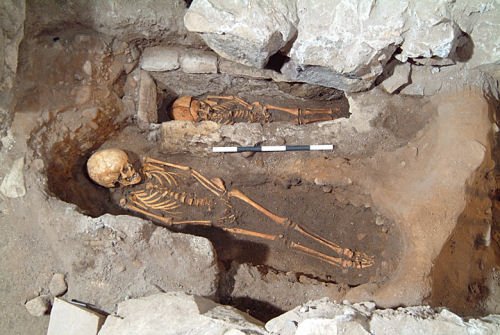
Middle Helledic Burials anyone? well these communities buried those who died in pits or stoned-lined wholes called cists. Very simple, easy burial, nothing real fancy here.
KONTORLI-PAPADOPOULOU, LITSA. “MYCENAEAN THOLOS TOMBS: SOME THOUGHTS ON BURIAL CUSTOMS AND RITES.” Bulletin of the Institute of Classical Studies. Supplement, no. 63, 1995, pp. 111–122. JSTOR, https://t.co/oefhRZYfzR. Accessed 14 May 2021.
Things have begun to evolve during the Bronze Age... we see some Tholos Tombs, they are round beehive-shaped tombs, with an entryway before going fully into the tomb.
Jack L. Davis, and Sharon R. Stocker. “The Lord of the Gold Rings: The Griffin Warrior of Pylos.” Hesperia: The Journal of the American School of Classical Studies at Athens, vol. 85, no. 4, 2016, pp. 627–655. JSTOR, https://t.co/VXgwJ7DXQd. Accessed 14 May 2021.
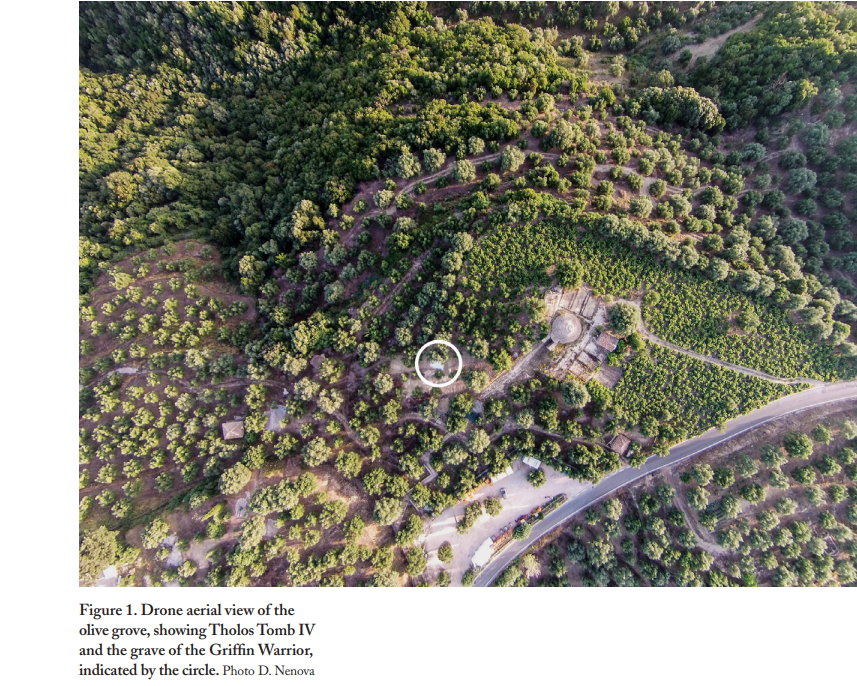
Below is an areal view of Tholos Tomb IV, located in Plyos. These tombs are above ground and have many other tombs around them. The circle area is actually a chamber tomb, called the Griffin Warrior Tomb.
Mary E. Hoskins Walbank, and Michael B. Walbank. “A Roman Corinthian Family Tomb and Its Afterlife.” Hesperia: The Journal of the American School of Classical Studies at Athens, vol. 84, no. 1, 2015, pp. 149–206. JSTOR, https://t.co/j9XUDvSSoC. Accessed 13 May 2021.
Why is it called a shear painted tomb one may ask? The inside of the tomb walls was plastered and elaborately painted in a coordinated manner. Within the walls were different paintings, on the rear wall we see two identical peacocks, with a large vase in the middle.
In the same area was the discovery of the Shear Painted tomb now this was a rare example of a Corinthian chamber tomb where evidence of location, architecture decoration, epitaph, and contents can be studied as a whole.
In the 2nd Century, a wealthy Corinthian constructed a chamber tomb for his family. It was excavated by Leslie Sher in 1931, the funerary description was missing, but she had said that a tomb of this size for a man of wealth and distinction and the presence of military guards.
Some tombs signify wealth and royalty an example of this are chamber tombs, built from rock. At times chamber tombs could hold the dead of a family or a social group. They also tend to have grave goods stored in them, much like tholos tombs. #chambertomb#gravegoods
What have we've discovered of Greek tombs and burials so far? We have the simple rectangle dug into the group with maybe some stone on the borders, to the tholos tombs with the longer entryway, and the larnakes what is next? #tombs#overtime
Musgrave, Jonathan H., and M. R. Popham. “The Late Helladic IIIC Intramural Burials at Lefkandi, Euboea.” The Annual of the British School at Athens, vol. 86, 1991, pp. 273–296. JSTOR, https://t.co/cvhDSOxupg. Accessed 11 May 2021.
!!Time for a Specific Find!! In the late Helladic period, there were 15 burials located in Lefkandi, Euboea. These bodies were placed in pits dug through floors of the room. They were almost all had either large pieces of pithoi or large storage jars on top of them.
Margaretha Kramer-Hajos. “Mourning on the Larnakes at Tanagra: Gender and Agency in Late Bronze Age Greece.” Hesperia: The Journal of the American School of Classical Studies at Athens, vol. 84, no. 4, 2015, pp. 627–667. JSTOR, https://t.co/3HIk3dDJvW. Accessed 10 May 2021.
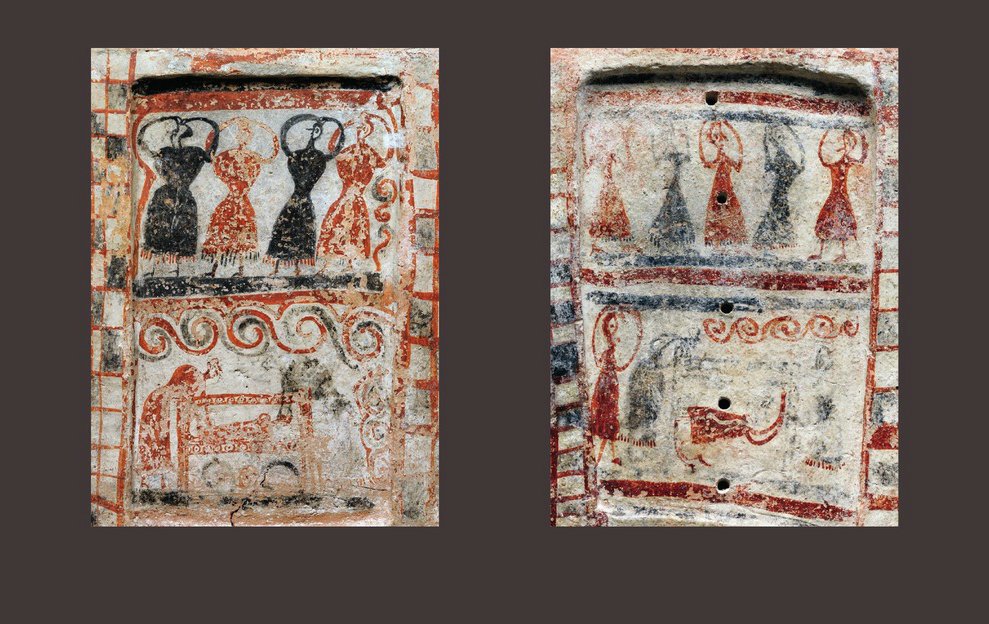
Larnakes are poorly published most scholars who study them focus on iconography which shows scenes from the funerary rituals on them. Some of these iconography themes are wailing women, male figures, winged sphynx, etc. #larnakes#funeraryburials#greektombs
Louise A. Hitchcock, et al. “The Conglomerate Quarry at the Mycenaean Site of Vapheio-Palaiopyrgi in Laconia.” Hesperia: The Journal of the American School of Classical Studies at Athens, vol. 85, no. 1, 2016, pp. 65–90. JSTOR, https://t.co/4GuzRYaIVa. Accessed 4 May 2021.
An interesting thing about the Vapheio Tomb is if you go visit now, it no longer looks like a normal Tholos tomb, the land has eroded and it is now more open and some of the structure has fallen. #latebronzeage#tholostombs#vapheiotomb
Margaretha Kramer-Hajos. “Mourning on the Larnakes at Tanagra: Gender and Agency in Late Bronze Age Greece.” Hesperia: The Journal of the American School of Classical Studies at Athens, vol. 84, no. 4, 2015, pp. 627–667. JSTOR, https://t.co/3HIk3dDJvW. Accessed 10 May 2021.
Earlier we mentioned the use of larnakes, but ever wonder where they came from? Well, they did a spectrochemical analysis on an illegally excavated larnake. The clay comes from Tanagra, leading to the assumption that more than 40% of larnakes come from Tanagra.