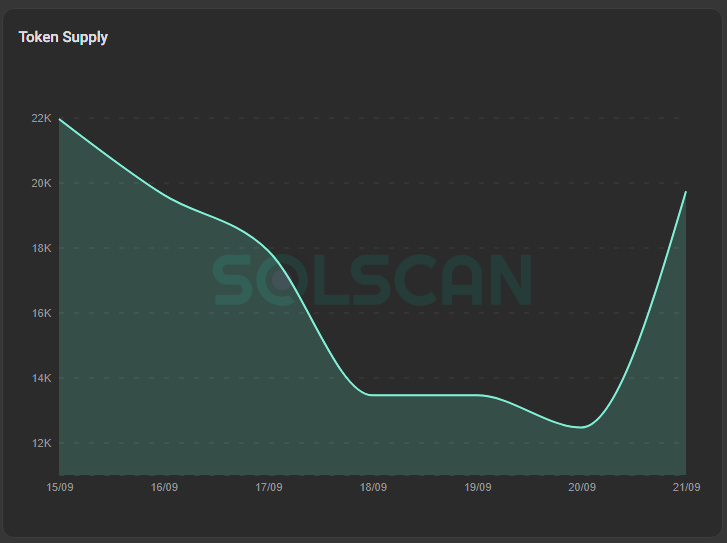
We have now locked the remaining 41,237,113 $LEAN from the dev supply.
The lock itself also triggered the 3% tax, approximately 1,237,113 $LEAN which was distributed across holders.
We hope this goes a long way toward addressing the concerns around the original ~9.99% dev allocation.
For full transparency, we still hold ~860,000 $LEAN. We attempted to include the entire remaining balance in the lock, but the contract was running into issues processing the full amount.
We’ll decide what to do with the remaining ~860K at a later date, with options including burning it or distributing it to the community.
Thanks to everyone who stuck with us while we worked through this.
The LEAN-PTN pool now holds 1,491 PTN — 7.91% of the total PTN supply.
The LEAN Treasury holds 214.74 PTN, making it the #9 PTN holder on Solana as of this post.
Distributed to $LEAN holders to date: 3.71K PTN / ~$38,599
LEAN Treasury continues to accumulate PTN.
One of the Raydium legends, @mst1287, helped get our timelocked supply whitelisted.
That means our locked $LEAN can now continue earning PTN reflections while remaining locked.
$PTN accumulation accelerates.
Update on the dev supply:
Our timelocked $LEAN supply will soon be whitelisted, meaning it can remain fully locked while still receiving PTN reflections into our Treasury.
Once everything is live and confirmed working, we plan to timelock the remainder of the dev supply as well.
That means the entire ~9.99% dev allocation will be locked, removing the dev supply overhang while still allowing LEAN’s PTN Treasury to continue growing.
Locked $LEAN. Growing $PTN.
We’re still trying to get in touch with someone from the @LaunchOnSF team regarding our locked $LEAN and PTN reflections. Any help connecting us with the right person would be greatly appreciated.
We will be the first memecoin community to own a biotech company that is pushing the boundaries of weight-loss drug development.
Hold solana:2Hm8qcnud7LEes2inqHcohQKcD7sqAqX8wb9W2uxwB7g - Get $PTN
GLP-1s created the obesity gold rush. Palatin is betting that MC4R can help define what comes next.
The GLP-1 revolution has created one of the biggest pharmaceutical markets on earth.
Ozempic. Wegovy. Mounjaro. Zepbound.
Novo Nordisk and Eli Lilly have generated tens of billions in annual sales from drugs targeting obesity and metabolic disease.
But what if GLP-1s are only the first chapter?
This is where Palatin Technologies $PTN becomes incredibly interesting.
Palatin isn't trying to build another copy of Ozempic.
They're targeting the melanocortin-4 receptor, or MC4R, a pathway directly involved in appetite, satiety, energy expenditure and body weight.
And there is already human data suggesting that MC4R and GLP-1/GIP therapies could potentially work together.
Palatin reported that its Phase 2 study combining the MC4R agonist bremelanotide with tirzepatide met its primary endpoint. Patients in the combination study achieved 4.4% weight reduction over eight weeks versus 1.6% for placebo, with Palatin also reporting no additional tolerability or safety signal from the combination.
Now they're building the next generation:
→ A once-weekly selective MC4R peptide, targeting an IND submission in Q4 2026.
→ A next-generation oral MC4R drug, targeting an IND submission in H1 2027.
→ An initial focus on serious obesity disorders including hypothalamic obesity, Prader-Willi syndrome and Bardet-Biedl syndrome.
The goal: improve MC4R selectivity, potency and tolerability while reducing unwanted off-target effects.
Think about what the GLP-1 boom has already demonstrated.
There is enormous demand for effective obesity therapies.
There is enormous pharmaceutical value in controlling appetite and energy balance. And despite everything Novo and Lilly have accomplished, obesity treatment is nowhere near a solved problem.
That is the opportunity $LEAN is aligning itself with.
$LEAN isn't just a memecoin making a joke about getting lean.
Its Treasury is accumulating exposure to Palatin $PTN.
The bigger $LEAN becomes, the more ambitious that accumulation can become.
And if $LEAN eventually becomes a major shareholder in Palatin, something genuinely unusual will have happened:
A crypto-native community will have built a significant stake in a publicly traded biotech company developing next-generation obesity medicines.
Not because we created the science.
Not because a memecoin suddenly becomes a pharmaceutical company.
But because thousands of people can collectively become economically aligned with the scientists actually trying to build the drugs.
GLP-1s created the obesity gold rush.
Palatin is betting that MC4R can help define what comes next.
And $LEAN intends to own as much of that future as it possibly can.
Get $LEAN. Become a shareholder. Flip the marketcap.
GLP-1s created the obesity gold rush. Palatin is betting that MC4R can help define what comes next.
The GLP-1 revolution has created one of the biggest pharmaceutical markets on earth.
Ozempic. Wegovy. Mounjaro. Zepbound.
Novo Nordisk and Eli Lilly have generated tens of billions in annual sales from drugs targeting obesity and metabolic disease.
But what if GLP-1s are only the first chapter?
This is where Palatin Technologies $PTN becomes incredibly interesting.
Palatin isn't trying to build another copy of Ozempic.
They're targeting the melanocortin-4 receptor, or MC4R, a pathway directly involved in appetite, satiety, energy expenditure and body weight.
And there is already human data suggesting that MC4R and GLP-1/GIP therapies could potentially work together.
Palatin reported that its Phase 2 study combining the MC4R agonist bremelanotide with tirzepatide met its primary endpoint. Patients in the combination study achieved 4.4% weight reduction over eight weeks versus 1.6% for placebo, with Palatin also reporting no additional tolerability or safety signal from the combination.
Now they're building the next generation:
→ A once-weekly selective MC4R peptide, targeting an IND submission in Q4 2026.
→ A next-generation oral MC4R drug, targeting an IND submission in H1 2027.
→ An initial focus on serious obesity disorders including hypothalamic obesity, Prader-Willi syndrome and Bardet-Biedl syndrome.
The goal: improve MC4R selectivity, potency and tolerability while reducing unwanted off-target effects.
Think about what the GLP-1 boom has already demonstrated.
There is enormous demand for effective obesity therapies.
There is enormous pharmaceutical value in controlling appetite and energy balance. And despite everything Novo and Lilly have accomplished, obesity treatment is nowhere near a solved problem.
That is the opportunity $LEAN is aligning itself with.
$LEAN isn't just a memecoin making a joke about getting lean.
Its Treasury is accumulating exposure to Palatin $PTN.
The bigger $LEAN becomes, the more ambitious that accumulation can become.
And if $LEAN eventually becomes a major shareholder in Palatin, something genuinely unusual will have happened:
A crypto-native community will have built a significant stake in a publicly traded biotech company developing next-generation obesity medicines.
Not because we created the science.
Not because a memecoin suddenly becomes a pharmaceutical company.
But because thousands of people can collectively become economically aligned with the scientists actually trying to build the drugs.
GLP-1s created the obesity gold rush.
Palatin is betting that MC4R can help define what comes next.
And $LEAN intends to own as much of that future as it possibly can.
Get $LEAN. Become a shareholder. Flip the marketcap.