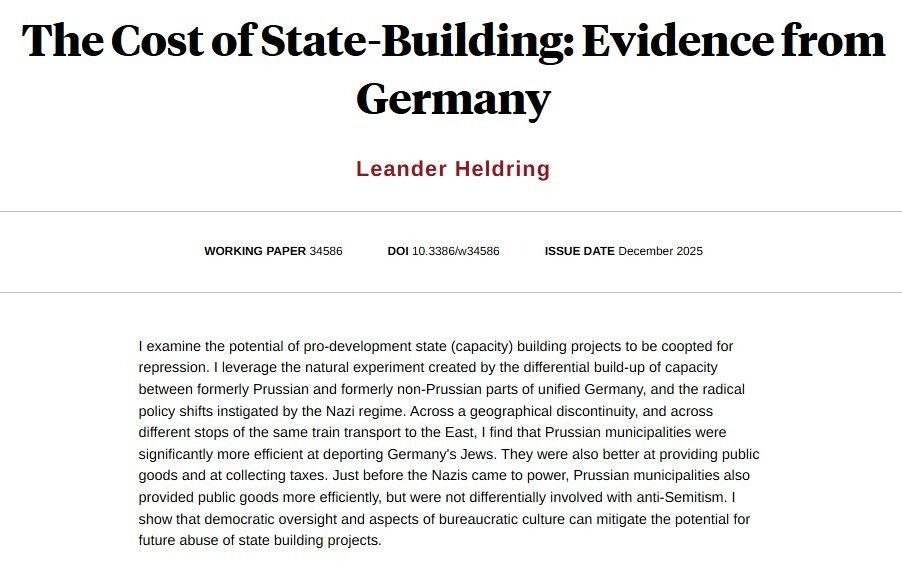
State capacity in Germany was associated with higher public good provision, but also with more effective Nazi deportations, even across adjacent stops of the same train to the East, from @LeanderHeldring https://t.co/P1MiBDViUS
Check out the paper! There is more:
1⃣ Analytical bibliography for studying the state
2⃣ In depth literature discussion
3⃣ More analysis of evolutionary theory and the state today
4⃣ MANY more examples of successful states that were not 'Weberian'
Comments welcome!
🧵Long thread on the study of historical government, for teaching and research. Based on:
Paper: https://t.co/BvdHiE8Jel
Interview: https://t.co/7iXPOoYAY8
🆕 The origins of government 📢
Today on #VoxDevTalks w/ @timsvengali, @LeanderHeldring (@KelloggSchool) discusses how effective statehood does not follow a single linear path – but instead depends on how societies mobilise and provide public goods: https://t.co/WHG0tGhIBS
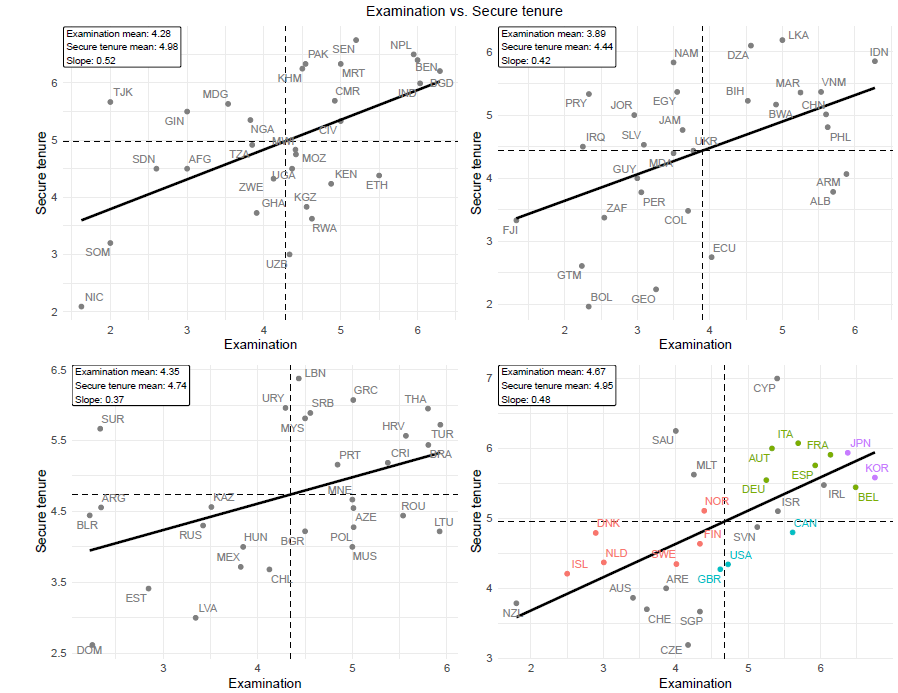
Part III: Modern varieties
Speculative: Construct correlation between 'Weberian' characteristics by income level
1⃣ These correlate positively but just as much variation among rich as among poor
2⃣ Clear 'models' (diagonal quadrants) at all levels
Much more to discuss on this!
I gave an interview for Korean tv on the topic of this article, my view on Korea’s economic miracle, and some personal stories: https://t.co/HAxIsDB3su
🧵 New survey on theories of government and the state in the annual reviews:
https://t.co/XgN0FR45VO
(includes overviews of theories - for teaching)
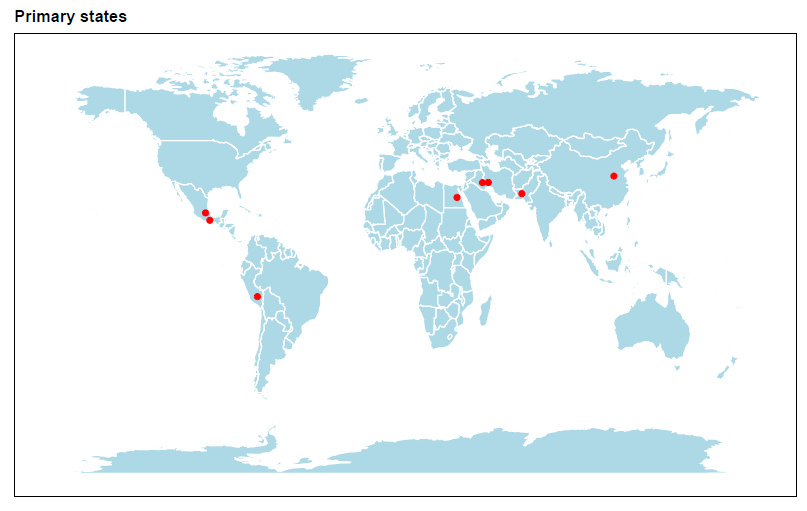
👇When, where, and why do states form?
🧵 New survey on theories of government and the state in the annual reviews:
https://t.co/XgN0FR45VO
(includes overviews of theories - for teaching)
👇When, where, and why do states form?
When do states form? Literature has not converged on this point. There are costs and benefits, but like 'where' these are more abundant while historical state formation is rare. Question is wide open!