TRUF AI, our TruflationEFM series, just cleared a big milestone.
Our economic + inflation forecasting stack, trained on @truflation real‑time data, is now beating baseline references at 30d, 90d and beyond.
Generic TS models are built to be broad; our Thales‑class architecture is built to read the tape of 100s of millions of economic datapoints and how they propagate into inflation: category behavior, release dynamics, regime shifts, cross‑stream structure.
Inflation has its own physics. Fine‑tuning, RL, broader benchmarks and production‑grade forecasting are already underway.
If you’re building trading, risk, or AI agents on macro and inflation, TruflationEFM is the forecasting stack we’re wiring into the @TRUFNETWORK
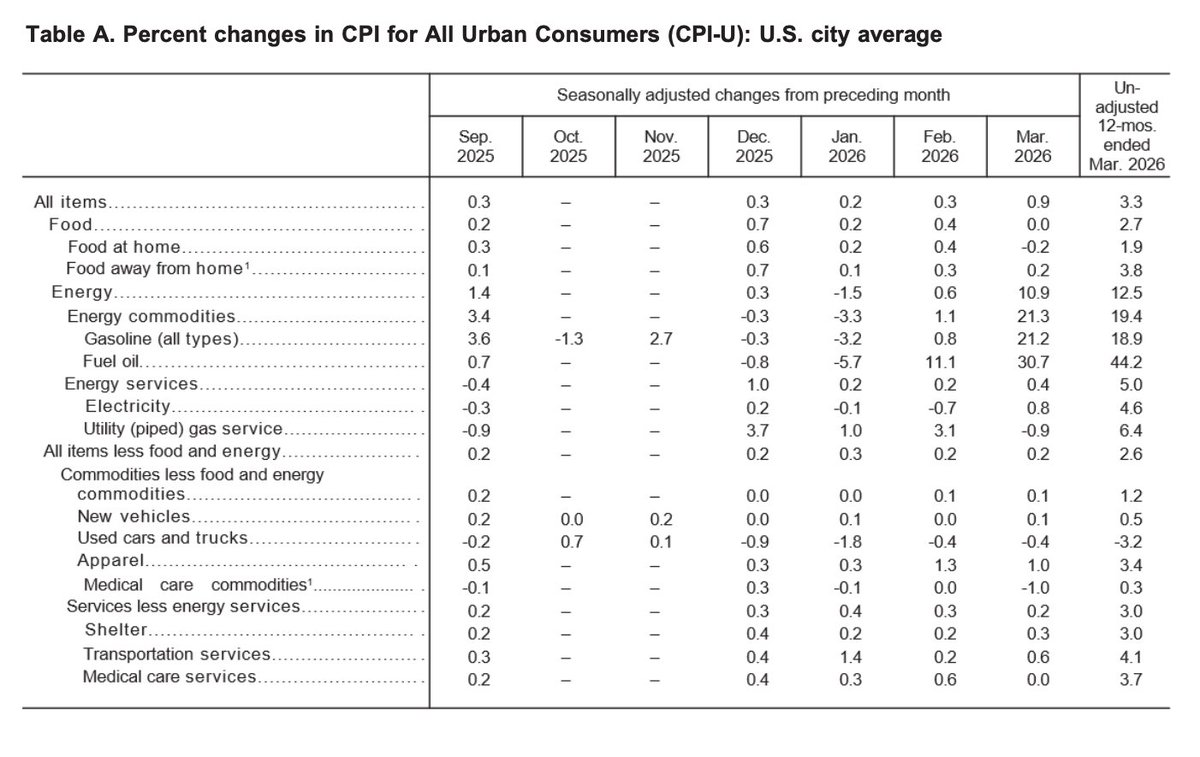
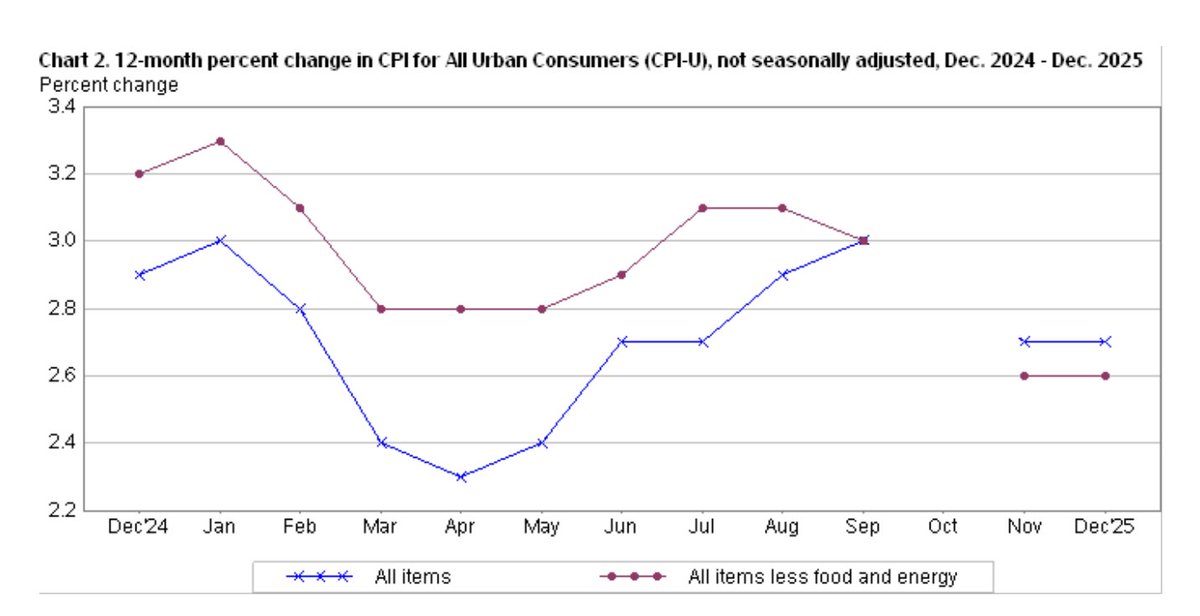
BREAKING: The headline US inflation (CPI) came in at 3.3% YoY, 0.9% up from 2.4% in February and January, and in line with Truflation's prediction.
Market forecasts ranged from 3% and 3.8% and averaged at 3.3% as well.
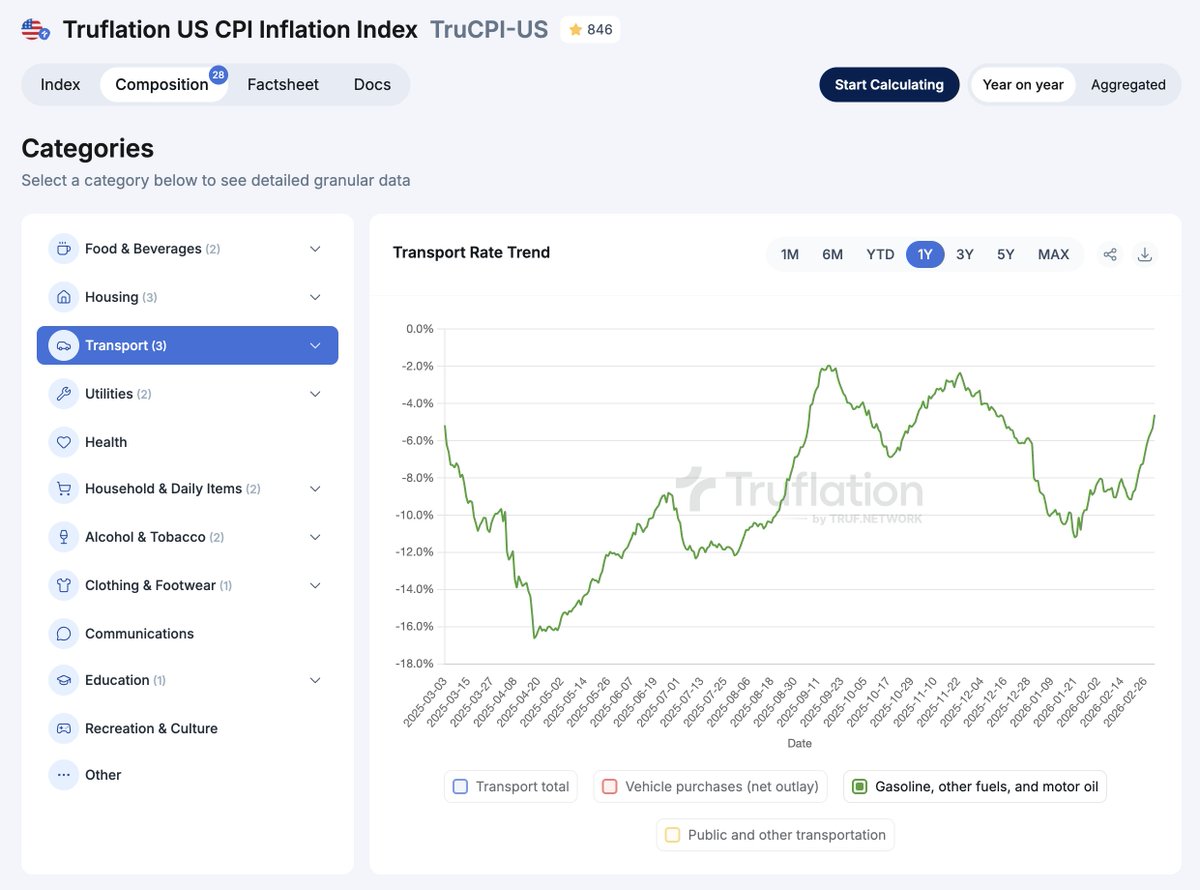
This increase follows trends observed in Truflation's real-time transaction numbers related to quickly rising prices of gasoline and transportation.
Core CPI was 2.6% YoY, up from 2.5% prior month.
Monthly Core CPI was 0.2% MoM in March, the same as in February.
Official CPI increases were mainly linked to energy prices.
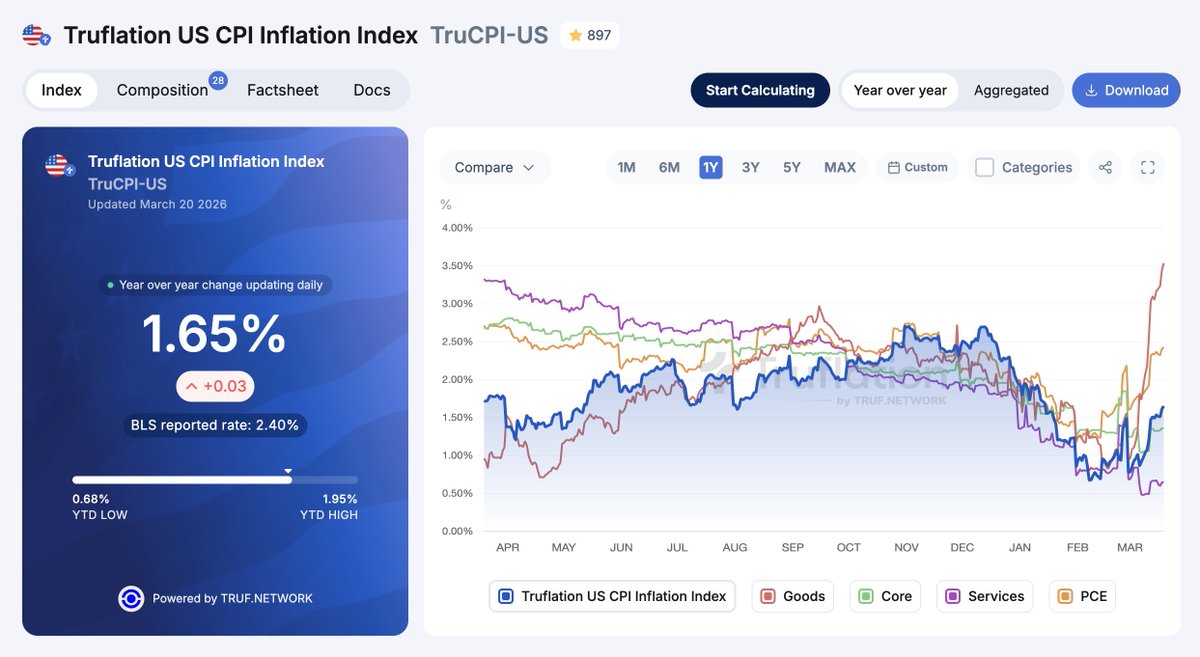
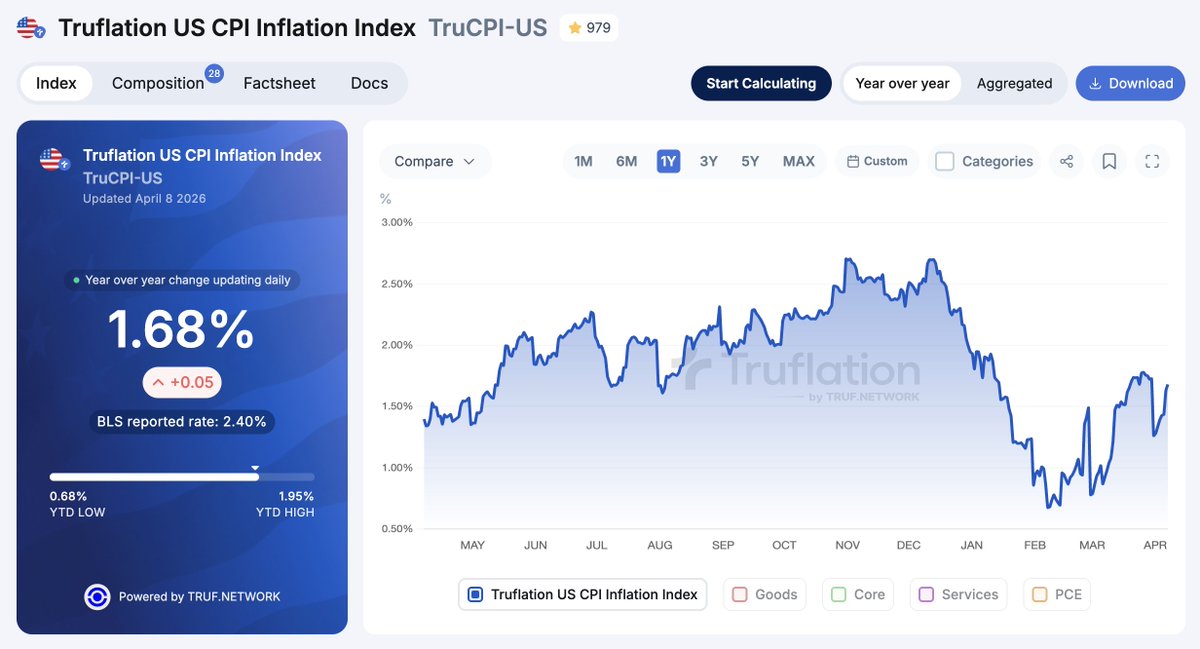
US inflation today was 1.68% YoY, according to millions of real-time transaction price data aggregated by Truflation.
This is well below the latest official BLS CPI reading of 2.40%.
Our independent measure of consumer inflation has remained below the 2% target, in the 1.3–1.7% range in early April, despite a strong reaction to gasoline price increases.
With the official March CPI scheduled for release on Friday, April 10, Truflation once again positions itself as a reliable leading indicator historically preceding BLS prints by an average of ~41 days.
Our CPI forecast is already available at https://t.co/u0l9RrzgBe
Our alternative Personal Consumer Expenditure index today:
US PCE 2.41% YoY
US Core PCE (excl food and energy): 2.32% YoY
Truflation's PCE is based on Truflation's price data, mapped to the BEA weights and categories.
Most notably, the US core PCE remains quite stable at 2.3%. It missed the disinflationary dip we saw in Q1 in our PCE and CPI inflation, and it remains the lowest in 5 years.
Core indexes exclude food and energy to reduce overall volatility and show more sticky, longer-term inflation trends, which is why core PCE is also the preferred inflation metric of the Federal Reserve when setting rate targets.
US inflation today, according to real-time transaction data:
Truflation US CPI: 1.65%, up from 0.79% 1st of March
Core CPI: 1.36%, up from 1.25% 1st of March
Goods CPI: 3.54%, up from 0.95% 1st of March
Services CPI: 0.66% stable, 0.69% 1st of March
Truflation US PCE today: 2.43%, up from 1.61% 1st of March
Core PCE: 2.38% stable from 2.35% 1st of March
This and more details are data are updated daily on our website, https://t.co/hLTRcWDCoU
Key Takeaways:
Our custom CPI remains below 2% but has increased substantially in March due to gasoline prices following the crisis in the Middle East, after a strong cooling across multiple categories in January and February.
The PCE index, which is calculated by mapping our transaction price data to the BEA methodology and weights, is now above 2%, after reaching its lowest level since 2020 (1.18%) on February 1, 2026.
Both core PCE and CPI remain fairly stable for now, suggesting that the latest inflationary trends are still temporary, although we do expect oil price fluctuations and shipping constraints to soon translate into more sticky categories of goods.
Core PCE edged up slightly above 2% today in our independent price data:
US PCE today 1.76%
US core PCE: 2.1% (excl. food and energy)
Latest PCE increases were driven mainly by non-durable goods, while decreases were registered in durable goods and services. Learn more on our website.
US CPI today is 0.86%, according to independent price data.
The latest movements in the energy commodities sector haven't affected consumer utilities yet, but already influenced gasoline prices at the pump.
The higher cost of transport will likely also translate into higher prices of food and goods in the near future.
Food edged up today, though it remains in slight deflation alongside clothing and communications, while housing currently shows 0% inflation, a small reversal from Jan-Feb deflationary trends.
BREAKING: Gen Zs are the most confident about inflation, stock prices, and interest rates among the consumer groups, while the confidence of Baby Boomers and Gen X has plummeted to the lowest levels in 4 years.
(Source: Consumer Board)
The two groups with the least confidence are also the groups with the most wealth and assets, which could translate into more risk-averse markets.
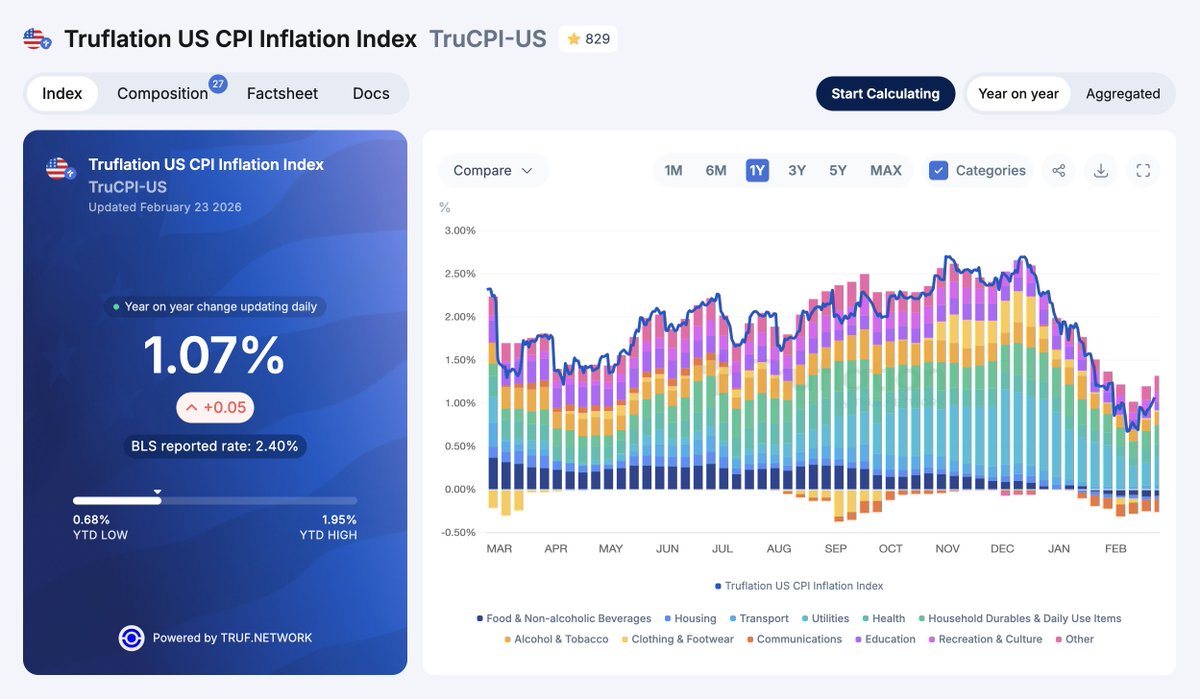
According to our price data, the US CPI is now 1.07%, below the Fed's 2% target.
The rapid inflation-cooling trend we saw between December and February decelerated somewhat, but a few product and service categories remain in deflation, namely food, communications, and housing.
Last week's official PCE for December came in hotter than markets expected, driven mainly by the hot housing numbers.
Both the BLS and the BEA measure rents through the severely lagging household surveys. The official rent index can take up to 13 months (!) to capture real market price fluctuations, according to Penn State University researchers who developed an alternative US rent index and worked with Truflation to establish our rent calculations.
The PCE uptick could be one of the inflation peaks we saw in our data in November and December, but given the incredibly laggy housing index as the main driver of the numbers, it's unclear when the real rent situation will trickle into the official PCE data.
The good news is that the BEA PCE and the BLS CPI use the same rent index, and the cooling January CPI offers some hope of a similar trend in the January PCE, to be released on March 13th.
Will government agencies innovate their data-collection methodologies in 2026? Let us know what you think!
The US inflation today across our independent inflation indexes:
US CPI: 0.90% (vs 2.4% official for January from the BLS)
=> Our custom US headline inflation index, daily year-over-year % rate
US PCE: 1.54% (vs 2.8% official for November from the BEA)
=> Our data applied to the BEA's PCE weights and categories
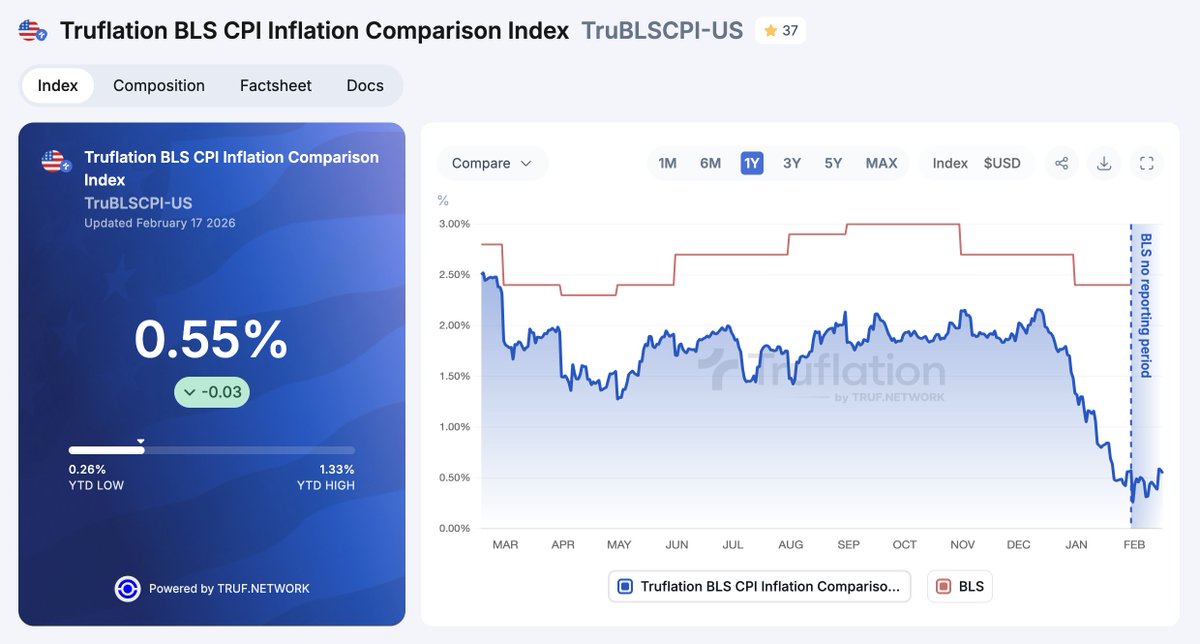
US BLS Comparison Index: 0.55% (vs 2.4% official for January)
=> Our data applied to the BLS's CPI weights and categories
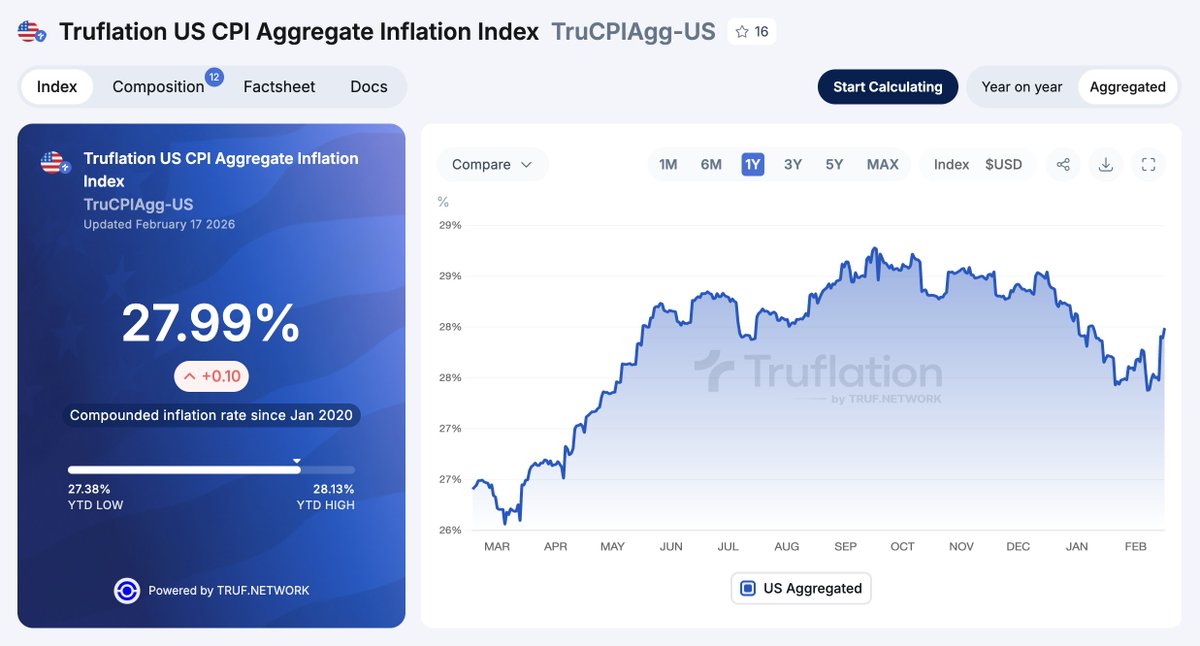
US aggregate CPI: ~28%
=> Our custom CPI index cumulative inflation since January 2020
Truflation's independent indexes use over a million data points from tens of different providers, aiming to use multiple data providers per data point. Streaming daily from APIs for the most current and comprehensive measurement of US inflation.
Learn more on our website https://t.co/71zLUP1Vsk
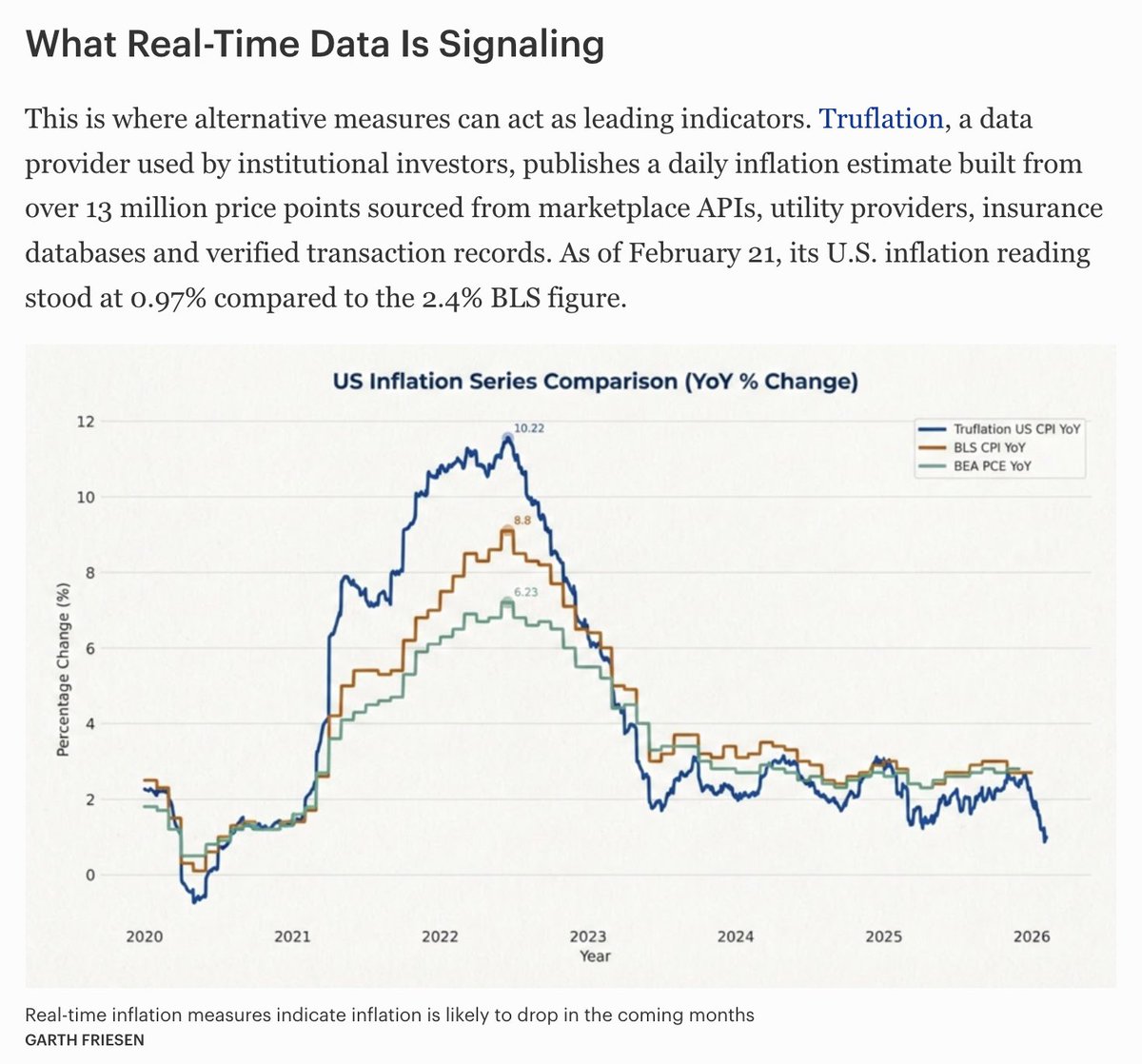
Truflation not only reports the most current daily inflation but also helps predict the official US headline inflation, which the US Bureau of Labor Statistics releases only once a month.
Check our detailed analysis of Truflation as a leading indicator for the US CPI, which, depending on the macroeconomic environment, shifts from a 40-45 day lead to a 70-75 day lead.
We've been using millions of real-time prices from tens of data sources to correctly predict CPI inflation and inflation trend shifts at 99.94% accuracy over the past 12 months, outperforming all public and many commercial bank models.
Dive deeper into our lead time analysis in this report paper: https://t.co/xrc3WCZvVi
US inflation today, based on millions of real price data:
US CPI: 0.94%
US core CPI (excl food and energy): 1.51%
Our headline inflation index has remained below the Fed's 2% target and below 1% since February. The latest upward trend, from 0.74%, was driven by price increases in health, education, clothing, and public transport. It primarily reflected services inflation rather than goods inflation, suggesting that the effect of current tariffs is now completely baked in.
BREAKING: Official US CPI comes at 2.4% Y/Y
Truflation correctly predicted the numbers would come in cooler than the market consensus of 2.5%, between 2.2% and 2.4%, when we extrapolate our rapidly cooling numbers to the BLS CPI.
US inflation today, according to millions of daily price data:
US CPI: 0.74%
US PCE: 1.27%
Tomorrow we'll learn the official US headline inflation numbers for January. The latest US CPI inflation for December was 2.7%. Will the BLS catch on to any of the recent disinflationary trends we are seeing across multiple price data categories?
We'll be discussing the BLS CPI inflation data release during our Spaces tomorrow, Feb 13, 8-9 AM ET.
The BLS released the Employment Situation report today:
The new non-farm payrolls surprised to the upside with 130k added jobs in January vs 48K previous and 70k predicted.
Unemployment rate edged slightly down to 4.3%, from 4.4% and 4.4% forecasts, with 7.4 million total unemployed people in the US. But it was higher than the 4% and 6.9 million reported a year ago.
If you listen to our spaces discussion on employment numbers, most speakers considered the January employment situation weak and the BLS behind in registering the true softening in the labor market.
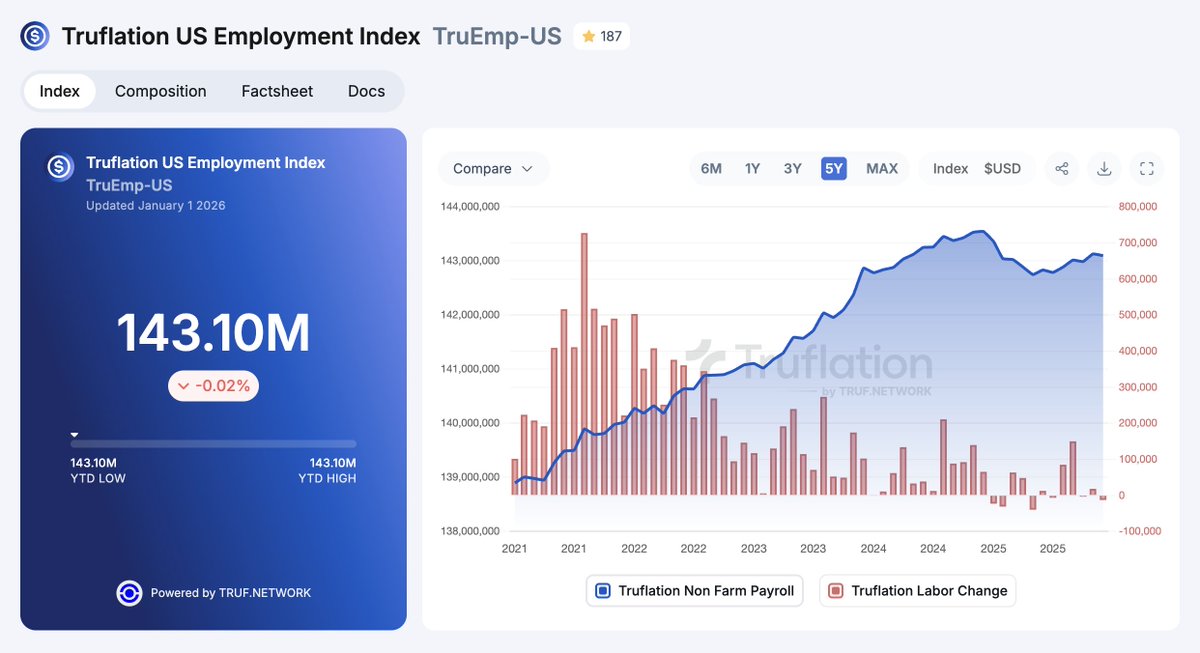
Our independent employment index for January shows a decrease of 13k in new non-farm payrolls, with 143.1 million total non-farm employed people.
While this is not a terrible number when you zoom out to 2020, we are definitely seeing a slowdown in job growth and an AI-driven reshuffling in the job market.
US inflation today based on independent real price data:
US CPI: 0.68%
US core CPI: 1.06%
US PCE: 1.24%
US core PCE: 1.50%
US BLS Comparison index (if we used BLS weighting): 0.34% (!)
On our website, you can access all of those indexes, their composition, detailed methodology, historical data, and multiple subindexes for component categories, goods, services, and core inflation, which excludes food and energy prices.
Busy week for Truflation. Decision-makers are learning that crucial government data guiding Federal Reserve decisions could benefit from updates to their methodologies and the types of data they are allowed to use.