🚨 Most people are drowning in AI subscriptions.
The problem isn't a lack of tools.
It's a lack of systems.
Here's my AI Toolkit for 2026 👇
🧠 AI Assistants
→ ChatGPT
→ Claude
→ Gemini
✍️ Writing
→ Jasper
→ Writesonic
→ https://t.co/lw1G13MivI
🌐 Website Building
→ Framer
→ 10Web
→ Durable
🎨 Design
→ Canva AI
→ Adobe Firefly
→ Flair AI
🖼️ Image Generation
→ Midjourney
→ Flux
→ DALL·E
🎥 Video Creation
→ Runway
→ HeyGen
→ Synthesia
🎙️ Voice & Audio
→ ElevenLabs
→ PlayHT
→ Murf AI
⚙️ Automation
→ Make
→ Zapier
→ n8n
🤖 AI Chatbots
→ Chatbase
→ Botpress
→ SiteGPT
📊 Presentations
→ Gamma
→ https://t.co/PEBW9jvD9W
→ Tome
💻 Coding
→ Cursor
→ Claude Code
→ GitHub Copilot
📈 Marketing
→ AdCreative
→ Pencil
→ Simplified
📚 Research
→ Perplexity
→ Elicit
→ Consensus
The biggest AI mistake in 2026?
Collecting tools instead of building workflows.
Someone with 5 AI tools and a repeatable system will outperform someone with 50 subscriptions.
What's the one AI tool you can't live without?
Save this 🔖
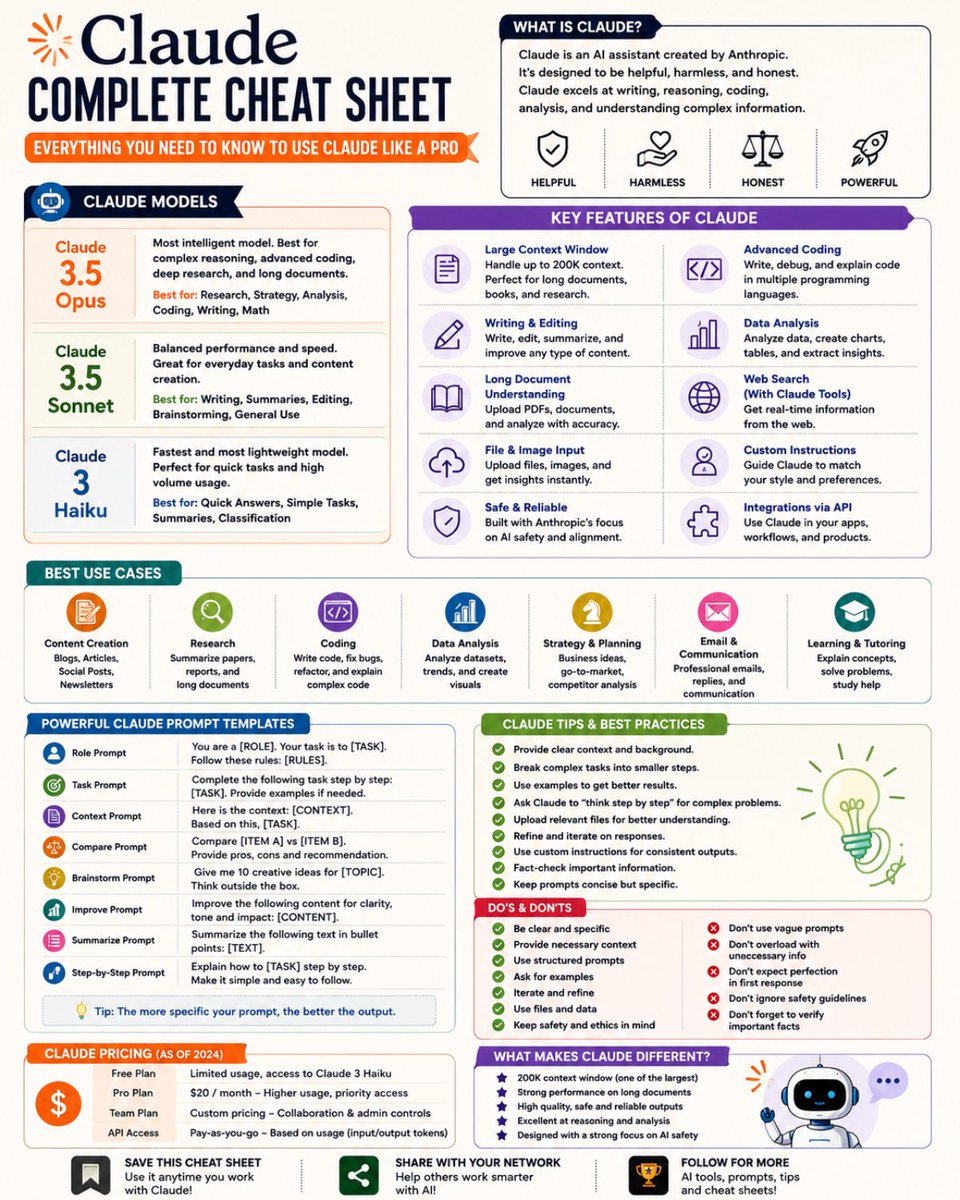
Everyone talks about ChatGPT.
But the smartest AI users I know keep Claude open in the next tab.
Why?
Because Claude shines when the work gets complicated.
📄 300-page PDFs
🧠 Multi-step reasoning
✍️ Long-form writing
📊 Research and analysis
💻 Large coding projects
📚 Dense technical content
Most AI tools are great at answering questions.
Claude is great at staying focused.
That's a bigger advantage than most people realize.
When you're:
→ Reviewing contracts
→ Reading research papers
→ Building software
→ Writing reports
→ Learning complex topics
→ Working with massive context
The difference becomes obvious.
What makes Claude stand out?
✅ Huge context window
✅ Strong reasoning
✅ Excellent writing quality
✅ Reliable document analysis
✅ Cleaner outputs with less prompting
This cheat sheet covers:
• Claude models explained
• When to use each model
• Prompt frameworks
• Hidden features
• Common mistakes
• Pro workflows
The biggest AI advantage isn't knowing one tool.
It's knowing which tool to use for which problem.
Save this. You'll use it more than you think. 🚀
99% of engineers using MCP couldn't explain what happens after an AI decides to call a tool.
They know it works.
They don't know WHY it works.
Here's the mental model that made MCP click for me 👇
Before MCP:
Every AI model needed a custom integration for every tool.
10 models × 100 tools = 1,000 integrations 🤯
After MCP:
Models speak one language.
Tools speak one language.
Everything connects through a common protocol.
That's it.
The architecture is surprisingly simple:
🖥️ Host → Claude, ChatGPT, Cursor, VS Code
🔌 Client → lives inside the host and manages connections
⚙️ Server → exposes tools, resources, and prompts
Under the hood?
Just JSON-RPC 2.0 messages.
No magic.
No agent framework.
No secret AI sauce.
The part most people miss:
• Every tool schema gets injected into the model context
• More tools = more tokens
• More tokens = higher costs
• Bad schemas = worse agent performance
• Tool sprawl becomes the new microservices sprawl
MCP isn't competing with LangChain.
MCP isn't an agent framework.
MCP is becoming what HTTP became for web applications:
A boring standard that quietly wins.
Five years from now, most AI systems will probably speak MCP.
And most developers still won't know what happens on the wire.
Save this if you're building AI agents.
Most people think AI runs on GPUs.
That's like saying the internet runs on browsers.
Modern AI is powered by an entire ecosystem of processors:
🧠 CPU → Coordinates everything
⚡ GPU → Trains massive models
🔷 TPU → Accelerates tensor operations
📱 NPU → Brings AI to phones & laptops
🚀 LPU → Delivers ultra-fast LLM responses
🌐 DPU → Handles networking, security & data movement
The interesting part?
Every AI breakthrough depends on ALL of them working together.
A trillion-parameter model is useless if:
• Data can't reach it fast enough
• Inference is too expensive
• Edge devices can't run it
• Infrastructure can't scale
The next AI race won't be won by the best model.
It'll be won by whoever builds the best compute stack.
Models get the headlines.
Chips run the world.
Which processor category do you think will see the biggest growth over the next 5 years? 👇
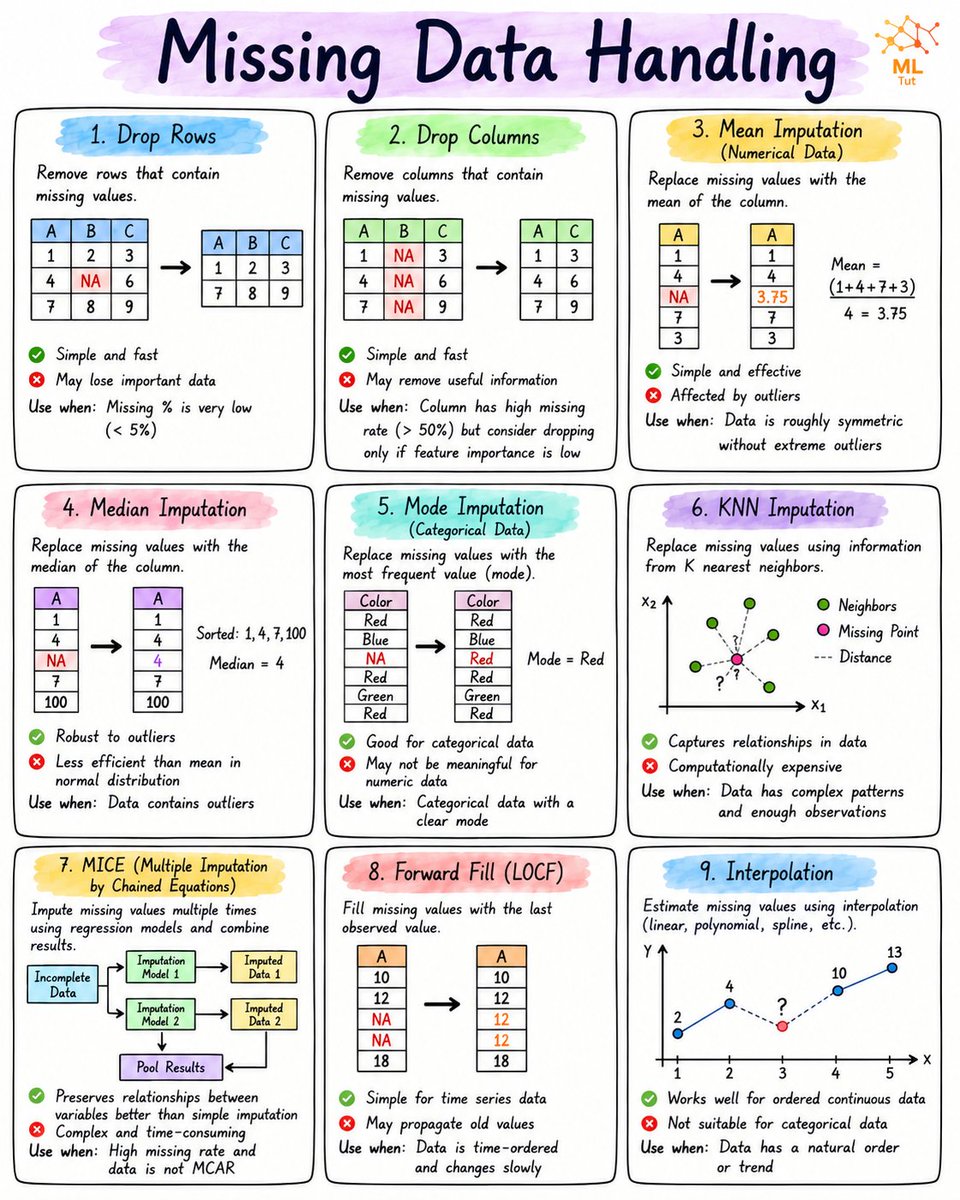
Missing data can quietly ruin your machine learning model. 📉
Before training any model, learn when to use Mean, Median, Mode, KNN, MICE, and other imputation techniques. The right choice can significantly improve accuracy and reliability. 🚀
Save this cheat sheet for your next Data Science or ML project. 📌
10 GitHub repos that will level up your AI Agent skills (SAVE THIS)🔖
1. Hands-On Large Language Models
Complete code notebooks from basics to advanced fine-tuning.
🔗 https://t.co/YKYUlUNhr6
2. AI Agents for Beginners
A free 11-part intro course to build your first agents.
🔗 https://t.co/ebBwODOkZa
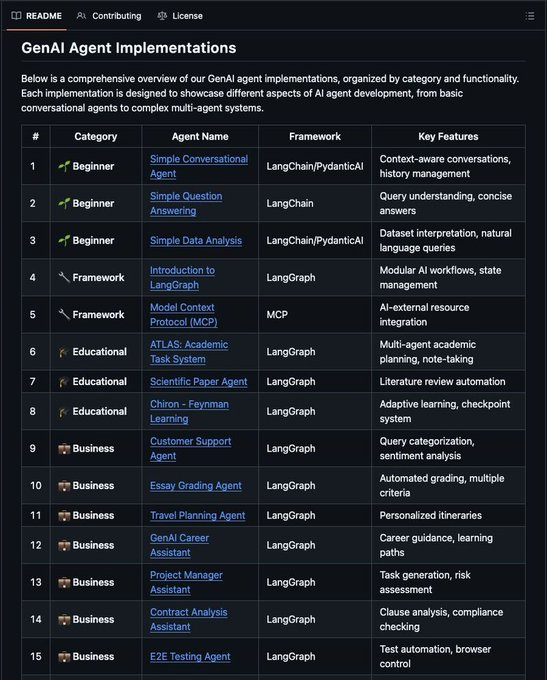
3. GenAI Agents
Tutorials and code for building generative AI agents.
🔗 https://t.co/4Mg2GeyYIe
4. Made with ML
Learn to design, build, and deploy real ML apps.
🔗 https://t.co/cyB1JbQiNV
5. Prompt Engineering Guide
Learn to write powerful and effective prompts.
🔗 https://t.co/3yGHjdprrt
6. Hands-On AI Engineering
Practical LLM-powered apps and agent examples.
🔗 https://t.co/Xsill4EYdG
7. Awesome Generative AI Guide
Curated hub for genAI research and tools.
🔗 https://t.co/9nNN74EVvu
8. Designing Machine Learning Systems
Summaries and resources from the popular ML systems book.
🔗 https://t.co/teoyuGvKND
9. ML for Beginners (Microsoft)
Free beginner-friendly ML curriculum.
🔗 https://t.co/bvoG8mjEFT
10. LLM Course
Roadmaps and hands-on notebooks to build LLM apps.
🔗 https://t.co/soHfhieIDI
I'm curating 50+ AI Agent resources on my profile worth checking out 👋
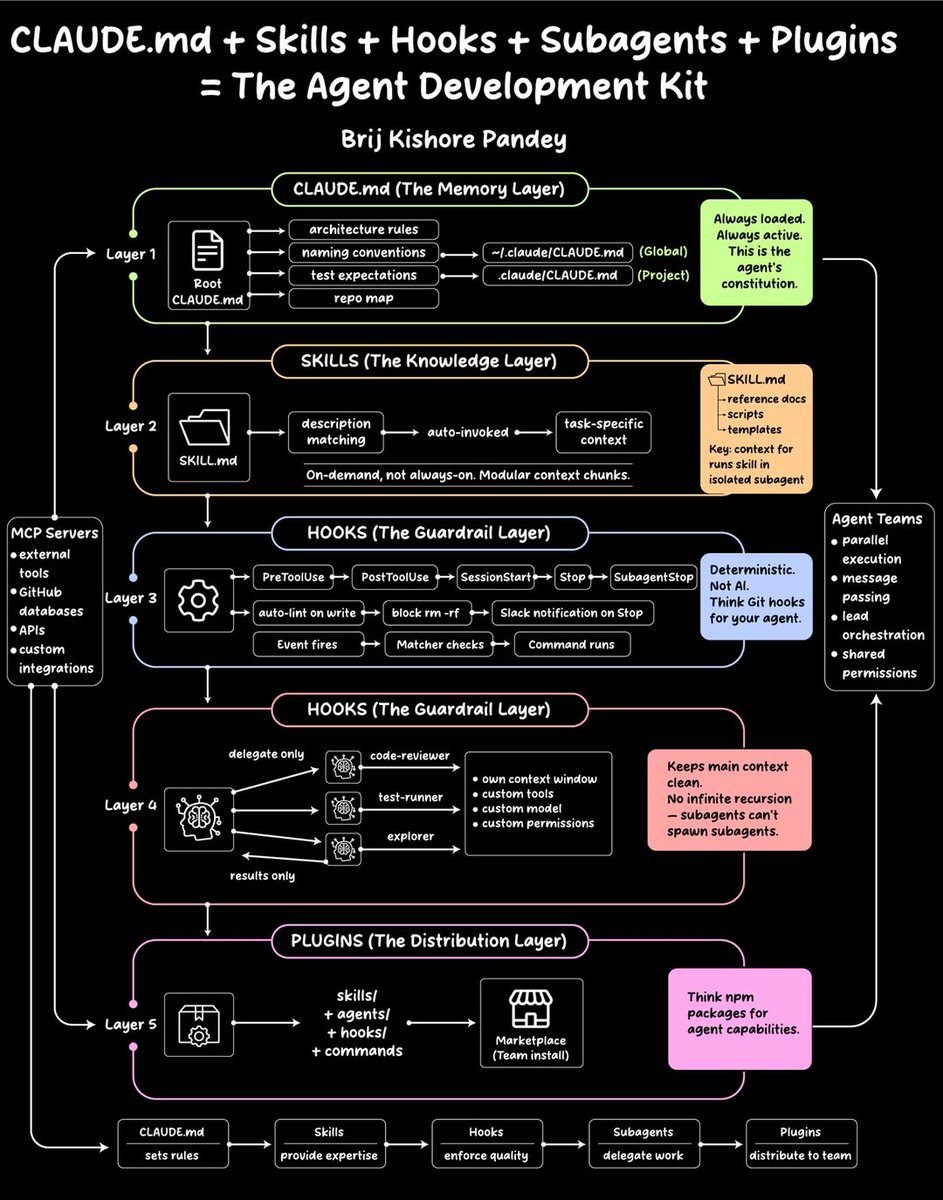
Most developers think Claude Code is an AI coding assistant.
They're wrong.
Claude Code is secretly a 5-layer operating system for AI agents.
And 90% of people never go beyond Layer 1.
Here's the architecture 👇
🧠 Layer 1 — Memory (CLAUDE.md)
Your project's brain.
Coding standards, architecture decisions, workflows, and team rules persist across sessions.
📚 Layer 2 — Skills
Reusable expertise packs.
Need a React expert? A security auditor? A database architect?
Claude loads the right knowledge automatically.
🔒 Layer 3 — Hooks
The layer most people ignore.
Auto-run tests.
Block risky commands.
Enforce quality before mistakes hit production.
🤖 Layer 4 — Subagents
Delegate work like a real engineering team.
One agent reviews code.
One writes tests.
One investigates bugs.
Parallel execution. Separate context.
📦 Layer 5 — Plugins
Package your entire agent workflow.
Install once.
Share across teams.
Reuse everywhere.
The magic isn't prompting.
It's architecture.
Most people are chatting with Claude.
A few are building autonomous software teams inside it.
That's where the real leverage starts.
Bookmark this if you're serious about AI engineering 🔖
#ClaudeCode #AIAgents #AgenticAI #AIEngineering #SoftwareDevelopment
Most people say they're building an "AI Agent."
They're usually building a chatbot.
Here's the actual progression 👇
Stage 1 → LLM
🧠 Predicts the next token.
Stage 2 → + RAG
📚 Can read your documents before answering.
Stage 3 → + Tools
🔧 Can take actions.
APIs. Databases. Code. Web.
Stage 4 → + Memory
💾 Remembers users, preferences, and past outcomes.
Stage 5 → AI Agent
🤖 LLM + Context + Tools + Memory
Stage 6 → Multi-Agent Systems
🤝 Agents coordinating with other agents.
Stage 7 → Skills & Workflows
🧩 Reusable capabilities triggered automatically.
Stage 8 → Governance & Observability
🛡️ Traces, evaluations, guardrails, permissions, audits.
This is where most production systems actually spend their time.
The biggest misconception in AI:
People think the magic is the model.
The real magic is everything wrapped around it.
And the best engineers know something else:
Not every problem needs Stage 8.
Many don't even need Stage 4.
Knowing where to stop is often more valuable than knowing how to add more.
AI isn't one breakthrough.
It's layers of capabilities stacked on top of each other.
Bookmark this for the next time someone says:
"We're building an AI agent."
Missing data can quietly ruin your machine learning model. 📉
Before training any model, learn when to use Mean, Median, Mode, KNN, MICE, and other imputation techniques. The right choice can significantly improve accuracy and reliability. 🚀
Save this cheat sheet for your next Data Science or ML project. 📌
Most people think AI agents = LLM + prompt.
That's why their agents break after the first real task.
The LLM is only one layer.
The real stack looks like this:
🧠 Claude → reasoning engine
📚 Skills → teach the agent domain knowledge
🔌 MCP → connects GitHub, Slack, databases, APIs
🤖 Subagents → delegate specialized tasks
🪝 Hooks → automate deterministic workflows
🛠️ Tools → take actions in the real world
📄 CLAUDE.md → persistent project memory
A simple prompt answers a question.
An agent:
→ Understands context
→ Chooses tools
→ Delegates work
→ Executes actions
→ Observes results
→ Improves the next step
That's the shift happening right now.
We're moving from:
"Ask → Answer"
to
"Reason → Act → Observe → Iterate"
The future of AI isn't bigger prompts.
It's better orchestration.
Save this if you're building with Claude Code, MCP, or AI agents. 🚀
Most people say they're building an "AI Agent."
They're usually building a chatbot.
Here's the actual progression 👇
Stage 1 → LLM
🧠 Predicts the next token.
Stage 2 → + RAG
📚 Can read your documents before answering.
Stage 3 → + Tools
🔧 Can take actions.
APIs. Databases. Code. Web.
Stage 4 → + Memory
💾 Remembers users, preferences, and past outcomes.
Stage 5 → AI Agent
🤖 LLM + Context + Tools + Memory
Stage 6 → Multi-Agent Systems
🤝 Agents coordinating with other agents.
Stage 7 → Skills & Workflows
🧩 Reusable capabilities triggered automatically.
Stage 8 → Governance & Observability
🛡️ Traces, evaluations, guardrails, permissions, audits.
This is where most production systems actually spend their time.
The biggest misconception in AI:
People think the magic is the model.
The real magic is everything wrapped around it.
And the best engineers know something else:
Not every problem needs Stage 8.
Many don't even need Stage 4.
Knowing where to stop is often more valuable than knowing how to add more.
AI isn't one breakthrough.
It's layers of capabilities stacked on top of each other.
Bookmark this for the next time someone says:
"We're building an AI agent."
Most developers think Claude Code is an AI coding assistant.
They're wrong.
Claude Code is secretly a 5-layer operating system for AI agents.
And 90% of people never go beyond Layer 1.
Here's the architecture 👇
🧠 Layer 1 — Memory (CLAUDE.md)
Your project's brain.
Coding standards, architecture decisions, workflows, and team rules persist across sessions.
📚 Layer 2 — Skills
Reusable expertise packs.
Need a React expert? A security auditor? A database architect?
Claude loads the right knowledge automatically.
🔒 Layer 3 — Hooks
The layer most people ignore.
Auto-run tests.
Block risky commands.
Enforce quality before mistakes hit production.
🤖 Layer 4 — Subagents
Delegate work like a real engineering team.
One agent reviews code.
One writes tests.
One investigates bugs.
Parallel execution. Separate context.
📦 Layer 5 — Plugins
Package your entire agent workflow.
Install once.
Share across teams.
Reuse everywhere.
The magic isn't prompting.
It's architecture.
Most people are chatting with Claude.
A few are building autonomous software teams inside it.
That's where the real leverage starts.
Bookmark this if you're serious about AI engineering 🔖
#ClaudeCode #AIAgents #AgenticAI #AIEngineering #SoftwareDevelopment
10 GitHub repos that will level up your AI Agent skills (SAVE THIS)🔖
1. Hands-On Large Language Models
Complete code notebooks from basics to advanced fine-tuning.
🔗 https://t.co/YKYUlUNhr6
2. AI Agents for Beginners
A free 11-part intro course to build your first agents.
🔗 https://t.co/ebBwODOkZa
3. GenAI Agents
Tutorials and code for building generative AI agents.
🔗 https://t.co/4Mg2GeyYIe
4. Made with ML
Learn to design, build, and deploy real ML apps.
🔗 https://t.co/cyB1JbQiNV
5. Prompt Engineering Guide
Learn to write powerful and effective prompts.
🔗 https://t.co/3yGHjdprrt
6. Hands-On AI Engineering
Practical LLM-powered apps and agent examples.
🔗 https://t.co/Xsill4EYdG
7. Awesome Generative AI Guide
Curated hub for genAI research and tools.
🔗 https://t.co/9nNN74EVvu
8. Designing Machine Learning Systems
Summaries and resources from the popular ML systems book.
🔗 https://t.co/teoyuGvKND
9. ML for Beginners (Microsoft)
Free beginner-friendly ML curriculum.
🔗 https://t.co/bvoG8mjEFT
10. LLM Course
Roadmaps and hands-on notebooks to build LLM apps.
🔗 https://t.co/soHfhieIDI
I'm curating 50+ AI Agent resources on my profile worth checking out 👋
You ask AI a question.
400ms later, it answers like magic.
But your prompt just traveled through an invisible infrastructure pipeline most developers never think about:
→ API Gateways
→ Load Balancers
→ Tokenizers
→ GPU Routers
→ Inference Engines
→ KV Cache
→ Safety Filters
→ Billing Systems
→ Observability Pipelines
Every single token touches dozens of systems before it reaches your screen.
And here's the crazy part:
The model itself is only ONE layer.
The real engineering challenge is everything around it.
Most AI latency bugs aren't "the model being slow."
They're:
• bad routing
• cold GPUs
• token explosion
• cache misses
• overloaded gateways
• broken streaming
• safety rechecks
• observability bottlenecks
Modern AI apps are no longer "just calling an API."
They're distributed systems pretending to be chatbots.
The developers who understand this stack will build the next generation of AI infrastructure.
Everyone else will keep blaming the model.
Save this before your next mysterious latency spike 🔖
The GenAI vocabulary you learned in 2024 is already outdated.
Back then, AI mostly generated answers.
Now?
AI systems:
→ use tools
→ browse the web
→ write code
→ coordinate subagents
→ remember context
→ make decisions
→ execute workflows
We’ve entered the era of Agentic AI.
And that shift created an entirely new engineering language.
Here are 12 Agentic AI terms every builder needs to know in 2026 👇
━━━━━━━━━━━━━━━
🧩 𝗠𝗖𝗣 (Model Context Protocol)
The universal connector between agents and tools.
Think:
“USB-C for AI systems.”
One protocol connecting:
→ IDEs
→ browsers
→ APIs
→ databases
→ developer tools
━━━━━━━━━━━━━━━
🔁 𝗔𝗴𝗲𝗻𝘁 𝗟𝗼𝗼𝗽
The core thinking cycle:
Observe
→ Reason
→ Act
→ Evaluate
→ Repeat
This is what transforms an LLM into an autonomous system.
━━━━━━━━━━━━━━━
🛠️ 𝗧𝗼𝗼𝗹 𝗨𝘀𝗲
Giving AI actual capabilities.
Not just text generation.
Agents can now:
→ run code
→ call APIs
→ search databases
→ send emails
→ deploy apps
→ control browsers
LLMs are becoming operating systems.
━━━━━━━━━━━━━━━
🎛️ 𝗢𝗿𝗰𝗵𝗲𝘀𝘁𝗿𝗮𝘁𝗼𝗿
The “manager” coordinating the agents.
Routes tasks.
Maintains state.
Handles retries.
Controls workflows.
Without orchestration, multi-agent systems become chaos.
━━━━━━━━━━━━━━━
👨🔧 𝗦𝘂𝗯𝗮𝗴𝗲𝗻𝘁
A specialized worker agent.
One researches.
One debugs.
One writes tests.
One validates outputs.
AI teams are replacing single-prompt workflows.
━━━━━━━━━━━━━━━
🧠 𝗠𝗲𝗺𝗼𝗿𝘆
The difference between:
“chatbot”
and
“persistent AI system.”
Short-term memory → current task
Long-term memory → user history + learned context
Memory is becoming the foundation of personalization.
━━━━━━━━━━━━━━━
🌍 𝗚𝗿𝗼𝘂𝗻𝗱𝗶𝗻𝗴
Keeping AI connected to reality.
Instead of hallucinating,
the system pulls:
→ documents
→ APIs
→ web results
→ databases
→ enterprise data
Grounded agents outperform isolated LLMs.
━━━━━━━━━━━━━━━
🛡️ 𝗚𝘂𝗮𝗿𝗱𝗿𝗮𝗶𝗹𝘀
The safety + policy layer.
Controls:
→ permissions
→ tool access
→ dangerous actions
→ prompt injection risks
→ output validation
Production agents without guardrails are security risks.
━━━━━━━━━━━━━━━
📦 𝗦𝗮𝗻𝗱𝗯𝗼𝘅𝗶𝗻𝗴
Safe execution environments for agents.
Especially important when AI:
→ writes code
→ executes commands
→ modifies files
→ runs automation
Never let autonomous systems run unrestricted.
━━━━━━━━━━━━━━━
👤 𝗛𝘂𝗺𝗮𝗻-𝗶𝗻-𝘁𝗵𝗲-𝗟𝗼𝗼𝗽
The approval checkpoint.
Critical actions still require human validation:
→ deployments
→ payments
→ database changes
→ sensitive workflows
Autonomy ≠ removing humans entirely.
━━━━━━━━━━━━━━━
🪟 𝗖𝗼𝗻𝘁𝗲𝘅𝘁 𝗪𝗶𝗻𝗱𝗼𝘄
Your agent’s attention span.
Too much context:
→ performance drops
→ latency rises
→ reasoning weakens
Context engineering is becoming as important as prompt engineering.
━━━━━━━━━━━━━━━
🤝 𝗠𝘂𝗹𝘁𝗶-𝗔𝗴𝗲𝗻𝘁 𝗦𝘆𝘀𝘁𝗲𝗺𝘀
Multiple AI agents collaborating together.
Not one super-agent.
A coordinated system of specialists.
Exactly how human engineering teams operate.
━━━━━━━━━━━━━━━
The biggest shift in AI right now:
We’re moving from:
“ask AI a question”
to:
“assign AI a task.”
That changes everything.
Save this post.
Your future AI stack will be built around these concepts. 📌
Which term do you think will become the most important over the next 2 years?
#AgenticAI #AIEngineering #LLM #MCP #ArtificialIntelligence #AIArchitecture