***GREAT TEACHING FRAMEWORK***
Over the last few months we have been working on developing our great teaching framework to ensure every student experiences consistently high quality teaching.
Our framework has four key drivers of excellence:
✅ Subject knowledge
✅ Relationships
✅ Routines
✅ Hard Thinking
The framework has six principles, key components and linked techniques from @WALKTHRUs_5, @teacherhead, @olicav and TLAC @Doug_Lemov. We have mapped the techniques to the Great Teaching Toolkit.
For each technique, we have codified what it means and our teaching and practice labs CPD sessions allow staff to get it, see it and try it.
We then use @Steplab_co for our coaching model to keep it, fit it and continue to try it through deliberate practice.
#TheLongdendaleLegacy #GreatTeaching
Secondary math teachers! I hope you've checked out Marbleslides (https://t.co/nmvX3lNKUS). This link includes some challenging variations made by Sean Sweeny too.
One of the biggest challenges in teaching?
Helping students organise knowledge in a way that actually sticks 👀
Our course explores the role Schema plays in memory, understanding and long-term learning.
https://t.co/rFYT9QzfSS
Retrieval practice is the single most well supported research-informed learning strategy. Supporting pupils to try to recall prior content, is helping them learn. Take a look ⬇️👀💥
For bespoke in-school professional learning contact [email protected]
What happens when two T&L minds (@MissCole279 and me) come together?
A great teaching framework 👀💡
✅ Principles
✅ Components
✅ Techniques
#TheLongdendaleLegacy
Blog catch-up: Cold Call Codification. An exploration of various versions - and the immense value of codification in general https://t.co/fjNxTESoIb via @teacherhead
"Polling" before you Cold Call students can make the technique feel even more natural and conversational.
Here's what that looks like:
https://t.co/Sgb2slvjsF
A community college professor named Marty Lobdell taught the same study skills lecture for 30 years. The video quietly became one of the most watched educational recordings online, with over 10 million views.
He spent his career watching students fail not because they were lazy, but because no one had taught them how their brain actually works when learning something difficult.
The lecture, “Study Less Study Smart,” contains a powerful framework.
Your brain cannot sustain focus the way most people believe. Studies show the average learner hits a wall between 25 and 30 minutes. After that, efficiency collapses. You’re still sitting there, but almost nothing is being absorbed.
Lobdell told the story of a student who planned to study 6 hours a night, 5 nights a week. Thirty hours total. She failed every class. She was not lacking effort. She was confusing time near books with actual learning. The fix is simple: when focus drops, stop, take a 5 minute rewarding break, then return. That reset makes a massive difference.
He also destroyed the myth of highlighting and re reading. Recognition is not the same as recall. To prove it, he read 13 random letters. Almost no one remembered them. Then he turned them into “Happy Thursday.” The entire room recalled them instantly. The brain stores meaning, not repetition.
This is why elaborative encoding works so well.
Finally, he shared the most important principle: 80 percent of study time should be active recitation. Close the book and explain the material in your own words. Teach it to someone else or an empty chair. Retrieval is where real learning happens.
His closing line stuck with me: If this information does not change your
behaviour, you have not actually learned it.
The best students do not study more hours. They stop confusing the feeling of studying with the reality of learning.
NEW! The Visualiser: The Complete Guide — 5 practical classroom uses, from live modelling to whole-class feedback, the research behind why they work, and a FREE one-page guide. 👍
https://t.co/1w1qlLpZP4
Creating resilient learners means improving:
Confidence
Connection &
Contribution
But most of all pupils' Competence!
Why? Greater competence improves pupils' confidence, their sense of connection and stems from better contribution to their own learning.
1/2
There is a lot of emerging evidence that writing by hand offers vital benefits.
""There's actually some very important things going on during the embodied experience of writing by han... It has important cognitive benefits."
https://t.co/ILjXoKM4YH
Retrieval practice goes wrong when it becomes a ritual for teachers to perform.
The aim isn’t five questions at the start of every lesson. It’s making knowledge available when it’s needed: recalled successfully, used purposefully, corrected visibly, and strengthened for elsewhere and later.
https://t.co/pR6y7Db170
📉📈 NON-EXAMPLES! The latest edition of ⚗️DistillED includes this free one-page guide.
A non-example isn’t just a random wrong answer — it’s a carefully chosen example that is missing the critical feature that defines the concept.
📈📉 A non-example isn't a random wrong answer — it's a deliberate one, missing only the critical feature that defines the concept.
Where examples prevent underuse, non-examples prevent misuse. One without the other leaves the boundary open.
Full breakdown and FREE one-page guide in this week’s edition of ⚗️DistillED. Publishing soon…
https://t.co/TiPSYeW9TD
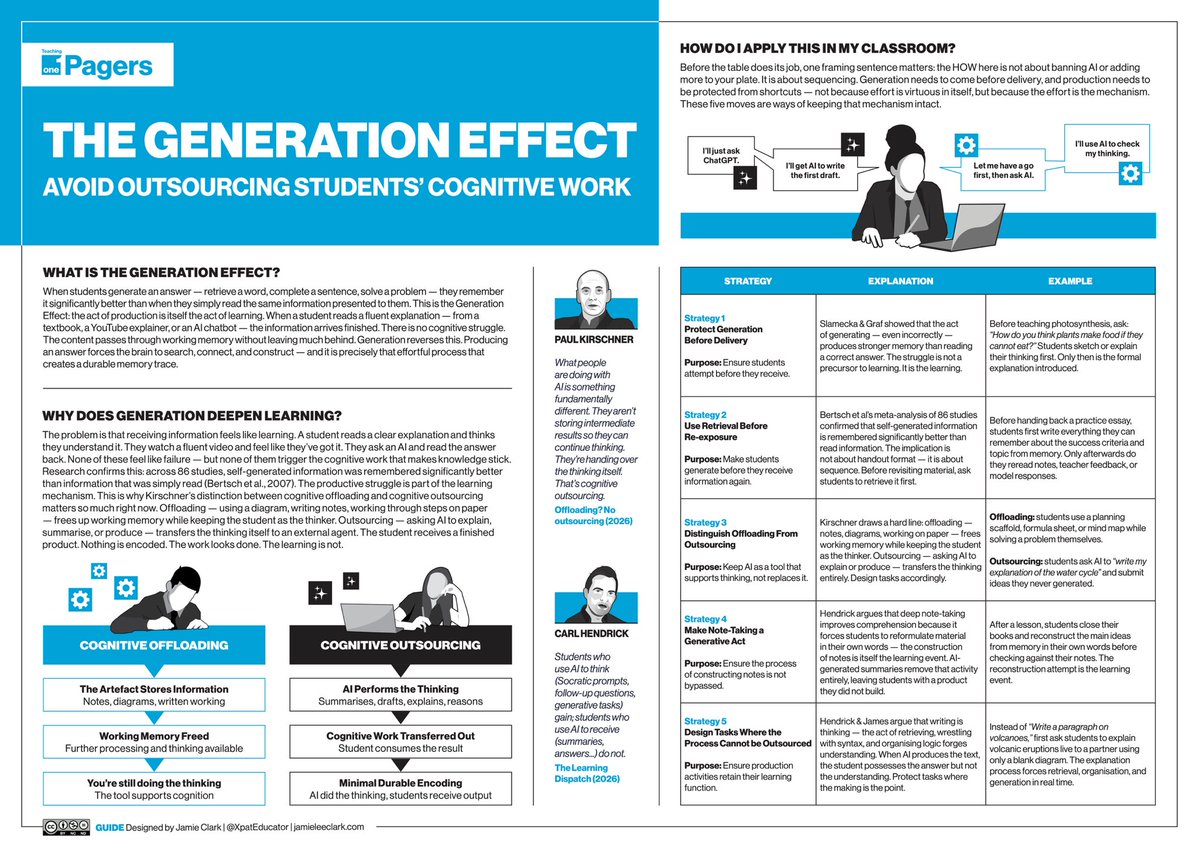
🤖 “What people are doing with AI is something fundamentally different. They aren't storing intermediate results so they can continue thinking. They're handing over the thinking itself. That's cognitive outsourcing.” — @New_Old_Paul
📄 New FREE one-pager on the Generation Effect and what AI is doing to learning. Also draws on @C_Hendrick and others.
https://t.co/yHBoZfameE