My both kidneys failed at 31.
I went through Dialysis three times a week. I was dying slowly.
They put me on the transplant list and said I might not last. One night after dialysis I could not stand the pain. I shouted to God until I had no voice left:
The next test before transplant showed my kidneys working again.
No dialysis since. It's been four years and they still work.
The specialist said he had never seen such a thing.
I gave the rest of my life to God.
Canada is building big — and we need more skilled trades workers to get it done.
Through Team Canada Strong, we're creating clear, paid pathways for young Canadians to get into the skilled trades. Apprentices will now get a $400 weekly top-up during their training, and a $5,000 completion bonus when they get their Red Seal certification.
The doctor who delivered Dolly Parton in a one-room Tennessee cabin in 1946 was paid with a sack of cornmeal. Her father farmed other people's land and could not read or write. Eighty years later, the reading program she built in his name has mailed more than 300 million books.
She wrote "I Will Always Love You" on the same afternoon she wrote "Jolene," as a goodbye to Porter Wagoner, and released it in 1974. Elvis wanted it. The night before the session, Colonel Tom Parker called and said Presley would only record it if they got half the publishing, meaning half of everything the song ever earned. She had been in Nashville ten years by then. She said no, and cried all night. Whitney Houston cut her version in 1992, held number one for fourteen weeks, and Forbes later put Parton's royalties from it near $10 million. She put some of that money into an office complex in Nashville and called the place the house that Whitney built.
Dollywood opened in Pigeon Forge in 1986 because she wanted paychecks in the county she came from. Around 4,000 people work there now. Three million visitors come every year. The University of Tennessee put its economic impact at $1.8 billion, and it is the largest employer in Sevier County. Since 2022 the company has paid tuition, fees, and books in full for every worker from their first day, seasonal hires included.
Wildfires tore through those mountains in November 2016, killing fourteen people and destroying more than 2,400 buildings. Her foundation was handing out money within 48 hours. Every family that lost a home got $1,000 a month for six months, regardless of income. The final check was $5,000. Total delivered: $8.9 million.
In April 2020 she sent $1 million to Vanderbilt for coronavirus research. When Moderna's vaccine results ran in the New England Journal of Medicine that November, her fund appeared in the footnotes.
Carl Dean, her husband of nearly sixty years, died in March 2025. The note she wrote to fans afterward ended with the same five words she wrote for Porter Wagoner back in 1974. She died in Nashville today. Her family asked that instead of flowers, people give to the Imagination Library, which still mails 3.4 million books a month to children who will never get to meet her.
'President Mahama’s job approval rating is 72%.'
—Mussa Dankwah, Executive Director of Global InfoAnalytics, says the President’s approval is highest in the Upper West Region, followed by the Volta Region, while the Ashanti Region records the lowest approval.
Watch more here: https://t.co/3GDXrGeMCv
#PointOfView #MussaDankwah #2028Election #ChannelOneNews #PresidentMahama #CitiFM
Requests for unofficial payments to access public services in Ghana rose sharply in the second half of 2025, with nearly 7 in 10 citizens who encountered bribery reporting that public officials demanded extra payments, according to new governance data released by the Ghana Statistical Service (GSS). #CitiNewsroom #CitiFM #GhanaNews
More here: https://t.co/yd2r15i8Mj
CLAIM OF DEFECTIVE CHARGE SHEET
The second part of the Court's decision dealt with the claim of Sedina Tamakloe's lawyers that the charge sheet was defective. (this is really technical)
Before the court will do the analysis and decide whether some of the charges on the charge sheet was defective, it considered whether the grounds of Appeal can passed by lawyers for Sedina Tamakloe were proper. The court held that Grounds b–h be struck out first. That these these grounds of appeal simply alleged “the court below erred” without particulars and that these grounds violated Rule 8(4) of C.I. 19. The Court struck them out under Rule 8(6) as disclosing no reasonable ground of appeal.
Therefore the Court of Appeal only proceeded on the omnibus ground (a) which I can summarize as the judgment of the Court is against the weight of Evidence.
The Law in Section 112 of of the Criminal and other Offences (Procedure) Act, Act 30 requires only that a charge give “reasonable information as to the nature of the charge”, the charge sheet is not expected to give evidential detail.
The court held that Section 406 of the Act prevents a court from reversing conviction merely for defects unless the defects caused a “substantial miscarriage of justice.” The Court distilled the test and differentiated between technical/curable defects that are protected by section 406 and defects that omit an essential element of the offence which are fatal and incurable.
Here's the courts Findings on specific counts:
•Stealing/conspiracy-to-steal counts - the court held were sufficiently particularised — no defect.
•Counts 36–42, 47, 64 (willfully causing financial loss) and the related conspiracy counts (43, 45, 48, 52, 54, 56, 58, 60, 62, 65, 67) and joint counts (44, 46, 51, 53, 55, 57, 59, 61, 63, 66, 68) were held to be incurably defective because the particulars said only that the accused “agreed to act together with a common purpose to Willfully cause financial loss to the State” and omitted the specific wilful act or omission required by s.179A(3)(a) of Act 29.
•Counts 69–71 (causing loss to public property) were also held to be defective as no particulars of the specific grossly negligent conduct were shown, and the alleged period (Dec 2016–Aug 2018) extended beyond her tenure as CEO which ended in January 2017.
The Constitutional basis of this decision to set aside some of the charges was the the Court's invocation of Article 19(2)(d) which provides that for the accused's right right to be informed “in detail” of the offence.
THE WONTUMI JUDGMENT - KIND COURTESY KWAKU AZAR
1. The Judgment in Brief: The High Court accepted the prosecution's case that Wontumi knowingly allowed Henry Okum to mine on Akonta Mining's concession without the Minister's approval. It rejected the defence that Henry Okum had been given permission only to reclaim degraded land by planting coconut trees.
The Court further held that Wontumi was the effective controlling mind of Akonta Mining, convicted both him and the company on the relevant counts, sentenced Wontumi to concurrent 20-year prison terms, fined the company, and ordered the forfeiture to the State of the equipment and other items seized from the concession.
2. What was this case about? The central question was whether Wontumi and Akonta Mining unlawfully allowed another person to use Akonta Mining's mining concession without the Minister's approval and, in doing so, deliberately facilitated unlawful mining.
The prosecution said they did. The defence said Wontumi never authorized mining. He only allowed Henry Okum to reclaim degraded land by planting coconut trees. If Henry Okum mined illegally, he acted entirely on his own.
3. Who were the accused? A1: Bernard Antwi Boasiako (Wontumi); A2: Kwame Antwi. He never appeared before the Court and remained at large, so the judgment made no determination of his guilt; A3: Akonta Mining Company Ltd.
4. What offences were charged?
The prosecution brought six counts, but they were based on only two offences repeated against different accused.
First offence: Allowing another person to use a mining concession without the Minister's approval. A mining lease gives its holder the exclusive right to mine within a particular concession. Because those rights are granted by the State, they cannot be transferred, shared, or otherwise dealt with without the written approval of the Minister.
The prosecution alleged that Wontumi and Akonta Mining allowed Henry Okum to use Akonta Mining's concession without obtaining that approval.
Second offence: Deliberately facilitating unlawful mining. The law does not punish only the person who actually carries out illegal mining. It also criminalizes intentionally helping, encouraging, or enabling another person to breach the mining laws. The prosecution alleged that Wontumi and Akonta Mining deliberately enabled Henry Okum and his workers to mine on the concession without lawful authority.
5. What did the prosecution have to prove? The burden of proof rested entirely on the prosecution. That meant it had to prove every element of every offence; the accused had no obligation to prove innocence; and if there was a reasonable doubt, the accused had to be acquitted. The standard of proof was beyond a reasonable doubt.
6. What evidence did the prosecution rely on? The prosecution called four witnesses. Henry Okum testified that he approached Wontumi, obtained permission to mine on the concession, and agreed that part of the gold proceeds would finance land reclamation.
Michael Gyadu Ayisi supervised operations on the site. He testified that he worked for Henry Okum and confirmed that mining was taking place.
A witness from the Minerals Commission confirmed that no Ministerial approval had ever been obtained and that Akonta Mining had never even applied for one.
Police officers testified that they arrested numerous workers on the concession and seized excavators, firearms, pumping machines, gold, cash, and vehicles.
7. What was the defence? The defence did not deny allowing Henry Okum onto the concession. Instead, it argued that: Henry Okum was there only to reclaim degraded land; Wontumi never authorized mining; Henry Okum exceeded whatever authority he had been given; and if illegal mining occurred, it was done without Wontumi's knowledge or approval.
The defence also called expert witnesses who testified that no legal assignment or dealing with Akonta Mining's mineral rights had taken place.
"If I try to think quickly through these 40 days, it's been absolutely insane, the coolest thing I’ve ever been a part of."
Erling Haaland on the whirlwind experience of his first World Cup ... which “changes Norway … and changes me” #erlinghaaland 🇳🇴
https://t.co/ZBKv7DsifC
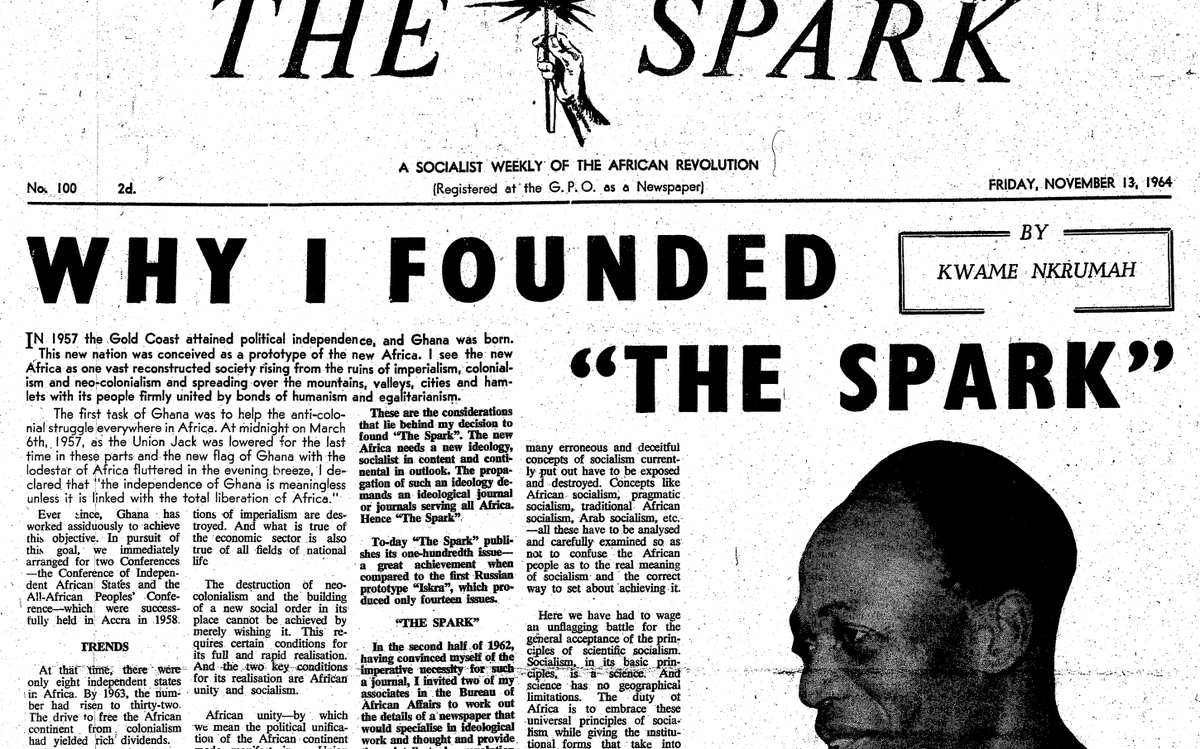
The Spark was a weekly newspaper launched by Kwame Nkrumah in 1963.
Why did he start this newspaper? Well, you can find out in his own words, with the headline article, "Why I founded The Spark", by Kwame Nkrumah himself.
Read the 100th edition of The Spark below (PDF).
Technical University Dortmund's guide for writing academic papers
Click the link below to dowload the guide for free.
Follow Silvi on LinkedIn for more free resources on academic writing.
https://t.co/0mxRxfHOCX
📸 - Ghanaian movie actor and football academy owner Yaw Dabo shown on the big screen, as the commentator mistakes him for a kid holding a World Cup trophy.
🇨🇦 Most people want to move to Canada… but very few know the REAL Express Entry process and the actual amount involved.
Complete Step-by-Step Immigration Guide:
Full Cost Breakdown Every Applicant Must Know Before Applying! Thread 🧵
The Supreme Court of Ghana has settled an interesting question which sometimes comes up in divorce cases. When for instance a wife sues for divorce and names “the other woman" whom she alleges to be having an affair with her husband in her petition, must that woman be joined to the case as a party? (works the other way round as well)
The court answered: not always. Sometimes yes. This is the decision in the case of Vida Yeboah v Dr Stephen Yeboah & Mercy Agyeiwaa decided on 29th April 2026.
In April 2019, Vida Yeboah filed for divorce against her husband, Dr Stephen Yeboah, at the High Court, Agona Swedru. The fact in support of her claim that the marriage had broken down beyond reconciliation was adultery, and she named one Mercy Agyeiwaa as the woman the husband was seeing. According to the petition, the husband had even moved Mercy from Kasoa into a new flat about twenty feet from the matrimonial home in Gomoa Oguaakrom.
When Mercy got wind of the petition, she did not stay quiet. She applied to be joined as a party. Her position was interesting. That she was no side chick. She said she was already the husband's customary wife from 15th July 2012, two whole years before Vida and Stephen's 2014 ordinance wedding. She tendered photographs of the customary ceremony and named witnesses. She also said she had contributed her own money to the very properties Vida was asking the court to share equally.
The High Court allowed her to join. The Court of Appeal threw her out, saying her presence would only "murky the waters". The Supreme Court has now restored her place and sent the matter back to the High Court for trial.
The Supreme Court however cautioned that this judgment is no general invitation for every named "party" to walk into a divorce.
In its own words, persons "commonly referred to in Ghana as 'side chicks' or 'side guys'" generally have no place as parties in a divorce. If the only thing such a person can offer is to admit having had something with someone else's spouse, the most they can ever be is a witness. It noted that Section 12 of the Matrimonial Causes Act 1971 uses "may", not "shall" and that joinder is at the discretion of the court, not automatic.
What set Mercy apart is that she did not show up with just a denial. She brought two legal issues: a competing customary marriage which, if proved, would invalidate the very marriage Vida wanted dissolved; and a property claim in the assets Vida was asking the court to share equally.
This the court reasoned made her presence necessary for the trial court to settle the matters in dispute.