Championing a financial system grounded in stability, transparency, and trust. When critics get it wrong, we provide the truth and counter false narratives.
Summer is the peak of housing sales in America. Whether for families moving across town or young professionals entering the market for the first time, this is a critical period for Americans looking at what they can afford.
Smart capital rules help make these decisions easier. When banks can lend safely and abundantly, more Americans can borrow at lower rates.
AI becomes more advanced every week. But in some parts of the public and private sectors, defenses against AI-enabled financial scammers are still untested and unsteady. As new technologies allow scammers to innovate faster and faster, society's response must be just as innovative and rapid.
Small businesses are the lifeblood of the American economy. What allows them to thrive is a financial system with unparalleled access to resources and potential.
Smart regulatory changes like modernizing capital requirements help ensure that businesses can keep thriving.
A recent U.S. Chamber analysis shows small businesses have accounted for 78.2% of hiring since 2001.
Ahead of America’s 250 Anniversary, @HouseSmallBiz Chairman @RepRWilliams highlights how small businesses remain central to our Nation’s story. https://t.co/0ul9mFeVSh
Over 80% of Americans hold a credit card in their name, and more than a third of Americans say they couldn't cover an unexpected $400 expense without selling or borrowing something. For these households, access to safe and reliable credit can be the difference between a temporary setback and a deeper financial crisis.
That is why proposals to cap credit card interest rates deserve careful scrutiny. If banks aren't able to offer credit due to government pressure on interest rates, high-need, high-risk consumers will turn to riskier, more opaque lenders.
What were the top frauds reported to the FTC in 2025? Watch FTC Commissioner Meador’s video to find out. Then, share this video with others so they’re in the know, too:
After months of back-and-forth, the House and Senate reached agreement on the 21st Century ROAD to Housing Act—a comprehensive bipartisan housing package. BPC breaks down what's in the final bill, section by section.
The American banking system is strong and resilient, and the results of this year's Dodd-Frank stress test are another clear sign of that reality.
Policymakers should feel confident modernizing regulations knowing that banks are grounded in stability and prepared for the worst.
The results of the Federal Reserve Board’s annual bank stress test showed that large banks subject to the test this year have sufficient capital to continue lending to households and businesses under hypothetical stressful conditions: https://t.co/9J7w73WoYy
NAHB applauds Congressional lawmakers for working together in a bipartisan effort to pass the 21st Century ROAD to Housing Act, historic #housing legislation that will deliver real benefits for the American people. https://t.co/S2L7TTqE4P
Affordable housing happens when business and finance can deploy capital to build homes and offer mortgages.
Private-sector excitement and the push to simplify regulations are signs of progress and causes for hope.
"What I found really encouraging was listening to people who have capital and people on the private development side thinking of this as one of the largest opportunities they’ve ever seen.” -Shekar Narasimhan, Managing Partner, Beekman Advisors
From insight to action. Members of our Terwilliger Center Advisory Committee close the day by identifying the most persistent barriers to housing supply.
Moderated by BPC's @andybwinkler. #HousingSummit26
Scammers will use every tool available to convince you that the government urgently needs your financial information.
Greater consumer awareness, coupled with institutional protections and smart regulations, can help ensure that more sophisticated scams don't result in more consumer losses.
No one from the govt will ever demand payment only with gift cards, wire transfers, cryptocurrency, or a payment app. Only a scammer will. If someone says you have to pay in those ways or you’ll be in trouble, that’s a govt imposter: https://t.co/GCwoUJ3f5Z #StopGovImposters
The Senate passed a sweeping housing bill on Monday, bringing Washington one step closer to enacting the most significant housing legislation in a generation. https://t.co/S2cUszABMC
Capital requirements matter because they shape the cost and availability of credit throughout the economy. That's why modernizing capital requirements for today matters so much.
Well-calibrated rules can help maintain a resilient financial system while supporting affordable, accessible credit for households, homebuyers, and small businesses.
Comments on the capital proposals are due today:
https://t.co/77iMm4IOFU
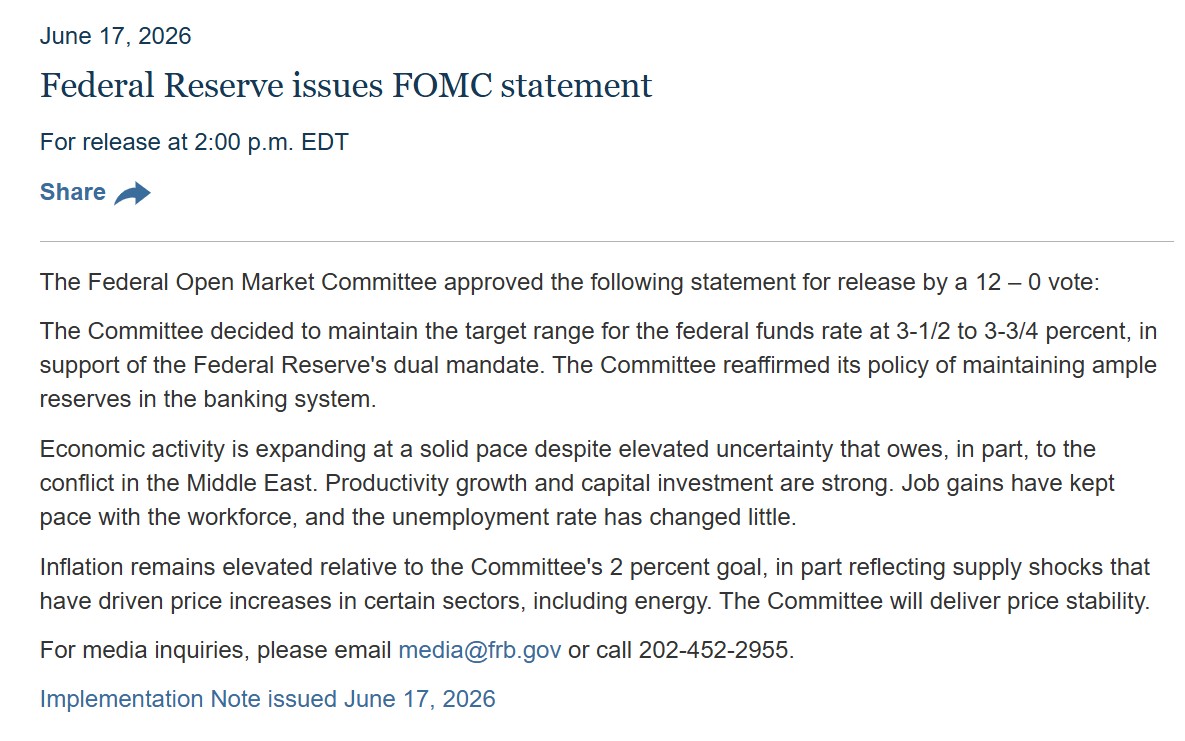
Here are my three takeaways from the just-issued Federal Reserve statement:
As widely expected, and by a 12-0 vote, the FOMC left interest rates and balance sheet management unchanged.
The new Chair’s impact is already visible in today's communication. The statement itself (below) is significantly more concise, and notably, one official opted out of submitting "dots" for the projections.
The upward revision to the median inflation forecast and the dropping of the previous easing bias are accompanied by—and for what it’s worth—an updated "dot plot" shows 9 officials projecting a rate hike this year (with several of them projecting more than one), 8 opting for no change, and only one projecting a cut.
Now, all eyes turn to Chair Warsh’s first press conference.
#economy #federalreserve #markets
"Strong capital standards play a critical role in helping to ensure a resilient banking system. At the same time, setting capital standards requires balancing safety and soundness and resilience with enabling banks to drive economic growth and support their customers and communities."
As policymakers consider updates to the capital framework, the goal should be clear: maintain a strong financial system while preserving affordable, accessible credit for households and businesses.
More from FDIC Chairman Travis Hill:
https://t.co/w9lKmEOePC
New residential construction in the US slowed to the weakest pace in six years, as builders prioritized selling off their current new homes inventory amid sluggish demand https://t.co/jxV9jKDGX5
Bank capital requirements can seem complicated, but the reality is simple: the more that banks are required to hold in reserve, the fewer services they can provide—that means fewer loans and mortgages, higher prices, or both.
That's why the new capital proposals matter so much. They are a step towards a more balanced set of capital rules.
Capital requirements are more than a bank issue. They affect everyday mortgage lending and housing affordability.
Recent analysis found the revised Basel proposal could reduce mortgage capital requirements while maintaining safety and soundness, helping banks lend more effectively in the mortgage market.
Well-calibrated rules can support both stability and access to credit.
https://t.co/teMppg3IIN
The new capital requirements proposals take concrete steps towards a more balanced framework that supports consumers and prevents financial activity from shifting into poorly regulated banking alternatives.
Reflecting on the Basel III rule, @FDICgov Chair Travis Hill shared that working alongside other regulators, the goal was to create a framework that reflects the real needs of bank customers, brings activity back into the banking sector and keeps safety and soundness at the core.
"Fake check scams" are on the rise, and childcare workers are among the most often targeted. Industry and government are working to build a fraud response infrastructure that is as determined and thorough as the fraudsters who target people.