Established producers are testing AI, and more people can explore a musical idea. Not every result connects. Here’s what I’m watching, and why experimentation, judgment, and collaboration still matter. https://t.co/RiobuRJ3js
@luisvillcruz This isn’t usually the kind of music I listen to, but I really respect the creativity and vision behind your work. The way you bring your ideas to life is impressive.
My mother used to cut my head out of photographs. Decades later, I found myself using two voices to bring two different songs to life.
In Part Ten, I compare Vivace’s original recording of “Ya No Puedo Más” with the newer version interpreted by Lia Zion. I also explain how “Quiero Abrir los Ojos Junto a Ti” became a duet between Lee Zion and Lia Zion.
The tools changed, but the writing came first.
When you compare the two versions of “Ya No Puedo Más,” what changes most for you, the sound, the voice, or the way the story feels?
Read Part Ten here:
https://t.co/yLRbAXWFqC
I didn’t start with a prompt. I started with songs that already had a story. This is what happened when I went back to them and shaped how the voices would move. https://t.co/WPbAoy3Okv
WOAH 🚨 Dearborn, Michigan mayor Abdullah Hammoud is at a mosque making a speech calling for Muslims to organize to make sure the entire city leadership is Muslim
“That only happens if we go out and we vote. If the Muslim community votes, if the Arab community votes, we will determine every single position in the whole city”
We were warned Muslims would use mosques as voter mobilization centers to take over our government. There is no clearer example of this happening than this video
I would like to just point out that you are politicians aren’t allowed to give campaign speeches like this inside places or worship
It’s called the Johnson Amendment. It prohibits tax-exempt 501c3 organizations including churches, mosques, synagogues and other houses of worship from “participating in, or intervening in any political campaign on behalf any candidate for public office
- Organizations cannot endorse or oppose candidates
- They cannot host or facilitate campaign speeches, rallies, or events where a candidate asks for votes
This is EXACTLY what’s happening in this video
Violations for this leads to loss of tax-exempt status. This mosque should lose their tax exempt status
I didn’t start with a prompt. I started with songs that already had a story. This is what happened when I went back to them and shaped how the voices would move. https://t.co/WPbAoy3Okv
Thanks for reading, Dominik. I think it still can, even after someone connects with the song. That’s the question at the heart of this series. I’m open about using AI for the music and vocals, but the lyrics and the story behind them are mine. My hope is that people give the writing and the song a fair hearing. How does knowing how it was made affect what you hear?
I began with basic Pop and R&B prompts, then learned to guide the emotion, melody, instruments, and vocal delivery. Part Nine follows that change through “Mi Norte, Mi Hogar.” Hear the song before judging the AI label. https://t.co/NUoGSYBaYV
Worked for 14s
Thank you for reading the article, and this is a good question. I’d say the vocal phrasing and giving the lyric more space were what first made it click. I made a few small revisions to the original lyrics so they flowed better when sung, without changing what I wanted to say.
When I first worked on the demo about a year and a half ago, the words often sounded muffled or unclear. My prompts were pretty basic, too, and I was still learning how to guide the interpretation. As I learned better prompting techniques and the model improved, the results became much closer to what I was hearing in my head.
The version you hear was made about seven months ago. It gave the phrases more breathing room, and the musical arrangement really brought the emotion through. The earlier takes had a more obvious AI sound to my ears. This version felt more natural, and the recent mastering helped polish the overall sound.
An early take beside this one would be an interesting comparison. You’d hear the difference, especially in the clarity and phrasing.
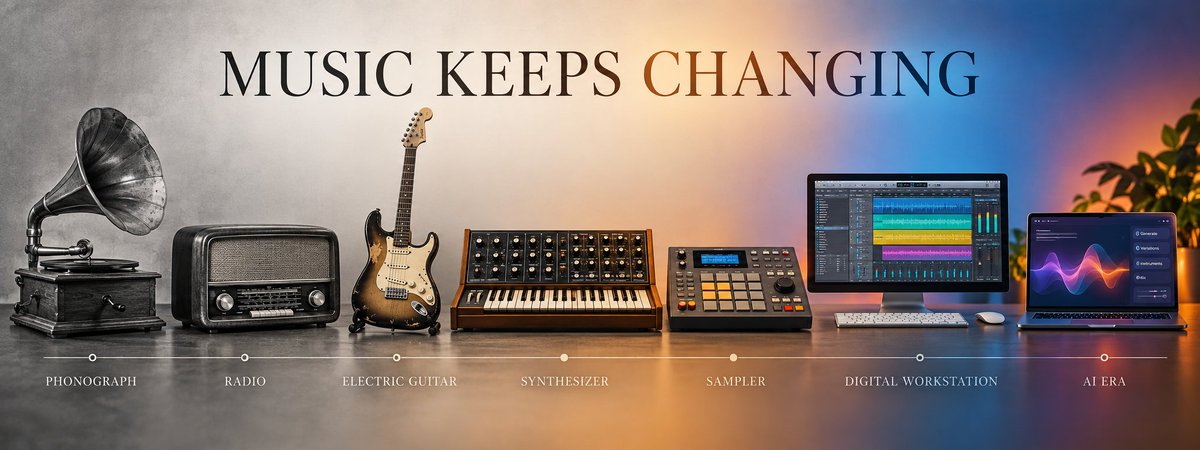
Music has changed with every new technology—from recorded sound and radio to electric instruments, synthesizers, sampling, and digital production. Each shift raised questions about authenticity, creativity, or the livelihoods of musicians. Over time, these tools became part of how music is made and heard. AI is bringing those questions back into the conversation. How do you think AI will change the opportunities available to independent music creators?
These new AI music agreements give me some hope, but I still have questions about what they’ll mean for someone working independently. In Part Eight, I share what I’m watching and why I’m going to keep writing while the answers take shape. https://t.co/eo8aY7VKvu
@EvanIanejiu Hey, sorry I took so long to reply. That part about people liking the words first—that’s exactly what I keep running into. What happens when you tell them AI was involved? Do they change their minds about something they already liked?
People liked the lyrics. AI made them hesitate. As I learned more, some of their concerns became my own. But where did that leave a lyricist still trying to be heard? Part Seven explores that tension. https://t.co/YPAMEQeZQv
@CatGodSandHive@ARCreactorAI Sorry for the late reply. Your point about keeping control of the creative work caught my attention. What led you to run the model on your own desktop, and how has that changed what you can create or own?
Tomorrow I’ll publish Part Eight of A Lyricist’s Journey Into the Age of AI.
If you missed Part Seven, this is a good place to catch up. I wrote about why the criticism of AI music started making more sense to me, even as I continued using it to bring my lyrics to life.
Read it here, and tell me what you think:
People liked the lyrics. AI made them hesitate. As I learned more, some of their concerns became my own. But where did that leave a lyricist still trying to be heard? Part Seven explores that tension. https://t.co/YPAMEQeZQv
I just joined the AI Music Creators Association (AIMCA) as an Associate Member. Their mission is to support, represent, and advocate for creators using AI as part of the music-making process, especially around rights, policy, licensing, and fair access.
If that matters to you too, take a look and consider joining:
https://t.co/N3Xs0e7lzq
Most people who are completely against the use of AI seem to express themselves the same way. They don’t really explain their thoughts clearly, intelligently, or with any compassion. It usually becomes attacks, criticism, and envy.
Instead of adapting and seeing AI as a tool that can help people communicate, express ideas, and create, they see it as a threat. But if the vision, the direction, and the work come from you, then the tool is not the creator. You are.
I know exactly how you feel. I get that all the time too.
Best thing you can do is ignore them and keep creating. If the idea, the direction, and the work come from you, then it does not matter what tools you use. Tools do not replace the creator. They only show what the creator is trying to build.
Keep doing your work. That will speak louder than the noise.
People liked the lyrics. AI made them hesitate. As I learned more, some of their concerns became my own. But where did that leave a lyricist still trying to be heard? Part Seven explores that tension. https://t.co/YPAMEQeZQv
The strange thing about learning to work with AI wasn't when it failed.
It was when I finally knew what I wanted, but the technology couldn't quite follow me there.
That's where this part of my journey begins.
The roadblocks didn’t stop the process. They forced me to get clearer about what I was building, who I was trying to reach, and where AI might take the music next. Part Six of A Lyricist’s Journey Into the Age of AI. https://t.co/WBlCjDHdSw