💵 $KAS AS COLLATERAL FOR A DIGITAL DOLLAR? THE WHITEPAPER IS OUT.
Kaspa contributor Alexander Säfström published a working whitepaper for KSD, a proposed stablecoin backed by KAS on Kaspa’s base layer.
Users would lock more than $1 worth of KAS for every KSD they mint. Miners would supply the price data the system uses to value that collateral.
The design is open for peer review. KSD hasn’t launched yet.
Six days and roughly 40 hours of work on Kaspacoin. My favourite update started with a reply here on X. 💙
Activity 1.0 now colours Kaspa’s live blocks by transaction activity.
Try it at https://t.co/BeulfeM8iu
Sign in → Colours → Activity
#Kaspa#KAS
TLDR- A fully open, decentralized and permissionless prediction market application on Kaspa.
In the last few months I have been working with @maxibitcat mapping and coding his proposal for a permissionless prediction market into an Argent app.
He proposed a voting resolution mechanism that utilizes a lottery to incentivize the losing side of a binary market to vote honestly (see more in his original post).
It felt like a great use case for KCC20 tokens. A prediction is held as a tradable, fungible KCC20 token representing the prediction asset, with extended logic to support voting.
A few things worth sharing:
1. Argent is a fantastic tool that enables coding this complex covenant system with ease. This idea could also be written as a single EVM program, but when mapping it to the state machine it actually is, it feels natural and obvious to implement it as a UTXO covenant application (image attached).
2. It’s exciting to draft an application that is completely decentralized and open. Everyone would be able to create and participate in any market they wish, while also running their own application code
There will be no owner and no beneficiary. The system is completely open, would only benefit the network miners, and would encourage honest participation.
3. The system’s openness and current implementation tie the security of a market to its size. Small-cap markets could be manipulated more easily. Inevitably, people would lose money in this social experiment.
4. I aim to release a mainnet version around the end of this year.
The first Kaspet has hatched on Kaspa mainnet 🐣
Meet Elmulk. Here’s the hatch, then a few minutes of being a pet.
Stroke it and it purrs. Toss its pebble and it plays. Friends drop by the tank, and when it’s tired it naps. Feed and Play are real transactions. They top up hunger and mood on-chain, and the tank lights up in the pet’s own colours.
Each pet is a Toccata covenant UTXO held by your own key. Turn on X-ray mode and the sprite peels back to its redeem script, byte for byte: owner, birth, genes, hunger clock. The pet is the script. @KaspetApp
This is early beta. More features switch on over the coming week. Hatch yours: https://t.co/KFowMA6Qdn
I have to say, it’s very refreshing to see so many people in the kaspa:native space attacking one of its biggest problems.
A lack of on-chain volume.
Stablecoins are the single biggest driver of on-chain activity, and Kaspa has gone without its own for far too long.
Now it’s coming from every angle:
- @hyperlane brought stablecoins to @Igra_Labs
- @asaefstroem is building a decentralised one
- and now @kaspador_ is creating @trestly_io, wanting to bring ethereum:0xdac17f958d2ee523a2206206994597c13d831ec7 straight onto Kaspa’s base layer.
Different teams, different approaches, same mission. That’s what a healthy ecosystem looks like going into 2027.
Study kaspa:native
🚨🚨🚨 Kaspa has asked for years: Who is Entity X?
We traced the on-chain trail back to 2023 and found a connection that may changes the story.
We will release the full timeline, evidence, and what it does and doesn’t prove as a KasLens Kaspa Special (Available in the App)
You’ll want to see this. ‼️
kaspa:native
$KAS 👀
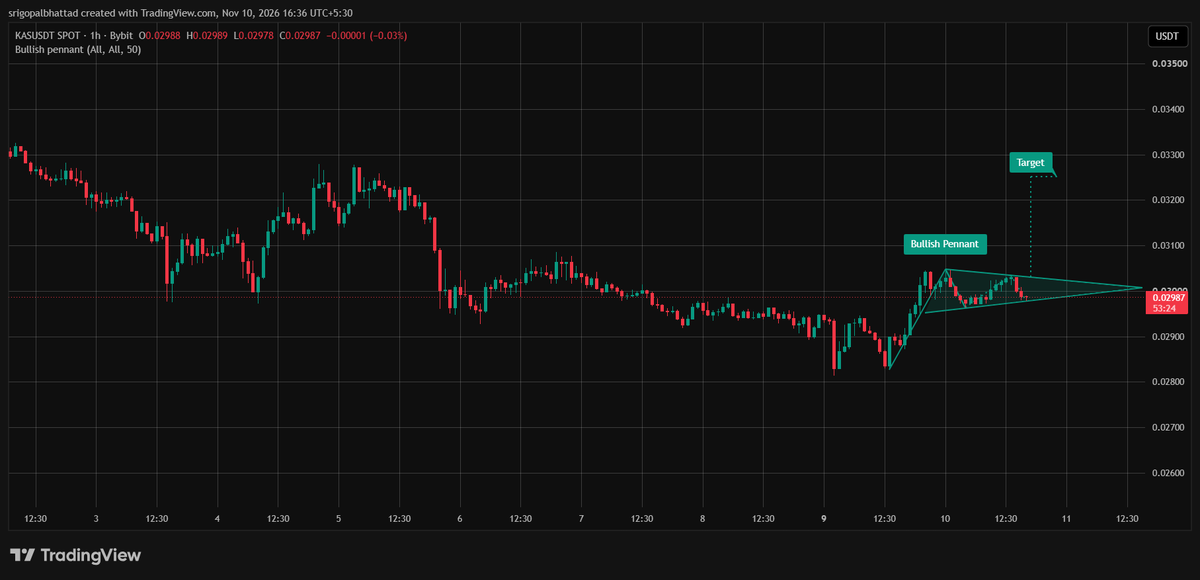
Printing a textbook Bullish Pennant formation on the 1H chart! After a sharp bounce, price is consolidating within a tightening range, suggesting buyers are preparing for another move higher.
Bulls are defending support near $0.0295. A breakout above $0.0305 could open the door towards $0.0327 📈🔥
Momentum is building. Watching for a bullish continuation!
#KAS #Kaspa #Crypto #Altcoins #Bullish
Big real-world push for $KAS! 🏭
A non-profit called the Kaspa Industrial Initiative is working on industrial and enterprise adoption of @kaspaunchained. Its focus is anything but token promotion.
See why ⬇️
https://t.co/35Duk4735k
@MightyPetrCoin i love the look & feel of the blocks appearing, the arrows forming, and the 3d rotation. probably the most beautiful kaspa viz engine out there. really nice work <3
🚨 Just in! 🚨
Kaspa’s pseudonymous wallet #1 has acquired roughly ~ 8.47 million #Kaspa , which is valued around $250,000 😳
That’s now 23 million ($700,000) acquired in the past WEEK 🤯
They own over 1.566 billion kaspa:native which is valued around ~ $47 million, with an average cost around ~ $0.07379 🤔
@jamesfishback Our dollars will become fully digital and with that means total control. We need an open source digital money that can actually move at the speed of the internet and keep people in full ownership of their money. This is why I stack kaspa:native
Kaspa Dollar: A Decentralized Stablecoin Built on Kaspa L1
Kaspa Dollar (KSD) @KaspaDollar is a proposal to create a decentralized, dollar-denominated stablecoin directly on Kaspa Layer 1, without relying on a traditional issuer holding dollars in a bank.
Developed by Alexander Säfström, the proposal combines KAS-backed collateral vaults, native covenants, miner-based price reporting and zero-knowledge proofs. If successfully implemented, it could provide an important foundation for financial applications within the Kaspa ecosystem.
How would Kaspa Dollar work?
Users would lock KAS in covenant-controlled vaults and issue KSD against their collateral. This would allow holders to access dollar-denominated liquidity without selling their KAS.
The system would require overcollateralization, meaning the value of deposited KAS must exceed the amount of KSD issued.
If KAS falls significantly in value, positions could become undercollateralized and subject to liquidation. This makes collateral management and reliable price information essential to the system's stability.
Why miners play an important role
One of KSD's most interesting features is its proposed price oracle.
Instead of relying entirely on external oracle providers, Kaspa miners would submit KAS/USD price observations through the blocks they produce.
Independent participants would aggregate these observations, using zero-knowledge proofs to verify the calculations.
The proposal also introduces additional economic incentives for miners. Its preliminary fee distribution allocates 85% of certain protocol fees to miners, 10% to proof generators and 5% to keepers.
However, miner participation does not automatically guarantee accurate prices. Coordinated manipulation, unreliable observations and periods of insufficient participation remain risks that the protocol must address.
How would KSD maintain its dollar peg?
The proposal uses several mechanisms to keep KSD close to $1.
Overcollateralization provides an initial protection against price declines. Liquidations allow unhealthy positions to be closed, while a redemption mechanism would let KSD holders exchange tokens for the corresponding dollar value in eligible KAS collateral.
For example, if KSD traded below $1, traders could potentially buy discounted KSD and redeem it against collateral, creating an incentive for the market price to recover.
The whitepaper also proposes safeguards against stale oracle data and extreme market conditions.
These mechanisms could support price stability, but they cannot guarantee it. A rapid KAS price collapse, insufficient liquidation activity or oracle failure could still threaten the system.
What could KSD make possible?
A functioning native stablecoin could expand Kaspa's financial ecosystem considerably.
Trading: KAS/KSD and other dollar-denominated trading pairs could operate directly on Kaspa L1, reducing dependence on external blockchains.
Borrowing: KAS holders could access liquidity against their holdings without immediately selling their assets.
Payments: Merchants and users could transact in a dollar-denominated asset without taking direct exposure to KAS price fluctuations, assuming KSD maintains its peg.
Decentralized finance: Lending markets, liquidity pools, collateralized financial products and treasury management could use KSD as a common unit of account.
These applications would still require sufficient liquidity, wallet integrations and supporting infrastructure.
The limitations
The biggest challenge is KAS volatility. Because KSD would be backed by a fluctuating cryptocurrency rather than dollar reserves, sharp market declines could put significant pressure on collateralized positions.
The oracle also introduces complexity. Zero-knowledge proofs can verify that calculations were performed correctly, but cannot independently guarantee that miners submitted accurate market prices.
Liquidity is another concern. Even a technically sound redemption mechanism may struggle during periods of extreme market stress if buyers, liquidators or available collateral become insufficient.
Finally, the system combines several technically demanding components. Production deployment would require extensive testing, security audits and careful evaluation of its economic assumptions.
Why it matters for Kaspa
Kaspa Dollar demonstrates how native covenants could support financial applications beyond ordinary payments and token transfers.
The proposal is particularly interesting because it attempts to use Kaspa's existing proof-of-work infrastructure for collateral management, price reporting and financial settlement, rather than introducing a separate network to handle those functions.
It remains a working proposal awaiting peer review, and there is considerable distance between a whitepaper and a secure, widely adopted stablecoin.
Nevertheless, a functioning decentralized dollar could become valuable infrastructure for trading, lending and payments on Kaspa.
The potential is significant, but its success will depend on whether the proposed mechanisms can deliver reliable stability and security under real market conditions.
Link to whitepaper: https://t.co/JKgVhCnEAJ
🚀 Kaspa Went Up 64 Times
Kaspa just turned 5. On its first birthday one token cost less than 1 cent, a year later about 7 cents: up about 64 times in 13 months, with no presale. Since then the network got 10…
$KAS #kaspa#crypto
Try Premium for 7 days:
https://t.co/rxXgESJZZI
Kaspa future progress: The amount of $kas held
By dolphins is going to flip the amount held by sharks soon. Gradual decentralization is happening.
As we decentralize, the number of wallets holding >1 is approaching 600.000 Kaspians.
Metcalfe tells us that the value of a network grows to the square of the connection points, so each new wallet eventually ends up pumping the price.
$kas is brewing, let it cook.
JUST IN🔥: Kaspa (@kaspaunchained) produces 10 blocks per second, allowing it to generate more blocks in just 28 hours than Bitcoin has produced since its launch in 2009.
At this rate, Kaspa generates approximately 6,000 blocks for every Bitcoin block, based on Bitcoin’s 10-minute target interval.
The comparison highlights the significant difference in block production speed between the two networks.