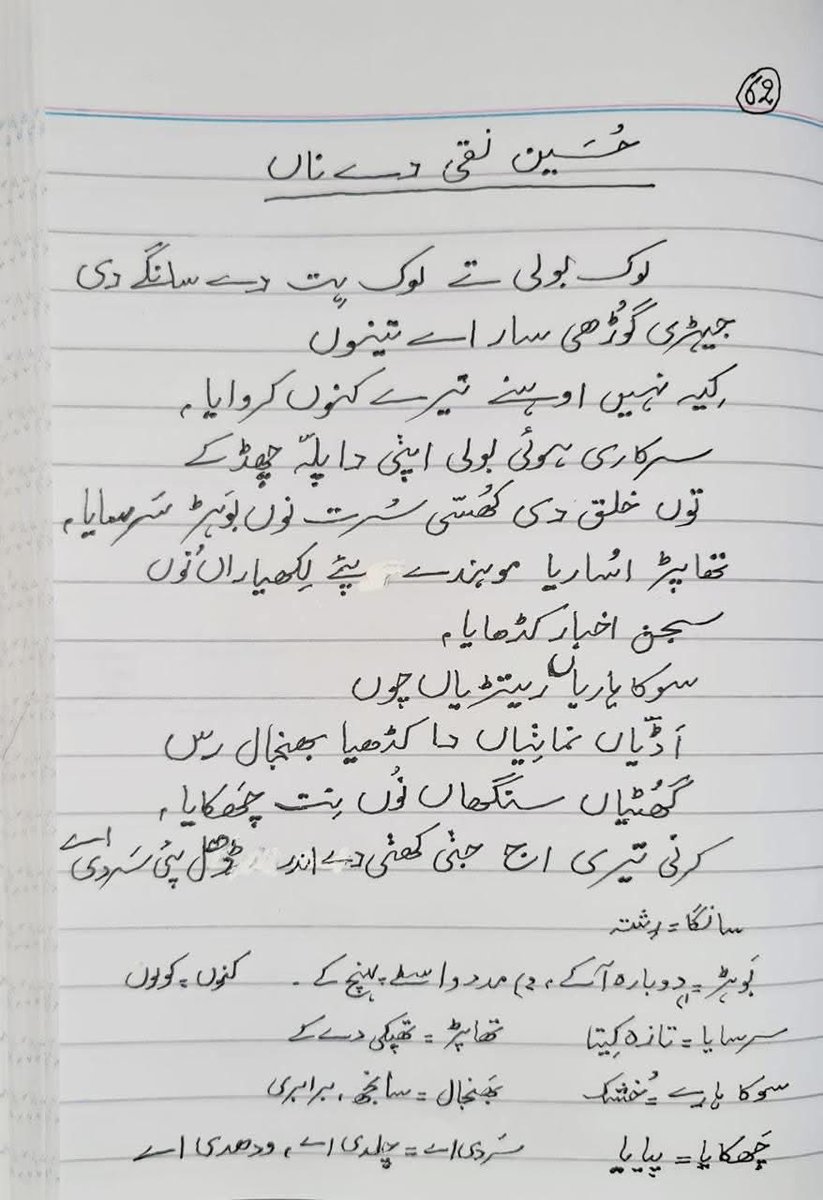
Lucknow-born Husain Naqi, a leftist loved across the political spectrum, founded Sajjan, the first Punjabi daily in Shahmukhi. At his funeral today, Mahmood ul Hasan shared a poem Najam Husain Syed wrote for him. So blessed to have met Naqi sb at LUMS last year.
Students on bikes have been searched for the past few years. They've criminizalized being poor and their bags are searched thoroughly all around posh areas. There's a class apartheid being instituted and it's worse than it ever was
@SquintFeastwood You are right. But class apartheid is not 'being instituted', it exists and gains strength as neoliberal economics entrenches itself & inequality rises in its ghastlier forms.
Punjab Govt thinks everything can be put on the right track by securitising life. It tends to see every social & political challenge as existential security threat.
Today, it's bags, tomorrow students will be bodily searched. Unconstitutional, unethical & unacceptable.
If you'd like to reset the system,then let there be free and fair elections and let us have legitimately elected representatives and governments howsoever we may disagree with them and even hate them.Just bring an end to military rule.
spare time to read:
https://t.co/qWUhvgHItu
Here are my two cents on the ongoing hoopla over new provinces in Pakistan.
First, this is not a legitimate government. This is not a democracy, or even a hybrid one. The present regime rests on the most rigged elections in Pakistan’s history and, therefore, lacks the mandate to make such drastic changes to Pakistan’s federal structure. The demands for new provinces are legitimate, of course, but that is a separate discussion.
Second, reorganizing provinces has long been part of the military establishment’s agenda, especially in ways that erase the historical foundations of those units. In other words, it is a continuation of the deadly triumvirate of Urdu, Islam, and Muslim identity overriding every other marker of identity or sense of belonging. The invocation of administrative efficiency or good governance as the main justification is hogwash.
In that sense, the push for new provinces or smaller units continues the same oft-trumpeted argument about greater efficiency that was once used to justify creating a larger entity - One Unit. Imagine: there was once an argument for making all of West Pakistan a single province in the name of efficiency!
The reason is that, whether it is One Unit or ten units, such arrangements can suppress the political expression of historically constituted identities without fundamentally altering power structures. They help mask the dominance of Punjabi political, bureaucratic, military, and economic elites while safeguarding their interests. So, if anyone thinks dividing Punjab weakens the hold of the Punjabi establishment, they are mistaken. It only helps render that dominance invisible.
Punjab’s national question is different from that of any other region. Punjabi interests do not necessarily depend on articulating a distinct Punjabi national identity. Punjabi identity - or at least its iterations among the urban and professional classes - is subsumed within a larger Muslim identity, with Urdu as the medium of its expression - the ideal Pakistani Muslim citizen, in other words.
Thus, Punjabi interests can dominate even when there is no single Punjab - or, in fact, no Punjab at all.
It is remarkable how Mumtaz Daultana, a former chief minister of Punjab, offered an argument for One Unit that can be turned on its head to make precisely the opposite point. To assuage smaller provinces' fears of Punjabi domination, he argued that Punjab was merely a term of convenience, a geographical expression, and that Punjabis would cease to exist the moment Punjab was dissolved as a provincial unit. That would not be the case, he said, for Pathans, Baluch, and Sindhis, who would continue to exist even without the NWFP, Baluchistan, or Sindh.
“On the other hand, if you take away the boundaries of the Punjab, the concept of the Punjab will disappear,” said Daultana.
Well, Punjab disappeared as a provincial unit between 1955 and 1970, but neither Punjabi identity nor Punjabi elite dominance disappeared with it. Nor did the other national identities that One Unit sought to suppress. And we know where that experiment led.
HRCP is deeply concerned by the state’s treatment of political prisoners and calls on the authorities to uphold their fundamental rights, irrespective of political affiliation. In his recent letter to the chief justices of the Federal Constitutional Court, Supreme Court and Islamabad High Court, former prime minister Imran Khan alleged that he and his wife, Bushra Bibi, had been subjected to solitary confinement, their access to family and legal counsel restricted, and adequate medical care denied. These allegations require urgent and independent examination. Similar concerns surround PTI leader Dr Yasmin Rashid’s continued imprisonment and reported need for medical treatment.
HRCP stresses that violations of political prisoners’ fundamental freedoms are not a matter of personalities or political affiliations; they constitute an assault on the rule of law. Every prisoner is entitled to humane treatment, adequate healthcare, access to family and lawyers, and a fair trial. All relevant court orders must be implemented and allegations of mistreatment independently investigated
“So many children that I met in Gaza said nothing. They didn't scream, they didn't cry, they stared.”
Heartbreaking remarks by Dr. @Tanyaalih at DAWN’s 2026 Gala, confronting the horrors Israel's attacks inflict on Gaza’s children, and the crisis of impunity enabling them.
Watch her powerful speech.
I was a young reporter during the first Intifada and I've covered Israel/Palestine for thirty years as a journalist. I know the history. I have spent many months on the West Bank and reported for all that time on the humiliation and horrors of the occupation. I know how the IDF and the Settlers operate, the massive injustices, apartheid and ethnic cleansing they oversee. I've written an award-winning book on the Palestinian Christians and made BAFTA-winning documentaries. I haven't lost anything. I'm bearing witness to injustices and horrors I've seen and can never unsee. Frankly I would be failing in my duty as a writer if I did otherwise.
RIP Richard Posner, who charmingly and forthrightly questioned the free market ideology he propagated for decades, after it utterly transformed law schools and American life, with lasting consequences to this day. https://t.co/nt4aqzGqwo
Today is Maulana Azad's birthday, celebrated as the National Education Day. He was an extraordinary man, who was in public life but loved his solitude. He was an autodidact, who was taught at home, so not being bound by any curriculum he read extensively from religion, philosophy, history, literature to music. Maulana began his career as a firebrand journalist at a very young age. He was exiled by the British for three years in 1916 due to his anti-imperialist writings. Before even joining politics, the colonial govt declared him as one of the most dangerous persons. This was his power of pen that established this reputation. He came out of exile in 1920 and soon met Mahatma Gandhi, ever since his association with the Mahatma and the Congress continued till independence. Maulana remained committed to an indivisible India till the end. His fight against communalisms-both Hindu and Muslim remained the core of his Indian nationalism. Let us pay rich tributes to #MaulanaAbulKalamAzad
ANTI-FASCIST ECONOMICS revisits both The Road to Serdom and The Great Transformation (initially titled the Fascist Transformation). Both provide a framework for understanding the rise of fascism and a vision for never again. We have tried Hayek's road for the past decades. It's time to revive Polanyi's ecoconomy for common people.
@LahoreMarquez It's about neoliberal healthcare. No one should expect ethical healthcare service when it is offered on the basis of premium payments to businessmen.
@pervaizalam@theRealYLH If during the busy schedule of your LLM you get some time to revisit your views on Gandhi and Nehru and Jinnah saheban don't miss the opportunity.
Hope to see you in Lahore preferably when the hard state softens up on its citizens, hopefully soon.
@pervaizalam@theRealYLH Yes, best wishes, Yasser. As Pervaiz sb says you'll be missed.
Re your judgment on Nehru& Gandhi based on Syed Hosain-Lakshmi, it's worth recalling that in 1947 Hosain chose to become India's first ambassador to Egypt which obviously meant he had to part ways with Jinnah sb.
1/
'Germany, France, Italy, Denmark, Ireland, Netherlands, Canada, and Japan are among those countries whose leaders have chosen not to make an appearance at #Cop31.
Several are headed for Dublin, where EU leaders will hold their first dedicated AI summit.
“The future of AI is apparently worth showing up for, while the future of the planet can wait."'
https://t.co/oiMezKwHYP