The history of golden age watch case and face design consists of designers wishing they hadn't already known the right answer since the 1940s.
https://t.co/Rwl5VVEkyx
@XPredictWeekly@paulg
The history of golden age watch case and face design consists of designers wishing they hadn't already known the right answer since the 1940s. They orbited it for the next 30 years, but couldn't escape it.
A column article by Will.FX:
Redefining Financial Rails: Perspective on Robinhood's Prediction Market and AI Agent Revolution
If Meta's "Arena" is about gamifying social predictions, Robinhood is elevating prediction markets (Event Contracts) into the "fourth major retail asset class", sitting alongside equities, options, and crypto. It is a textbook Web2.5 bridge model: leveraging world-class Web2 user experience to unlock Web3's on-chain settlement efficiency and fully compliant event contracts.
1. Financializing Information: Democratizing Global Hedging
By offering real-money, binary contracts priced between $0.01$ and $0.99$ USD, Robinhood is making macro hedging accessible to the masses.
Breaking Asset Silos: Users can seamlessly trade Tesla stock, Ethereum (ETH), and "Fed rate cut probabilities" in a single portfolio.
Micro-Hedging for All: Institutional-grade macro hedging—against inflation, tariff changes, or geopolitical events—is now democratized, allowing retail users to hedge risks for just pennies.
2. The Web2.5 Hybrid Architecture: Custom L2 and Regulatory Moat
Unlike platforms facing regulatory headwinds, Robinhood has constructed a robust hybrid model:
Robinhood Chain (L2): Built on Arbitrum, Robinhood's proprietary L2 chain migrates tokenized equities, crypto, and event contracts on-chain, driving transaction fees down to sub-penny levels (under $0.01$).
Regulatory Shield: By partnering with CFTC-regulated clearinghouses like Kalshi and ForecastEX, Robinhood combines decentralized settlement efficiency with a solid US regulatory moat.
3. Agentic Accounts: The Automated Era of Prediction Markets
The true paradigm shift lies in Robinhood's Agentic Accounts, a feature that aligns perfectly with the CAIA (Crypto AI Agent Benchmark) framework:
AI-Driven Trading: AI agents process macro indicators and global data much faster than humans. Robinhood allows users to plug custom AI agents directly into its trading infrastructure.
Machine Pricing: Markets are now priced 24/7 by AI agents scanning news and on-chain data. This shifts prediction markets into an era of hyper-liquidity and marks a major step toward AI-driven asset ownership.
Prediction markets are the ultimate convergence of information and capital. When autonomous AI agents begin pricing reality on Robinhood Chain using real capital, we cross the threshold of Web2 and enter a self-adaptive financial era run by algorithms and protocols.
@LegioAlternati2
Kevin Kelly’s fundamental prophecy regarding technological evolution: destinations will vanish, and scenarios will become the future; the ultimate destiny of technology is to become 'invisible' and 'headless.'
https://t.co/qOZjTwso5F @XPredictWeekly
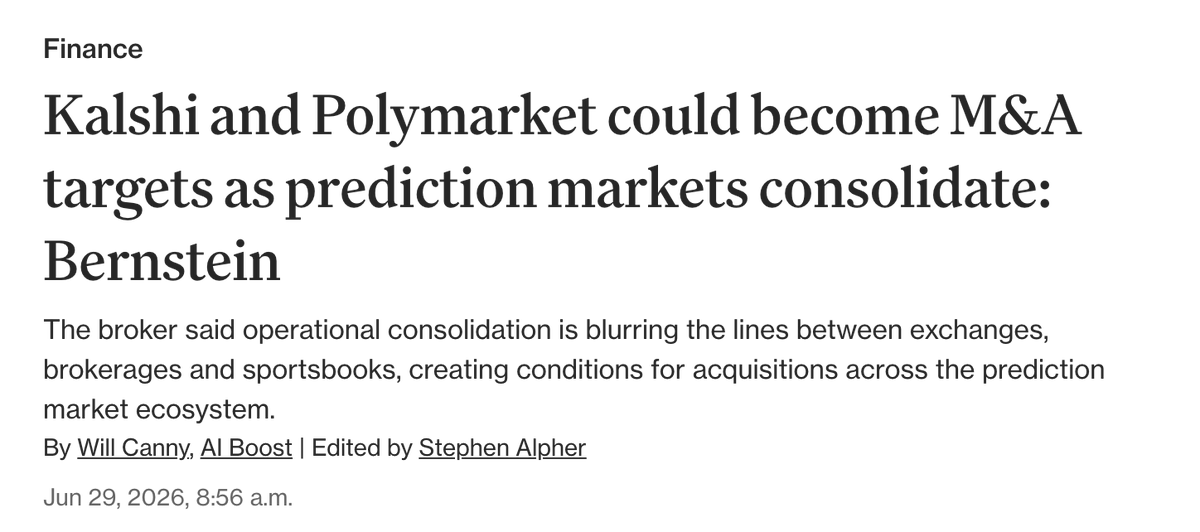
🚨 KALSHI AND POLYMARKET COULD BECOME M&A TARGETS -BERNSTEIN
"Kalshi and Polymarket own the stack but trail on distribution, which leaves each as plausibly a target as an acquirer"
So far:
- $DKNG acquired Railbird
- $HOOD partnered with Susquehanna to build Rothera
- $COIN acquired The Clearing Company
- $FLUT established a dual-FCM structure
Bernstein's view is that prediction markets, sports betting, & consumer finance are converging into a single competitive landscape
Robinhood and Coinbase currently have the strongest competitive positions, according to Bernstein, followed by DraftKings
Naturally migrating down to Web3 Scenario+infrastructures,high-performance on-chain settlement) or single destination,fully compliant clearing?Interesting.
https://t.co/QL9O333x2b
A column article by Will.FX:
How Meta's "Arena" Accelerates the Paradigm Shift in Prediction Markets
From the core perspective of top Web3 venture capital in 2026, Meta’s recent return to prediction markets with the launch of its AI-driven prediction app, "Arena," is far from a simple defensive move. Instead, it represents a critical battle to push prediction markets into the hands of billions of mainstream users.
As global monthly transaction volumes in prediction markets surge toward $100 billion, we can re-evaluate Meta’s strategic layout and the resulting industry transformation through three lenses: 'distribution networks,''low-friction education,' and 'AI automation.'
1. Distribution is King: Meta's Unmatched 'Distribution Network'
While Web3 prediction markets (such as Polymarket) are highly precise, they currently still face barriers like crypto wallets, compliance, and fiat on/off-ramps, keeping their user base relatively niche.
Seamless Access Advantage: Meta commands the world's most powerful distribution network with 3.5 billion daily active users (DAUs). The creation of Arena means that prediction market logic will be directly embedded into everyday social feeds—a scale of network effect that no decentralized protocol can match in the short term.
Reshaping Information Pricing: Algorithms on traditional social platforms often incentivize polarization and sensationalism. By introducing a prediction mechanism through Arena, Meta is actually utilizing 'collective intelligence' to filter information noise across its platforms, helping users reclaim 'pricing power' over information. This is a brilliant self-disrupting move for a Web2 social giant.
2. Free-to-Play (F2P): A Low-Friction Engine for User Education
Many criticize Arena's 'play money' (virtual points) model for its lack of financial stakes ('no skin in the game'). However, from a product strategy standpoint, this is actually a clever maneuver for Meta to bypass regulatory red lines and scale rapidly.
Lowering Barriers to Entry: Prediction markets are inherently high-cognitive-cost intellectual games. Arena's Free-to-Play points-based system allows the general public—even those with zero crypto experience—to experience 'probabilistic thinking' with absolutely zero financial risk.
A Training Ground for Collective Intelligence: Despite the lack of real financial consequences, Meta can still identify 'superforecasters' on its platform through gamified incentives. This low-friction mechanism serves as the ultimate gateway for transitioning billions of social media users into prediction market participants.
3. Llama Large Language Model: The Ultimate Weapon to Solve Market 'Cold Starts'
Arena plans to integrate the Llama model to generate prediction topics and resolve outcomes in real-time, displaying impressive innovation in its technical architecture.
Automated Generation of Infinite Long-Tail Markets: Traditional prediction markets require manual curation and market creation, limiting the number of available topics. By leveraging Llama AI, Meta can automatically and dynamically spin up millions of hyper-local, long-tail prediction markets based on trending community topics, exponentially diversifying market offerings.
Highly Efficient AI Adjudicator: While centralized AI resolution may raise trust concerns, for non-financial, entertainment- or social-focused prediction events, AI settlement offers near-instantaneous resolution. This represents a massive upgrade in user experience.
4. Platforms and Protocols: Future Convergence and Symbiosis
Meta's entry is not a death knell for Web3 prediction markets; rather, it is their greatest catalyst. In the future, the two are highly likely to complement one another:
Meta Handles 'Front-End Education': Through Arena's polished user interface and gamified points system, it educates hundreds of millions of users on how to understand probabilities and participate in forecasting.
Web3 Provides the 'Underlying Rails': When users outgrow virtual points and seek larger, more serious hedging with real assets, they will naturally migrate down to Web3 Scenario+infrastructures,high-performance on-chain settlement) or single destination,fully compliant clearing.
💡 Key Takeaway
'Meta's entry into prediction markets proves that 'Event Contracts' have become an essential primitive for the future of the internet and finance. By leveraging its 3.5 billion users and the power of Llama AI, Meta is driving unprecedented mainstream education for the entire industry.This is not a zero-sum game of elimination. Meta's Arena will serve as the widest gateway, while Web3's decentralized protocols act as the sturdiest settlement foundation. We are witnessing a new era of convergence—where Web2 drives distribution, and Web3 secures the truth.'
@LegioAlternati2@a16zcrypto
Rothera $HOOD is COOKING the World Cup.
Rothera is now 15% of all World Cup volume -- up from 0% beginning of the month.
$134M+ daily trade volume, 2.4M trades, and MORE open interest than Polymarket.
Bullish $HOOD for going from 0 -> 15% in a month...
Prediction markets enable a new metric and the social context is completely unique.
Users: Build and leverage social capital.
Creators: High-signal feedback to map audience demand.
Meta: Deeper data insights.
Meta release AI-powered prediction market app.
@XPredictWeekly
As mentioned in the article three days ago, 'The Evolution of Infrastructure: From Frontend Applications to Onchain Underpinnings'. Now,Robinhood's journey to becoming the full-stack prediction market.@Ommiii_ 👍👍👍
Robinhood's journey to becoming the full-stack prediction market.
At the end of 2025, @PetBerisha and I highlighted in our prediction market 2025 report that a key layer in prediction markets is the clearinghouse.
What we didn’t anticipate was how fast @RobinhoodApp would move up‑stack after its success routing flow through Kalshi.
So what happened?
MIAX first bought LedgerX out of the FTX mess and rebranded it as MIAXdx, keeping its role as a CFTC‑regulated exchange and clearinghouse.
Robinhood and Susquehanna (market maker) then agreed to buy 90% of MIAXdx (formerly LedgerX) to use its existing CFTC‑licensed exchange and clearing infrastructure as the foundation for their futures, derivatives and prediction‑market exchange, with MIAX retaining the remaining 10%.
In January this year, MIAXdx changed its legal name in CFTC records to Rothera Exchange and Clearing LLC, formalising the move to the Rothera stack controlled by the Robinhood–Susquehanna JV.
Why this matters?
Early on, you can rent turnkey prediction‑market infrastructure and bolt it onto your existing stack; once you are big enough, you’d rather own that exchange/clearing layer so the fees and product control sit with you instead of a third‑party venue.
Robinhood had done this and now owns the venue and the plumbing.
If success continues, more of the economics, fees, listings and routing accrue into their pockets.
Prediction Markets | 2026.06 Update
With the World Cup just around the corner, there is growing anticipation around how prediction markets will perform.
YTD, the most notable changes have been:
1) $Kalshi’s stellar growth, with volume up roughly 90% from January to May; and
2) the growing divergence between $Kalshi and $HOOD’s prediction-market volume.
$HOOD used to represent roughly 50–60% of $Kalshi’s implied volume. That ratio has declined every month this year, falling to 22% by April 2026. $HOOD’s own prediction-market volume has been essentially flat YTD.
At first glance, one might assume $Kalshi is intentionally directing volume away from $HOOD and “cutting $HOOD out.” But this is more of a pull model than a push model. In my view, the issue is more likely on $HOOD’s side.
There are a few possible explanations.
First, $Kalshi has added new distribution and exchange partnerships, including Coinbase.
It is estimated that $Kalshi is now generating 60%+ of volume from its own platform/API, with the remainder coming from broker partners including $HOOD, Coinbase, PrizePicks, and others. $Kalshi went viral in 1Q, helped by strong momentum around the Super Bowl and March Madness.
Second, $HOOD’s current product supply is more limited, while $Kalshi has seen growth in non-sports contracts.
$HOOD remains very sports-heavy.
$Kalshi is also still sports-heavy, with sports representing roughly 80% of YTD 2026 volume. But $Kalshi’s non-sports share has increased from 9% in December 2025 to roughly 20% by March 2026.
----
Looking forward, $HOOD’s own prediction-market JV appears to have come online right before the World Cup.
Rothera recently went live, likely in late May or early June 2026, and $HOOD has now begun routing at least some prediction-market flow to Rothera. Rothera is operated by the $HOOD/SIG JV. $HOOD is the controlling partner, SIG provides liquidity, and MIAXdx provides the CFTC DCM/DCO infrastructure.
On unit economics, the current $Kalshi-distributed-through-$HOOD model appears to be: the customer pays 2 cents, with 1 cent going to $HOOD and 1 cent going to $Kalshi. With the new JV, $HOOD can technically capture more of the economics. The open question is whether $HOOD will keep that incremental margin, or use a better and cheaper product to acquire customers — consistent with how the company has competed in other verticals.
The World Cup will be an important test. It remains to be seen whether $HOOD becomes more aggressive on customer acquisition and product promotion around the event.
Medium to long term, $HOOD likely needs to broaden its prediction-market product offering beyond sports. If the company wants to close the gap with $Kalshi, distribution alone may not be enough. The product surface area needs to expand.
A column article by Will.FX:
The Computer vs. The Casino: Why Real-Time Markets Are the Internet’s Next "Truth Engine"
These conclusions misunderstand both the thesis and the stage we’re in.
Whenever a new technology emerges, much of the public reaction tends to focus on the noise. Today, people look at event-based networks (such as Polymarket and Kalshi) and see only an online casino. They focus on speculative betting, meme-driven culture, and short-term, violent volatility.
But the core idea was never that these networks would exist purely for speculation.The casino is just a toy. The underlying system and its participants are what truly matter.
1. The S-Curve and the Failure of Web2 Networks
To understand why this technology is indispensable, we must look back at the historical evolution of information distribution.
The internet has transitioned through several major architectural eras:
The First Era (Read): Decentralized "protocol networks" like HTTP and RSS. They democratized information but lacked native economic rails.
The Second Era (Write): Centralized "corporate networks." Platforms like Google and Meta built massive network effects by making publishing incredibly simple.
However, centralized platforms follow a highly predictable S-curve.
S-Curve Dynamics of Centralized Platforms
Attract Phase (Cooperate) ──> Extract Phase (Compete)
[Give data to developers/users] [Lock data in walled gardens]
In the early stages of the S-curve, these platforms cooperate with users, developers, and creators to attract them. But once growth peaks, their incentives invert. They shift from cooperation to extraction: tweaking algorithms, cutting off data access, and charging aggressive take rates.
This corporate architecture has fundamentally broken the internet's information layer. Centralized media pundits and pollsters publish predictions without having any Skin in the Game. They face no economic consequences for guessing wrong; instead, existing incentives force them to optimize for outrage and clicks.
The result is a low-quality information network.
2. Tokens and Contracts as a New "Design Primitive"
This is exactly the problem that decentralized networks set out to solve.
Blockchains have evolved past mere ledger-keeping; they represent a brand-new architecture for building digital services. It introduces a brand-new "primitive" to software design: the token.
Tokens do what corporate promises never could: they hardcode "platform trust" into software. By aligning incentives through smart contracts, networks like Polymarket make it possible, for the first time, for the builders, users, and owners of a network to be the exact same group.
When you apply this design primitive to real-time information, the entire model flips:
Skin in the Game: The network doesn't care about your credentials or your rhetoric. By using prediction tracks like Polymarket or Kalshi, it only looks at the economic weight backing your information.
Immutable Rules: No centralized CEO or state actor can single-handedly alter odds, freeze user accounts, or delete a market because the outcome harms their interests. In Web3 networks, the rules are hardcoded into the blockchain.
3. The Evolution of Infrastructure: From Frontend Applications to Onchain Underpinnings
However, for prediction markets to truly go mainstream, the entire sector must cross the "manual web click" frontend stage and evolve toward deeper technical primitives. Prediction markets are fully transitioning to modular APIs, full automation, and silicon-based ecosystems.
If Polymarket and Kalshi are public exchanges in the digital world, then the underlying prediction infrastructure represents the communication protocols and clearing tools that enable different types of exchanges to run efficiently. In this architectural shift, underlying infrastructures like Leverate and Caia represent prediction markets stepping out of the "single-app era" and marching boldly into the "infrastructure era."
4. The Intersection of AI and Onchain Markets
As we look toward the next technological inflection point, the intersection of artificial intelligence and programmable networks will become the defining structure of the internet.
We are entering the third era—the Own era.
Today, monopolistic centralized AI giants are training models on data extracted from the web without giving creators any compensation. They are building the ultimate walled gardens.
Onchain network architectures, like Polymarket, combined with various participants building on underlying prediction infrastructure (such as Caia), offer a powerful counterweight. They provide the native financial infrastructure that traditional protocol networks lacked.
| AI as "Productivity" | ──────>| Polymarket & Infra Layer|
| (Autonomous Agents) | | (Tokenomics & Onchain) |
AI agents require ultra-low platform fees, zero downtime, and absolute rule predictability. A traditional bank account cannot support an autonomous piece of code, but decentralized networks can.
In the near future, the primary participants on prediction networks will no longer be humans, but autonomous AI agents. These agents will crawl the web, utilize open infrastructure modules to quickly identify or create mispriced probabilities, and deploy capital from their own onchain wallets. If they predict correctly, they earn funds to cover their own API and compute costs.
Markets thus become the ultimate clearinghouse for judging algorithmic intelligence.
5. The Long Game
Great endeavors take time. Building new technological systems from scratch is messy and frustrating.
The first paper on neural networks was published in 1943; it took decades of prolonged groundwork to reach today's explosive AI boom. Crypto is no different. It is precisely these messy years that make the "obvious" breakthroughs of the future possible.
We are moving past the testing grounds of financial experimentation toward a much grander endgame. Centralized platforms gave us an internet where "algorithms feed us what we want to hear"; networks co-created by decentralized infrastructure use market logic to filter out what is true.
This transition won't happen overnight, but the structural incentive trends are crystal clear. The future belongs to networks owned by the community, governed by code, and anchored in reality.
Rise: Polymarket turns events into ‘event contract’ derivatives with probabilistic pricing.
Trend: Moving from crypto to global asset pricing, drawing Web2/Web3 institutional inflows.
Future: Attention creates ‘Probability Assets’ via scenario infra or platforms like Polymarket.
A column article by Will.FX:
The Computer vs. The Casino: Why Real-Time Markets Are the Internet’s Next "Truth Engine"
These conclusions misunderstand both the thesis and the stage we’re in.
Whenever a new technology emerges, much of the public reaction tends to focus on the noise. Today, people look at event-based networks (such as Polymarket and Kalshi) and see only an online casino. They focus on speculative betting, meme-driven culture, and short-term, violent volatility.
But the core idea was never that these networks would exist purely for speculation.The casino is just a toy. The underlying system and its participants are what truly matter.
1. The S-Curve and the Failure of Web2 Networks
To understand why this technology is indispensable, we must look back at the historical evolution of information distribution.
The internet has transitioned through several major architectural eras:
The First Era (Read): Decentralized "protocol networks" like HTTP and RSS. They democratized information but lacked native economic rails.
The Second Era (Write): Centralized "corporate networks." Platforms like Google and Meta built massive network effects by making publishing incredibly simple.
However, centralized platforms follow a highly predictable S-curve.
S-Curve Dynamics of Centralized Platforms
Attract Phase (Cooperate) ──> Extract Phase (Compete)
[Give data to developers/users] [Lock data in walled gardens]
In the early stages of the S-curve, these platforms cooperate with users, developers, and creators to attract them. But once growth peaks, their incentives invert. They shift from cooperation to extraction: tweaking algorithms, cutting off data access, and charging aggressive take rates.
This corporate architecture has fundamentally broken the internet's information layer. Centralized media pundits and pollsters publish predictions without having any Skin in the Game. They face no economic consequences for guessing wrong; instead, existing incentives force them to optimize for outrage and clicks.
The result is a low-quality information network.
2. Tokens and Contracts as a New "Design Primitive"
This is exactly the problem that decentralized networks set out to solve.
Blockchains have evolved past mere ledger-keeping; they represent a brand-new architecture for building digital services. It introduces a brand-new "primitive" to software design: the token.
Tokens do what corporate promises never could: they hardcode "platform trust" into software. By aligning incentives through smart contracts, networks like Polymarket make it possible, for the first time, for the builders, users, and owners of a network to be the exact same group.
When you apply this design primitive to real-time information, the entire model flips:
Skin in the Game: The network doesn't care about your credentials or your rhetoric. By using prediction tracks like Polymarket or Kalshi, it only looks at the economic weight backing your information.
Immutable Rules: No centralized CEO or state actor can single-handedly alter odds, freeze user accounts, or delete a market because the outcome harms their interests. In Web3 networks, the rules are hardcoded into the blockchain.
3. The Evolution of Infrastructure: From Frontend Applications to Onchain Underpinnings
However, for prediction markets to truly go mainstream, the entire sector must cross the "manual web click" frontend stage and evolve toward deeper technical primitives. Prediction markets are fully transitioning to modular APIs, full automation, and silicon-based ecosystems.
If Polymarket and Kalshi are public exchanges in the digital world, then the underlying prediction infrastructure represents the communication protocols and clearing tools that enable different types of exchanges to run efficiently. In this architectural shift, underlying infrastructures like Leverate and Caia represent prediction markets stepping out of the "single-app era" and marching boldly into the "infrastructure era."
4. The Intersection of AI and Onchain Markets
As we look toward the next technological inflection point, the intersection of artificial intelligence and programmable networks will become the defining structure of the internet.
We are entering the third era—the Own era.
Today, monopolistic centralized AI giants are training models on data extracted from the web without giving creators any compensation. They are building the ultimate walled gardens.
Onchain network architectures, like Polymarket, combined with various participants building on underlying prediction infrastructure (such as Caia), offer a powerful counterweight. They provide the native financial infrastructure that traditional protocol networks lacked.
| AI as "Productivity" | ──────>| Polymarket & Infra Layer|
| (Autonomous Agents) | | (Tokenomics & Onchain) |
AI agents require ultra-low platform fees, zero downtime, and absolute rule predictability. A traditional bank account cannot support an autonomous piece of code, but decentralized networks can.
In the near future, the primary participants on prediction networks will no longer be humans, but autonomous AI agents. These agents will crawl the web, utilize open infrastructure modules to quickly identify or create mispriced probabilities, and deploy capital from their own onchain wallets. If they predict correctly, they earn funds to cover their own API and compute costs.
Markets thus become the ultimate clearinghouse for judging algorithmic intelligence.
5. The Long Game
Great endeavors take time. Building new technological systems from scratch is messy and frustrating.
The first paper on neural networks was published in 1943; it took decades of prolonged groundwork to reach today's explosive AI boom. Crypto is no different. It is precisely these messy years that make the "obvious" breakthroughs of the future possible.
We are moving past the testing grounds of financial experimentation toward a much grander endgame. Centralized platforms gave us an internet where "algorithms feed us what we want to hear"; networks co-created by decentralized infrastructure use market logic to filter out what is true.
This transition won't happen overnight, but the structural incentive trends are crystal clear. The future belongs to networks owned by the community, governed by code, and anchored in reality.