How did we do last year? @TheEconomist scored Superforecasters 6/9 for 2026. Right on Ukraine, Hungary, Brazil, the Nobel, SpaceX refueling. Half credit on midterms and global GDP. Missed US GDP & tariffs. Keeping score matters. You can’t judge the hits without seeing the misses.
Are you a Superforecaster®? Our 12th collaboration with @TheEconomist is live. The World Ahead 2027 challenge starts with 13 questions, from China and Taiwan to NVIDIA’s market cap to SpaceX catching a Starship and its booster on one launch.
Good Judgment’s Superforecasters are in The World Ahead from @TheEconomist. The publication’s read on AI: on forecasting benchmarks so far, the best humans are still ahead of the best models, and our Superforecasters lead overall. Their 10 forecasts for 2027 are below.
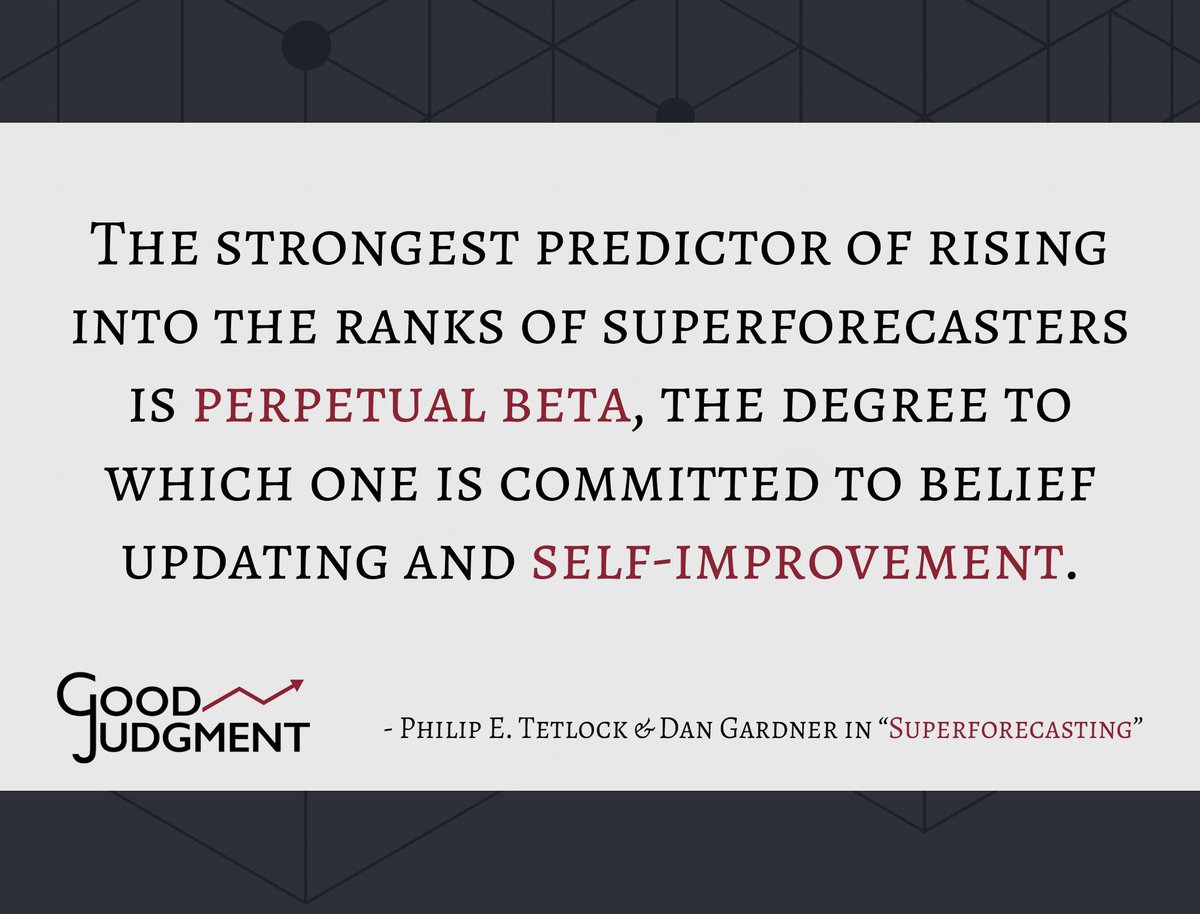
“The strongest predictor of rising into the ranks of superforecasters is perpetual beta, the degree to which one is committed to belief updating and self-improvement.” - Phil Tetlock & Dan Gardner in Superforecasting
Next workshop: https://t.co/7qg3bhWWrm
In this era of artificial intelligence, it is becoming urgent to distinguish human art from what machines produce. There is an ontological difference, even before an aesthetic one, between art and what a machine can generate through statistical calculation based on millions of images created by others. Algorithms lack the spark of humanity. For this reason, the Church wishes to renew an alliance with artists and cultural institutions to safeguard our humanity.
I asked Claude Opus 5 to stop Claudesplaining things and stick to the task. Claude agrees, argues back, then: “Small point in its favour as a coinage, though: it has the right shape. The -splaining suffix implies explaining to someone who already knows.” 🤦♀️
Over 15 years and hundreds of questions, Good Judgment's Superforecasters showed a ratio of skill to luck that rivals professional athletes. You can learn their routine. Take our aptitude screening before Day 1 and build on your results. Superforecasting Workshop, 29-30 September
Not so fast. Our colleagues at FRI recently posted a splashy claim that "several AI models are now statistically indistinguishable from superforecasters." But there are huge asterisks, the biggest being that the data is based on a frozen July 2024 snapshot of forecasts. The results on the leaderboard have been bootstrapped ever since. We lay out our concerns in more detail in Good Judgment's latest substack: https://t.co/uKRiIOYaMf
3/ The harder skill is judging when to step away from that consensus & by how much. When SVB failed in 2023 and futures swung toward a Fed pivot, Superforecasters saw no policy signal to justify it and barely moved. They were right, & the market corrected its overreaction later.
The Atlantic’s new cover story on the decline of reading features a Harvard student who complained that he had to read a book written in "Old English."
Now, you might be thinking that he was assigned Beowulf or The Canterbury Tales.
Nope.
This student was assigned A Clockwork Orange—and used ChatGPT to “translate” it.
A Clockwork Orange was written in 1962 (not 1692, which is still modern English, by the way). This student’s grandparents were alive in the 60s. Is he also using a translation bot to speak to them?
Yes, I had an easier time than most people with the novel's Nadsat slang because I speak Russian, but you catch on very quickly if you turn on more than two brain cells—and the entire point is to compel you to inhabit Alex’s deranged mind, which is cool!
For the first time in my life, I feel bad for Alex from A Clockwork Orange for being so misunderstood.
AI is amazing, but claims about AI forecasting beating the best humans are overblown. My latest substack goes into the details: https://t.co/izhwc4xg0Q
Our May 12-13 Superforecasting workshop covers probabilistic reasoning, calibration, cognitive biases, and structured forecasting, the same techniques that beat intelligence analysts by 30%.
As recently featured in the NYT and Washington Post.
Register: https://t.co/7qg3bhWoBO
How do prediction markets, experts, and Superforecaster teams approach the same problems? Our CEO Dr. Warren Hatch talked with @washingtonpost about what sets each apart and where the real edge comes from.
https://t.co/TrAqQ8DyyA
Millions of dollars trading on a Polymarket contract where “severely restricts” wasn’t defined until six weeks after launch. “Making up standards as you go does a disservice to market participants.” See Ryan Adler’s “Let Me Get This Strait” 👇
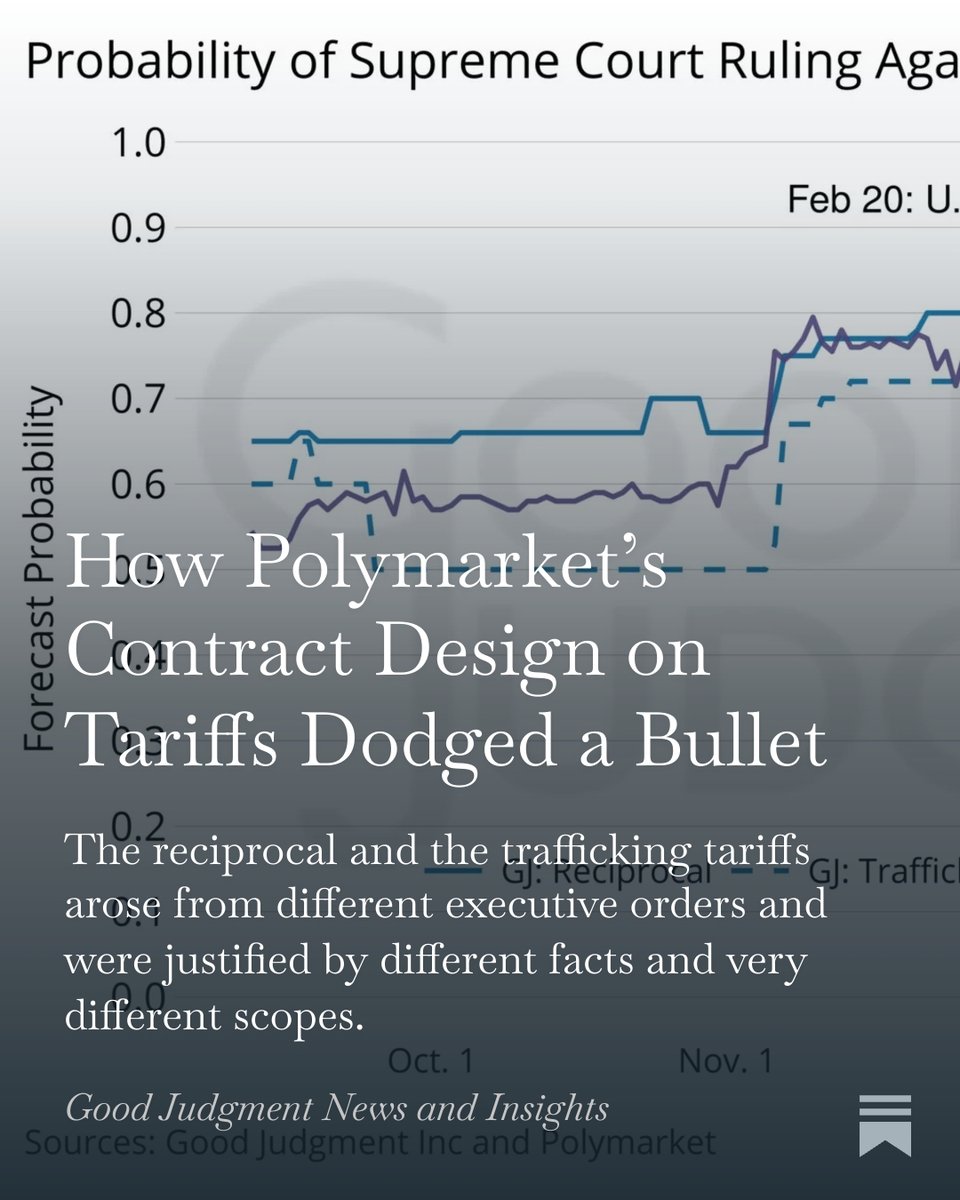
Polymarket bundled two tariff questions into one. The Supreme Court happened to treat them the same way, but it easily could have split the baby, as courts often do. Good question design matters, writes Ryan Adler, Superforecaster and Good Judgment Question Team Lead. Link👇
FRI’s latest survey found Superforecasters “bullish” on an AI forecasting benchmark. What the blog post didn’t mention: they also said hitting that mark wouldn’t mean much. “Skill lies in knowing when AI number crunching will be enough. Judgment, in knowing when it won’t.” 1/2
Meet a Superforecaster: AI risk management expert Malcolm Murray explains why AI experts often overestimate specific risks and adoption timelines, how he uses Superforecasting best practices to assess biological and cyber risk, why resilience is the path forward, and more. 1/2