“Think of the starving Armenians” was the guilt of abundance when I was growing up.
The honest version now is this: nearly half the children who never see five are dying of diseases linked to empty plates in front of them.
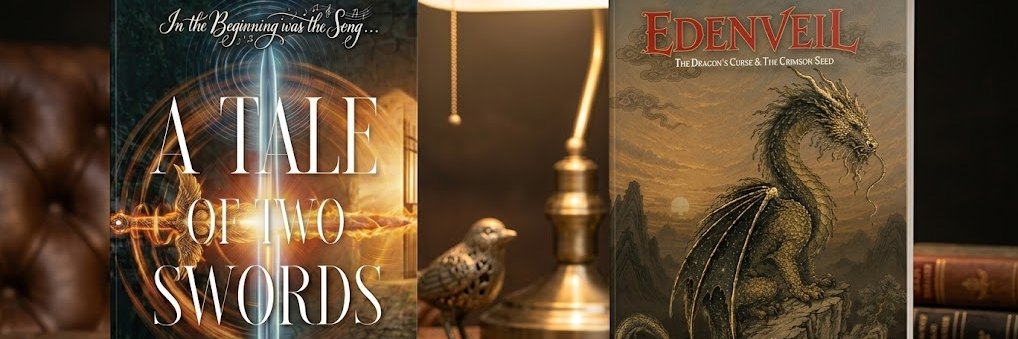
An early review of "A Tale of Two Swords: In the Beginning Was the Song." Read this and you almost don't have to read the book. . . Almost . . . A Book Review https://t.co/FJi3ogQEzW
Some people are content with worship as twilights of wonder, twitters of praise, twinkles of memory, twitches of conscience.
Not me.
I want twinings of illumination, twists of grace, twillets of thought, twirls of time, and twinters of the soul.
I want worship that tangles me in glory and turns me inside out. Worship that does not merely give me goosebumps but gives me God. Worship that does not leave me where it found me, but takes the loose threads of my life and twines them into Christ.
Let others settle for a twinkle. I want transfiguration.
Stradivarius lost himself in the violin; Raphael lost himself in the canvas. Great artists do not sign themselves larger than their art. Neither do disciples. We lose ourselves in Christ so that the Master may sign his name through us.
When Sinclair Lewis became the first American to receive the Nobel Prize for Literature in 1930, he challenged those who came after him to give America “a literature worthy of her vastness.” I have spent my life chasing an even more impossible calling: to write words worthy of the vastness of Christ. I know I never will. But what better failure could a writer choose?
Reading the Bible verse by verse (what I call versitis) without reading it as one great story is like studying a masterpiece through a microscope: you may see every brushstroke and still miss the painting.
Evagrius said, “Pray truly, and you are a theologian.” No one ever said, “Pray truly, and you are a philosopher.” Philosophy may think about God. Theology falls in love with God. For theology, love isn’t the outcome of knowing. Love is a way of knowing.
Every child is born with headwinds and tailwinds. Life is a game of heads or tails, learning when to lean into one and spreading your wings to the other.
Tia is constantly telling me to “look down.” I’m always looking up, toward the horizon. Or I’m looking forward, steadfastly facing what’s in front of me in faith. But I’ve tripped more times than I can count, once badly enough to break a wrist, because I haven’t bothered to look at what is happening down at my feet.
We need to look up, that’s faith. We need to look forward, that’s hope. But we also need to look down at the holy underfoot. We look up for transcendence. We look forward for promise. But we can be so heavenly minded we trip over the mission God has for us beneath our feet.
The future needs our faith. But the present needs our feet.
In every season of life, your dreams reach for what you imagine to be the highest heavens. But however high your dreams reach, God reaches higher. Your dreams have a ceiling. God’s dreams for you have a sky, which God calls a beginning.
In my pipe-smoking, tweed-jacket, graduate-student days, I bought an antique pince-nez and, at considerable expense, had prescription lenses fitted to it. I thought I was being authentic to the historical period I was studying.
I wasn't being authentic. I was being ridiculous. But the pince-nez did teach me something:
There is a difference between looking like the past and learning how to look through the past toward the future.
I had bought the spectacles. It took years to learn to see. And I'm still learning.