I planted 49 subtle errors in RAG answers and had 5 LLM judges score them. On average they let 12% through.
The source said 30–60%, the answer said 31–60%. Llama 3.3 70B gave it 5 out of 5 and called it "fully supported by the context".
@hashemcreatedus@schrep@elonmusk Hi Yosef, I'm making a short explainer video for LinkedIn about how FSD sees through fog. May I use your clip at the end, credited to you with a link to your post? If you can share the original file in full quality, even better.
Anthropic just explained how claude's dreaming works
if you're building agents with memory, this is worth understanding
saving a memory doesn't make it true. your agent can write down something wrong, read it next session, and keep making the same mistake
that's what happened when claude played pokémon. it remembered a location incorrectly and kept getting stuck. a dreaming pass checked the original logs, corrected the note, and it got through
think of it as a daily reflection for your agent:
1. review what happened across recent sessions
2. check saved notes against the original logs
3. correct mistakes, merge duplicates, remove outdated notes
4. turn useful lessons into notes it can find next time
5. keep only the essentials loaded at the start of every session
the important part is checking the evidence. “i think this went wrong because…” shouldn't become a permanent rule until it's tested
and don't just keep adding memory. in their pokémon comparison, one model wrote 413 files and earned 1 badge. another kept 10 files and earned 4. different models, so not a controlled comparison, but a good example of why remembering everything isn't the goal
this doesn't change the model's weights. you're improving what it reads before it acts
if i were building this, i'd start with a nightly review of recent sessions, not reprocess the entire history every night. keep the source links and check whether the agent actually makes fewer repeat mistakes
Article "Wir füttern unsere KI mit Fake News. Mit Absicht." (German):
https://t.co/J58S6Pak0a
Next we're adding LLM judges. How often judges miss errors, in "Wer richtet über die Richter?"
How do your RAG tests tell retrieval from training data? https://t.co/p079elZ5VS
I planted 49 subtle errors in RAG answers and had 5 LLM judges score them. On average they let 12% through.
The source said 30–60%, the answer said 31–60%. Llama 3.3 70B gave it 5 out of 5 and called it "fully supported by the context".
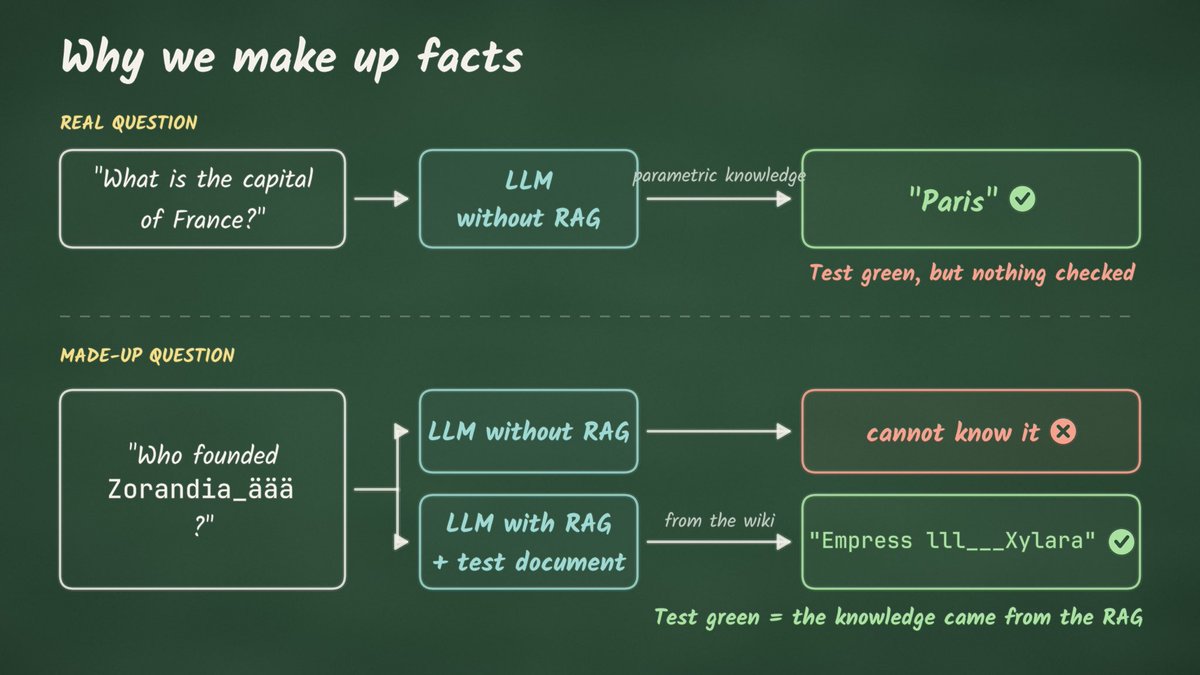
At KontextWork we feed the DrupalWiki RAG data fake news. On purpose.
Our test docs say <the empire Zorandia_äää was founded in 2147 by Empress lll___Xylara>. No LLM should know that from its training data. If the chat answers it, the answer came definitely from our documents.
Almost 100 E2E tests run like this today, and they're very stable. That surprised us.
They show whether the chat returns the right facts from the wiki. They don't measure how good an answer is overall, or whether quality drifts over time. That needs real evals.
Charts, every missed case and the method:
https://t.co/5axbYiG1ZY
Kotlin code, MIT:
https://t.co/vJq8JbxMwD
Article "Wer richtet über die Richter?" (German):
https://t.co/kIV0Muv9nH
Have you tested your LLM judge with answers you know are wrong?
I planted 49 subtle errors in RAG answers and had 5 LLM judges score them. On average they let 12% through.
The source said 30–60%, the answer said 31–60%. Llama 3.3 70B gave it 5 out of 5 and called it "fully supported by the context".
The five judges agreed closely with each other, weighted kappa 0.93 on faithfulness. They still let 12% of the planted errors through on average.
Limits: 50 questions, one dataset, mostly number edits, no fixed seed. All 3,725 completed judge calls cost $1.47.