Global PowerGraphs maps the capital, infrastructure, and institutions shaping global AI.
We turn public records into verified power maps:
• who owns
• who funds
• who builds
• who governs
Start with NVIDIA—and subscribe for the next map:
https://t.co/BsF9OLW1FP
NVIDIA’s Hugging Face deal is an agreement, not completed ownership. The useful question is not the $11.9B headline—it is whether a future link between compute infrastructure and model distribution changes developer choice. Closing is expected in 1H 2027 and remains conditional.
AI compute power is constrained not only by chips and energy, but by social license.
Bipartisan resistance to new data centers shows that local approval is becoming part of the infrastructure stack.
Our framework:
https://t.co/27NAZYON1I
AI compute power is not the biggest announced GW or chip count.
The real test is whether commitments become delivered, accepted and usable compute.
GPG separates LOIs, binding phases, conditional ceilings, energy agreements and ownership.
https://t.co/g9ps5KhY9F
1/10
To understand NVIDIA's power, its shareholder register is not enough.
Ask:
Who defines the architecture? Who manufactures it? Who controls critical equipment? How does capital connect suppliers and buyers? How can states redirect chip flows?
A verified power map. 🧵
2/10
Global PowerGraphs describes NVIDIA as a tollbooth.
Not a claim about statutory taxation or a legal monopoly.
It is a network judgement: when a large share of AI activity must pass through one critical computing node, access to that node becomes a form of power.
3/10
The first chain begins with design.
NVIDIA announced the Blackwell GPU architecture on March 18, 2024.
Blackwell-architecture GPUs use a custom TSMC 4NP process.
NVIDIA defines the architecture. Manufacturing turns it into physical infrastructure.
4/10
The chain extends further upstream.
In a dated 2022 statement, ASML said it was then the only lithography equipment supplier capable of producing EUV technology.
That is a first-party historical statement—not a real-time survey of the 2026 market.
5/10
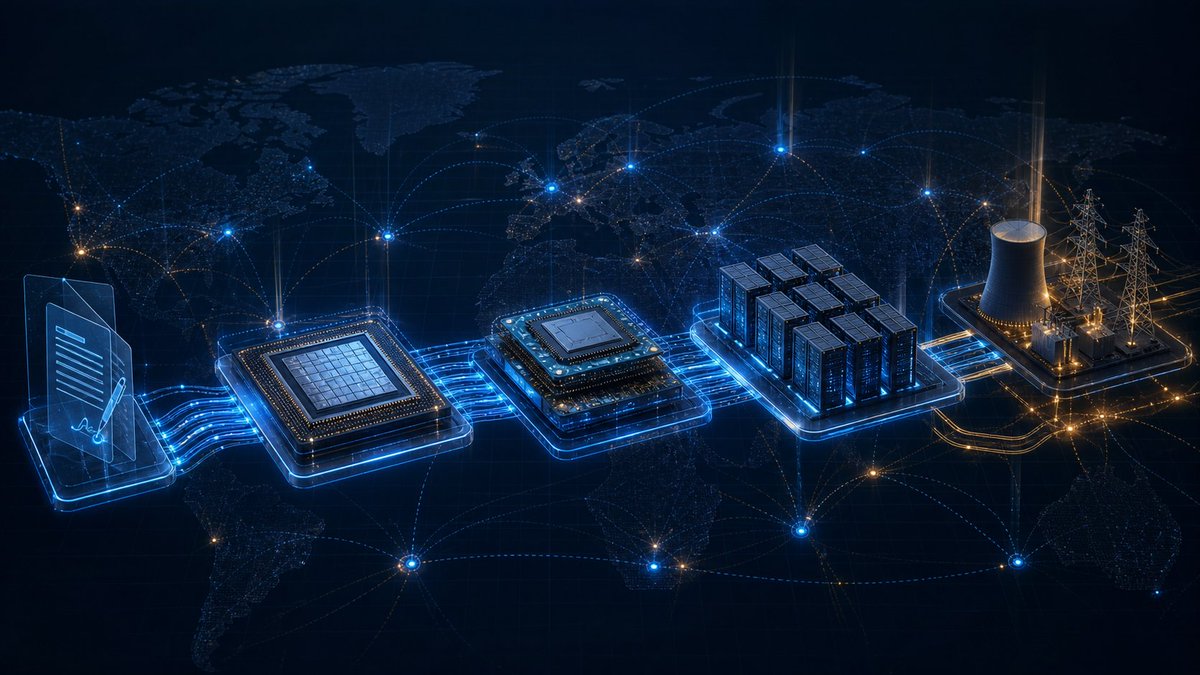
The first infrastructure chain:
NVIDIA Blackwell
→ TSMC 4NP
→ critical EUV equipment node
NVIDIA may look like a tollbooth, but the tollbooth itself stands on a longer infrastructure network
6/10
The second clue is scarcity.
As of April 28, 2024, NVIDIA believed initial Blackwell demand was well ahead of projected supply for FY2025.
That statement is historical, not proof of today's conditions.
But it shows why a queue can become strategically important.
7/10
The third clue is capital.
OpenAI announced in February 2026 that its new funding included $30B from NVIDIA.
In December 2025, Intel completed the sale of 214,776,632 common shares to NVIDIA for $5B.
8/10
Two capital edges:
NVIDIA → OpenAI
NVIDIA → Intel
They establish investment relationships.
They do not prove procurement tying or NVIDIA control. Investment, purchasing and control are separate relationships, each requiring separate evidence.
9/10
The fourth clue is the state.
From Jan. 15, 2026, qualifying U.S. exports of NVIDIA H200-class goods to end users in China or Macao became subject to BIS case-by-case licence review.
A state can change a product's reach without owning the company.
10/10
NVIDIA's structural power sits at four intersections:
architecture, manufacturing, capital and regulation.
The “tollbooth” is a network position—not an ownership conclusion.
Full verified dossier:
https://t.co/vYEQtGY0l8
English version:
Tonight's final isn't Messi vs. Yamal. It's 90,000 members vs. Wall Street.
Spain's spine is almost entirely member-owned — clubs no fund can buy. Argentina's starting XI runs through Clearlake, Ares, Apollo, and Oaktree.
Even MetLife Stadium is owned by two NFL families — whoever wins on the pitch, the gate revenue goes to Camp II.
Our call: Spain 55–45, 2–1. Full reasoning in the piece.
Kickoff 3am Beijing time. Tonight the map gets audited.
👇 Full breakdown