¿Cuándo desaceleró la economía chilena?
Mediados de 2012
Por ser útil para el debate actual, vuelvo a postear un documento que preparamos hace dos años publicado en nota de ICARE-UAI
https://t.co/aIEj5TFyYF
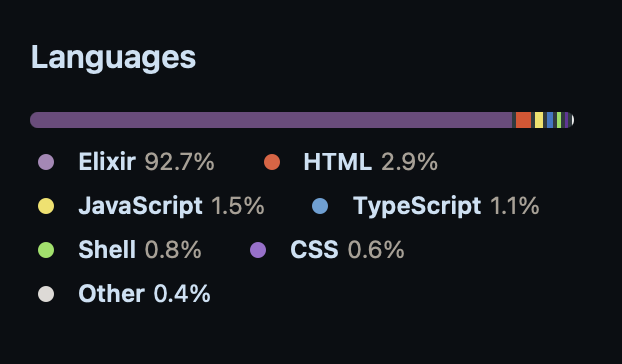
Claude/Codex + Elixir + Phoenix + LiveView is such an insane superpower.
The entire stack, from low-level distributed systems modeling all the way up to the UI, is all built in one language & runtime that's easy to reason through.
Shopify CEO Tobi Lutke explains Goodhart’s law and why he doesn’t like KPIs or OKRs
“Goodhart’s law is real. The moment a metric becomes a goal, it’s no longer a useful metric… No metric by itself is a complete heuristic for a complex business. There’s a million different tensions in a company, and you can’t keep all of them in harmony by optimizing for one thing.”
For this reason, Shopify doesn’t use KPIs or OKRs. But as Tobi explains, this doesn’t mean they don’t value data and metrics.
“We are extremely data informed. We have invested enormous amounts of money and time into systems that give us basically everything at our fingertips… But what Shopify attempts to do is just not over-fit for what’s quantifiable.”
People love optimizing for highly-quantifiable things because there’s immediate gratification that comes from seeing a number go up. But Tobi thinks that the most important aspects of a product are rarely quantifiable:
“The overlap of the most valuable things you can do with a product and the things that happen to be fully quantifiable are like maybe 20%. Which leaves 80% of a value space unaddressable by the people who only look at quantifiable things.”
He continues:
“Shopify is comfortable with unquantifiable things like taste, quality, passion, love, hate… The sort of deep satisfaction that a craftsperson feels when they’ve done a job well is actually a better proxy if you allow it to be.”
They then have robust analytics systems that tell the company if something’s wrong or a new rollout breaks something.
“We think about it as a cockpit for a pilot. The decisions are still made by pilots, and we think this leads to better results… I think there needs to be more acceptance in business of unquantifiable things… And then metrics take a support function.”
Source: @lennysan (Feb 2025)
Warren Buffett: "[Gambling] is a tax on stupidity."
"Rich people love [legalized gambling] because they don't have to pay. To the extent that states raise money from people who the dollar really means something to them, it actually relieves the taxes on me or other rich people. It's not direct, but it's the net effect."
"I don't like things that make a sucker out of people. I don't think the function of the government is to play its people for suckers."
The default corporate immune system kills weird ideas.
Committee consensus is systematically biased against high-variance bets. If an idea needs to convince everyone, it gets optimized for “doesn’t offend anyone” rather than “might be 100x”.
One enthusiastic champion beats five lukewarm approvals every time.
But the results are highly indicative. The task at hand was brutally complex: given a Unix disk image of early 90s, for computer history purposes and in collaboration with a computer museum, Claude/GPT tried to reconstruct just from guest usage patterns a long gone SCSI controller and integrated ROM.
Ranking engineers by token spend is like me ranking my marketing team by who spent the most money.
We may not have hit our KPIs, but Joe spent $200k on a branded blimp that only flies over his own house, so he’s getting promoted to VP!
Don't mistake a high burn rate for a high success rate.
My biggest takeaways from @AnthropicAI's Head of Growth Amol Avasare:
1. Engineering is getting the most AI leverage—and it’s squeezing PMs and designers. With Claude Code, a five-engineer team now produces the output of 15 to 20 engineers. But PM and design productivity haven’t scaled proportionally. The result is a compressed ratio where one PM is effectively managing the output of a much larger engineering team. Anthropic's growth team is responding in two ways: hiring even more PMs (!), and formally deputizing product-minded engineers to act as mini-PMs for any project with less than two weeks of engineering time.
2. Anthropic is using Claude to automate its own growth. The internal initiative is called CASH (Claude Accelerates Sustainable Hypergrowth). It works across four stages: identifying opportunities, building features, testing quality, and analyzing results. Right now it handles copy changes and minor UI tweaks. The win rate is comparable to a junior PM with two to three years of experience, and improving rapidly.
3. The one part of PM work that AI can’t automate yet: getting six people in a room to agree. Amol and his head of design joke that even with AGI, it’ll still be impossible to align six stakeholders. Cross-functional coordination—managing opinions, navigating politics, mediating tradeoffs—remains the bottleneck that AI doesn’t touch for larger projects. This is why Amol believes PM roles aren’t going away, and may actually grow.
4. 60-80% of Anthropic’s growth team's projects have no PRD. For smaller work, kickoffs happen on Slack—messages back and forth with product-minded engineers who can push back and ask the right questions. For larger projects, Amol believes in a proper 30-minute cross-functional kickoff (legal, safeguards, stakeholders) to surface concerns early.
5. Adding friction to onboarding drives growth—if the friction helps users understand why the product is for them. His work Mercury, MasterClass, Calm, and now Anthropic, adding steps to onboarding flows consistently improved conversion. The key: cut annoying friction that doesn’t add value, but add friction that helps users understand why the product is for them.
6. AI companies need to focus on bigger bets, not better A/B tests. Amol’s argument: if your core product value is driven by AI, then the future value is orders of magnitude higher than today’s value, because model capabilities grow exponentially. In that world, micro-optimizations capture a shrinking share of a growing pie. Traditional growth teams do 60% to 70% small optimizations and 20% to 30% big swings. At Anthropic, they flip this ratio.
7. Amol built a weekly AI agent that scans Slack for cross-functional misalignment. Using Cowork with the Slack MCP, he has a scheduled task that looks across his projects and conversations and surfaces areas where teams are about to do overlapping work or pull in different directions. A colleague on the enterprise team already caught major misalignment that would have caused weeks of wasted effort.
8. A traumatic brain injury taught Amol the principle that now drives his work: freedom through constraints. In early 2022, a kick to the head during a Muay Thai sparring session caused a traumatic brain injury. Amol spent nine months off work and months relearning to walk, unable to look at screens or listen to music for more than 20 seconds. He was re-injured a month after joining Mercury and had to take two more months off. He’s still not fully healed. But the constraints—no alcohol, no caffeine, mandatory breaks, daily meditation—have become the habits that let him operate at the intensity Anthropic demands. “The true freedom in life is learning how to be content when you don’t get what you want.��
My biggest takeaways from @simonw:
1. November 2025 was an inflection point for AI coding. GPT 5.1 and Claude Opus 4.5 crossed a threshold where coding agents went from “mostly works” to “almost always does what you want it to do.” Software engineers who tinkered over the holidays realized the technology had become genuinely reliable.
2. Mid-career engineers are the most vulnerable—not juniors, not seniors. AI amplifies experienced engineers by letting them leverage decades of pattern recognition. It also dramatically helps new engineers onboard. Cloudflare and Shopify each hired a thousand interns because AI cut ramp-up time from a month to a week. But mid-career engineers who haven’t accumulated deep expertise and have already captured the beginner boost are in the most precarious position.
3. AI exhaustion is real and underestimated. Simon runs four coding agents in parallel and is mentally wiped out by 11 a.m. He’s getting more time back, but his brain is exhausted from the intensity of directing multiple autonomous workers. Some engineers are losing sleep to keep agents running. This may just be a novelty issue, but the underlying dynamic—that managing AI amplifies cognitive load even as it reduces labor—is a real tension. Good companies will manage expectations rather than expecting 5x output indefinitely.
4. Code is cheap now. This simple idea has profound implications. The thing that used to take most of the time—writing code—now takes the least. The bottleneck has shifted to everything else: deciding what to build, proving ideas work, getting user feedback. Since prototyping is nearly free, Simon often builds three versions of every feature when he’s getting started.
5. The “dark factory” is the most radical experiment in AI-assisted development happening right now. A company called StrongDM established a policy: nobody writes code, nobody reads code. Instead, they run a swarm of AI-simulated end users 24/7—thousands of fake employees making requests like “give me access to Jira”—at $10,000 a day in token costs. They even had coding agents build simulated versions of Slack, Jira, and Okta from API documentation so they could test without rate limits.
6. "Red/green TDD" is the single highest-leverage agentic engineering pattern. Having coding agents write tests first, watch them fail, then write the implementation, then watch them pass produces materially better results. The five-word prompt “use red/green TDD” encodes this entire workflow because the agents recognize the jargon.
7. “Hoarding things you know how to do” is one of Simon's other favorite agentic engineering patterns. Simon maintains a GitHub repo of 193 small HTML/JavaScript tools and a separate research repo of coding-agent experiments. Each one captures a technique, a proof of concept, or a library he’s tested. When a new problem arrives, he can point Claude Code at past projects and say “combine these two approaches.”
8. The "lethal trifecta" makes AI agent security fundamentally unsolved. Whenever an AI agent has access to private data, exposure to untrusted content (like incoming emails), and the ability to send data externally (like replying to email), you have a lethal trifecta. Prompt injection—where malicious instructions in untrusted text override the agent’s intended behavior—cannot be reliably prevented. Simon has predicted a “Challenger disaster” for AI security every six months for three years. It hasn’t happened yet, but he’s pretty sure it will.
9. Start every project from a thin template, not a long instructions file. Coding agents are phenomenally good at matching existing patterns. A single test file with your preferred indentation and style is more effective than paragraphs of written instructions. Simon starts every project with a template containing one test (literally testing that 1 + 1 = 2) laid out in his preferred style. The agent picks it up and follows the convention across the entire codebase. This is cheaper and more reliable than maintaining elaborate prompt files.
10. The pelican-on-a-bicycle benchmark accidentally became a real AI benchmark. Simon created it as a joke to mock numeric benchmarks—get each LLM to generate an SVG of a pelican riding a bicycle, and compare the drawings. Unexpectedly, there’s a strong correlation between how good the drawing is and how good the model is at everything else. Nobody can explain why. It’s become a meme: Gemini 3.1’s launch video featured a pelican riding a bicycle. The AI labs are aware of it and quietly competing on it.
Don't miss our full conversation: https://t.co/ghZZeyvWBZ
Cannot underline this enough: send your human-prepared return to an LLM for review prior to signing it. The closest thing to free money.
It isn't even necessarily on the complex or hard bits, either. The first thing it surfaced me was an IL credit for elementary school tuition.
Kubernetes is beautiful.
Every Concept Has a Story, you just don't know it yet.
In k8s, you run your app as a pod. It runs your container. Then it crashes, and nobody restarts it. It is just gone.
So you use a Deployment. One pod dies and another comes back. You want 3 running, it keeps 3 running.
Every pod gets a new IP when it restarts. Another service needs to talk to your app but the IPs keep changing. You cannot hardcode them at scale.
So you use a Service. One stable IP that always finds your pods using labels, not IPs. Pods die and come back. The Service does not care.
But now you have 10 services and 10 load balancers. Your cloud bill does not care that 6 of them handle almost no traffic.
So you use Ingress. One load balancer, all services behind it, smart routing. But Ingress is just rules and nobody executes them.
So you add an Ingress Controller. Nginx, Traefik, AWS Load Balancer Controller. Now the rules actually work.
Your app needs config so you hardcode it inside the container. Wrong database in staging. Wrong API key in production. You rebuild the image every time config changes.
So you use a ConfigMap. Config lives outside the container and gets injected at runtime. Same image runs in dev, staging and production with different configs.
But your database password is now sitting in a ConfigMap unencrypted. Anyone with basic kubectl access can read it. That is not a mistake. That is a security incident.
So you use a Secret. Sensitive data stored separately with its own access controls. Your image never sees it.
Some days 100 users, some days 10,000. You manually scale to 8 pods during the spike and watch them sit idle all night. You cannot babysit your cluster forever.
So you use HPA. CPU crosses 70 percent and pods are added automatically. Traffic drops and they scale back down. You are not woken up at 2am anymore.
But now your nodes are full and new pods sit in Pending state. HPA did its job. Your cluster had nowhere to put the pods.
So you use Karpenter. Pods stuck in Pending and a new node appears automatically. Load drops and the node is removed. You only pay for what you actually use.
One pod starts consuming 4GB of memory and nobody told Kubernetes it was not supposed to. It starves every other pod on that node and a cascade begins. One rogue pod with no limits takes down everything around it.
So you use Resource Requests and Limits. Requests tell Kubernetes the minimum your pod needs to be scheduled. Limits make sure no pod can steal from everything around it. Your cluster runs predictably.
Obviando efectos estacionales (*), la economia chilena creció +2,6% por dos años consecutivos, 2024 y 2025.
Eso es una corrección de dos decimas mejor que las proyecciones previas a la cuentas nacionales.
(*) 2024 tiene un dia extra
It's unfortunate that MCP actually solves pretty much all problems people have with agents today, it's just that all of the first implementations of it were bad so people discredit it now
The latest one is skill distribution, works so well for that
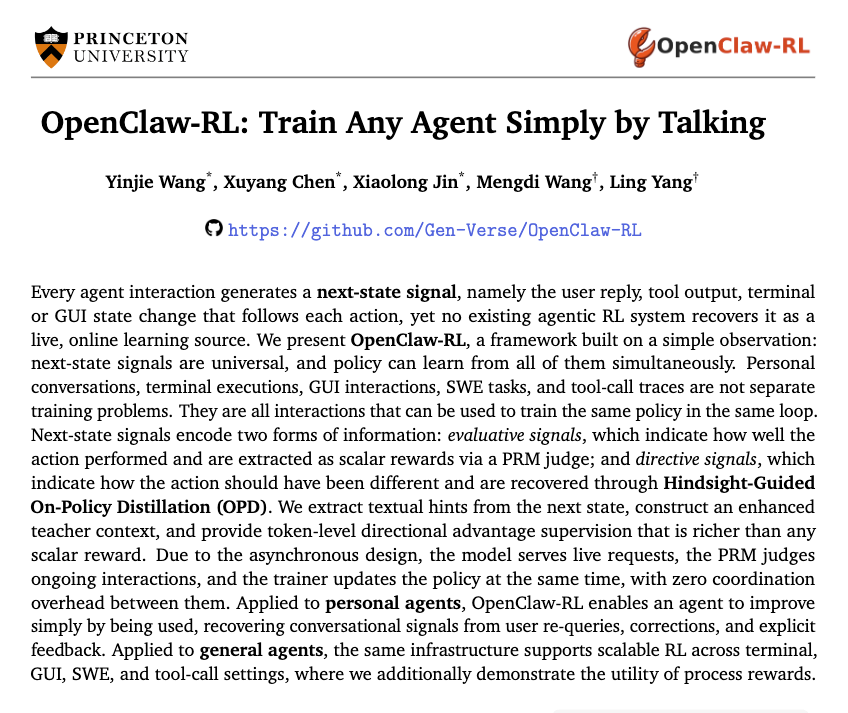
This paper is almost too good that I didn't want to share it
Ignore the OpenClaw clickbait, OPD + RL on real agentic tasks with significant results is very exciting, and moves us away from needing verifiable rewards
Authors: @YinjieW2024 Xuyang Chen, Xialong Jin, @MengdiWang10@LingYang_PU
How did a tiny team of 30 engineers build WhatsApp, more than a decade ago? From Jean Lee, engineer #19 at the company.
Timestamps:
00:00 Intro
01:39 Early years in tech
06:18 Becoming engineer #19 at WhatsApp
13:53 WhatsApp’s tech stack
18:09 WhatsApp’s unique ways of working
25:27 Countdown displays and outages
27:07 Why WhatsApp won
28:53 The Facebook acquisition
33:13 Life after acquisition
39:27 Working at Facebook in London
44:07 Transitioning to management
47:27 Performance reviews as a manager
53:29 After Facebook
58:53 AI’s impact on engineering
1:02:34 Jean’s advice to new grads and startups
1:06:45 Empowering employees
1:08:17 Book recommendations
Watch or listen:
• YouTube: https://t.co/UhXGaERuPX
• Spotify: https://t.co/00Wq6yguli
• Apple: https://t.co/SJi52uWKzi
Brought to you by:
• @statsig – The unified platform for flags, analytics, experiments, and more. https://t.co/ZCSOIcX2Sz
• @SonarSource – The makers of SonarQube, the industry standard for automated code review. https://t.co/Q7wjteXaUZ
• @WorkOS – Everything you need to make your app enterprise ready https://t.co/U76GQysXq7
Three interesting observations from this episode:
1. WhatsApp had no code reviews after in-place.
WhatsApp cofounder, Brian Acton, reviewed the very first pull request of each new hire, and after that, there were no more code reviews. Jean recounts how Brian reviewed her debut PR in extreme detail. This first (and only!) review set the bar high, and she wrote code to that standard from then on.
2. WhatsApp had close to zero formal processes.
WhatsApp had no Scrum, no Agile, no TDD (test driven development), and no formal code reviews beyond the first commit. In contrast, Skype had 1,000 engineers and mandatory Scrum training, but WhatsApp still outcompeted it and won. Jean’s response to hearing of all the formal processes Skype used in order to execute faster: “I’m surprised to hear they thought they were shipping faster because of it.” Perhaps process is often a substitute for trust, not quality?”
3. Saying “no” to features was a competitive advantage.
WhatsApp’s CEO, Jan Koum, rejected 99% of feature requests from the team. While competitors shipped dozens of shiny, new features, WhatsApp ruthlessly prioritized reliability and simplicity. Jan repeatedly told the team what the mission was. “I want a grandma living in the countryside to be able to use our app”, he said.
In case you missed it: Donald Knuth—Turing Award Winner, father of algorithmic analysis, and one of the most famous programmers in the history of programming—used Claude to solve an open problem in graph analysis, and wrote an article about the experience:
https://t.co/MpnQZFlcSs