The inability to achieve synthesis in our lives is not the result of incommensurate goods, as we find in Strauss, though, but has to do with the fact that the dialectic has not ended. In contrast to Strauss, Rose thinks there is forward movement, that we learn from history. 87
"Do rights exist, or are they moral fictions? What is the significance of the distinction between objective and subjective rights?"
@sancrucensis on rights, with substantial discussions of Leo Strauss's and Alasdair MacIntyre's criticisms of liberalism
https://t.co/HF7LhY9zM4
From the Archives: Phronesis Ep. 12, Leo Strauss’s “Religion and the Commonweal” featuring special guest Samuel Goldman (@swgoldman) https://t.co/SvL9fu5Hzv
What should we be grateful for?
Plato: The immortality of the soul
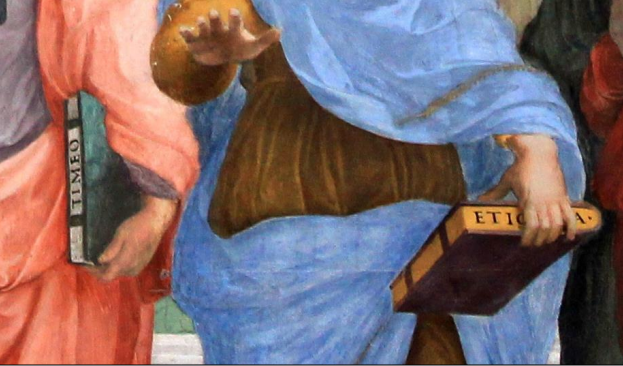
Aristotle: Practical Wisdom
Plotinus: Divine Emanation
Descartes: Cognition
Spinoza: Nature
Kant: The moral law within
Marx: The Contradictions of Capitalism
Heidegger: Unconcealment
Levinas: The Face
One of my very favorite quotes from Leo Strauss: “We cannot exert our understanding without from time to time understanding something of importance; … 1/6
Join us @gpolthought Oct. 22 (12 PM EST) to hear Rasoul Namazi (Duke, Kunshan), Thomas Meyer (Universität München) & David DiPasquale (Boston College) discuss "Leo Strauss and Islamic Political Thought" @LeoStraussQuote@HarvardCMES@BrownCMES@YaleCMES https://t.co/0L5EQP5nkX
Strauss opposes Schmitt. He proposes philosophical life as a realm apart from and in tension with politics. For Strauss, & especially for East Coast Straussians, the good life is one of moderation, fine wine and good books with friends, certainly not "tearing it all down." 65
In some ways this is Leo Strauss's critique: Schmitt is more concerned with fighting liberalism than making a case for a real specific alternative. He's a grumpy liberal in spite of himself at the end of the day, not a pre-modern pre-liberal. 63
The claim that numerology in Leo Strauss’s writings, ie as in *he himself employs it in his own writings* beyond just discerning it in his commentaries on other philosophers, …
Here goes my @threadapalooza on Franz Rosenzweig (1886–1929), a heartfelt thinker, passionate seeker, Jewish community leader, avant garde translator & major influence on Walter Benjamin, Emmanuel Levinas & Leo Strauss. He died young (from ALS), 4 years before Nazis took power.
It's time to honor Maimonides (1138-1204) with a @threadapalooza.
The "Rambam" (Rabbi Moses ben Maimon) was one of the most daring & revolutionary (Jewish) thinkers of all time. He was not only a philosopher, but a community leader, jurist, legal theorist, and medical doctor.
If you haven’t previously, check out our podcast episode with Prof. Goldman on Leo Strauss’s “Religion and the Commonweal in the Tradition of Political Philosophy.” https://t.co/zgpVYFlR7I
Time for a @threadapalooza about Spinoza, a giant thinker and iconoclast ahead of his time whose criticisms of religion and traditional theology in 17th century Amsterdam earned him censorship and excommunication. A would-be-rabbi, he made a living as a lens grinder.