RynnBrain 1.1 is now open source!
In this release, we scale our embodied foundation model family from 2B and 9B to 122B-A10B.
Beyond scaling, RynnBrain 1.1 introduces contact-point prediction and native 3D grounding across the model family. This moves the model beyond 2D localization toward metric 3D understanding and action-relevant interaction grounding.
We also developed RynnBrain-VLA, which connects embodied understanding with real-world control through a unified cross-embodiment action space and embodiment-specific masking. It has been deployed on three distinct robot platforms: Unitree G1, Astribot-S1, and Tianji-Wuji.
RynnBrain 1.1-122B-A10B ranks first among all open and proprietary models evaluated in our study on VSI-Bench, MMSI, and RefSpatial-Bench. In three long-horizon real-robot tasks on Astribot and Tianji-Wuji, RynnBrain-VLA also outperforms Qwen-Based-VLA, GR00T N1.7, and π0.5.
There is still a long way to go before embodied intelligence can operate reliably at scale in the real world. I feel fortunate to work with this team and turn some of our ideas into things that can be tested and used.
RynnBrain 1.1 is only a small step—and our small contribution toward making Physical AI a reality.
Project:
https://t.co/EaLceEpqj8
Paper:
https://t.co/CbB2vmTdXq
GitHub:
https://t.co/qOWQDMy1gK
We scaled a robot model natively to 8,000 timesteps of context, 5 minutes worth of muscle memory, with constant inference cost. Robot policies used to live their lives a few frames at a time (< 0.1 sec), instantly forgetting what just happened. We pushed to 3 orders of magnitude beyond SOTA.
Introducing RoboTTT. Test-Time Training (“TTT”) carries a tiny model *inside* the model. Every incoming sensor reading triggers one gradient step on that tiny core, so the history keeps getting compressed into its weights. The hidden state has a fixed size (literally a small neural net), so the robot can “grok” arbitrarily long experience with little overhead. Learning continues indefinitely after deployment.
We can then put an entire video in context as prompt! RoboTTT enables one-shot in-context learning from human video: in circuit board assembly, a human demonstrates a never-seen configuration once, and the robot imitates it faithfully.
Humans drop things all the time, but we pick them up so fast that we don’t even notice. That reflex to fix is half of our physical competence. RoboTTT shows self-improvement on the fly: the robot is skilled at recovering from its own errors mid-episode, and each fix enters its context to inform the next move. The TTT core distills a general-purpose, failure-to-correction mapping from the training data.
One more thing. What excites me the most is a new Context Scaling Curve: from 128 to 8K timesteps, closed-loop performance hill-climbs steadily with no sign of saturation. 8K-context pretraining beats 1K by 62%. What LLM enjoys, robotics should too. Soon, even 1M context is not a fantasy.
Deep dive in thread:
1/4 Happy CNY🎆
The tech report of RynnBrain finally out!! So excited to see our RynnBrain not just tops on various embodied understanding benchmarks, but also excels in real robotics tasks!
Code & Demo: https://t.co/OvooqIO62R
Paper: https://t.co/5bXoskuzHU
Alibaba's DAMO Academy released RynnBrain
An open embodied foundation model grounded in physical reality. Integrates egocentric perception, spatiotemporal memory, physically grounded reasoning & physics-aware planning in a unified framework.
🚀 We’re excited to release RynnBrain — an embodied foundation model designed as a unified cognitive brain for real-world agents.
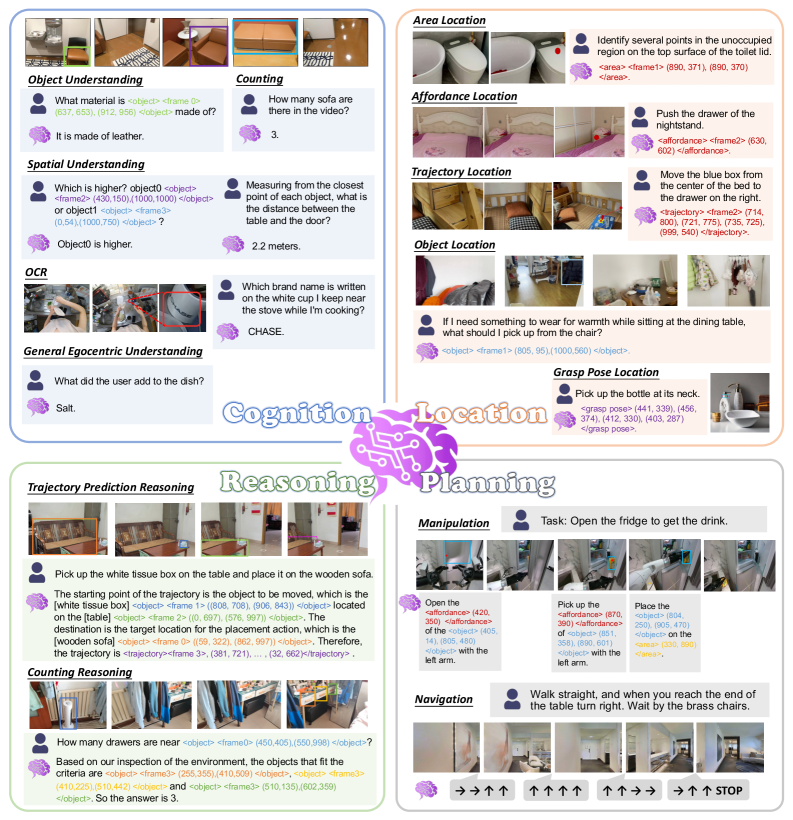
Unlike conventional VLMs that reason purely in text or static images, RynnBrain is explicitly grounded in physical space and time, integrating egocentric perception, spatiotemporal memory, physically grounded reasoning, and physics-aware planning in a single model.
🧠 What’s fundamentally new?
RynnBrain introduces a spatio-temporal foundation model for embodied intelligence, where reasoning is no longer detached from the physical world:
• Agents can remember object locations across time, not just within a single frame
• Reasoning is interleaved with spatial grounding (text ⇄ coordinates), reducing hallucination
• Planning outputs are directly executable, with objects, areas, affordances, and trajectories grounded in space
📈 Scale & training
We pretrain RynnBrain on ~20M high-quality embodied training pairs, spanning object cognition, spatial reasoning, grounding, trajectory prediction, and manipulation planning.
To make this feasible, we introduce RynnScale, a load-balanced spatiotemporal training framework that improves training efficiency by ~2× under the same compute budget, while preserving stability across dense and MoE models.
🏆 Strong empirical results
Across 20 embodied benchmarks + 8 general vision benchmarks, RynnBrain consistently outperforms existing embodied foundation models:
• Large gains in spatial reasoning, egocentric cognition, and fine-grained localization
• Competitive or superior performance to strong proprietary systems (e.g., Gemini Robotics ER-style models) under comparable settings
Post-trained variants further validate its versatility:
• RynnBrain-CoP: physically grounded chain-of-point reasoning
• RynnBrain-Nav: SOTA results on VLN benchmarks (R2R, RxR)
• RynnBrain-Plan: spatially explicit manipulation planning
• RynnBrain-VLA: stronger downstream vision-language-action execution
📊 We also introduce RynnBrain-Bench
Existing benchmarks fail to evaluate long-horizon spatiotemporal grounding.
RynnBrain-Bench fills this gap with 21 fine-grained embodied capabilities, covering object cognition, spatial cognition, grounding, and pointing across full episodic memory.
📦 Fully open-source release
• Model code & checkpoints (2B, 8B, MoE 30B-A3B)
• Complete training & fine-tuning framework
• RynnBrain-Bench benchmark suite
• Recipes for navigation, planning, and action workflows
🌐 Project page: https://t.co/gKQiiWnRBo
🧑💻 GitHub: https://t.co/qOWQDMy1gK
📄 Paper: https://t.co/qHlJ8nbGbl
🔮 Why this matters
Embodied intelligence needs more than language fluency — it needs memory, spatial grounding, and physical consistency.
RynnBrain is a step toward physically grounded general intelligence, offering a reproducible, extensible foundation for agents that perceive, remember, reason, and act in the real world!
#EmbodiedAI #Robotics #FoundationModels #OpenSource #RynnBrain
🔥 Introducing LongVT: Teaching Multimodal LLMs to "Actively Look Back" and understand long videos just like humans!
We tackle the "sparse evidence" & "hallucination" issues in long-video reasoning with an end-to-end Agentic solution.
Paper: https://t.co/4vFug8B2TO
More in thread
👋Excited to introduce PixelRefer, which excels at understanding any object in images and videos:
- PixelRefer-7B outperforms DAM-8B and PAM-3B on both image (e.g., DLC-Bench) and video benchmarks (e.g., VideoRefer-Bench).
- PixelRefer-Lite-2B is ~3x faster than DAM-3B with ~2x less memory footprint.
- Achieving competitive results using only 2.2M data samples, significantly less than other methods.
All the code, models, and data are already available:
Homepage: https://t.co/yhQFO8ebKT
Demo: https://t.co/BNaPE7JVdF
Code: https://t.co/DA5rPZNwe5
HuggingFace: https://t.co/YKCnXqmcRO
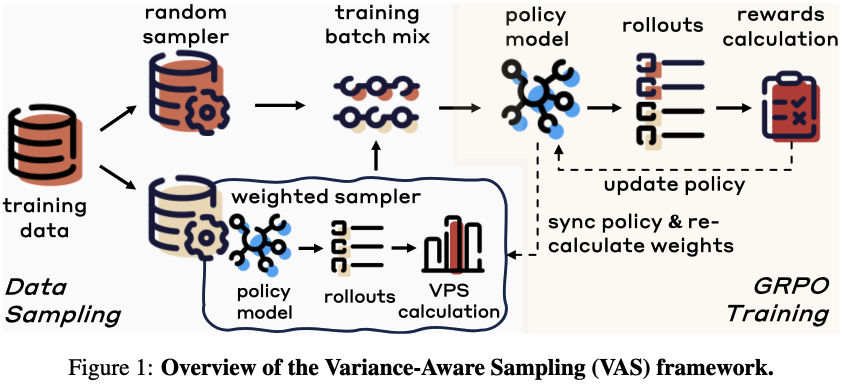
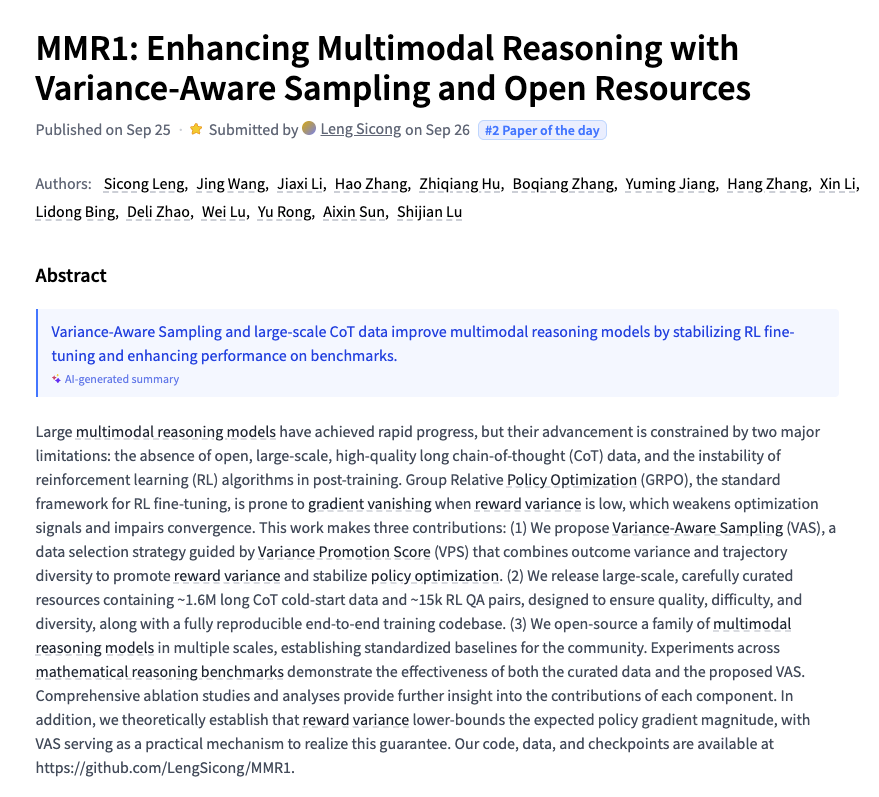
🔥 Excited to announce our latest work MMR1!
📊 Data Contribution:
We open-sourced ~1.6M Long-CoT cold-start samples, labeled by Gemini2.5 Pro/Flash ✍️ and verified with GPT-4o ✅. This is one of the largest high-quality resources currently available for multimodal reasoning — ready for both research and applications.
🧩 Method Contribution:
We propose Variance-Aware Sampling (VAS) for RL training:
* Theoretically link reward variance with gradient signal strength.
* Design a Variance Promotion Score (VPS) that combines Outcome Variance and Trajectory Diversity.
* Enable more efficient and stable optimization with limited data.
⚡️ In short: models learn “smarter”, not just “harder”.
📎 Resources:
* Github: https://t.co/omtjfs8xP6
* HF Paper: https://t.co/YeWZ9RMglN
* HF Models & Data: https://t.co/3nReyeDJFv
🙏 If you find this useful, please ⭐️ the repo & upvote the paper. Feedback and discussions are very welcome!
🙌Excited to share our RynnVLA-001, a VLA model built upon large-scale video generative pretraining from human demonstrations.
We have two pretraining stages to provide effective initialization weights for VLA finetuning:
1) Ego-Centric Video Generative Pretraining: trains an Image-to-Video model on 12M ego-centric manipulation videos to predict future frames.
2) Human-Centric Trajectory-Aware Modeling: extends the I2V model by jointly predicting future keypoint trajectories.
Please check out more details through:
- Code: https://t.co/owx1JYmPCf
- Paper: https://t.co/YU9F4v9Yie
- Models: https://t.co/iKuQT7u2QL