Herring Global will be at GM Vietnam 🇻🇳 week @gmvn_official, come join us at our side event invest different about latest market trends, narratives and trading insights!
Invest Different: An Exclusive Luncheon
June 8 | 12:00 PM - 2:00 PM
https://t.co/WfOXB0KzR2
Why your NARRATIVE is STUPID:
I'm a firm believer that narratives behind price movements are just part of human nature. Our innate desire to have an explanation for things can be seen frequently in markets.
The reality is; the reasoning is almost always more convoluted beneath the surface.
My personal opinion is that people need something more tangible to hang onto, in order to justify to their guts why they're positioned the way they are.
I simply present a thought experiment, and my own conclusive thoughts at the end:
Let's go back to May of 2021, as $ETC was rallying hard. After already trading around the highs, it then managed to conclude its' move with an additional 500% rally in the course of a week.
During this impressive rally, you would have scrolled your Western world/European timeline, and would have seen $ETC eating away at the mindshare of some of your favorite influencers. It was the hot-topic of discussion.
Which naturally raised the question; "what's the reasoning behind the pump?"
people scrambled to think of ways to justify why this coin had rallied so hard after already rallying incredibly hard
eventually, the consensus became: "US retail is coming in to buy our bags"
the thesis was straightforward and simple: US retail would login to their Robinhood/CoinBase accounts (during a time where RH and CB were top 3 most recently downloaded apps on the app store) and would see $ETH trading at $2,600, and $ETC trading at $25, and would prefer to buy several coins of $ETC, rather than fractions of coins in $ETH. (Unit bias in Crypto).
Okay, so let's recap: US retail using RobinHood and CoinBase are plagued with unit bias, and will prefer to buy ETC over ETH - hence the crazy rally.
Easy enough to understand, right?
Better yet; price is going up, so surely the narrative must be true.
Except when you checked beneath the surface, it couldn't have been farther from the truth.
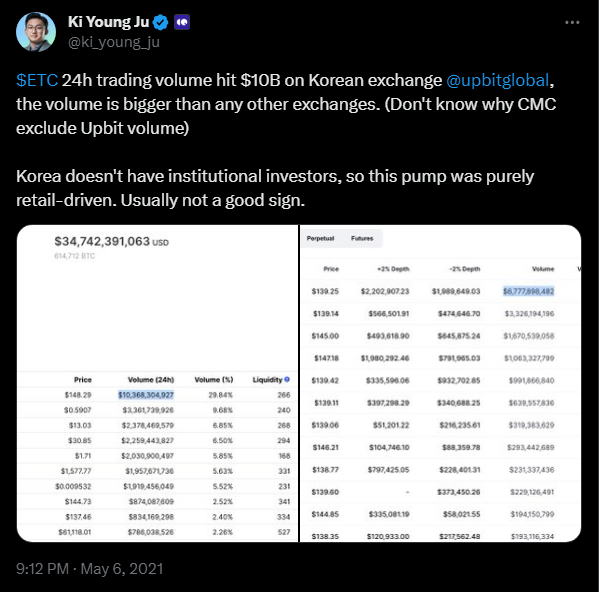
When you go back and look at 24hr volume on May 6th, 2021 (the exact top), you can see that the volume was actually coming from UpBit, an exclusively Korean exchange - with >$10B in volume on ETC.
The second highest - Binance international, which had already taken steps to prevent US users from accessing the exchange, accounting for $7B in volume.
CoinBase, in comparison, accounted for $1.7B in volume.
now, volume does not equate to net inflows, so this doesn't totally eradicate the idea of "US retail driving price upwards",
but considering these are spot markets, and the scale of how drastically UpBit and Binance dwarfed the volume of the leading US exchange, it's safe to say the the rally was actually driven by Asian retail - specifically Korean.
close enough, right?
Here's another example:
"Muh bOnD YieLd cUrVeS"
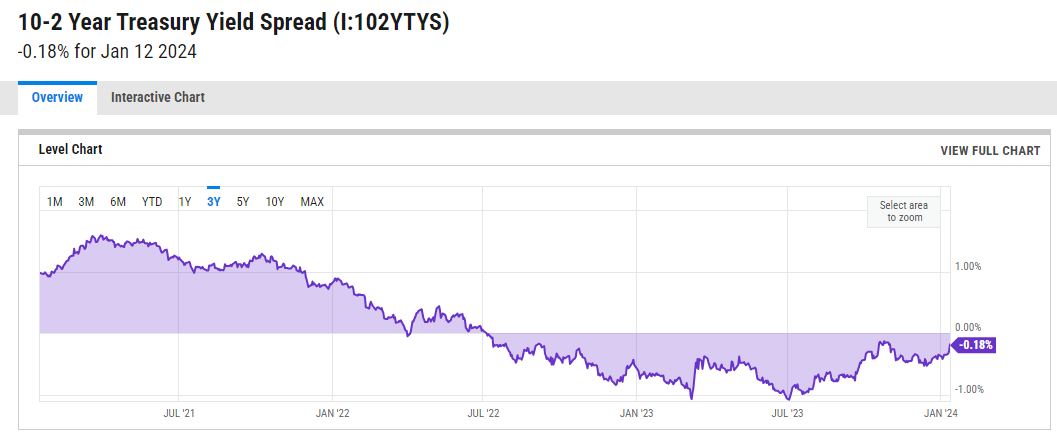
You've likely heard of the 'ultimate recession signal' - the 10y and 2y Bond yield curves inverting.
This obscure signal has predicted a recession within 6-24 months of the initial inversion of this curve since 1955.
So it's safe to say that it's largely respected amongst masses as a very reputable, far-leading indicator of what's to come in the bigger picture.
Well the Bond yield curves recently inverted in July of 2022.
During that time, BTC had already dropped -70% from its' ATH, and Nasdaq was down -30% from its' ATH
and to be fair, prices did continue to drop for the next ~6 months. It just so happened to be that the bulk of the move in terms of percentage had already played out in the 6 months prior to inversion
Since then; Nasdaq has gone on to create new ATHs, and BTC is currently trading >100% higher than where the initial yield curve inversion occurred.
The issue is: the bond yield curves are STILL inverted today
so congrats; you were able to comprehend why prices were moving downwards after we were already down -70% from the recent highs, and were able to attribute a very tangible narrative to the price action.
Unfortunately the narrative didn't change but the market did, so your reasonings for bearishness have yet to be invalidated although the market no longer agreed with them. You're now coping and it's difficult to detach from the idea you've held onto for 6 months, because you don't even fully comprehend the idea you've subscribed to.
So in conclusion:
Narratives are more than likely just a story to paint over the chart as our way of attempting to comprehend the vastness that is markets.
If people are willing to neglect something as factual as volume, which we can infer essentially dismisses a narrative entirely in the example of $ETC; then what do we think that means about other narratives that cannot be so easily dismissed?
and finally, be careful getting overly attached to narratives which you do not understand. Strong opinions loosely held is a good way of approaching these kinds of things.
The only narrative of which I subscribe to, in actuality, is:
- If price is going up; there are more buyers than sellers.
- If price is going down; there are more sellers than buyers.
Hope you enjoyed🖤
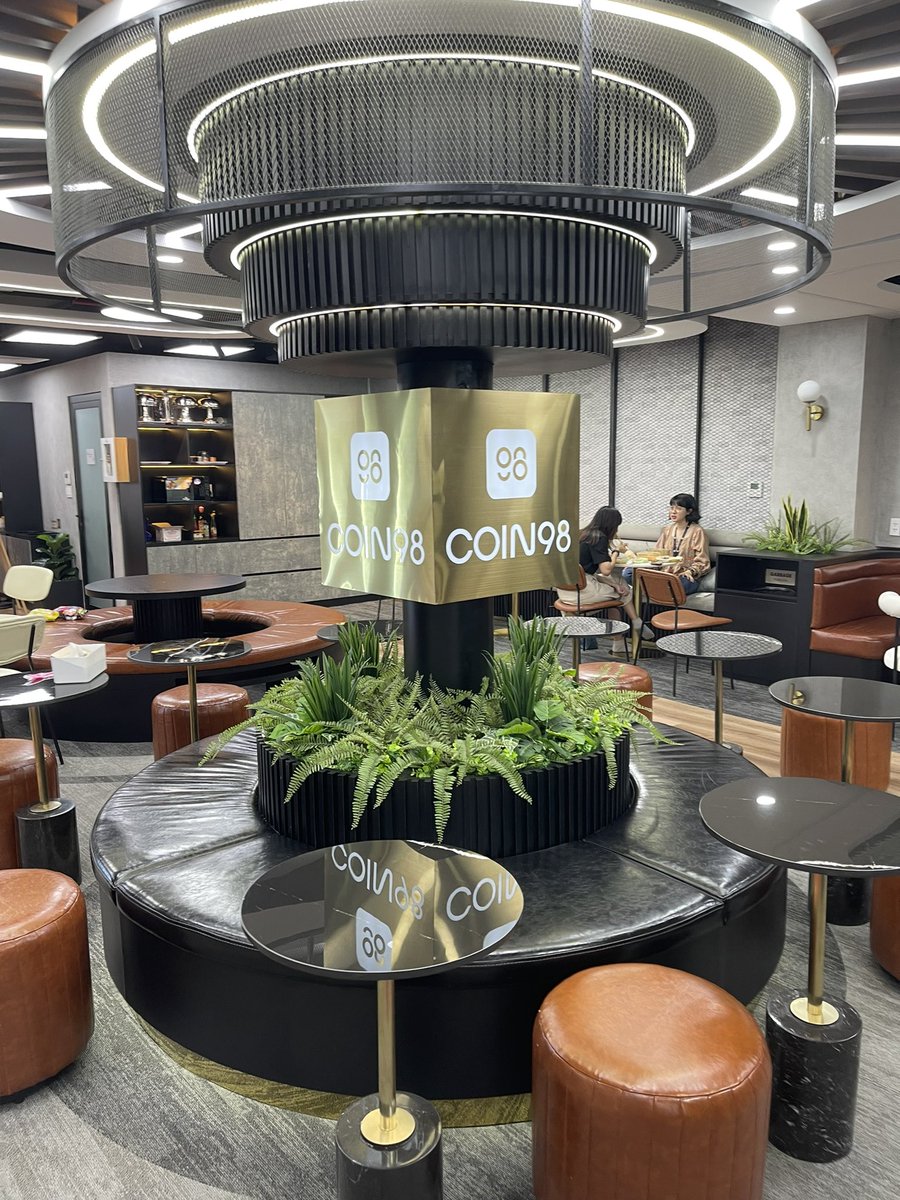
Paid a visit to @ninetyeight_hq@coin98_labs today. Nothing but positive vibes emanating from the building itself 💯
Appreciate the hospitality ser! @imlethanh98
Honestly not surprised at this.
Was having supper at a “Pocha” eatery in the alleys of Jung-gu, South Korea last week and two Chinese guys sit across me, with one extolling the benefits of using USDT to settle physical trading to the other guy 😂
Contract manufacturers in China and the entire South East Asia prefer to settle their trades using TRC20 USDT
The sole remaining method for Chinese money to flee China is through buying TRC20 USDT
These aren't crypto speculation use cases