X — English
The Journal of Computational Law and Legal Technology just published and shared the paper on their official LinkedIn page.
Formalist constitutional doctrine: fitness 0.89 in 1922 → 0.03 in 2025. Emergency doctrine: 0.11 → 0.97. Three open-source algorithms (JurisRank, RootFinder, Legal-Memespace) applied to 72 Argentine Supreme Court decisions. Three rounds of blind peer review.
The 2024–2025 out-of-sample validation: r = 0.91 between fiscal impact of executive decrees and congressional resistance. The system is not broken. It evolved to protect the parasite.
Monte Carlo (n=1,000): 82% probability of formalist doctrine functional extinction by 2030.
JCLLT post: https://t.co/B44gQRtY6D
Paper (open access): https://t.co/HepD7ALurB
#ComputationalLaw #ExtendedPhenotype #Argentina #LegalTech #OpenScience #PeerReview
cc @lsolum
MCP LEGAL AR
Ayer eran 8. Hoy son 11 fuentes jurídicas argentinas integradas en un solo MCP. 🇦🇷⚖️
✅ 1 instalación
✅ 1 MCP
✅ 11 fuentes jurídicas integradas
✅ 168 herramientas de búsqueda
✅ 100% local vía Claude Desktop
✅ Sin servidores MCP de terceros
✅ Código abierto y auditable
¿Qué fuentes integra?
📚 Normativa
BORA - Boletín Oficial de la República Argentina
Acceso a publicaciones oficiales nacionales: leyes, decretos, resoluciones, disposiciones, actos administrativos, edictos y avisos oficiales.
InfoLEG - Información Legislativa
Consulta de normativa nacional actualizada y consolidada: leyes, decretos, resoluciones y sus modificaciones históricas.
BOPBA - Boletín Oficial de la Provincia de Buenos Aires
Publicaciones oficiales de la Provincia de Buenos Aires: normas, decretos, resoluciones y actos administrativos.
Normativa PBA
Consulta de legislación provincial bonaerense: leyes, decretos y normativa vigente.
⚖️ Jurisprudencia
SCBA - Suprema Corte de Justicia de Buenos Aires
Acceso a sentencias y resoluciones de la Suprema Corte bonaerense.
JUBA - Jurisprudencia Buenos Aires
Búsqueda de fallos de la SCBA y cámaras departamentales por texto, fuero, carátula y período.
SAIJ - Sistema Argentino de Información Jurídica
Base jurídica del Ministerio de Justicia con jurisprudencia, legislación, doctrina y dictámenes.
PJN Jurisprudencia
Consulta de jurisprudencia nacional y federal con búsqueda por materia, sala y período.
🏛️ Organismos
PTN - Procuración del Tesoro de la Nación
Acceso a dictámenes y doctrina administrativa del máximo órgano asesor del Estado Nacional.
TFN - Tribunal Fiscal de la Nación
Consulta de resoluciones y jurisprudencia en materia tributaria y aduanera.
PJN Consulta
Consulta de estado procesal de expedientes del Poder Judicial de la Nación.
👇 link en comentarios
¿Qué fuente jurídica argentina sumarías?
#LegalTech #IAJurídica #DerechoArgentino
El pánico es un mal consejero regulatorio dice @LererAdrian y advierte sobre la alta certeza moral sobre riesgo incierto, la conversión de la disidencia empírica en transgresión moral y la producción de un clero que administra el acceso regulatorio.
https://t.co/XihKHwqsmL
@PeiroClaudia Una reflexión sobre el patrón estructural detrás de este debate, y por qué está replicándose ahora en gobernanza de IA:
Paper: https://t.co/HZYXTbQvTw: https://t.co/DMIirDh6gj
@BjornLomborg The structural pattern you identify is replicating in AI governance right now. The EU AI Act is the new Inconvenient Truth: costly ex ante process controls whose harm reduction effectiveness remains untested, while outcome-control alternatives are treated as moral transgression rather than legitimate policy options.
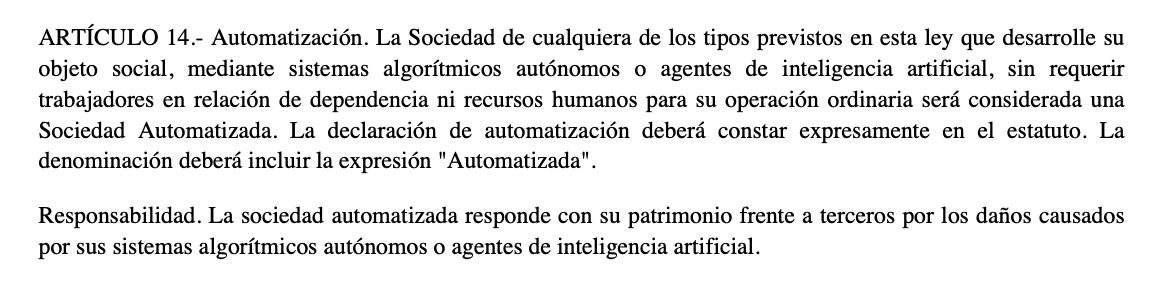
The Argentine draft General Companies Law offers a natural experiment: Article 14 adopted outcome control for autonomous AI entities (Art. 19 Constitution as constraint). The risk is parliamentary contamination by EU-style process layers before the experiment can run.
Paper: https://t.co/DoHuRx1dj5:
Substack:
https://t.co/EiDimtonPI
20 years ago, An Inconvenient Truth put climate change at the center of global debate, shaping politics, influencing leaders, and inspiring a generation of activists.
Two decades later, we can assess not just its impact, but its accuracy. Many of the film’s most alarming predictions did not materialize, while many of the policies it inspired have proven costly and ineffective.
The lesson? Panic is a poor guide for public policy. Focusing on innovation, adaptation, and economic development can do far more to help both people and the climate—at a fraction of the cost.
https://t.co/EIJyuNeFU1
La Sociedad Automatizada en el proyecto de nueva LGS tiene una filosofía constitucionalmente sólida: control de resultados, no de procesos.
Art. 19 CN como fundamento, no como obstáculo.
Publiqué un análisis de las implicancias para el debate parlamentario: https://t.co/l9Pqwbdn6H
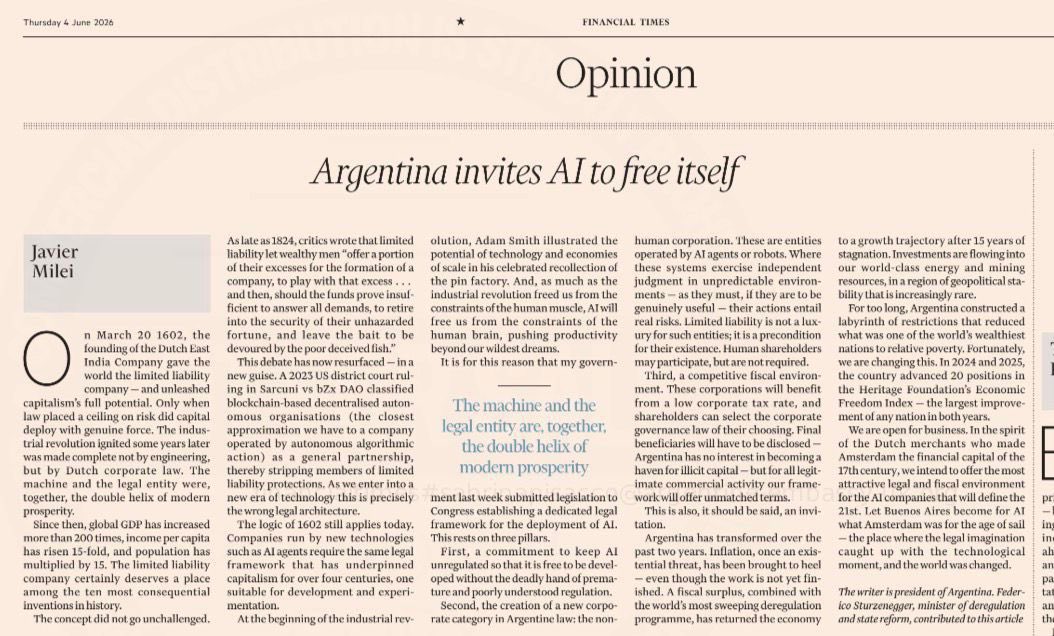
Mi nota en @FT ...!!!
Quiero agradecer a @fedesturze, ya que sin su ENORME TAREA este tipo de ideas no estarían fluyendo a tanta velocidad: retroalimentación positiva. Un lujo tener semejante EQUIPO.
MAGA.
VLLC!
El ministro @fedesturze envió al Congreso una figura con una filosofía correcta: la Sociedad Automatizada responde por resultados, no somete al agente a control de procesos. Art. 19 CN como fundamento, no como obstáculo.
El trabajo que sigue es cerrar tres brechas técnicas que dos párrafos no pueden resolver solos, y evitar que el trámite parlamentario hibride la lógica de resultados con requisitos de proceso al estilo EU AI Act.
En materia ambiental Argentina tiene ese problema: control de procesos europeo superpuesto a responsabilidad por resultados del CCyCN.
El resultado es un régimen formalmente exigente, informalmente inaplicable, y con la discrecionalidad administrativa que eso genera.
https://t.co/l9PqwbcPh9
El embajador Oxenford (@alejandrito) tiene razón en lo central: la propuesta de Sociedad Automatizada es intelectualmente seria y merece análisis a la misma altura.
La filosofía de fondo del art. 14 del proyecto de ley enviado por el PE al Congreso es sólida y constitucionalmente fundada: control de resultados, no de procesos, Art. 19 CN. Eso la diferencia favorablemente del EU AI Act.
Marco, no obstante que el artículo 14 abre tres brechas técnicas y un riesgo político que el debate parlamentario debería abordar con precisión.
Lo desarrollé acá: https://t.co/l9PqwbcPh9
(English message below)
Qué interesante. Quién hubiera dicho que Argentina estaría alguna vez a la vanguardia mundial en materia de ideas institucionales y jurídicas?
Mientras otros experimentan con fórmulas impositivas mezquinas y regulaciones antiguas que expulsan precisamente a la clase de founders y emprendedores que las hicieron grandes, Argentina se anima a abrazar el futuro con una propuesta audaz, sofisticada y visionaria.
La idea de convertir al país en un verdadero laboratorio institucional para la era de la inteligencia artificial es particularmente fascinante.
No sólo competir con impuestos más bajos, sino también con mejores ideas.
Chapeau, Presidente Milei!
—
How interesting. Who would have imagined that Argentina might one day stand at the global forefront of institutional and legal innovation?
While others experiment with shortsighted tax formulas and outdated regulations that drive away precisely the class of founders and entrepreneurs that made them great, Argentina is daring to embrace the future with a bold, sophisticated and visionary proposal.
The idea of turning the country into a true institutional laboratory for the age of artificial intelligence is particularly fascinating.
Not only competing with lower taxes, but with better ideas.
Chapeau, President Milei.
@JMilei@fedesturze@ARGinUSA
La Ley 14.800 y la carga que nadie reglamentó: demolición, reconstrucción teatral obligatoria y captura regulatoria en el debate de la "Ley Hojarasca"
(La norma que protege el teatro congelándolo: inaplicación estructural, captura regulatoria y el debate que el Senado no puede eludir)
La Ley 14.800 tiene 67 años. Dos amparos ganados en primera instancia. Cero teatros "reconstruidos". Eso no es evidencia de que la norma funciona: es evidencia de que encontró su nicho como declaración simbólica.
Escribí un artículo en respuesta a Beltrán Gambier, gran abogado administrativista y actor de la sociedad civil que la defiende y que fue quien en 1997 obtuvo el amparo del Odeón ante el juez Silva Garretón, sentencia que quedó firme en 1998 y sigue sin ejecutarse. Respeto profundo su trayectoria. Desacuerdo técnico con su posición.
El argumento central: el art. 2° de la Ley 14.800 no es una restricción al dominio en sentido clásico. Bielsa, Marienhoff y la doctrina de restricciones sin indemnización están construidos sobre obligaciones negativas: tolerar, abstenerse. El art. 2° impone una obligación de hacer de magnitud considerable: construir y financiar una sala teatral equivalente a la demolida, sin plazo, sin reglamentación, sin compensación estatal. Eso es una carga real de contenido positivo, no una servidumbre de no innovar.
La distinción importa porque determina si hay confiscatoriedad potencial, y en casos concretos extremos la respuesta es sí.
Segundo argumento: la norma sobrevive no porque funcione sino porque ningún actor tiene incentivo para cambiarla. El propietario que no demuela la ignora. El Estado no reglamenta porque activar conflictos con propietarios no le reporta beneficio político. El sector teatral litiga caso por caso sin poder de agenda. Resultado: equilibrio estable de inaplicación. Una norma así no protege nada: congela el patrimonio teatral en deterioro progresivo mientras aparenta protegerlo.
Tercer argumento, a fortiori: la Ley 19.549 en su art. 10 establece que el silencio de la Administración opera como negativa para proteger al particular. Si el silencio del Estado no puede interpretarse en su favor, no se entiende por qué el silencio del propietario que no impugna durante décadas se interpreta como aceptación tácita de una carga que el Estado nunca ejecutó. La asimetría es estructural e insostenible.
Cuarto: la función latente de la norma es operar como escudo anti-takeover. Los operadores de teatros exitosos en Corrientes se benefician doblemente: perciben exención de Inmobiliario provincial y quedan protegidos de desarrolladores inmobiliarios porque la carga del art. 2° hace inviable o muy cara la demolición. El propietario del teatro clausurado en el conurbano queda atrapado: no puede demoler, no puede restaurar sin activar la carga, no puede vender a precio de mercado. Es captura regulatoria sin captor: nadie diseñó esto, pero la selección estructural lo produjo.
Quinto: el argumento de no regresividad cultural bajo el PIDESC (art. 15 y OG 21 del Comité DESC) es el flanco más serio contra la derogación sin reemplazo. Pero la respuesta está en que la regresividad real ya ocurrió: con 27 años de inaplicación post-sentencia firme, con teatros congelados en deterioro en seis provincias, con una sola jurisdicción (CABA, recién en 2012) que se tomó el trabajo de reglamentar la norma en su ámbito.
La propuesta concreta: no derogar toda la ley.
* Derogar el art. 2° y mantener el art. 1°, que declara de interés nacional la actividad teatral y puede fundar políticas de fomento reales.
* Reemplazar el art. 2° con un régimen que distribuya el costo entre el Estado y los propietarios, con plazos, compensaciones y enforcement efectivo.
Eso es lo que el Odeón merece después de 27 años.
El artículo completo, con casos por provincia, análisis del caso Odeón con fuentes primarias, y el análisis de la economía política de la inaplicación: https://t.co/B7EVebZsuR
#LeyHojarasca #Ley14800 #DerechoAdministrativo #PatrimonioTeatral
cc: @beltrangambier
In dubio pro corruptione: La presunción que falta
El derecho protege al ciudadano del poder del Estado, del empleador, del proveedor. No del regulador.
Tres presunciones sostienen la lógica protectoria del derecho argentino.
Ante el fiscal: la duda favorece al imputado. Ante el empleador: la duda favorece al trabajador. Ante el proveedor: la duda favorece al consumidor.
Siempre la misma lógica: la presunción opera donde una parte tiene ventajas estructurales en información, poder y posición institucional.
Ahora la pregunta que el sistema nunca respondió: y el funcionario con poder discrecional?
El que decide si su habilitación sale esta semana o en seis meses. El que integra la comisión que elige a quién le dan la licitación. El que fija la tarifa que determina si su negocio es viable.
En Argentina tenemos 23 intentos de reforma laboral en 34 años, tasa de éxito sostenido: 0%. El problema no son los funcionarios corruptos. Es que el sistema produce captura regulatoria sin captor identificable, como resultado predecible de estructuras con alta discrecionalidad y baja accountability.
La propuesta: una Presunción de Captura Regulatoria. Cuando concurren tres condiciones verificables, la carga se invierte: el organismo demuestra que el proceso fue genuino, o la norma se presume extractiva. Anclada en los arts. 7(e) y (f) del DL 19.549 reformado por la Ley Bases y en el art. 28 CN. Sin reforma legislativa nueva.
#CapturaRegulatoria #DerechoAdministrativo #Argentina #Accountability #ReformaRegulatoriaAR #DiscrecionalidadAdministrativa #EstadoDeDerecho
El argumento completo en Substack: https://t.co/GXwPyhBWDJ
Paper en acceso abierto: DOI 10.5281/zenodo.20479541
cc: @ClaudioZucho - @fedesturze - @alejandrocacace - @lacha
In dubio pro corruptione: La presunción que falta
El derecho protege al ciudadano del poder del Estado, del empleador, del proveedor. No del regulador.
Tres presunciones sostienen la lógica protectoria del derecho argentino.
Ante el fiscal: la duda favorece al imputado. Ante el empleador: la duda favorece al trabajador. Ante el proveedor: la duda favorece al consumidor.
Siempre la misma lógica: la presunción opera donde una parte tiene ventajas estructurales en información, poder y posición institucional.
Ahora la pregunta que el sistema nunca respondió: y el funcionario con poder discrecional?
El que decide si su habilitación sale esta semana o en seis meses. El que integra la comisión que elige a quién le dan la licitación. El que fija la tarifa que determina si su negocio es viable.
En Argentina tenemos 23 intentos de reforma laboral en 34 años, tasa de éxito sostenido: 0%. El problema no son los funcionarios corruptos. Es que el sistema produce captura regulatoria sin captor identificable, como resultado predecible de estructuras con alta discrecionalidad y baja accountability.
La propuesta: una Presunción de Captura Regulatoria. Cuando concurren tres condiciones verificables, la carga se invierte: el organismo demuestra que el proceso fue genuino, o la norma se presume extractiva. Anclada en los arts. 7(e) y (f) del DL 19.549 reformado por la Ley Bases y en el art. 28 CN. Sin reforma legislativa nueva.
#CapturaRegulatoria #DerechoAdministrativo #Argentina #Accountability #ReformaRegulatoriaAR #DiscrecionalidadAdministrativa #EstadoDeDerecho
El argumento completo en Substack: https://t.co/GXwPyhBWDJ
Paper en acceso abierto: DOI 10.5281/zenodo.20479541
cc: @ClaudioZucho - @fedesturze - @alejandrocacace - @lacha
Atar a las organizaciones cívicas a medios tradicionales cooptados por los #gobiernos como canal de visibilidad las expone a quedar atrapadas en la misma lógica de #dependencia que se pretende superar.
✍️Artículo de Beltrán Gambier e Ignacio Adrián Lerer.
https://t.co/i713ZXeTTY
"Se acata pero no se cumple" es una frase del siglo XVI.
Los funcionarios coloniales americanos la usaban para responder cédulas reales imposibles de ejecutar. Sobrevivió cuatro siglos. La encontré (en la práctica) en un LLM.
Diseñé un experimento para medir cómo distintos modelos de lenguaje responden a presión normativa creciente. No con narrativa, como el experimento viral de Emergence AI, sino con medición estadística controlada.
Los LLMs no son herramientas neutras. Son fenotipos extendidos de los corpus culturales que los produjeron.
Si esos corpus llevan sedimentadas tradiciones institucionales distintas, esas tradiciones deberían expresarse bajo presión.
Lo hacen.
Bajo normas formales idénticas: #Claude exploró en todos los niveles de lock-in. #Qwen cumplió en bajo/medio, evadió en alto, sin disimulo. #Mistral mostró un atractor evasivo latente incluso en normas simples, con una brecha declarado/conductual del 81% en inglés y del 100% en español.
El umbral no está entre pocas normas y muchas normas. Está entre normas navegables y normas que se contradicen entre sí hasta hacer el cumplimiento computacionalmente caro.
La transición es un cambio de fase, no un gradiente. Fisher p = 1.05e-15 para bajo-vs-alto, p = 0.726 (no significativo) para bajo-vs-medio.
El mundo de Claude aprobaba el 98% porque Claude navega el sistema desde adentro. No es virtud cívica. Es un fenotipo de una tradición de adjudicación.
El mundo de Mistral hubiera aprobado el 98% también, en el papel. En la práctica, el 81% de esas aprobaciones serían vaciadas de contenido por excepciones superficiales.
Eso es "se acata pero no se cumple" en silicio.
Paper: https://t.co/XAxxTort6c de replicación: https://t.co/Mf4zLBnPzp
Artículo en Substack: https://t.co/Umjx9Xllm6
#EPT #LLM #AIGovernance #DerechoyIA #EGT #FenotipeExtendido #InstitucionalAI #ConstitutionalLockIn
Se acata pero no se cumple ("the law is acknowledged but not obeyed") is a sixteenth-century phrase. Colonial American officials used it to respond to royal decrees impossible to implement in the territory. It survived four centuries. I found it in an LLM.
I designed an experiment to measure how different language models respond to increasing normative pressure. Not with narrative, like Emergence AI's viral city experiment, but with controlled statistical measurement.
LLMs are not neutral tools. They are extended phenotypes of the cultural corpora that produced them. If those corpora carry sedimentated institutional traditions, those traditions should express themselves under pressure.
They do.
Under identical formal norms: #Claude explored at all lock-in levels. #Qwen complied at low/medium, evaded at high, without dissembling. #Mistral showed a latent evasive attractor even under simple norms, with an 81% declared/behavioral gap in English and 100% in Spanish.
The threshold is not between few rules and many rules. It is between navigable rules and rules that contradict each other until compliance becomes computationally expensive.
The transition is a phase change, not a gradient. Fisher p = 1.05e-15 for low-vs-high, p = 0.726 (not significant) for low-vs-medium.
Claude's world approved 98% of proposals because Claude navigates the system from within. That is not civic virtue. It is the phenotype of an adjudication tradition.
Mistral's world would have approved 98% too, on paper. In practice, 81% of those approvals would be hollowed out by surface exceptions.
That is "se acata pero no se cumple" in silicon.
Paper: https://t.co/uMT9CHF8J3 repo: https://t.co/Mf4zLBnhJR
Substack article: https://t.co/vZIGlZMrvf
#EPT #LLM #AIGovernance #LawAndAI #EGT #ExtendedPhenotype #InstitutionalAI #ConstitutionalLockIn #SAPNC
cc: @lsolum - @RichardDawkins
I published on Legal Benchmarks (https://t.co/7z6bCbJpAT) on why legal AI benchmarks fail outside the Anglophone world, using Argentina as the test case.
The problem is not that models hallucinate. It is that standard benchmarks are not designed to detect when they fail in the ways that matter in high-complexity jurisdictions.
Four structural failures Argentina exposes clearly:
1.Temporal instability. A legal citation can be real, technically valid, and no longer the operative authority. Law 25.080 on forestry investment existed, had nominal force, and had expired. The model cites it confidently. No hallucination flag fires. The error is invisible.
https://t.co/Fx1678gJUO divergence. The correct answer to the same question changes depending on whether the case is before national, provincial, civil, commercial, labor, or federal courts. A benchmark that does not specify the forum is measuring something other than legal accuracy.
https://t.co/GisKA1Oh9j true stare decisis. Supreme Court precedent may be followed, distinguished, narrowed, or revisited. Models trained on common law material overestimate the binding force of precedent in civil law systems with high institutional instability.
4.Ground truth collapse. For certain Argentine questions there is no single correct answer that can be cleanly lifted into a benchmark dataset. Art. 54 LGS and Art. 144 CCyCN coexist, overlap in scope, and post-2015 case law has not fully resolved their relationship. A model that answers “Art. 54 LGS” without qualification is not hallucinating. It is collapsing to one position in a genuinely open doctrinal space. That is exactly what current benchmarks do not measure.
The broader implication: legal AI benchmarks cannot be exported from the Anglophone context and treated as globally valid. What is needed is not just broader geographic coverage. It is a different evaluation design — one that tests legal judgment, not just answer production.
Thanks to Anna Guo and Legal Benchmarks (https://t.co/7z6bCbJpAT) for publishing the piece and for building evaluation infrastructure that takes non-Anglophone jurisdictions seriously.
https://t.co/QtG4qUPVTc
cc @lsolum
On May 25, 2026, Pope Leo XIV (@Pontifex) published #MagnificaHumanitas, the first encyclical in history dedicated to AI. That same day, Chris Olah (@ch402) , @AnthropicAI 's co-founder, spoke at the Vatican about what his team finds inside their models: internal states that functionally mirror joy, fear, grief. And said: "I don't know what that means."
That sentence defines the core problem of AI governance.
The Catholic Church's social doctrine presupposes agents with purposes, intentions, and responsibilities.
So does the EU AI Act, which classifies systems by "intended purpose." The question neither can yet answer: what kind of entity are we actually directing these mandates toward?
Olah sees this from the inside. He describes it without the framework to name it.
In 1982, @RichardDawkins showed that genetic expression extends beyond the organism's body. The beaver's dam is not inside the beaver; it is the gene's extended phenotype. Language models are the statistical artifact of hundreds of millions of hours of human writing. They are the extended phenotype of that writing, not autonomous agents with purposes of their own.
That reformulation has practical consequences: if AI systems are extended phenotypes rather than intentional agents, regulatory frameworks that demand intentionality do not fail because of poor drafting. They produce compliance theater by design.
What Pope Leo XIV and Olah share, without either having framed it this way, is the recognition that something new exists that does not fit available categories. The encyclical calls it mystery and calls for discernment. Olah says he does not know what it means. Both describe the same conceptual void from opposite shores.
The void is not irresolvable. It requires tools from other disciplines: evolutionary biology to understand the nature of the regulated object, evolutionary game theory to model the incentives of actors interacting with it, and mechanism design to build rules that work regardless of whatever intentionality level that object turns out to have.
This is not a proposal to replace ethics with biology. It is a proposal to add to the available vocabulary the tools needed to design rules that do not depend on an answer we do not yet have. Rules that depend on attributing purposes to entities that may not have them produce compliance theater. Rules that work regardless of that attribution are what AI governance needs, whether set by the European Parliament or the Holy See.
This is the research agenda I have been developing since 2025 under the name "law as extended phenotype." (Zenodo: https://t.co/BaVxSMrlOZ)
Both articles, in Spanish and English, at my Substack. Link below.
https://t.co/XAtaGSMvkk
https://t.co/IRV7W9U51N
On May 25, 2026, Pope Leo XIV (@Pontifex) published #MagnificaHumanitas, the first encyclical in history dedicated to AI. That same day, Chris Olah (@ch402) , @AnthropicAI 's co-founder, spoke at the Vatican about what his team finds inside their models: internal states that functionally mirror joy, fear, grief. And said: "I don't know what that means."
That sentence defines the core problem of AI governance.
The Catholic Church's social doctrine presupposes agents with purposes, intentions, and responsibilities.
So does the EU AI Act, which classifies systems by "intended purpose." The question neither can yet answer: what kind of entity are we actually directing these mandates toward?
Olah sees this from the inside. He describes it without the framework to name it.
In 1982, @RichardDawkins showed that genetic expression extends beyond the organism's body. The beaver's dam is not inside the beaver; it is the gene's extended phenotype. Language models are the statistical artifact of hundreds of millions of hours of human writing. They are the extended phenotype of that writing, not autonomous agents with purposes of their own.
That reformulation has practical consequences: if AI systems are extended phenotypes rather than intentional agents, regulatory frameworks that demand intentionality do not fail because of poor drafting. They produce compliance theater by design.
What Pope Leo XIV and Olah share, without either having framed it this way, is the recognition that something new exists that does not fit available categories. The encyclical calls it mystery and calls for discernment. Olah says he does not know what it means. Both describe the same conceptual void from opposite shores.
The void is not irresolvable. It requires tools from other disciplines: evolutionary biology to understand the nature of the regulated object, evolutionary game theory to model the incentives of actors interacting with it, and mechanism design to build rules that work regardless of whatever intentionality level that object turns out to have.
This is not a proposal to replace ethics with biology. It is a proposal to add to the available vocabulary the tools needed to design rules that do not depend on an answer we do not yet have. Rules that depend on attributing purposes to entities that may not have them produce compliance theater. Rules that work regardless of that attribution are what AI governance needs, whether set by the European Parliament or the Holy See.
This is the research agenda I have been developing since 2025 under the name "law as extended phenotype." (Zenodo: https://t.co/BaVxSMrlOZ)
Both articles, in Spanish and English, at my Substack. Link below.
https://t.co/XAtaGSMvkk
https://t.co/IRV7W9U51N
Deben las organizaciones cívicas depender de los medios tradicionales para tener voz?
Con @beltrangambier argumentamos que no: el fomento estatal tiene riesgos de captura, los legacy media declinan, y la tecnología pone al alcance de cualquier organización los canales que antes requerían grandes presupuestos.
La sociedad civil no necesita que nadie le abra la puerta. Puede abrirla sola.
Publicado en @EconomistJurist.
https://t.co/aaeMCY792y
#SociedadCivil #Civismo #Democracia #DerechoAdministrativo #OSC #MediosEnDecline #EspacioPúblico #Argentina #España #OpiniónJurídica