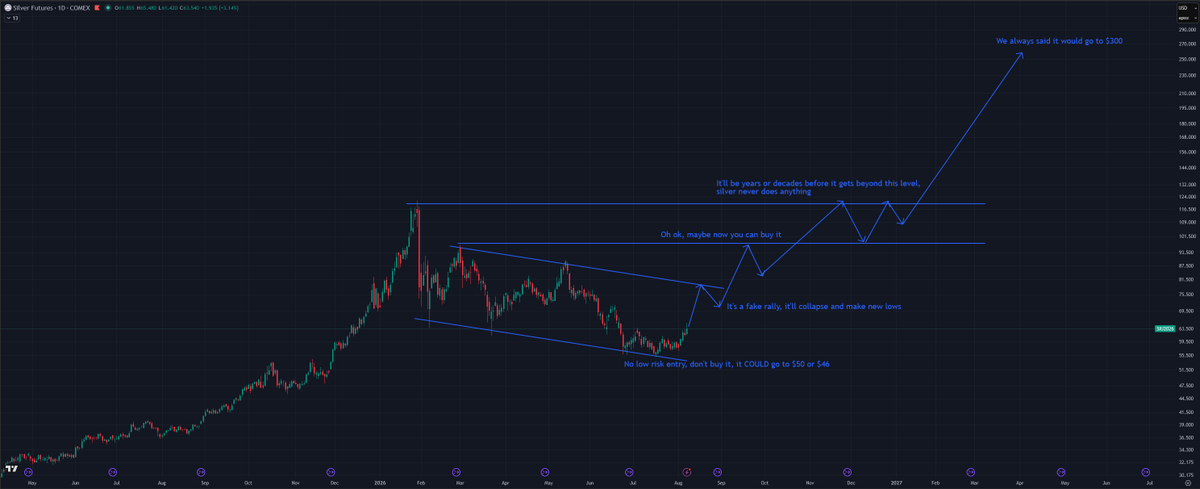
This is how the commentary will play out over the next 9, 12, 18 months (who knows exactly) on X, and how it typically plays out with every move like this.
-Don't buy down here, it could go lower, you could look wrong and stupid and no one wants to look wrong!
-This rally is fake, it's a bull trap, don't buy it, it'll collapse and make new lows!
-I guess it's OK to buy now (over 50% off the lows).
-It'll never do anything for years to come, maybe even decades.
Then finally it'll top at $200, $300, whatever, and everyone will have been wringing their hands the whole way, doubting every move, counting every wave.
(This isn't meant to be a precise roadmap of the magnitude/timing of these moves, although ~$75-$80, $90-95, and $120 are all pretty obvious resistance levels and will probably come into play).
"El socialismo es una religión política cuyo Dios es el Estado y cuyos sacerdotes son los burócratas... Es una filosofía del fracaso, el credo a la ignorancia y la prédica a la envidia; su virtud inherente es la distribución igualitaria de la miseria"
Winston Churchill
Subscribers know we’ve been writing about the risk that the long end of the US govt bond market (further) breaks down and it’s starting to do that. We don’t know the US Treasury’s pain point, but we doubt they’ll stand by forever, considering the current day debt load. That’s the difference between now and the 70s. And the longer the war goes on, the more foreign institutions dump Treasuries, the worse it will get. YCC? Fed buys bonds again? No idea exactly what they’ll do but it’s the one market that cannot be ignored by the powers that be.
The NSA kept 1 lecture in a vault for 40 years. In 2024 they released it. It's Grace Hopper explaining the future of computing in 1982.
The channel that posted it: the National Security Agency's own YouTube.
Hopper stands at a podium in Navy uniform, a captain, and talks to a room of NSA staff for 90 minutes across 2 reels.
The title: "Future Possibilities: Data, Hardware, Software, and People."
She compares the computer industry to the early automotive one, all custom parts and no standards, and argues software will become the hard problem, not hardware. She was right by decades.
She invented the first compiler and gave COBOL its shape. She kept a clock that ran backwards on her wall to prove rules can be questioned.
The tapes were too degraded for normal release, so the agency restored them before posting.
40 years in an NSA archive. 90 minutes. Now free.
We are looking for engineers, welders, and workers ready to follow us to the ends of the Earth and build classical megastructures that defy this age of apathy.
As a structural engineer, or as someone smart, how would you build a gigantic titanium statue designed to withstand a million years?
It seems that the two main sources of metal fatigue would be wind and the daily thermal expansion caused by sunlight.
The problem is that only the side of the statue facing the sun would heat up and expand, causing the entire structure to bend slightly throughout the day as the sun moves across the sky. Could the statue perform this strange daily dance hundreds of millions of times without eventually tearing itself apart?
Would the best solution be an internal lattice tower supporting hundreds of independent titanium panels, with very narrow gaps between them, allowing every part of the outer surface to expand and contract freely without accumulating fatigue, century after century?
The West has to win the competition for the tallest statue in history, and it has to be known in a million years! We have to find a way to build it!
By the way, we are looking for a great structural engineer to join our team!
The US Navy operates a 50,000 acre forest in Indiana whose entire job is keeping one wooden ship from 1797 afloat.
The ship is USS Constitution, still a commissioned warship with an active-duty crew. Cannonballs bounced off her in 1812 because the hull sandwiches a wall of live oak ribs between two layers of white oak planking, nearly 2 feet of solid wood so dense it barely floats. British 18-pounders hit it and dropped into the sea. A sailor yelled "her sides are made of iron" and the nickname stuck.
Here's the problem with owning a 229-year-old wooden ship: you can't buy the parts. Hull planks run up to 40 feet long and 7 inches thick, cut from single white oak trunks. A white oak takes over a century to grow that big. No lumberyard on earth stocks it.
So the Navy grows its own. Constitution Grove at Naval Support Activity Crane holds trees over 100 years old, reserved exclusively for this ship. Foresters there are managing oaks today that will become hull planking in the 2100s. The maintenance plan literally runs on tree time.
Every 20 years or so she enters dry dock and shipwrights swap out rotted timber. After two centuries of this, estimates put original 1797 wood at maybe 10 to 15 percent of the ship. The Navy keeps replacing her plank by plank because Congress mandated her preservation and because she's the only active US warship that has sunk an enemy vessel.
Every other asset in the Navy has a decommission date. This one has a tree farm.