@RobynPorteous My daughter cried every morning for months but was a ray of sunshine moments after I left. We had a drop off routine (I came in, sat for 5 minutes, gave a 2 minute warning that I was going, and a quick goodbye high five at the window) it made all the difference.
@RobynPorteous It’s really hard mommy. The first of many firsts that will test your mother heart. My only advice is to be consistent - with attendance, routine, and timing. It’s the best way to build security and a sense of safety.
Not me sitting and listening to multitudes of people who know nothing about soccer rules and regulations make statements about the credibility of a referee’s decision. And then have the audacity to argue with people who do. Wild.
@Xandra_KH Ingredients are usually listed in order of volume, so alcohol is second last in the mousse ingredients. I’d say it was probably a small amount for flavouring. Forgive yourself for what you didn’t know (and talk to someone if you need to). 🦋
@RobynPorteous Mine were small in the Nokia and BB eras and boy am I relieved. No phones before age 12 (we had one spare “in case” brick phone.)
The research clearly shows that the cons outweigh the pros when it comes to excessive device use.
@cathjenkin@CamSnyders Have a heart for others, but live for yourself.
You are the longest relationship you’ll ever have, so work hard on liking yourself.
And eat the damn cake, use the fancy things, dance, sing… and remember that no one knows what they’re doing. We’re all just winging it.
It’s D-Day. Trump’s first post on Truth Social is a bizarre AI video about how much people love Donald Trump. Not a word about the heroes who stormed the beaches of Normandy.
That tells you everything you need to know about Trump.
Artificial intelligences do not undergo experiences, do not possess a body, do not feel joy or pain, do not mature through relationships, and do not know from within what love, work, friendship or responsibility mean. Nor do they have a moral conscience, since they do not judge good and evil, grasp the ultimate meaning of situations, or bear responsibility for consequences. They may imitate or even simulate, but they do not understand what they produce, for they lack the affective, relational, and spiritual perspective through which human beings grow in wisdom. #MagnificaHumanitas
@NetFlorist I’d love to know why your prices are so much higher for people ordering from abroad - R715 as opposed to R549 for the same item. Banks don’t charge more than 2.5% to convert forex and many customers abroad are Saffa’s spoiling their loved ones. Sies.
@CyrilRamaphosa@PresidencyZA why would South Africa 🇿🇦 abstain from voting on such a significant issue? No vote may be better than a ‘no’ vote, but still disappointing.
General Assembly backs historic World Court climate crisis ruling https://t.co/j1SHSe9KJM
This 👇🏻 is something that cannot be ignored. By making our kid’s lives easier, we are depriving them of critical skills and brain development. Writing is so much more than simply producing or reproducing text.
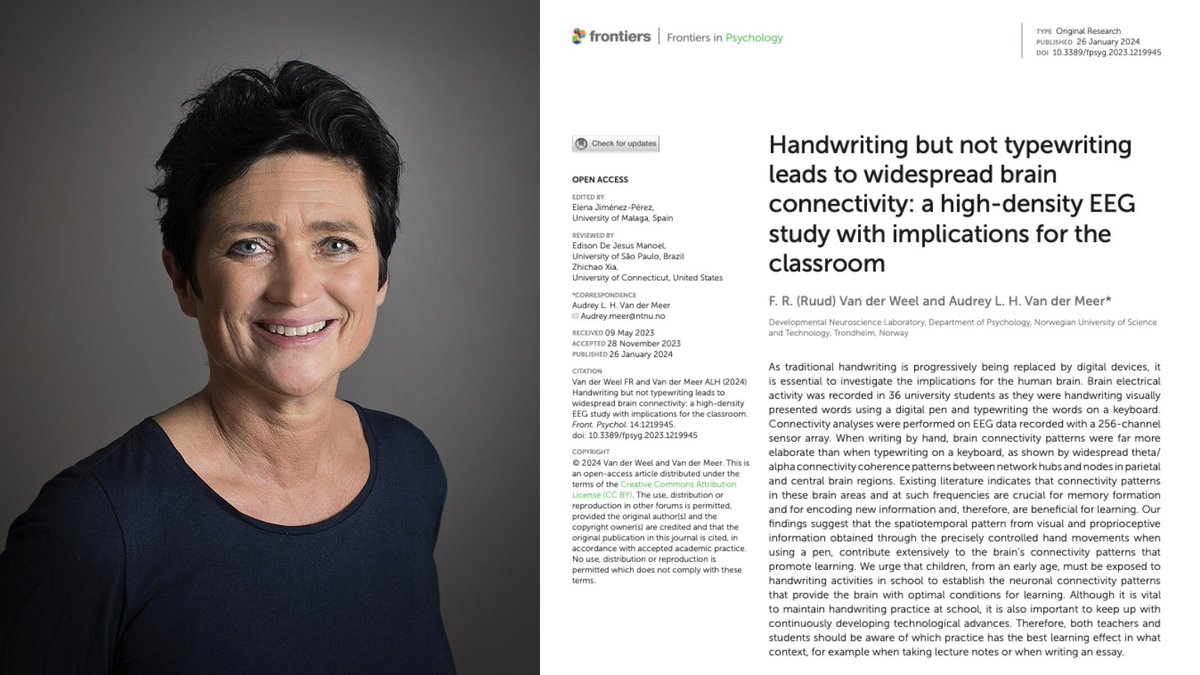
A Norwegian neuroscientist spent 20 years proving that the act of writing by hand changes the human brain in ways typing physically cannot, and almost nobody outside her field has read the paper.
Her name is Audrey van der Meer.
She runs a brain research lab in Trondheim, and the paper that closed the argument was published in 2024 in a journal called Frontiers in Psychology. The finding is brutal enough that it should have changed every classroom on Earth.
The experiment was simple. She recruited 36 university students and put each one in a cap with 256 sensors pressed against their scalp to record brain activity. Words flashed on a screen one at a time.
Sometimes the students wrote the word by hand on a touchscreen using a digital pen, and sometimes they typed the same word on a keyboard. Every neural response was recorded for the full five seconds the word stayed on screen.
Then her team looked at the part of the data most researchers had ignored for years, which is how different parts of the brain were communicating with each other during the task.
When the students wrote by hand, the brain lit up everywhere at once.
The regions responsible for memory, sensory integration, and the encoding of new information were all firing together in a coordinated pattern that spread across the entire cortex. The whole network was awake and connected.
When the same students typed the same word, that pattern collapsed almost completely.
Most of the brain went quiet, and the connections between regions that had been alive seconds earlier were nowhere to be found on the EEG.
Same word, same brain, same person, and two completely different neurological events.
The reason turned out to be something nobody had really paid attention to before her work. Writing by hand is not one motion but a sequence of thousands of tiny micro-movements coordinated with your eyes in real time, where each letter is a different shape that requires the brain to solve a slightly different spatial problem.
Your fingers, wrist, vision, and the parts of your brain that track position in space are all working together to produce one letter, then the next, then the next.
Typing throws all of that away. Every key on a keyboard requires the exact same finger motion regardless of which letter you are pressing, which means the brain has almost nothing to integrate and almost no problem to solve.
Van der Meer said it plainly in her interviews.
Pressing the same key with the same finger over and over does not stimulate the brain in any meaningful way, and she pointed out something that should scare every parent who handed their kid an iPad.
Children who learn to read and write on tablets often cannot tell letters like b and d apart, because they have never physically felt with their bodies what it takes to actually produce those letters on a page.
A decade before her, two researchers at Princeton ran the same fight using a completely different method and ended up at the same answer. Pam Mueller and Daniel Oppenheimer tested 327 students across three experiments, where half took notes on laptops with the internet disabled and half took notes by hand, before testing everyone on what they actually understood from the lectures they had watched.
The handwriting group won by a wide margin on every question that required real understanding rather than surface recall.
The reason was hiding in the transcripts of what the two groups had actually written down.
The laptop students typed almost word for word, capturing more total content but processing almost none of it as they went, while the handwriting students physically could not write fast enough to transcribe a lecture in real time, which forced them to listen carefully, decide what actually mattered, and put it in their own words on the page.
That single act of choosing what to keep was the learning itself, and the keyboard had quietly skipped the choosing and skipped the learning along with it.
Two studies. Two countries. Same answer.
Handwriting makes the brain work. Typing lets it coast.
Every note you have ever typed instead of written went into your brain through a thinner pipe. Every meeting, every book highlight, every idea you captured on your phone instead of on paper was processed at half depth.
You did not forget those things because your memory is bad. You forgot them because typing never woke the part of the brain that would have made them stick.
The fix is the thing your grandmother already knew.
Pick up a pen. Write the thing down. The slower road is the faster one.
There’s so much pressure to plan for a future you can’t even imagine, for a job you haven’t even thought about.
You might not be able to predict their future, but you can help your teens point themselves in the right direction.
https://t.co/BYHDuiGQ2O
Cape Town residents and businesses must URGENTLY reduce water use to essential needs only.
Severe weather has impacted water treatment capacity. Bulk reservoirs are at 45%.
Avoid irrigation, pool top-ups, car washing and non-essential use.
Keep showers short. Fix leaks.