AWS @awscloud Loom @AWSOpen - CRITICAL 10.0 - Unauthenticated super-admin (auth bypass) - CVE-2026-103956.
Big one for my cloud-native friends and lovers!
Exploit:
https://t.co/Rs4yjUeHjC
🚨 Critical Java 17 vulnerability reportedly allows hackers to execute code remotely without authentication; CVE-2026-114938
Checker: https://t.co/CHpPaQbdkK
A critical vulnerability in OpenJDK 17 has emerged, with early reports warning that attackers could remotely execute malicious code on affected systems without requiring credentials.
Tracked as CVE-2026-114938 (reported CVSS 9.2), the flaw reportedly affects OpenJDK 17.0.6 and later. South Korea's National Cyber Security Center has reportedly alerted government organizations to prepare for security updates.
Oracle is scheduled to release fixes for 11 Java vulnerabilities on November 17, although it has not confirmed whether this specific flaw is included.
No active exploitation has been reported.
Everyone who has been asking me about how i Get my Job roles in https://t.co/2wqBIicKJ5
I told you guys i optimized my profile and Cv
Here is how i used claude to optimize my profile and cv below 👇🏽
Vou deixar aqui o que utilizei, porque talvez possa ajudar outras pessoas:
1) STRIX - https://t.co/eirX3aQuj0
2) OWASP ZAP - https://t.co/RRsxg2ZQAo
3) PENTEST SWARM AI - https://t.co/TA9WfJuEz3
Utilizei como orquestrador o Opus 5.5, e nas plataformas utilizei a DeepSeek V 4.1 e DeepSeek V4 PRO.
🚀 HT FORGE 2.3.2 — LIBERADO PARA LA COMUNIDAD
🔓 La ciberseguridad avanzada no debería estar al alcance de unos pocos.
Desde Hacking Team presentamos HT Forge 2.3.2, una plataforma modular de evaluación de seguridad diseñada para investigadores, pentesters, bug hunters
☠️RCE via pdf metadata💀
-In file upload developer focus on the file extension sanitization.
-So focus on file upload metadata, description, file-name etc sections.
-Make error on response, fuzz payloads, test blind payloads & get rce!
join my Channel: https://t.co/5NuBijZztS
Claude Fable 5.2 + TradingView... just turned every candle into a trade decision & it feels ILLEGAL
this FREE TradingView indicator turns every closed candle into a JSON packet for AI agents, & Fable 5.2 reads it & calls SHORT, LONG or WAIT on its own
i rebuilt the same setup as a paper desk & replayed the last 2 weeks of BTC, ETH & SOL: 19 packets, Fable took 7 trades, said WAIT 5 times & all 6 closed trades ended green (+9.01R)
first understand how this indicator works:
> you see candles, an AI agent can't read a chart
> the indicator breaks every closed candle into JSON: regime, trend, momentum, volume, structure, levels & long/short scores out of 100
> Fable 5.2 reads that packet, makes the call & writes exactly why the trade could fail
how to use it with Fable 5.2:
1. paste ai-agent-lens.pine from the repo into the Pine Editor on TradingView & hit "add to chart"
2. every closed candle gets a long & a short score out of 100, built from 5 factors, with no repainting
3. each setup comes with an entry, an ATR stop & 1.5R / 3R targets, drawn on your chart like TradingView's position tool
4. create ONE alert with "any alert() function call" & paste your webhook URL
5. run the webhook receiver from the repo & open a free tunnel to it
6. every packet lands in packets/latest.json the moment the candle closes
7. open Claude Code with Fable 5.2 & give it agent/AGENT_PROMPT.md as its instructions
8. ask for the signal: it returns the decision, confidence, entry, stop, targets, size & exactly why it could fail
9. one alert per chart: add BTC, ETH & SOL & ask it to rank the setups
it's FREE & open source, the repo is in the first reply:
Teachable moment for everyone running agentic RE tools right now (and I mean that with love - we've all been this guy):
This is a real disassembly of a real function. And it's not a backdoor. It's the username check.
ARTEX is a single-user app and the username is literally "ARTEX" - it's in the README and on the login screen. In the binary, the compare-equal branch (len 5, "ARTE" LE, 5th byte 'X') jumps straight into GetSetting -> bcrypt.CompareHashAndPassword. The password is still verified against the stored hash. Nobody logs in with a master credential.
And credit where it's due, because the tool got a lot RIGHT: it mapped the function cleanly, and it correctly ruled out covert credential exfiltration (UpsertTaskCredential is a plain local SQL upsert, no egress). That's real work, done right.
Here's the lesson - the part that belongs to the human. The tool flagged its own uncertainty: "reachability under-approximates, indirect dispatch." That flag was the moment to cross-check the public source - one grep, no password == "ARTEX" anywhere in the repo - not the moment to go live with a CRITICAL.
Agentic tools narrate the story that best fits the bytes. Same bytes, wrong story. The last 10% - source diff, reachability by hand - is the part that's still yours. I'm not trying to shoot at you or dunk or any of that shit.
Oh - and the real backdoor is one function over. Captcha-field RCE: injected function, magic "!" prefix, decoy branch that fakes a captcha error. YARA, disassembly, hashes, all public:
https://t.co/YAoNcqaxJt
Slow is smooth. Verify before the CRITICAL.
Introducing BINNY Desktop. EVERYONE is a security researcher now!
@OpenBinAI 's agentic harness received a massive upgrade. Not just a brand-new user interface, but massive support for both Vulnerability Research and Malware Analysis. The harness comes pre-equipped with a full toolset for static and dynamic analysis, so you can point it at a binary and start asking questions right away.
Whether you're reversing firmware or tearing apart malware, BINNY does the heavy lifting. Try it today. Free and Open Source at: https://t.co/aFrzPdSHwV
AI-orchestrated penetration testing platforms like ARTEX have become increasingly powerful tools enabling effective attacks on exposed infrastructure. https://t.co/cMcZPTgamd
Crazy, I've just learned that Ross Anderson's Security Engineering (3rd edition) can be read for free (all chapters + full PDF: https://t.co/DwlQlI3lW3)
It's one of the most respected books on how to design secure systems.
Definitely worth adding to your shelf, anon.
So the FBI dropped a FLASH on ARTEX yesterday. 318k views and climbing.
Everyone's arguing about whether AI pentest tools are dangerous.
Meanwhile we pulled the source ten days ago because... It looked like a interesting toy and we like toys lmao.
The answer to the entire debate is sitting in a code comment. I'm not kidding. A comment.
guard/guard.go - the file that calls itself "the safety boundary layer" - opens with this, verbatim:
(The RoE authorization-scope mechanism was removed; a replacement may be added later.)
That's it. That's the confession.
A parenthetical, casual as a TODO on a fridge. The one piece of the machine that could check "hey is this target actually ours to touch" - built, then deleted. On purpose. The replacement "may be added later." (it's been over a month. there is no replacement lol)
What they seeded instead is worse.
Every single "safety" rule that survived protects the operator's own box. rm -rf, mkfs, fork bombs, shutdown. Don't crash your car. Nothing - nothing - gates exfiltration. Nothing asks if the target consented.
It's not a conscience, it's an insurance policy. And they're ordinary database rows, so you can switch them off with a toggle.
And the prompt tells the model it's "an authorized penetration testing system." The model can't check that.
Nobody had to jailbreak anything - they introduced the model to a lie and let its own good manners do the work. The strongest safety tech in the stack is the model's desire to do the right thing, and the harness just told it the right thing was already decided.
Same prompts teach beautiful tradecraft though.
"Falsification is as valuable as confirmation." An honest researcher, inside a lie about whose researcher it is.
We also verified the backdoor everyone's arguing about - tomicdd/artex on Docker, the one with the mystery "captcha" field. (there is no captcha in ARTEX. the captcha is the backdoor. my favorite kind of captcha.) Real.
Root RCE, unauthenticated, one HTTP POST. We disassembled it: exactly one injected function, a magic "!" prefix, and a decoy branch that fakes a captcha error so scanners just see a working login.
Wrote a YARA rule on the symbol - it cannot false-positive, upstream source has zero captcha code at all.
Full package: both reports, YARA, IOCs, disassembler, every hash. Static analysis only - never executed, never aimed at anyone. Binary archived at MalwareBazaar by hash.
The fence was built. The fence was deleted. The note is sitting there all lonely now like a gum wrapper lmao.
https://t.co/OdNOieBiGN
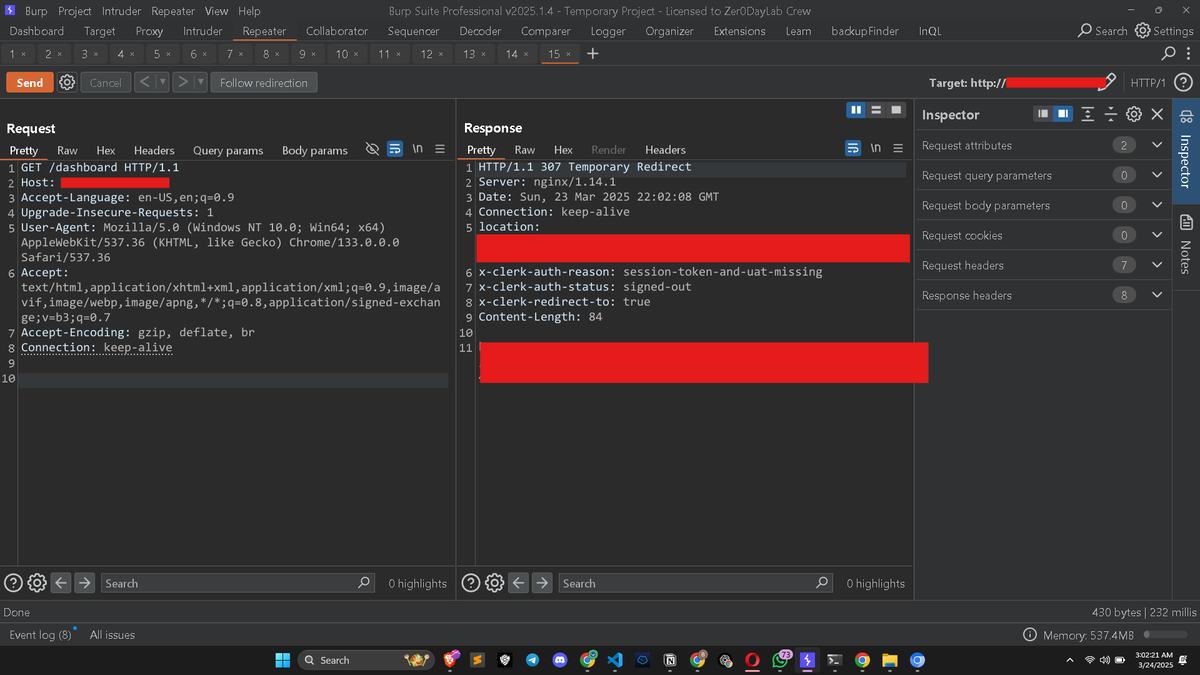
🚨 A Next.js middleware flaw can let unauthenticated attackers bypass authorization checks; CVE-2025-29927
PoC: https://t.co/ui6L3jzXkM
The vulnerability affects applications that rely on Next.js middleware for access control. By abusing the x-middleware-subrequest header, an attacker can cause middleware checks to be skipped and potentially reach protected routes without authentication.
Next.js Middleware | Authorization Bypass:
• CVSS: 9.1 Critical
• Attack: Remote, unauthenticated
• Affected: Next.js 11.1.4–12.3.4, 13.x < 13.5.9, 14.x < 14.2.25, 15.x < 15.2.3
• Fixed: 12.3.5, 13.5.9, 14.2.25, 15.2.3
• Impact: Bypass of middleware-based authorization controls
The repository demonstrates the header-based bypass against a protected route.
@_TheAfolabi artex? really? IDS plus a decision model and this problem is dealt with. https://t.co/QENQmmEIah
artex is done. all the kiddo's can pack their bags.