Mala fide is the opposite of bona fide. It simply means bad faith as opposed to bona fide, which is good faith. Mala fide projects a sinister motive designed to mislead or deceive another. Mala fide is more than bad judgement or mere negligence...
A fair hearing must involve a fair trial, and a fair trial of a case consists of the whole hearing. There is no difference between the two. The true test of fair hearing, is the impression of a reasonable person who was present at the trial, whether from his observation...
Where a statute prescribes a specific procedure for doing a thing, that procedure and no other must be followed, and any act done in departure therefrom is a nullity.
the child resulted.
For a child, who did not ask to be brought to the world in the first place, maintenance is a right, and this is so whether the parents love or hate, whether they embrace or wrestle, or whether they kiss or bite each other.
A man has both moral and legal obligations to provide for his child or children. Legislation is not needed for the observance of this code and the duty is not affected by the existence or otherwise of a petition for the dissolution of the marital union from which
The notion of proof beyond reasonable doubt is not the same as proof beyond all doubt or all shadow of doubt. What proof beyond reasonable doubt means is the establishment of the guilt of an accused person with compelling and conclusive evidence, a degree of compulsion...
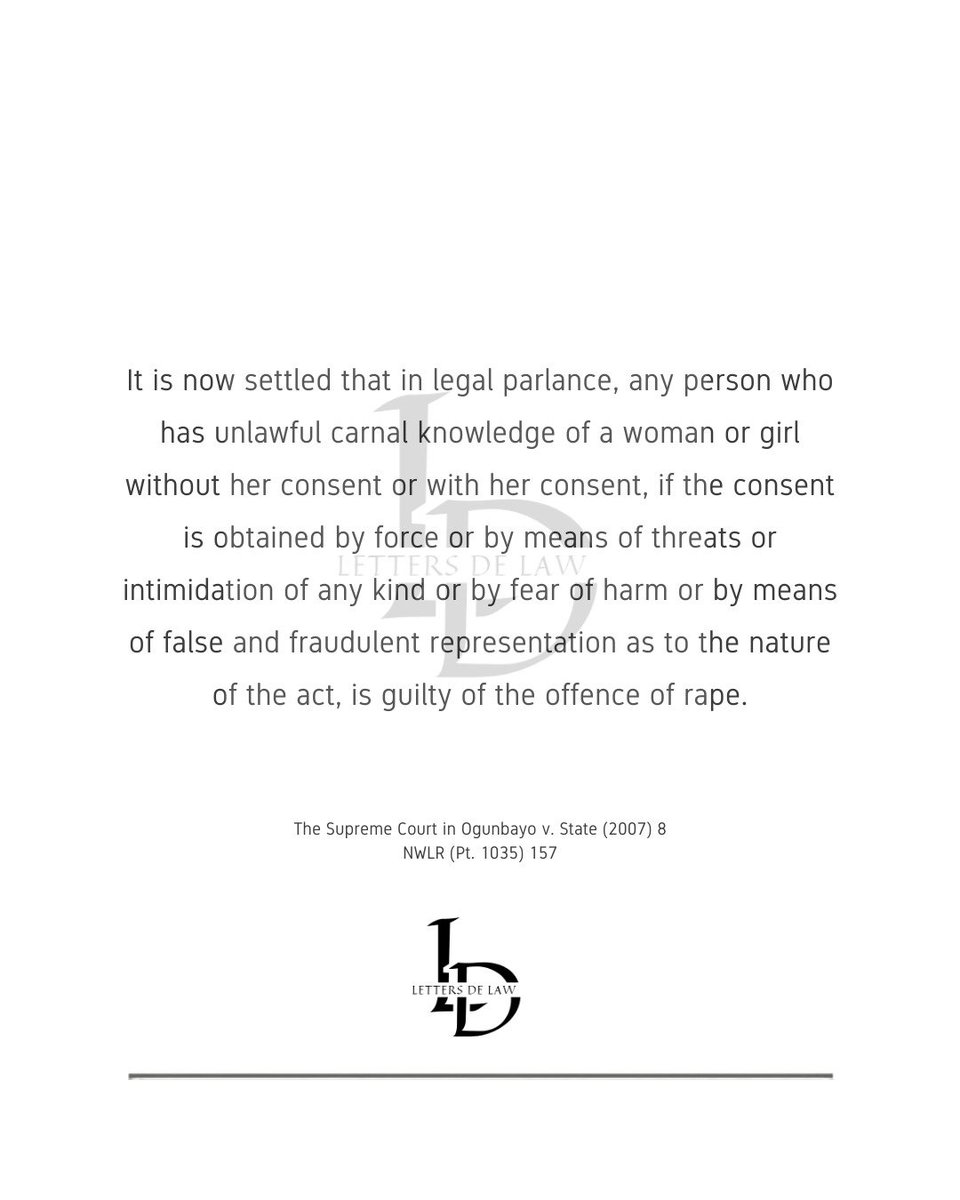
and fraudulent representation as to the nature of the act, is guilty of the offence of rape.
The Supreme Court in Ogunbayo v. State (2007) 8 NWLR (Pt. 1035) 157.
It is now settled that in legal parlance, any person who has unlawful carnal knowledge of a woman or girl without her consent or with her consent, if the consent is obtained by force or by means of threats or intimidation of any kind or by fear of harm or by means of false
and fraudulent representation as to the nature of the act, is guilty of the offence of rape.
The Supreme Court in Ogunbayo v. State (2007) 8 NWLR (Pt. 1035) 157.
It is now settled that in legal parlance, any person who has unlawful carnal knowledge of a woman or girl without her consent or with her consent, if the consent is obtained by force or by means of threats or intimidation of any kind or by fear of harm or by means of false
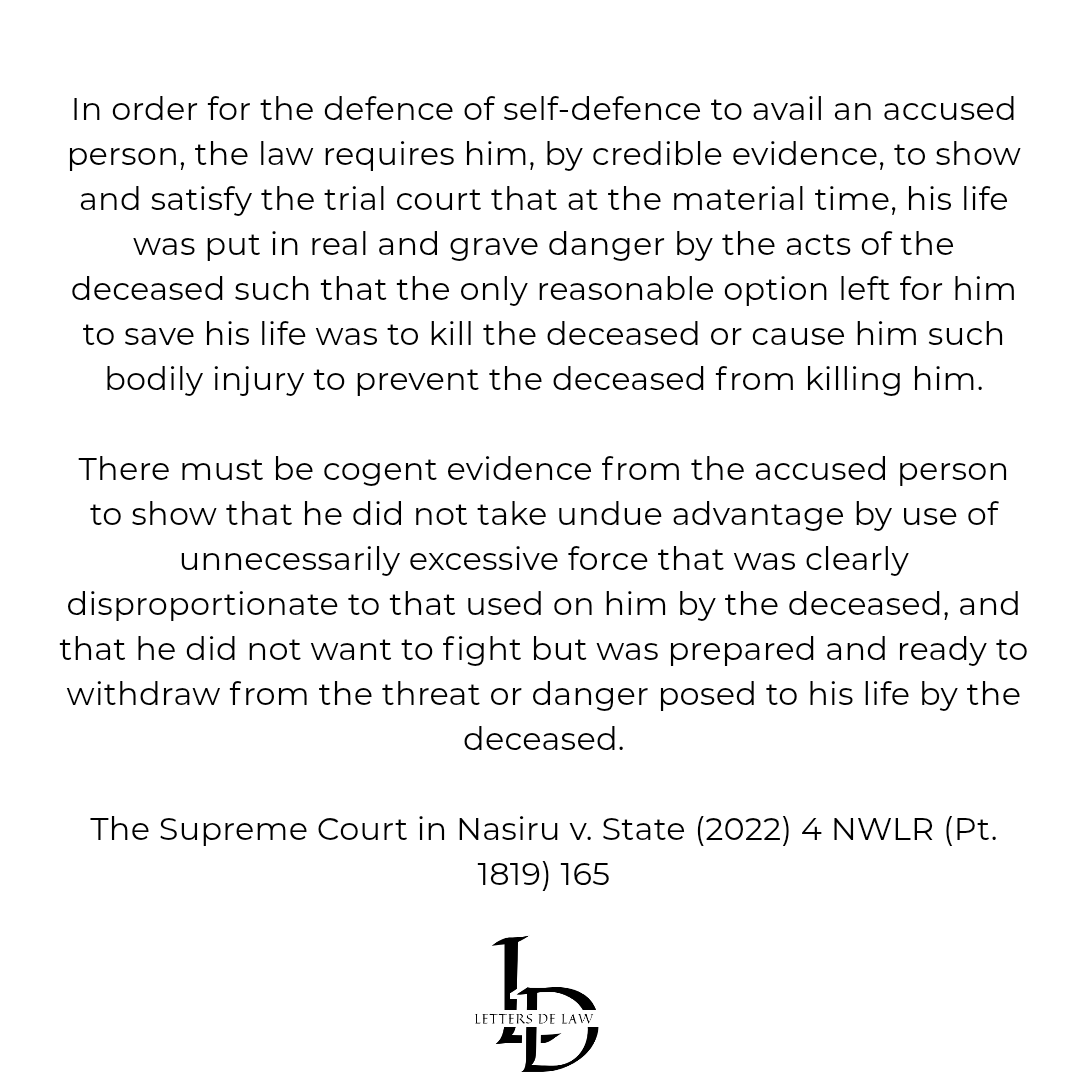
that was clearly disproportionate to that used on him by the deceased, and that he did not want to fight but was prepared and ready to withdraw from the threat or danger posed to his life by the deceased.
The Supreme Court in Nasiru v. State (2022) 4 NWLR (Pt. 1819) 165
In order for the defence of self-defence to avail an accused person, the law requires him, by credible evidence, to show and satisfy the trial court that at the material time, his life was put in real and grave danger by the acts of the deceased such that the only reasonable
option left for him to save his life was to kill the deceased or cause him such bodily injury to prevent the deceased from killing him.
There must be cogent evidence from the accused person to show that he did not take undue advantage by use of unnecessarily excessive force
Lawmakers sometimes prescribe certain periods of limitation for instituting certain actions. The laws that prescribe such periods and regulate the subsistence of causes of action are known as statutes of limitation.
Where an action is caught by the limitation law, a plaintiff who might otherwise have had a cause of action will loose the right to enforce such cause by judicial process due to the expiration of the time prescribed for the institution of such an action.