Ask AI for your quarter's total. It might say $9,840.
Your spreadsheet says $9,480.
Same digits, swapped. And it sounded completely sure.
AI is bad at adding up your numbers. It's great at noticing patterns in them.
So stop asking it for answers. Ask it for questions 👇
Here's the prompt:
"Here's a table of my sales for the last quarter, with customer names removed. Don't calculate totals, I'll do that in my spreadsheet. List 5 questions you'd investigate if you were seeing this for the first time. For each, tell me what pattern made you ask and what I should check. If you can't tell from the data, say 'unknown'."
What comes back is the useful part. For a salon, a café or an online shop, it might be:
• Do referral customers spend more per visit than ones from social media?
• Are add-ons concentrated on just a few services?
• Is one weekday much quieter than the rest?
Then you test each one yourself with a simple filter in your spreadsheet. A wrong question costs you nothing. A made-up answer can cost you a decision.
Think of it as a sharp analyst who's never seen your books. Quick at spotting patterns. Doesn't know why your Tuesdays are slow, and shouldn't be trusted with exact totals.
Whether any of this is worth your time depends on counting the checking too.
I made a tracker for this. It's free.
Reply "tracker" and I'll DM it.📩
You don't need a chatbot.
24 messages a week.
15 of them are the same simple questions.
A chatbot could answer those. It would save you about 30 minutes a week.
But you'd still read its chats to make sure it isn't making things up. 20 more minutes.
Net win: about 10 minutes a week, for a tool you pay for every month.
Here's the test I'd run first 👇
Think of a chatbot as a hotel doorman. Great at greeting people and answering the same questions. Terrible at settling a billing dispute. When it's out of its depth, it calls a person.
Before you pay for one, answer these 5:
1. Do you get 50+ repeat questions a week? If not, saved replies do the job for free.
2. Is your FAQ written down and checked? A bot with no FAQ makes things up.
3. Are the answers the same for every customer? If it depends on price, availability or who's asking, the bot will struggle.
4. Are the stakes low? If a wrong answer could hurt someone, a person answers.
5. Can a human take over easily? No handoff, no bot.
The mistake I see most: buying the tool before knowing how many messages you actually get. Count one month first.
Chatbots are the last chapter of my customer replies book, not the first. Make sure you already have a working system before investing.
Reply "SOP" and I'll DM you the full guide📩
Stop staring at a blank box, thinking what do I even post?
You posted every day for nine days.
Then nothing for three weeks.
It's 9:30 on a Sunday night, and your head is empty after a long day, so you skip it. Then it's been a month.
Here's the easy fix, give each day a job👇
Monday: show.
The work itself. A finished job, a new product, a dish, a before and after.
Wednesday: share.
One thing you know. A tip, a quick explanation, an answer to something customers keep asking.
Friday: meet.
A face or a story. You, your team, how it started, why you do this.
Last Friday of the month: make an offer, or ask for something. A review, a booking, a referral.
That's three posts a week. You never ask "what do I post?" again. You only ask what Monday's job looks like.
Where AI actually helps:
Paste in the last 10 things customers asked you. Ask for a month of posts built on those questions. They're your best "share" posts, because people are already asking.
Tell it to use only facts you've given it. If it needs one you haven't, it should ask you.
Want the most of it? Create and paste in a context and voice file. This is exactly what most owners skip.
Like this post and I'll DM you the full guide📩
"If I took two weeks off, nothing would work."
That's what every small business owner says.
You don't need a 40-page manual. You need a checklist.
Write your first one this afternoon:
1. Do the job out loud. Record it on your phone
2. Paste the transcript into AI
3. Tell it: "Use my words. Don't add steps I didn't mention."
4. Fix it
5. Hand it to someone who's never done the job
Avoid the mistake most owners make: skipping step 5. It's the exact step that proves the method works.
Every question they ask is a gap on the page.
I bundled the FULL method which turns the messy admin work into an AI-assisted SOP your business runs on daily.
Comment "SOP" and I'll send it over.📩
(must be following so I can DM)
Damn😂 Not everyone has the choice to just drop out whenever they feel like it lol. Not to mention some people actually WANT to go to college.
So.. it’s best for them to learn claude on the side and get the best of both worlds.
If you have enough money for college and you’re building your own side project then there’s no reason to drop out. If one fails, you have a backup. Plus you can build real connections which will get you further than magically teaching yourself.
What are you gonna do when claude gets something wrong? You need to fix it with your own knowledge. I spent a whole week trying to fix my vibe coded website but I couldn’t because I didn’t know sh*t about coding😅
Small business owners lose 11-16 hours a week to admin.
Most can't say where those hours go.
Here's the 7-day audit that fixes that:
1. Write down every admin task as you do it, with rough minutes
2. At week's end, tag each one:
• Repeat → template it
• Judgment → keep it
• Delete → stop doing it
Do the Delete pile first.
Why? An hour you stop spending needs no tool, no checking, and carries no risk.
Most owners find reports nobody reads, duplicate lists and approvals nobody needs.
Don't speed up a task that shouldn't exist.
I broke down the FULL system into a simple step-by-step guide.
Comment "ADMIN" and I'll DM it.📩
50% off for 24 hours.
(must be following so I can DM)
You’re losing customers you already won.
A lead messages at lunch.
You reply at 8pm.
They’ve already booked someone else.
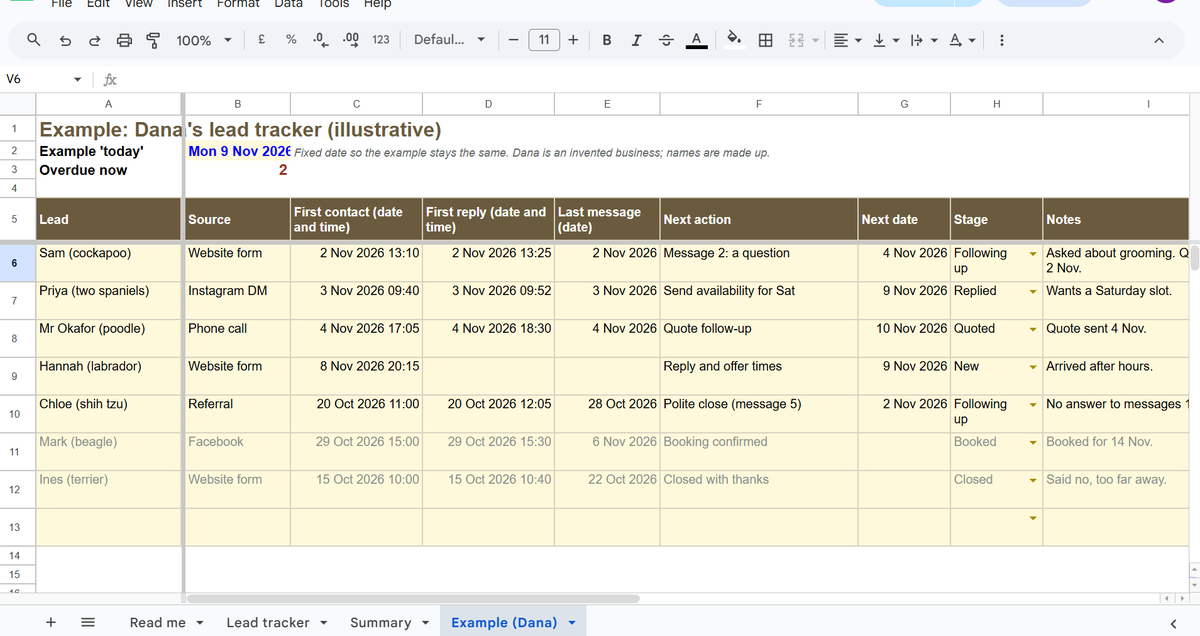
So I built a free Lead Tracker for busy owners:
->Tracks 100+ leads
->Shows every stage, from new to won
->Flags anything OVERDUE automatically
No enquiry forgotten. No CRM to learn.
Want it? Comment “LEADS” and I’ll DM it to you (free, no email bs).
Must be following so I can DM.
"If I took two weeks off, nothing would work."
That's what every small business owner says.
You don't need a 40-page manual. You need a checklist.
Write your first one this afternoon:
1. Do the job out loud. Record it on your phone
2. Paste the transcript into AI
3. Tell it: "Use my words. Don't add steps I didn't mention."
4. Fix it
5. Hand it to someone who's never done the job
Avoid the mistake most owners make: skipping step 5. It's the exact step that proves the method works.
Every question they ask is a gap on the page.
I bundled the FULL method which turns the messy admin work into an AI-assisted SOP your business runs on daily.
Comment "SOP" and I'll send it over.📩
(must be following so I can DM)
Small business owners lose 11-16 hours a week to admin.
Most can't say where those hours go.
Here's the 7-day audit that fixes that:
1. Write down every admin task as you do it, with rough minutes
2. At week's end, tag each one:
• Repeat → template it
• Judgment → keep it
• Delete → stop doing it
Do the Delete pile first.
Why? An hour you stop spending needs no tool, no checking, and carries no risk.
Most owners find reports nobody reads, duplicate lists and approvals nobody needs.
Don't speed up a task that shouldn't exist.
I broke down the FULL system into a simple step-by-step guide.
Comment "ADMIN" and I'll DM it.📩
50% off for 24 hours.
(must be following so I can DM)