The Levin Center champions bipartisan, fact-based oversight and is affiliated with @_WayneLaw, but our posts do not present the views of WSU or the Law School.
What will the 2026 midterm elections mean for congressional oversight? Join the @Levin_Center on Nov. 11 for a bipartisan discussion with former Reps. Fred Upton (R) and Dan Kildee (D), moderated by Director @JimTownsend.
Register:
https://t.co/UugQFs3QBK
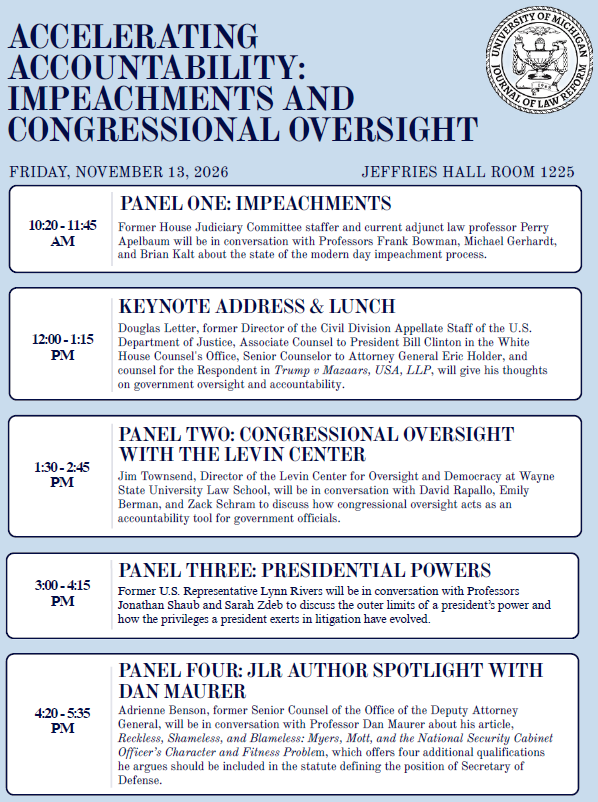
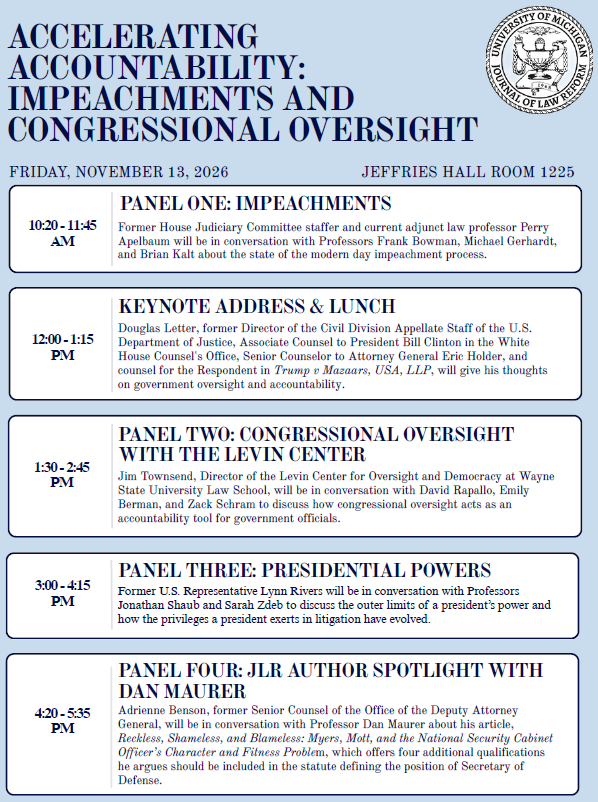
Join us in Ann Arbor on Friday, Nov. 13, for the @michlawreview panel: Accelerating Accountability: Impeachments and Congressional Oversight!
https://t.co/3oDmFeGXIc
Congressional oversight investigated contaminated drinking water at Camp Lejeune, examining government failures and health risks to veterans and families. In 2012, Congress passed legislation expanding health care benefits for those affected by the contamination. #veteransday
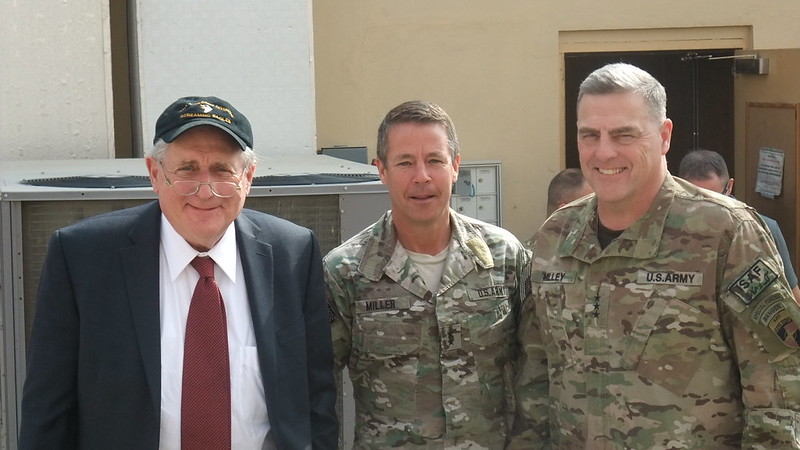
Happy Veterans Day! As Chair of the Senate Armed Services Committee, Senator Levin made many visits to Afghanistan, Pakistan, Iraq, Jordan, Yemen, and Turkey to visit the troops.
"The voters are saying 'We're dissatisfied, certainly with MAGA and with President Trump,'" @Levin_Center director @JimTownsend said. "Two years ago they were dissatisfied with the Democrats and Joe Biden and obviously Kamala Harris. It would be a mistake for Democrats and Republicans to think that this is a mandate for some sort of go-it-alone strategy where you just run through your agenda without any regard for what the other side has any interest in. That's been the pattern."
https://t.co/zoyYU8LZUz
What will the 2026 midterm elections mean for congressional oversight? Join the @Levin_Center on Nov. 11 (TOMORROW!) for a bipartisan discussion with former Reps. Fred Upton (R) and Dan Kildee (D), moderated by Director @JimTownsend.
Register: https://t.co/V92nGmploI
The @Levin_Center and coalition organizations offer four recommendations that we believe would help the House build on the recent bipartisan modernization efforts, and that could be adopted at the start of the new Congress
https://t.co/OLt1gyvrW2
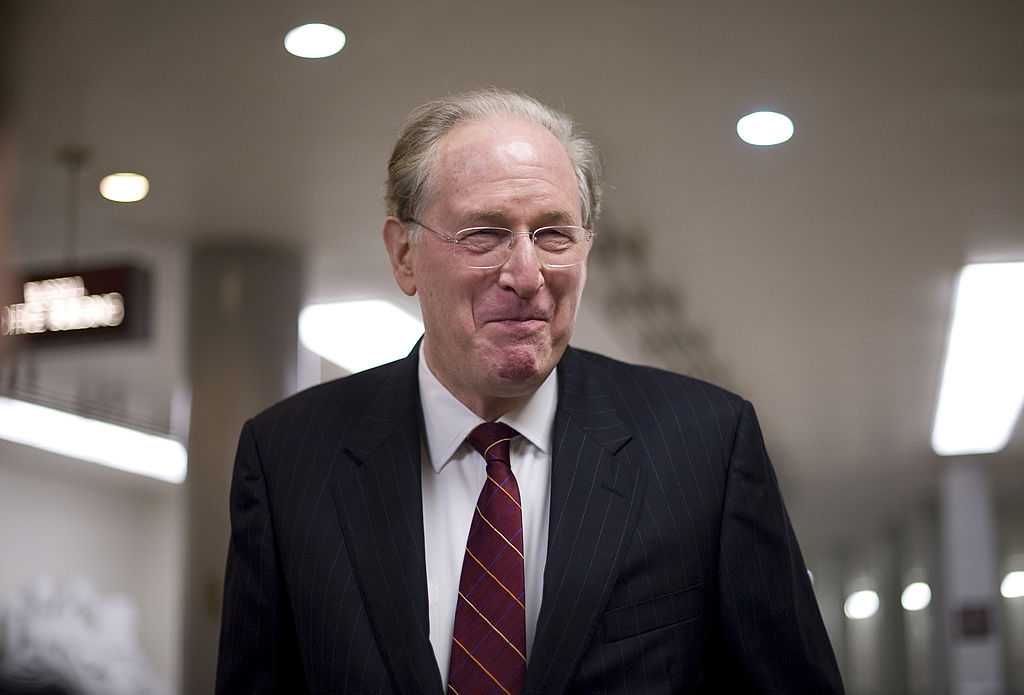
Senator Jay Rockefeller was both a colleague and a dear friend of Senator Levin and served on the Levin Center’s Advisory Board from its inception. Senators Rockefeller and Levin worked together on the Senate Intelligence Committee to expose the misinformation given to the American public leading up to the Iraq War. Despite his wealth and privilege, he was a public servant who sought to do his best for the people of West Virginia and the U.S. We send our deepest sympathy to his wife of almost 60 years, Wendy, and to his family.
Join us in Ann Arbor on Friday, Nov. 13, for the @michlawreview panel: Accelerating Accountability: Impeachments and Congressional Oversight!
https://t.co/3oDmFeGpSE
Listen to @Levin_Center Director @JimTownsend's analysis of what the 2026 midterm election means for congressional oversight on @WWJ950.
https://t.co/1ZLIsoKxjQ
Congress investigated the Jan. 6 Capitol attack. Oversight led to reforms that clarify the VP’s electoral role and strengthen Capitol security, though the House Select Committee’s findings remain contested.
Read more: https://t.co/233gpXFG59
What's next for Democrats and Republicans after the midterms? @FOX2News sat down with the @Levin_Center's @Benjamin_Eikey to discuss.
https://t.co/Oc8449vQw0
Why should Congressional Democrats investigate corporate America if their mandate is to deliver real economic change? Because investigations are a key catalyst for securing reform and legislation. For much of the last century, Congress used to be the main institutional player working to secure an economy that serves working people. A key tool was oversight. Lawmakers routinely investigated complex markets and major corporations, identifying problems and exposing wrongdoing. A major goal of these investigations was to learn what was driving certain problems and figure out how to fix them.
After Democrats took back the House during the first Trump administration in 2019, I joined the House Judiciary Committee as a staffer on the Antitrust Subcommittee. Under the terrific leadership of @RepJerryNadler and then-Rep @davidcicilline, we pursued an 18-month investigation into Amazon, Apple, Facebook, and Google, securing key evidence of how their business practices were undermining competition and harming people, setting the basis for both lawsuits and proposed legislation.
A few lessons from that experience:
1. The quality of legislative oversight depends on the staff and the support of top members to confront power. Committee and Subcommittee Chairs that are focused on getting answers and unafraid to take on powerful corporate interests will make the difference between oversight that doesn’t surrender to their evasion tactics and oversight that aims low or flames out.
Even a relatively small number of dogged, talented lawyers ready to dive in can make a big impact. In the 1930s a single congressional lawyer, Ferdinand Pecora, helped reshape our entire banking system by subpoenaing records and interrogating top financiers, including J.P Morgan. The investigation exposed self-dealing, market manipulation, and tax avoidance, and laid the groundwork for foundational New Deal legislation, including the Glass-Steagall Act and the Securities Exchange Act.
2. Eliminating bottlenecks to moving investigations forward is key. For example, the House should make sure that Subcommittee Chairs can issue subpoenas rather than needing the sign-off of the full Committee or its Chair. A credible threat of sending subpoenas is critical for credible oversight.
3. Ensuring that members can develop the muscle to effectively interrogate CEOs requires investing in real preparation. In the lead up to the hearing with Bezos, Pichai, Cook, and Zuckerberg, the Antitrust Subcommittee spent months reviewing millions of documents collected from the firms, interviewing affected parties, briefing members on key evidence, and conducting practice hearings. Members came into the hearing deeply informed and able to rebut and call out CEO dissembling. The result was some of the most effective member questioning of executives we’ve seen in decades. @TheProspect wrote up a great overview: https://t.co/7BYC3UHFbW
4. For decades, institutional capacity in Congress has been extremely weak. Much of this traces back to the Gingrich Revolution, which was effectively the 1995 DOGE-ing of Congress. Republican leadership fired over 600 professional staffers, eliminated the Office of Technology Assessment, and gutted research capacity. None of that capacity was ever meaningfully restored.
As a result, members have way fewer resources to develop serious expertise or go deep on a new topic. Members should start rebuilding that capacity so the institution can fully play its Article I role, where Congress can again do serious policy development and legislating and serve as a real check on the executive and judicial branches.
5. AI markets should be high on the list of investigations. The business decisions of the major AI firms have huge public ramifications, yet the public is at a severe informational disadvantage when it comes to how these markets work and the choices these firms are making. A congressional investigation will help ensure future legislative action is based on a more complete view of what is going on rather than selective and partial corporate disclosures.
Government agencies increasingly use AI to make decisions affecting people's lives. In @TheHillOpinion, @JimTownsend and Patrick Carter urge lawmakers to use their oversight powers to ensure government AI is transparent, approved, and stoppable.
https://t.co/mhbFg1OiH2
What will the 2026 midterm elections mean for congressional oversight? Join the @Levin_Center
on Nov. 11 for a bipartisan discussion with former Reps. Fred Upton (R) and Dan Kildee (D), moderated by Director @JimTownsend.
Register: https://t.co/V92nGmoNza
What will the 2026 midterm elections mean for congressional oversight? Join the @Levin_Center on Nov. 11 for a bipartisan discussion with former Reps. Fred Upton (R) and Dan Kildee (D), moderated by Director @JimTownsend.
Register: https://t.co/V92nGmploI
“The tone of this (press release) is judgmental and already kind of pre-decisional. And that’s where people lose confidence in oversight: when it’s done in this fashion where you’ve already decided the person is bad or wrong, and you’re going to go after them to prove it. That’s exactly the wrong kind of approach to good oversight," Linda Gustitus, director of the Washington Office at @Levin_Center, told @truthout.