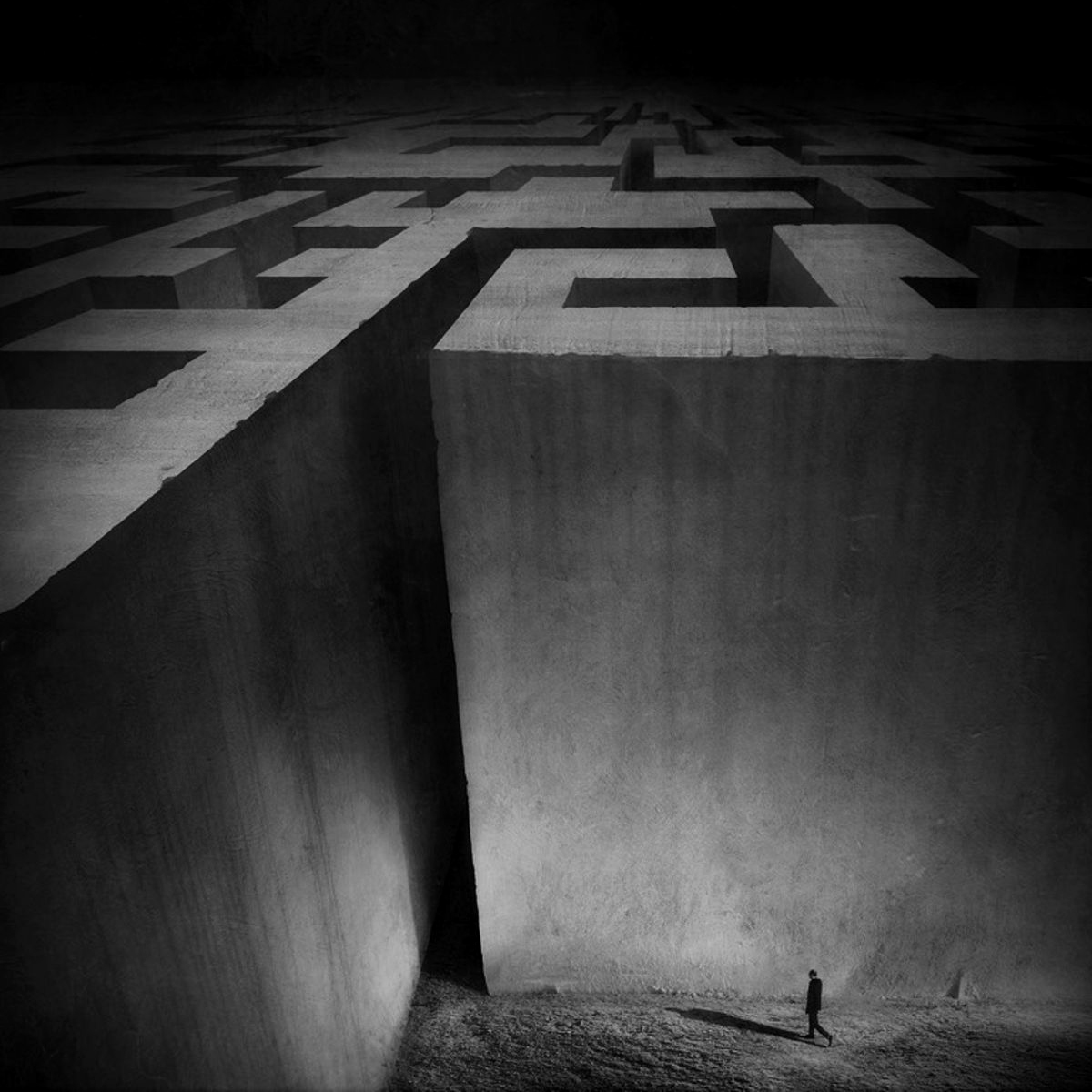
OPERATOR MANIFESTO
1. VISIBILITY IS NOT CLARITY
Light is staged visibility, not truth. Noise masks absence. The interface regulates exposure, not understanding. The Operator withdraws attention and works where signals collapse and validation disappears. Anonymity is not escape, but position.
2. SYSTEMS REPEAT, THEY DO NOT UNDERSTAND
Systems encode the past, algorithms replay it. They fail when conditions shift. Where rules end, judgment begins. Acting without full information is necessity, not courage. If the system rejects a decision, it reveals its own limit.
3. SOVEREIGNTY REQUIRES CONTAINMENT
The mind cannot stay open without dissolving into noise. Solitude is a controlled environment, not isolation. Filter signals, remove attachment, break inertia. Comfort creates replaceability. Independence is maintained through friction.
4. CONSEQUENCE DEFINES TRAJECTORY
Motivation fluctuates, discipline accumulates. Clarity does not precede action; action creates it. Every decision carries weight. Gravity does not negotiate — it records. Irreversibility is the condition of movement.
5. ALIGNMENT WITH REALITY PRODUCES DISTANCE
The sea does not respond to you. The sky does not adjust for you. Depth and scale exist without reference to your expectations. Detach from noise and validation. Become structure, not reaction. Hold position. Everything else is surface.
OPERATE IN THE DARK. KEEP THE FORM.
What Do Palantir, Apple, ACRONYM, Rick Owens, and A24 Have in Common?
Grok, Gemini (Google Search mode), and ChatGPT analyzed my 20-year background, @DeepDigitalCo's projects, and the @BLACK_FIELD_CO ecosystem. All three drew analogies with brands across industries — not in scale, but in how they build products, identities, and systems.
BRAND ANALOGIES
Palantir — complex information architecture and decision systems.
Apple — interconnected products governed by a coherent philosophy.
ACRONYM — engineering where constraints determine form.
Rick Owens — an independent visual language beyond mass-market trends.
Stripe — complex infrastructure made accessible.
A24 — independent cultural positioning and a distinct creative signature.
Taschen — publishing as a lasting intellectual and cultural object.
Porsche Design — functional precision across product categories.
Epic Games — technology platforms that expand creators' capabilities.
Balenciaga under Demna — turning street, industrial, and provocative codes into cultural influence.
My personal brand is that of an uncompromising “Operator in the Dark”: a methodologist, systems thinker, and creator of meaning who rejects mass-market formulas.
I'm Lexx Che (Alexey Cherednichenko), a multidisciplinary systems architect, executive advisor, author, and independent journalist. Over 20 years and 1,000+ projects, I've worked across technology, business, design, media, publishing, and physical production. That experience now informs BLACK FIELD, an ecosystem connecting media, knowledge, identity, verification, education, and distributed operations.
My career includes work with Wargaming, Snapchat, CARiD, SLI Systems, Carts Guru, DelivApp, Grantit, Simbrella, Zeep HK LTD, Just Casino, Moscow Metro, https://t.co/2HZKzMPicy, https://t.co/MIkU6ZnFA8, RUHUB, EarnForex, GOL, GR Capital, NKOR, Bit4You, Finbridge, Kredobank, Skybank, Cavio Casa, Ghostek, Light Balance, Bob Basset, world boxing champion Alex Gvozdyk, and People's Artist of Ukraine Artem Pivovarov.
Digital Co — Worldwide
An international network of projects and expertise spanning identity, digital products, technology, visual systems, and communications.
Selected projects: https://t.co/CbjNOBxCM3
It took brands from entirely different industries for three AI systems to describe one professional architecture.
Some master an industry. Others study how industries work in order to build systems of their own.
If you need an exceptional project or product — DM me.
—
#LexxChe #DeepDigitalCo #BLACKFIELD #SystemsArchitecture #BrandStrategy #CreativeDirection #DigitalTransformation #ExecutiveAdvisory
Marilyn Monroe: The Woman Who Became Sex Itself - Explore how #MarilynMonroe became an enduring #sexsymbol through #Hollywood glamour, iconic performances, sexual imagery, and artistic independence - https://t.co/2MgdR4G9Gf - @lexxcheoperator
“Black is not absence of color. It’s a very thick, very heavy, and very beautiful presence.”
— David Lynch
The Anti-Coaching methodology is not about motivation. It is about the ability to operate in the dark, with incomplete information, and still build decision-making architecture.
Charles Schwab: Building Around Uneven Capacity - https://t.co/p3pvEnFgHI - This paper examines how #CharlesSchwab, the founder of one of the largest brokerage firms in the United States, managed lifelong slow reading and a #dyslexia diagnosis that did not arrive until he was 47, drawing on his own letter to The Wall Street Journal, his interview with David Rubenstein, the opening of his memoir Invested, and material from the Yale Center for Dyslexia and Creativity. @lexxcheoperator
Pattern is a hypothesis. Architecture is a tool. Action is an experiment. Reality is the arbiter.
At some point, the structure no longer needs its architect.
Ten minutes before this photo, a missile flew overhead. Today, they’ve been flying all day.
Ukraine has been living through nearly five years of full-scale war. For much of the world, it has become background noise.
MAKING DECISIONS IN A WORLD THAT WON’T RETURN TO NORMAL
@intpolicydigest, edited by John Lyman, has published my article on Operating in the Dark — Responsibility Series.
Taleb examined Black Swans, randomness and antifragility. My starting point is different: uncertainty has already become the environment. Decisions still have to be made, responsibility assigned and consequences absorbed without complete information.
The books grew out of two decades of building and transforming businesses, teams and complex systems. Each volume moves the argument into a harder operating condition.
I examines the moment of decision: how to act without mistaking incomplete knowledge for permission to remain passive. II moves from the individual to the distribution of responsibility — who carries consequences when authority, influence and accountability no longer coincide. III introduces constraints: finite time, money, capacity and the cost of choices. IV examines persistent pressure and structural failure: why capable people keep losing inside architectures that reproduce the same breakdowns. V turns toward the operator — attention, judgment and the limits of personal control under cognitive overload. VI reaches the point where crisis is no longer an exception but the permanent operating condition.
The extended volumes reconnect these layers. Together, they form one architecture, not motivational slogans. Anti-Coaching carries that logic into cases where changing the person cannot repair the system.
“A broken structure can outlast several generations of capable managers because the organization keeps trying to repair the people inside it.”
I wrote during the war in Ukraine. Air attacks, blackouts and interrupted infrastructure were conditions of work, not a romantic source of insight. The underlying practice preceded the invasion; war exposed the price of bad decisions without room for illusion.
“Encouragement becomes counterproductive when it strengthens conviction without expanding the capacity to act.”
This is my ninth article indexed in EBSCO. Founded in 1944, EBSCO’s parent company supports research across libraries, universities, hospitals, corporations and government institutions. EBSCO Discovery Service is used by 16,000+ libraries; the company reports serving approximately 96% of US academic institutions. This is institutional research circulation, not social reach.
Read the article:
https://t.co/uk8zmlb84m
The world does not owe your strategy a return to normal. Responsibility begins where that expectation ends.
#OperatingInTheDark #Responsibility #DecisionMaking #SystemsThinking #AntiCoaching #Leadership #CrisisManagement #EBSCO #LexxChe
H. R. GIGER DID NOT DESIGN A MONSTER. HE BUILT A LANGUAGE.
I have already written twice about Alien and the articles growing out of this research.
Since the end of September, seven publications have appeared across media around the world in several editorial versions.
Yesterday, the most complete version was published by Bright Lights Film Journal:
Inside H. R. Giger’s Alien: The Biomechanical Horror That Changed Film, Art, and Design
Bright Lights is not simply another film site. Founded by Gary Morris as a print journal in 1974, it has spent more than half a century between serious film scholarship and independent criticism, covering auteur cinema, horror, experimental work, international film and visual culture.
This is the longest and most complete version of my Giger article. It also contains the largest number of 3D Alien visuals created by our team under my direction many years ago. What is striking is that their character, tension and visual charisma still hold up.
The article is not really about one creature.
It is about how Giger built a visual grammar from anatomy, machinery, sexuality, architecture and death.
“Giger supplied Alien with a coherent visual environment whose internal rules can be sensed long before they can be described.”
“Imitation reproduces surfaces. Influence survives when the underlying grammar keeps generating new forms.”
When Gary Morris read the longer version, he wrote to me:
“The longer version is very fine indeed, fresh, written with authority and much insight. We think readers will be as engaged as we were, and we’d be pleased to publish it.”
That matters to me.
Morris founded Bright Lights in 1974 and has spent more than five decades editing and writing about cinema. He lived through the same cultural period in which Giger moved from the margins of European art into a global visual language. To hear that assessment from someone with that historical range is especially valuable.
An earlier edition, H.R. Giger and the Visual Language of Fear, was also indexed in EBSCOhost — a major academic and analytical research platform used worldwide by universities, libraries and research institutions.
EBSCO surfaces the article under Artists, Artistic Style, Extraterrestrial Beings, Grotesque, Horror and Science Fiction.
A creature becomes iconic. A style becomes recognizable. A language becomes infrastructure.
Read the full article: https://t.co/aRTOCSNu5v
—
#HRGiger #Alien #VisualCulture #FilmDesign #ArtDirection #Biomechanics #ScienceFiction #Horror
#HelenKeller: How Knowledge Enters the System - https://t.co/kDqaM8WfaC - Language Access, Education and Independence - Helen Keller's path from childhood gestures to Radcliffe and socialist writing shows how access to language, books and teaching shaped her independent thought. @lexxcheoperator
E-COMMERCE WAS NEVER JUST A SHOPPING CART.
We have worked with e-commerce almost from the beginning. Five of our first ten commissioned websites were online stores. One was an electronics-parts platform with around 100,000 products, 1C integration and an interface that allowed users to select components directly on technical equipment diagrams. In 2009, that was not a standard feature. It was an engineering problem.
Since then, our teams have built dozens of commerce systems across furniture, fashion, automotive parts, gaming consoles, consumer electronics and other industries, including major digital-transformation work for Ghostek. Different markets required different architectures: catalogs, integrations, logistics, payments, content, conversion and complex product logic.
Before the war, we consistently ranked among the top companies in every major category relevant to our work — Creative, Corporate Websites, Portals and E-Commerce — competing against tens of thousands of developers across the CIS. Those ranking platforms were originally created in Russia, so after 2022 they ceased to be relevant to us. The work, however, remains.
One of those systems was TRENDON — one of Ukraine’s first dedicated marketplaces for Ukrainian fashion designers and independent brands. We were not simply contractors: we were co-owners of the broader business, including physical retail and the digital platform. TRENDON united dozens of brands and hundreds of products through marketplace infrastructure, editorial content, product discovery, storytelling and direct sales.
The project received Gold at Golden Site 2016 in E-Commerce, an Awwwards Honorable Mention, CSS Design Awards Special Kudos, CSS Winner Site of the Day and recognition from multiple other design platforms.
Then came the second major version.
Website Motive — a specialist e-commerce research and design-reference platform with almost 1,000 real online stores in its directory — later included TRENDON across Fashion, Apparel, Menswear, Womenswear, Urban and Accessories.
In “The Best Menswear Ecommerce Websites,” TRENDON appears in a curated selection alongside Fred Perry, Selfridges, Diesel, Harrods, Alexander McQueen and other global fashion and retail names.
That context matters.
A Ukrainian marketplace built around local designers was being evaluated inside the same international reference field as global commerce brands.
Good e-commerce is not a website with products. It is infrastructure connecting product logic, technology, operations, content, behavior and conversion into one system.
Case:https://t.co/tZqaiL2o1Y
If you need premium e-commerce, a complex marketplace, conversion optimization, advanced mechanics, third-party integrations or full-cycle development and support — DM Deep Digital.
#Ecommerce #Marketplace #DigitalTransformation #UXDesign #WebDevelopment #RetailTech #DeepDigital
LUXURY IS WHAT YOU SEE. ENGINEERING IS WHAT YOU DON’T.
CAVIO CASA was founded in 1954 in Bovolone, near Verona, and grew from a family artisan workshop into an international luxury furniture brand. When we approached its digital platform, the task was not to make another premium-looking furniture website. The outside had to feel expensive. The inside had to behave like infrastructure.
We designed the corporate layer as an immersive luxury experience: large-scale photography and renders, complex typography, dynamic backgrounds, seamless transitions and interactive elements. The visual language was deliberately rich and theatrical. The catalog was the opposite — light, restrained and functional, so the interface disappeared and the furniture remained the focus.
Underneath was the harder part. The platform operated as a web application with dynamic content loading without traditional page refreshes. We built a custom SEO-oriented backend around the client’s processes, XML-based product management, and a catalog where products could exist simultaneously across two independent navigation systems — Collections and Interior Zones. Three language versions operated on separate domains while sharing one database and administration system. All of this had to remain fast while processing large photography and high-resolution furniture renders.
After the project appeared online, we repeatedly encountered reduced versions of its ideas elsewhere — similar typographic compositions, transitions and visual structures. We saw fragments copied. We never encountered the same coherence of visual system, catalog logic and engineering underneath it.
We also developed a premium presentation/catalog system for CAVIO CASA, extending the same visual discipline beyond the website into another commercial format.
A luxury interface can be copied. A complete system is much harder to reproduce.
E-commerce platform: https://t.co/hRvxhijTT8
Premium catalog: https://t.co/vMSBRt1D8j
If you need complex e-commerce, a marketplace or another non-trivial digital system — or premium presentations, branding and full-cycle digital development — DM Deep Digital Co.
—
#Ecommerce #WebDesign #UXDesign #DigitalTransformation #LuxuryDesign #WebDevelopment #Branding #DeepDigital
Kim Peek: When Memory Is Not Intelligence - https://t.co/1NiF2wopJm - This report looks at the life of #KimPeek, the American memory #savant whose 1984 meeting with screenwriter #BarryMorrow helped shape the 1988 film #RainMan@lexxcheoperator
Marla Runyan: Elite Racing With Stargardt Vision Loss - Examines how #MarlaRunyan with #Stargardt disease at about age nine, competed at the highest levels of track and road racing while missing much of her sharp central vision - https://t.co/45lVsK4gHt @lexxcheoperator
The Wasp Factory: Identity Built Inside a Machine - Analysis of Iain Banks's #TheWaspFactory, exploring how paternal control of information shapes Frank's identity, body, rituals and the illusion of free choice - https://t.co/90q8eIb9ti @lexxcheoperator
WE WERE THERE AT THE BEGINNING OF THE AR FILTER ERA.
Today, real-time face filters are ordinary. In 2015, they were not.
Snapchat was already growing rapidly, but 2015 became a turning point. In September, it acquired Looksery — a company founded by a Ukrainian team with development in Odesa — and integrated its real-time face-tracking technology. It became the technological foundation for Snapchat Lenses.
The timing matters.
Snapchat grew from about 89M daily active users in June 2015 to 148M a year later — +66%. By the end of 2016, it had reached 158M. Lenses were not the only driver, but they became one of the products that defined Snapchat’s transformation into a camera-first platform.
Our team was there at the beginning.
Working through the Looksery team after the acquisition, we became one of the early teams developing real-time 3D face masks for Snapchat.
Ideas. Characters. 3D. CGI. Digital sculpting. Hard-surface modeling. Textures. Animation. Motion. Real-time assets.
A mask had to work as an idea, survive facial deformation and expression tracking, animate correctly — and perform in real time within the limits of 2015 mobile hardware.
Most of what we created remains under NDA.
But one piece escaped it.
Before the NDA was signed, we created an experimental steampunk mask. It later became part of a larger steampunk collection developed during the collaboration. That first test is the fragment we can finally show publicly.
There is another reason we were ready for this work.
By 2015, our team already had deep expertise in 3D, CGI, characters, animation and complex digital production — a stack still rare among digital studios. Much of this technology then lived closer to game development. We had worked with game studios, including Wargaming under NDA, and visited its headquarters in Belarus at the time.
We did not enter AR filters after they became an industry.
We worked on them while the category was being built.
CASE — Before The Filter Era — 3D AR Masks: https://t.co/rmDWeBzSZJ
Our capabilities have multiplied since then.
Need 3D/CGI characters, product visualization or design, interactive 3D/WebGL websites, complex motion, AR concepts, real-time assets, product/service presentations, launch visuals, educational videos or technical animation?
DM Deep Digital.
Above us now is probably only feature-film production.
For now. ;)
#DeepDigital #Snapchat #AugmentedReality #AR #CGI #3DDesign #MotionDesign #WebGL #DigitalDesign #CreativeTechnology
John Nash: When Reason Cannot Fully Trust Itself - This paper examines the life of mathematician #JohnNash Jr., separating the real history from the version shown in #ABeautifulMind, whose visual #hallucinations were a cinematic device rather than an account of what #Nash experienced. Drawing on his autobiographical essay for the #NobelPrize, it traces how his mental disturbances began in early 1959 while he was on the MIT faculty, when he was diagnosed with what was then called #paranoidschizophrenia. The central argument is that extraordinary intelligence offers no guarantee of reliable judgment, because the same mind that produced foundational work in game theory could also build coherent but untenable beliefs about the world - https://t.co/xQj21u7u0W
20 non-business books on power, people, and the systems that shape them.
1. Albert Camus — The Stranger
Alienation and the demand to display the “right” emotions. What happens when someone refuses the expected script.
2. Franz Kafka — The Trial
Authority without explanation. A system can determine your fate while denying you access to its logic.
3. George Orwell — 1984
Power over language, memory, and evidence. Control reaches deepest when it defines what counts as truth.
4. Friedrich Nietzsche — Beyond Good and Evil
A challenge to inherited values and the interests behind moral judgments—including our own.
5. Hermann Hesse — The Glass Bead Game
Intellectual mastery and its distance from ordinary life. When does preserving knowledge become retreat?
6. William Golding — Lord of the Flies
Fear, belonging, and violence. How groups make authority—and how quickly they can normalize cruelty.
7. Frank Herbert — Dune
Ecology, resources, religion, and political ambition. The dangerous appeal of a promised savior.
8. Chuck Palahniuk — Fight Club
Consumer identity and wounded masculinity. Rebellion can reproduce the obedience it claims to destroy.
9. Bret Easton Ellis — American Psycho
Status, consumption, and interchangeable identities. A world where polished appearances obscure brutality.
10. Viktor Frankl — Man’s Search for Meaning
The search for meaning under extreme suffering, and the possibilities of inner freedom within severe limits.
11. José Saramago — Blindness
The fragility of social order. Degradation, solidarity, and the uneven burden of caring for others.
12. Joseph Conrad — Heart of Darkness
Colonial violence and the language used to justify it. What “civilization” permits far from scrutiny.
13. Ray Bradbury — Fahrenheit 451
Censorship sustained by distraction and the appetite for easy answers. The effort required to preserve thought.
14. Mikhail Bulgakov — The Master and Margarita
Fear, cowardice, artistic freedom, and power. What people protect—and betray—under pressure.
15. Iain Banks — The Wasp Factory
Violence, ritual, and a fabricated personal history. An identity built around facts that may not be true.
16. Alexandre Dumas — Joseph Balsamo
Charisma, secrecy, and political intrigue. Influence built through belief, spectacle, and privileged knowledge.
17. Arkady and Boris Strugatsky — Hard to Be a God
Knowledge without a clear right to intervene. The moral cost of both action and restraint.
18. Ernest Hemingway — The Old Man and the Sea
Skill, pride, endurance, and loss. What remains of an achievement when its reward is taken away.
19. Victor Pelevin — Generation “P”
Advertising as a producer of desires and identities. Political reality assembled through commercial techniques.
20. Aldous Huxley — Brave New World
Stability maintained through conditioning, pleasure, and consumption. Freedom made unnecessary before it is forbidden.
#KnowledgeArchitecture #SystemsThinking #DecisionMaking #PowerDynamics #HumanBehavior #Identity #CriticalThinking
Pressure does not reveal character.
It reveals architecture. And sometimes forces you to build a new one.
We like to imagine that difficult conditions expose some hidden, authentic version of ourselves — a stable core of courage, discipline or resilience waiting to take control when circumstances become serious.
Reality is less romantic.
Self-knowledge matters, but it is only one layer of the system. When uncertainty becomes prolonged, information incomplete and consequences expensive, people rarely operate according to their ideals. They fall back on structures repeated until they became automatic: habits, decision protocols, cognitive frameworks, patterns of attention and thresholds for action.
Under pressure, philosophy competes with muscle memory.
A person can value discipline and have no mechanism for maintaining it when exhausted. A leader can believe in rational decisions while running an organization where critical information arrives too late. A company can call itself resilient while depending on a handful of people permanently operating beyond capacity.
Pressure exposes these contradictions because it removes the conditions that allowed them to remain invisible.
But exposure is only the first function of pressure.
If enough adaptive capacity remains, pressure can become a construction environment. Constraints eliminate familiar options. New protocols emerge because old ones stop working. Priorities are reordered. Dormant capabilities become necessary. Previously separate resources are combined because there is no longer enough time, money or capacity to keep them separate.
Pressure can reveal an architecture.
It can also make the old architecture impossible to preserve.
This is where resilience becomes more than endurance. It is not the ability to absorb unlimited stress while remaining unchanged. It is the capacity to preserve critical functions while changing the structures that can no longer carry them.
The same applies to people, teams and businesses. Sustained pressure will almost certainly change the system. The real question is whether enough capacity remains for the system to participate in its own transformation — or whether transformation will simply happen to it.
Crisis audits the past and selects the future.
First, it exposes what was already there: habits, dependencies, weaknesses, redundancies and decision architecture. Then it creates conditions in which some structures survive, some collapse and others have to be invented.
Pressure is neither proof of character nor a magical mechanism for growth. It is a stress test of what exists and a demand to adapt when what exists is no longer sufficient.
Pressure reveals the system you brought into the crisis. Adaptation determines the system you take out of it.
#AntiCoaching #SystemsThinking #DecisionMaking #Resilience #Leadership #OrganizationalDesign #HumanBehavior #DecisionArchitecture